The US fertility rate is decreasing: What it means for the nation's future
originally appeared on and was produced and distributed in partnership with 麻豆原创 Studio.
The US fertility rate is decreasing: What it means for the nation's future
Americans have been having , with fertility rates dropping by more than half鈥攁nd as a result, the country's population is quickly growing older.
In terms of reproductive rights, declining fertility rates are a sign of successful advocacy. From an economic perspective, however, a healthy birth rate is crucial to ensuring enough workers exist to keep the engines of the economy strong and provide care for older generations. Japan is struggling with this exact problem right now. In 2015, the United Nations estimated that , but Japan only had around two. By 2050, Japan's population is slated to drop by 15%, as elders pass on and newborns become less common.
partnered with 麻豆原创 to further explore the falling fertility rates in the U.S. with , and what it means for future demographics. While fertility rates are calculated based on a country's female population of childbearing age, Northwell Health and 麻豆原创 recognize that some people in that group may not identify as women.
Some countries, like Singapore, have tried to boost declining birth rates with "" like cash gifts to parents with multiple children, extending parental leave, and giving couples with children priority in public housing assignments. But despite , which also included grants to companies that give workers more schedule flexibility to accommodate family needs, Singapore's fertility rate continued to fall, from 1.41 to 1.16.
Poh Lin Tan, a public policy scholar at the National University of Singapore, concluded in a report for the International Monetary Fund that Singapore's attempts to redirect fertility trends aren't due to poor policies, but rather are a testimony to "the overwhelming success of an economic and social system that heavily rewards achievement and penalizes lack of ambition."
It's a similar story in South Korea, where the pressure to ensure children have all they need to succeed鈥攍ike expensive tutoring鈥攄iscourages people from having large families, according to Richard Jackson, president of the Aging Institute, who was .
In the U.S., time will tell if the Biden administration's will boost fertility鈥攂ut an , a senior fellow at the Public Policy Institute of California, indicates some may have helped. However, he says the net effect is generally not enough to bring the population back from the brink of decline.
Pinpointing the factors that have led to sustained fertility rate declines in the U.S. is puzzlingly complex. In the , scholars at the University of Maryland and Wellesley College find no relationship between the drop in childbearing and various other factors, such as religion or the financial stresses of student debt and rent prices.
Until the 1990s, women with higher educational levels had fewer children than those with less education. However, found that in the U.S., higher-educated women have higher fertility rates than women with an undergraduate degree or below. That's possibly due to greater financial stability and more opportunities to support raising children while having a career.
that lower fertility rates are related to higher rates of obesity and increasing urbanization, which leads to higher housing costs. Contraceptive use has undoubtedly affected rates, especially through the 鈥攁nd teen pregnancy has dropped . However, recent state-level abortion bans have made it more tricky to track the effects of policies on fertility.
Immigration, which is responsible for , is one solution to increasing the U.S. population. But fewer young immigrant women are arriving in the U.S., according to a with Kenneth Johnson, senior demographer at the University of New Hampshire. In fact, than arrived.
President Joe Biden's pledge to legalize undocumented, foreign-born residents announced in the first few months of his administration could help immigrants feel more comfortable settling in the U.S., but his proposal doesn't have enough congressional support to pass. Immigrants' boost to U.S. fertility rates may be short-lived, according to one scholar's analysis: sharply as its members find strong educational and work opportunities.
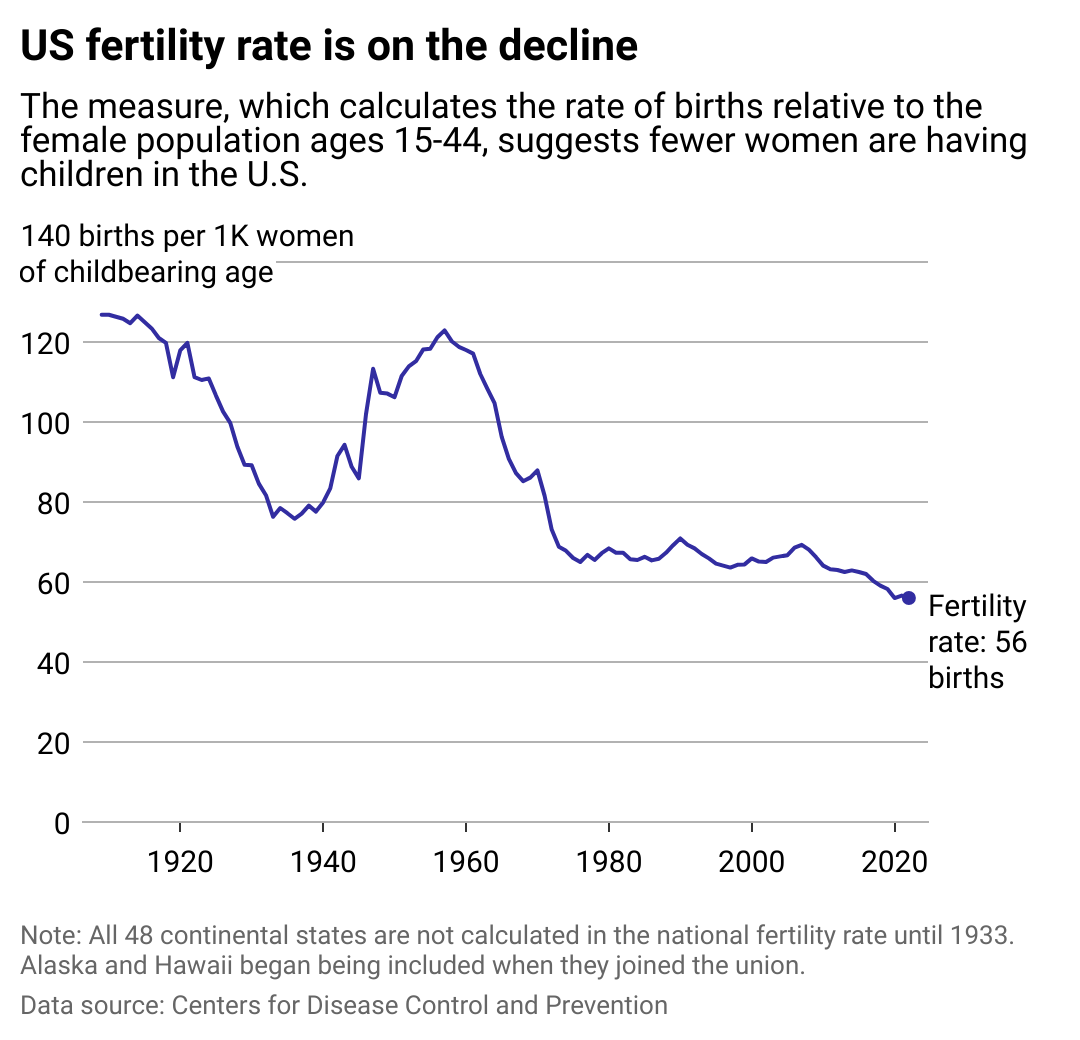
After a few decades of stability, the US fertility rate is falling
Nationwide, between 2007 and 2022, fertility rates dropped by about 19%, .
The health of the economy鈥攁s well as major social, health, and historical events鈥攁ffect family sizes. In times when the economy is poor or unsteady, birth rates tend to decline. That's what happened before the U.S. entered World War II. The war was followed by the during which 42 million births occurred from 1955 to 1964 alone. That boom collapsed in part due to .
The declining fertility rate became more concerning following the Great Recession between 2007 and 2009, when fertility rates dropped below 2.1 children per woman. That is the so-called "replacement rate" needed to maintain population numbers from one generation to the next.
The share of Americans over 65 than in any decade in more than a century. The youngest boomers are now 59. As more of them retire and therefore no longer pay into Social Security, funds for supporting retired elders are at risk. But there's time to act. The 2022 annual report from Social Security's board of trustees found that at current rates of contribution and withdrawal, the program can .
But elders' needs are more than financial. To provide enough elder care will require more workers鈥攚hich will likely include encouraging immigration. Additionally, Axios reports that may be utilized to care for aging boomers.
The rate is falling faster in some states
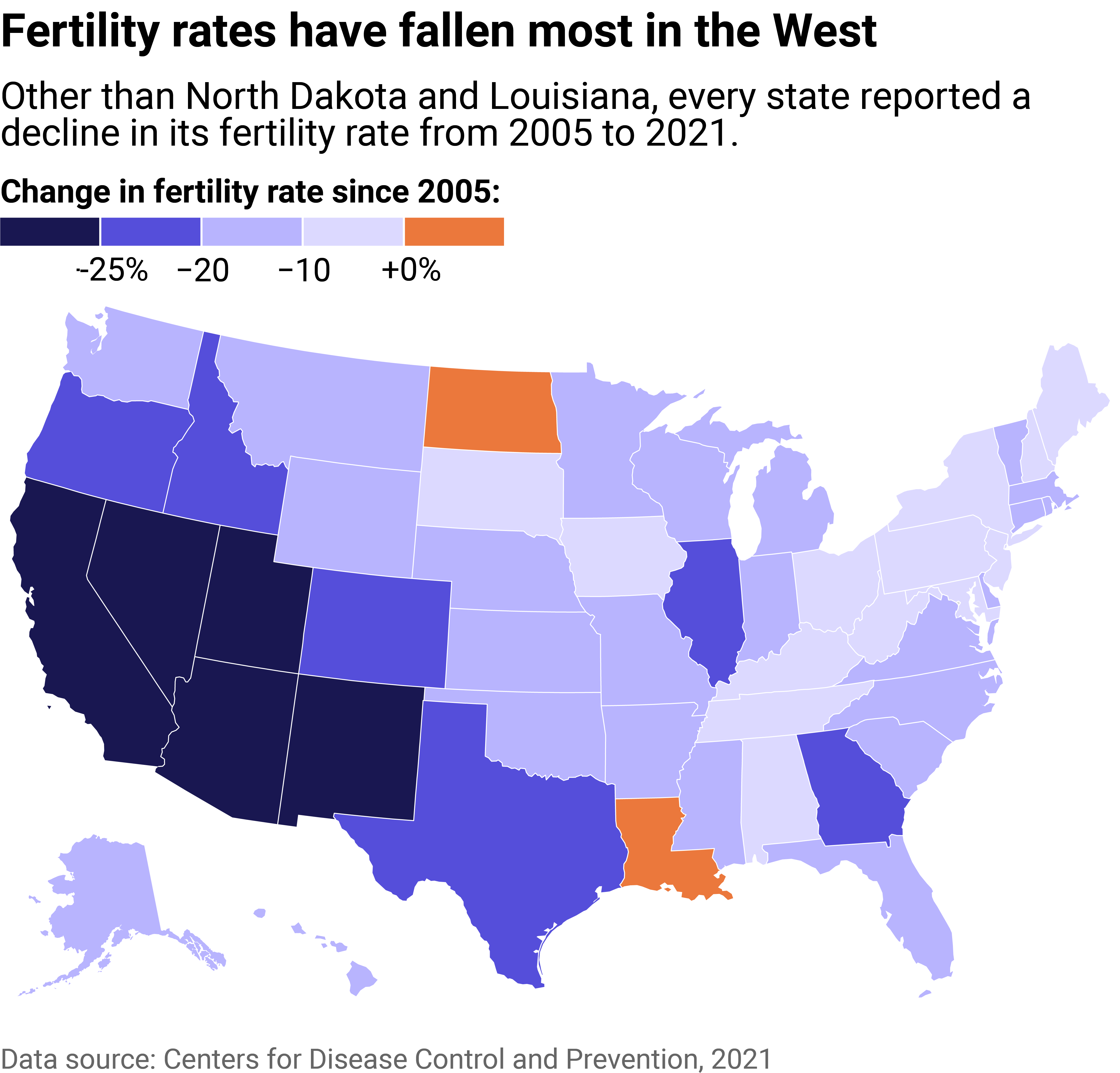
Fertility rates aren't uniform across the U.S. Between 2005 and 2021, only two states had increased fertility rates. Both of those states鈥擫ouisiana and North Dakota鈥攈ave some of the . Still, Louisiana reported only a 1.1% increase, and North Dakota saw a rise of 2.9%. Some experts believe that North Dakota's rising rate can also be explained by the financial boost created by the from 2007 to 2009.
On the other end of the spectrum, from 2008 to 2020, California's fertility rate dropped significantly, from .
Also seeing substantial fertility rate declines were politically liberal areas, following the first wave of the COVID-19 pandemic, according to a study in the journal . With education, economics, politics, and other factors all intertwined, determining what goals to set for the nation's fertility rates鈥攎uch less how to achieve them鈥攃ontinues to be a complex puzzle.
Story editing by Jeff Inglis. Copy editing by Tim Bruns.