We know primary care is crucial, so why is it declining?
Doctors and healthcare experts agree (and research shows) that access to plays a key role in keeping people healthy. But over the past decade, spending on primary care has declined in the U.S., and so has the number of primary care providers, reports.
That trend is likely to continue even faster due to major spending cuts included in the 鈥淏ig Beautiful Bill鈥� passed in July, according tofrom the Milbank Memorial Fund and the National Academy for State Health Policy.
The cuts federal Medicaid spending as well as state funding options. The resulting financial pressures will likely create barriers to care for patients and squeeze providers and healthcare facilities even further. That means some will go out of business, and others will no longer be able to afford treating Medicaid patients.
A have led to declining primary care access over the past decade:
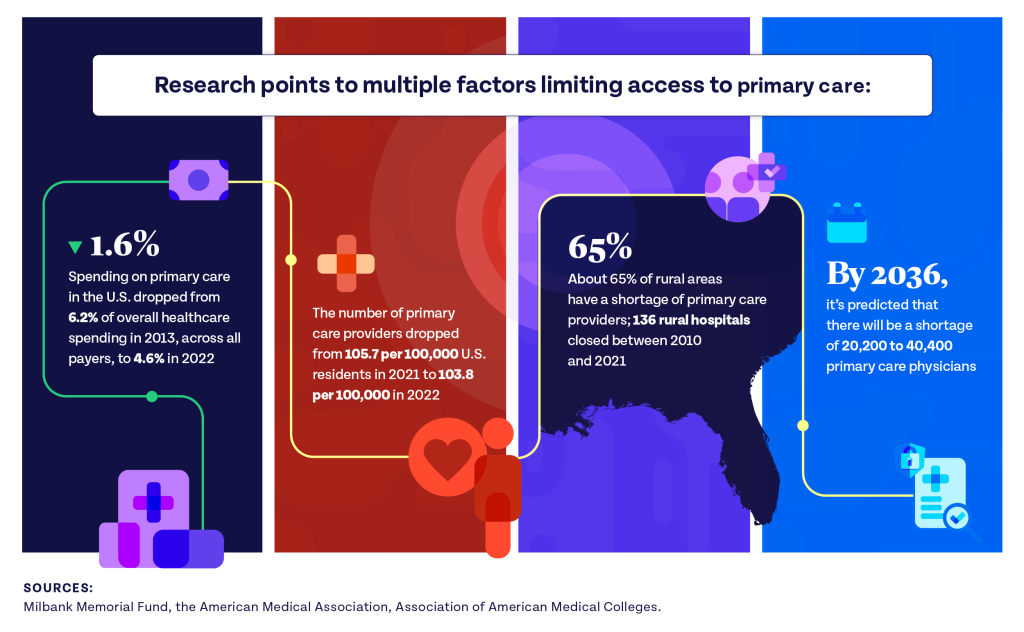
- Funding: Spending on primary care in the U.S. has been gradually falling for years鈥攆rom 6.2% of overall healthcare spending in 2013, across all payers, to 4.6% in 2022. The American Medical Association has calculated that Medicare physician payments have since 2001 when adjusted for inflation. That鈥檚 despite the fact that primary care can generate long-term savings; in Oregon, saved $13 for other services such as specialty care and emergency department visits.
- Current workforce: The number of primary care providers鈥攚hich includes doctors, physician associates, and nurse practitioners鈥攄ropped from 105.7 per 100,000 people in 2021 to 103.8 per 100,000 in 2022. That same year, couldn鈥檛 find an available appointment when needed, so they didn鈥檛 see any medical provider at all.
- Future workforce: Many medical students are opting for higher-paying specialties over primary care. While the number of primary care residents remained at 17 per capita between 2020 and 2022, the rate of all specialties increased from 29 to 30 per capita. The American Academy of Pediatrics reported that were filled in 2024, compared to 97.1% in 2023.
- Time-consuming documentation processes: More than 25% of family physicians said they were 鈥渧ery dissatisfied鈥� or 鈥渟omewhat dissatisfied鈥� with their Electronic Health Record (EHR) systems, which can eat up valuable time and prevent them from seeing additional patients.
These factors are making primary care less attractive for many current and future care providers, and the Association of American Medical Colleges (AAMC) points out that as the U.S. population grows and ages, in the next decade. The AAMC predicts that there will be a shortage of 20,200 to 40,400 primary care physicians by 2036.
Rural Communities and Primary Care
Areas historically underserved by the healthcare industry, including rural areas, are particularly vulnerable to shortages. The American Medical Association reports that about and 136 rural hospitals closed between 2010 and 2021.
These trends have real consequences: 鈥淩ural residents have higher rates of cigarette smoking, high blood pressure, and obesity. They also have higher rates of poverty, less access to healthcare, and are less likely to have health insurance,鈥� according to the Early death from the five leading causes of death鈥攈eart disease, cancer, injury, chronic lower respiratory disease, and stroke鈥攊s more common in rural than urban areas.
鈥峊ransportation in Focus
What are the ? PCPs can help detect and treat medical conditions and diseases earlier, they can help patients manage chronic diseases effectively, and they provide preventative services such as vaccinations and medical screenings.
There can be multiple barriers to receiving primary care, including insurance coverage, language, childcare, work obligations, and transportation: According to a study in the American Journal of Public Health, delayed medical care in 2017 because of transportation challenges. When there are fewer primary care providers, often spread further apart, transportation becomes even more crucial to ensure people can get to their appointments鈥攁nd ideally develop a relationship with their care provider.
The good news is that Medicaid and many Medicare Advantage health plans do offer transportation benefits for members who don鈥檛 have reliable transportation. Those benefits help millions of people more easily access primary care via non-emergency medical transportation in both rural and urban areas.
was produced by and reviewed and distributed by 麻豆原创.