Why doctors are rethinking HRT for breast cancer survivors
For decades, breast cancer survivors going through menopause have been told that hormone therapy is off-limits—full stop. But new analyses and a 2025 expert consensus paper suggest that there may be safe options.
“The data continually points to hormones being safe after breast cancer,” says Jenn Simmons, M.D., an integrative oncologist and breast surgeon in Philadelphia. “And the thing that we are repeatedly missing is why the opposite message was ever put out there, why it has remained out there, and why it is so pervasive.”
shares what recent science is revealing, and what the who get breast cancer each year should know.
Challenging the Current Wisdom
Current , set by professional organizations such as the National Comprehensive Cancer Network (NCCN) and the American Society of Clinical Oncology (ASCO), in hormone-positive breast cancer (70% to 80% of cases) out of concern that estrogen can cause breast cancers to develop, grow, or recur.
This stance came on the heels of initial findings from the Women’s Health Initiative (WHI), , which prompted headlines claiming estrogen increases risk of breast cancer, heart disease, and stroke.
The breast cancer risk the WHI reported was blown out of proportion. Women taking combined estrogen-progestin therapy had a “26 percent higher relative risk” of breast cancer compared to placebo. In real terms, that meant cases rose from about 3 per 1,000 women per year to 4 per 1,000—just one additional case. That single statistic shaped the breast cancer treatment protocol still in use today.
As a result, the availability of declined for women in general, but particularly for women with breast cancer.
Many of the initial Cardiovascular risk at start of therapy; vs. placebo; was specific to combination therapy (estrogen plus progestin). And the benefits of estrogen alone received little attention: Women taking it saw a incidence and mortality.
Oncologist Avrum Bluming, M.D., a former senior investigator for the National Cancer Institute and author of “Estrogen Matters,” has spent the better part of his long career trying to set the record straight on estrogen. He had a wake-up call after watching his wife suffer severe after breast cancer treatment at age 48.
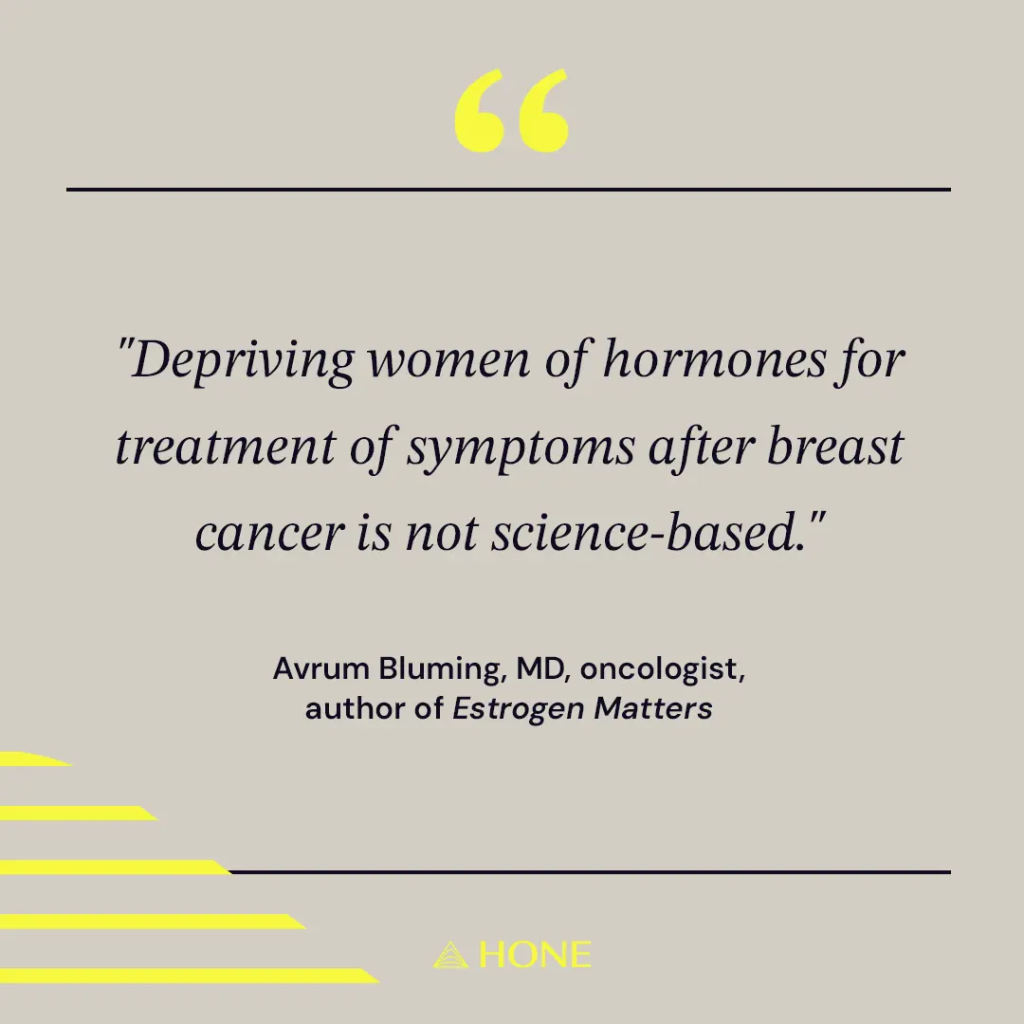
“Depriving women of hormones for treatment of symptoms after breast cancer is not science-based,” he says. He notes that most data on HT in survivors are observational, retrospective, and subject to selection bias.
In Bluming’s on breast cancer survivors on , he found only one that showed an increased risk of recurrence, and it was local (meaning at or near the original cancer site), not distant (meaning it had not metastasized to other parts of the body like the liver, lungs, or bone, which is more deadly).
The one study showing increased risk, , didn’t require baseline mammograms, so researchers couldn’t rule out that there was disease before the trial started. “If 25 studies say one thing, and one study that is designed in a faulty way says another, you have to challenge what is being accepted as common wisdom now,” Bluming says.
Estrogen , when Ann H. Partridge, M.D., of the Dana-Farber Cancer Institute, followed 516 women under age 42 taking anti-estrogen therapy after breast cancer. Because they were young, Partridge offered the option to pause their medication so they could get pregnant. “Talk about bathing in estrogen—it goes up by a factor of 10 during pregnancy,” Bluming notes. Sixty-four percent of the women delivered babies, some by IVF, which spikes even higher than HT. After seven years, recurrence rates were no greater than in the women who stayed on their medication.
Progestin: The Real Risk Factor?
Fast forward to 2025, when Jaeyeon Kim, Ph.D., a cancer biology professor at the Melvin & Bren Simon Comprehensive Cancer Center at Indiana University School of Medicine, from studies of MHT, , IVF, post-breast cancer hormone therapy, and more. His conclusion: Breast cancer signals come from progesterone, not estrogen.
"Progesterone is the more important factor for development, progression, growth, and even recurrence of breast cancer,” Kim says. “Estrogen not only doesn’t increase breast cancer risk, but it seems to decrease breast cancer risk—as long as progesterone or any progestin is not involved.”
This idea isn’t new (the small risk increase in the WHI was seen in the arm). But Kim’s study, which he wrote with oncologist Pamela Munster, M.D., and published in the Annals of Oncology in February 2025, could shift treatment protocols.
“We’re suggesting a new paradigm,” Kim says. “It may take years, if not decades, before any clinical or scientific consensus other than the current ‘contraindication’ emerges on this issue, but collective evidence cautiously suggests that estrogen therapy, combined with , might be a safe option for breast cancer survivors if it is deemed safe and needed by a patient and approved by their doctor.”
If progesterone is the cancer driver, why use any? Because endometrial protection matters. In women who still have a uterus, unopposed estrogen .
At first glance, Kim's findings might seem to undercut the idea that hormone therapy could ever be safe for survivors—if progesterone fuels cancer growth, isn’t HT still dangerous? But in fact, his work suggests a more nuanced picture: Estrogen on its own appears not only safe but potentially protective; the danger lies in progesterone and the way estrogen can amplify its signals.
Think of it like loving your best friend but not her husband—and he always shows up, too. For survivors, that means estrogen may need backup: Women without a uterus may be able to use it alone, but those with one intact may need strategies to keep progesterone in check, like the lowest possible dose of micronized progesterone (not ) or a localized progesterone-only IUD, according to Kim.
Another possibility could be pairing estrogen with a receptor-blocker such as Tamoxifen. Studies like the suggest this doesn’t raise (and may even lower) recurrence risk.
However, until there are clinical trials to translate this information into practice safely, Munster urges breast cancer survivors to continue their endocrine therapy (Tamoxifen or an aromatase inhibitor) for five to 10 years as advised by their oncologist.
Menopause Hormone Therapy for Breast Cancer Survivors
While nonhormone treatments, including things like and acupuncture, are the first line of therapy for breast cancer survivors with menopause symptoms, practitioners and even some professional societies are beginning to acknowledge a role for hormone therapy in this population.
Both the and the state that when a survivor’s symptoms remain severe despite nonhormonal measures, “hormone therapy might be considered” after specialist advice on the risks and benefits.
In September 2025, an interdisciplinary panel—including researchers from University College London—published the first comprehensive on this topic in the journal Menopause. Instead of a blanket “off-limits,” the statement reframes menopausal hormone therapy as an individualized decision made between a woman and her doctor, weighing meaningful symptom relief against her estimated risk of recurrence.
The new guidelines validate the thinking of oncologists who are already prescribing HT to survivors. A 2024 poll of 77 oncologists in the revealed that 15% of their breast cancer survivor patients were taking hormone therapy.
Holly J. Pederson, M.D., former director of Medical Breast Services at the Cleveland Clinic’s Breast Center, wrote a guidance piece in the September 2025 issue of the seeking to fill the evidence gap. She writes, “In the short term, there will not be definitive data, and decisions must be made based on the existing imperfect evidence.” She goes on to offer prescribing guidance based on breast cancer types, receptor status, the presence or absence of genetic mutations, and other factors.
Meet the Doctors Prescribing MHT
Simmons is one of the practitioners successfully treating breast cancer survivors with MHT. She starts with an analysis to root out any dysfunction, like a chronic infection, that may have contributed to the cancer, and then she helps patients tailor their , , and based on their unique physiology.
The hormone therapy she uses is bi-est, an 80/20 estriol-estradiol cream, sometimes prescribed with , , and DHEA.
“I have women with widely metastatic disease who are alive and well for five and six years who had been told to get their affairs in order,” Simmons says. “They have no evidence of disease, and they feel great.” One patient’s medical oncologist told her, “You know, I can't explain it, but just keep doing what you're doing.”
Rebecca L. Glaser, M.D., a retired breast cancer surgeon turned hormone researcher and founder of Millennium Wellness Center, has prescribed testosterone to more than 1,500 breast cancer survivors. Several have shown that when along with the aromatase inhibitor anastrozole, testosterone helps relieve symptoms associated with without raising recurrence risk.
In fact, it may reduce recurrence risk. A 2025 study published in the journal Advances in Preventive Medicine and Health Care shows that women receiving testosterone or testosterone/anastrozole combination implant therapy had a of invasive breast cancer. (Note: Testosterone is currently contraindicated after breast cancer because it can be aromatized to estrogen, so be sure to discuss this with your doctor.)
The Hidden Toll of Denying MHT to Breast Cancer Survivors
Fear of breast cancer recurrence is so pervasive that it has eclipsed other health issues that often accompany treatment and menopause. But it’s a dangerous trade-off.
“Most women who have breast cancer don’t die from breast cancer. They’re more likely to die from cardiovascular disease or stroke,” Pederson says.
A in the Journal of Clinical Oncology shows that common therapies for breast cancer may elevate risks for , , cardiac arrest, venous thromboembolic disease (blood clots in the deep veins), cardiovascular-disease-related death, and death from any cause compared to women without a history of breast cancer.
“Women get treated for breast cancer and die of ,” Simmons says. “The death gets attributed to heart disease, but it was really from breast cancer treatment.”
Bone loss from anti-estrogen therapies is a major risk factor for osteoporosis and fractures. Older women taking aromatase inhibitors are over to have a hip fracture within three years of starting the medication. And hip fractures are bad news. A found that 1 in 3 adults over 50 dies within a year of fracturing a hip.
Quality of Life for Breast Cancer Survivors
While not as dire as a heart attack or hip fracture, menopause symptoms can seriously compromise for breast cancer survivors.
A from the Stanford Institute for Economic Policy Research shows that women who see a provider for menopause-related symptoms earn 10% less four years later—because they either cut back their work hours or quit altogether. Menopause symptoms cost an estimated in lost , per a Mayo Clinic survey.
What’s worse, menopause symptoms such as , , and that are exacerbated by breast cancer treatments can persist even after cancer therapy ends, according to Pederson.
“Menopause symptoms are devastating, and they affect 80 percent of women,” Bluming says, adding that women thrown into tend to have more severe symptoms. “They last a median of 7.4 years, and longer in women of color. That's very, very serious.”
And by the way,” he adds, “ dramatically decreases those results in over 80 percent of treated women, and nothing else comes close.”
Seeking MHT After Breast Cancer
The decision to seek any kind of after breast cancer is highly nuanced. It’s a personal risk/benefit analysis between a woman and her medical team that must consider the type and stage of the cancer, the treatments used, the response to treatment, and the underlying risk for recurrence or a new cancer, according to Pederson.
“You need to look at the risks of doing something and also look at the risks of not doing something,” she told Thacker on her podcast.
To that point, Bluming recommends asking medical oncologists two questions before starting any treatment. “What is my risk of recurrence if I don't follow your advice?” And “What is my risk of recurrence if I do follow your advice?”
For many survivors, the risk is lower than you might think.
“Women who do not have a genetic mutation who’ve survived breast cancer have about a 0.4 percent per year chance of having another breast cancer develop,” Pederson says. “So it’s very, very low. Most people don’t realize that.”
While there’s still a lot we don’t know about menopause hormone therapy after breast cancer, saying “We don't know” isn't the same as saying “It's bad.” “What we're saying is thus far, it looks very good,” Bluming says. “Let's keep following and learning, but let's make decisions based on the information we have today.”
was produced by and reviewed and distributed by Â鶹ԭ´´.