America's neighbor to the north: 25 facts about Canadian history and culture
America's neighbor to the north: 25 facts about Canadian history and culture
O, Canada! Yes, the United States is by far the most populous country in North America, but its northern neighbor Canada (with which they share the world's largest non-military border) is physically much larger. Canada has it all, boasting gorgeous forests and mountains in British Columbia and beautifully booming cities like Québec City and Vancouver; in fact, Canada's vast geographic territory inspired the country's official motto of "From Sea to Sea."
That said, there is so much more to Canada than its sprawling Atlantic-to-Pacific landscape; the country has a rich history and culture than many people don't know about. While the as you'd think, . Since Canada was settled, many historically significant happenings—from the Canadian fur trade to the building of its cross-country railroad—have shaped the unique nation into what it is today: one that is economically thriving and culturally unique.
Sure, Canada today is recognized for its maple syrup, hockey games, excessively polite citizens, and extremely cold temperatures. But Canada also offers cultural festivals attended by millions annually, massive national parks, and numerous World Heritage sites. Additionally, tons of notable people with various talents hail from Canada—from famous rock 'n' roll stars like Neil Young, to renowned authors like Margaret Atwood, and even the inventor of insulin. Santa Claus and Sasquatch also call Canada home. (though most residents haven't had run-ins with either of them).
In the spirit of paying homage to the U.S. neighbor to the north, Â鶹ԭ´´ has rounded up a list of 25 interesting facts about Canada. We've gathered our information from various reputable sources and publications. Let's take a look, eh?
How Canada got its name
The name Canada came about from a happy misunderstanding dating back to 1535. Two , helping to route him to “kanata”—they were actually trying to lead him to a small village called Stadacona (modern-day Québec City). Today, it’s believed that the naming of the nation Canada is probably derived from this Huron-Iroquois word meaning “village” or “settlement.”
Canadian fur trade
From the early 17th century until the mid-19th century, animal fur trading was a huge commercial enterprise across the land that is now Canada (it mainly involved trapping beavers for their fur and creating the felt hats coveted by Europeans). This competitive trade played a major role in Canada’s development—it opened the continent to settlement, established relationships between Europeans and indigenous people, and helped pay for missionary work.
A country united by a railway
The coast-to-coast , incorporated in 1881, eased travel throughout the country for tourism, immigration, war preparation, and natural resource exploration. For decades after it was established, the Canadian Pacific Railway represented the chief mode of intercontinental transport in Canada.
The U.S. has invaded Canada multiple times
The United States during the American Revolution (1775) tried its hand at taking over Canada, creating a tension that eventually led to more fighting during the War of 1812. Even then, Canada became subject to U.S. invasion on a few other occasions—
The Calgary Stampede
The Calgary Stampede is dubbed "The Greatest Outdoor Show on Earth" and is one of Canada's most well-known events. Hosted annually in Calgary, Alberta, this 10-day festival started in 1912 and now attracts over 1 million visitors per year, putting on rodeos, concerts, a parade, theater performances, carnival games and rides, agricultural competitions, chuckwagon racing, and First Nations Inuit exhibitions.
Celebration of Light
Another popular event in Canada is the Celebration of Light, a massive musical fireworks competition hosted in Vancouver. During this multiday event that , different countries compete for the best fireworks display while musical performances add to the excitement.
National parks bigger than countries
Canada is revered for its gorgeous landscapes and natural beauty. The country is home to , is Canada’s largest national park and bigger than several entire countries, including Denmark, the Netherlands, and Switzerland. The park was created to serve as a home for bison.
Chilly temperatures that rival Mars
It’s no secret that America’s northern neighbor experiences some very cold temps and harsh winters. In Ottawa, the Fahrenheit, which actually seems warm in comparison to the ; on Feb. 3, 1957, in Snag, Yukon, temperatures dropped to an utterly frigid -81.4 degrees Fahrenheit—which is about the same temperature as the surface of Mars.
World’s largest non-military border
Canada and the United States share the ; it stretches for 5,525 miles, with the border between Alaska and Canada being 1,538 miles by itself. All but 10% of with the United States. Uniquely, the border between Stanstead, Quebec, and Derby Line, Vermont, is home to a and serves both cities.
Canada's literacy rate is more than 99%
puts it in the top percentile globally for literacy. The country is also home to a number of literary icons, including Lucy Maud Montgomery ("Anne of Green Gables"), Douglas Coupland ("Generation X"), Margaret Atwood ("The Handmaid's Tale"), and Alice Munro ("Lives of Girls and Women").
Ready for an alien invasion
If aliens are to touch down on Earth, Canada is fully prepared, as it’s the . Located in St. Paul, Alberta, the 130-ton concrete platform was unveiled in 1967; even Canada’s former Minister of National Defence Paul Hellyer attended the opening. The landing pad also contains a time capsule set to be opened in 2067.
A great economic power
Canada has a wealth of natural resources, including coal, petroleum, wildlife, iron ore, nickel, hydropower, and more. While the country only has a 10th of the population of the U.S., Canada is a and the (Mexico is first). This low-population-high-energy-production ratio makes Canada a leading economic power, additionally bolstered by its substantial service, automotive, and technology industries.
Two official languages
All throughout Canada’s history (and still today), there have been conflicts between the English-speaking and French-speaking Canadians. The country still remains officially bilingual, but at a high cost—granting Canadian people access to advertisements, forms, and other pieces of media in both languages
New Canadian flag adopted in 1965
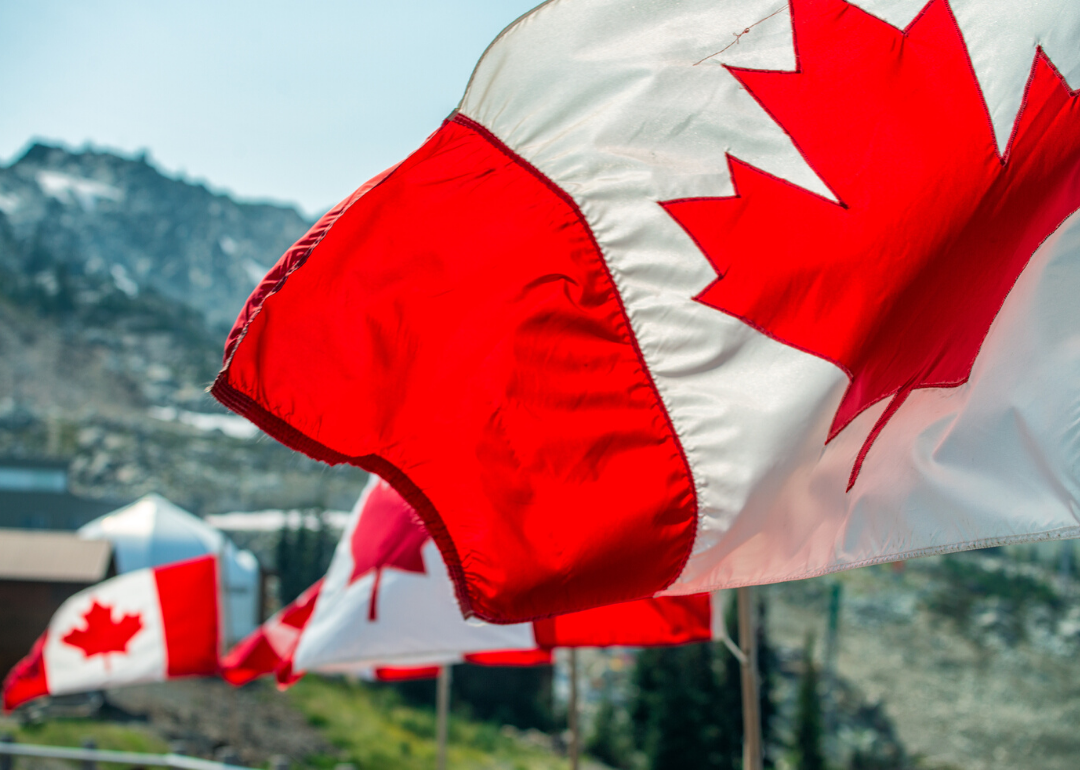
In 1965, a new National Flag of Canada was adopted and replaced the U.K.’s Union Flag after a great deal of debate. The Senate and Queen Elizabeth II eventually agreed and , and on Feb. 15 of that year, the new flag featuring an 11-pointed red maple leaf and sidebars was officially raised for the first time.
Important inventions by Canadians
We can thank Canadian inventors for coming up with some significant inventions, including kerosene, the electron microscope, the alkaline battery, insulin, Walkie-Talkies, the IMAX film system, and the snowmobile.
The Halifax explosion
Dec. 6, 1917, marks the day of Canada’s worst disaster to date. In Halifax, Nova Scotia, French munitions ship SS Mont Blanc collided with the Norwegian vessel SS Imo. This resulted in a devastating explosion—the largest man-made explosion before the atomic bomb—that
Kraft is a food group
Kraft macaroni and cheese is packaged in Quebec using Canadian wheat and milk. than any other country in the world: 3.2 boxes a year per person. It’s no wonder Kraft Dinners (or “KDs” colloquially) have been called .
Sasquatch and other cryptids
According to , Canada is home to numerous cryptids—animals that exist based on and anecdotes rather than proven science. To name a few: Sasquatch (aka, the Yukon Beaver Eater), Windigo the wild cannibal man, and Ogopogo, a large lake monster living in the depths of Lake Okanagan, British Columbia.
Santa Claus is Canadian
In 2012, Canada’s officially declared Santa Claus to be a Canadian citizen. He also pointed out that St. Nick’s iconic red and white suit is perfectly patriotic as the colors of the Canadian flag. If children wish to write and send letters to Santa, this is his address: Santa Claus, North Pole, H0H 0H0, Canada.
Canadians know how to rock
Canada has made big contributions to rock 'n' roll over the years, starting with The Crew-Cuts and their 1954 hit "Sh-Boom." Other rockers include Bryan Adams, Barenaked Ladies, Steppenwolf, Avril Lavigne, and Neil Young.
[Pictured: Neil Young performs in Burgettstown, Pennsylvania, in 2017.]
World Heritage sites
Canada is home to an impressive . Sites include Canadian Rocky Mountain Parks, Dinosaur Provincial Park, and Head-Smashed-In Buffalo Jump. Québec City, the only walled city north of Mexico, was the first city in North America to make it onto the list.
Halloween is a big deal
Although Halloween is celebrated all over the world, Canadians go all out on this holiday. Canadian market research firm Field Agent in 2019 found that the to give out or consume; and the Retail Council of Canada in 2014 estimated that that year—more than was spent that year in the U.S. In Vancouver, Oct. 31 is the only day of the year on their properties (with a few caveats).
Ice hockey reigns supreme
Although Parliament declared lacrosse to be Canada’s official summer sport, ice hockey remains its most-played and most-watched sport and reigns supreme as the country’s official winter sport. Ice hockey as we know it today was developed in Canada and most likely based off of a game played in 19th-century Nova Scotia with a wood block and stick.
The Apology Act
Canadians are known for being extremely polite and always apologizing. However, they say sorry so much that the government had to intervene. An to make apologies inadmissible in the courtroom, with adopting similar laws in 2009. Under this act, an apology “means an expression of sympathy or regret” and not “an admission of fault or liability in connection with the matter to which the words or actions relate.”
Pretty interesting stuff, eh?
The notorious Canadian interjection of "eh?" is just another example of Canadian politeness; it softens a sentence and includes the listener by asking their opinion. It's so frequently used that it's listed in the Canadian Oxford Dictionary as a valid word.