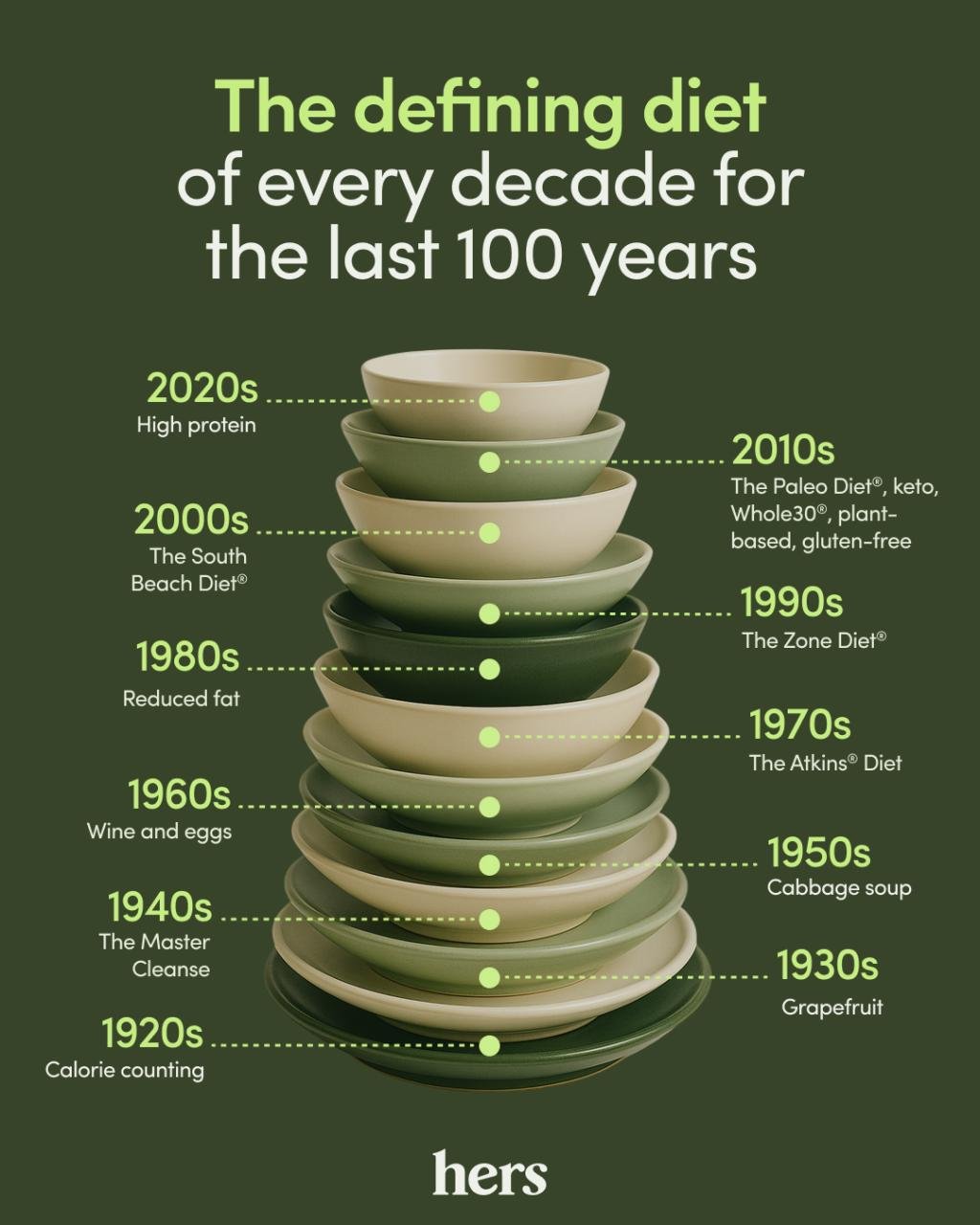
The defining diet of every decade for the past 100 years
While social media may make it seem like wellness hacks are more prominent than ever, researchers, celebrities, and publishers have been formulating and advertising diet trends for decades.
The speed at which information spreads has increased significantly in the past 100 years, leading to a proliferation of , but the allure of new weight loss strategies has been a mainstay over that period.
You may remember the cabbage soup diet of the 1950s or the grapefruit diet of the 1930s, but how effective are some of these old-school weight loss plans, and what can history teach us about which diets really stick, and which don’t?
looked at the most prominent diet trends from , analyzing their origins and efficacy. , a physician specializing in obesity medicine and Senior Vice President of Weight Loss at Hers, shares his expert opinion on where historical diet trends advanced today’s science, and where they fell short.
1920s: Calorie Counting
emerged in the 1920s as a “scientific” and “fail-proof” way of losing weight. Lulu Hunt Peters, an American physician and writer, is with relating calorie restriction to weight loss. In 1922, Peters’ book “Diet and Health With Key to the Calories,” which preached calorie counting as a way of life, topped the New York Tribune’s list of bestselling nonfiction books.
Over 100 years later, calorie counting and eating in a has remained a popular method for either losing or maintaining weight. A 2021 found that 39% of participants were actively using calorie tracking apps for weight control.
“ is still one of the most popular ways that people lose weight,” Dr. Primack says. “The problem is that when people don’t find success with it, it becomes a chore. If you do it for six months and you can’t do it in the seventh month, it doesn’t magically lead to intuitive eating or reset your appetite center. People who are analytic do really well with tracking, but people who are more impulsive might not benefit from this.”
1930s: The Grapefruit Diet
The , also known as the 18-day diet, originated in Hollywood and promised that consuming grapefruit or grapefruit juice with every meal would result in quick weight loss. It pushed foods rich in fat and protein—like bacon and eggs—and advised avoiding sugar, fruits (other than grapefruit), grains, and starchy vegetables.
While consuming -rich fruits and vegetables is crucial to a healthy diet, a 2012 found that daily consumption of grapefruit in particular did not significantly decrease body weight, lipids, or blood pressure.
“The grapefruit diet is a classic fad diet, and fad diets just don’t work,” Dr. Primack said. “Taking any particular food or food groups and adding them or taking them out of your diet forever is probably restrictive in nature and not recommended. ‘Everything in moderation’ is the current number one matra.”
1940s: The Master Cleanse
The diet was a body healing and detoxification plan introduced in a book by naturopath Stanley Burroughs in the 1940s. It consisted of consuming nothing but an “elixir” drink daily for four to 14 days. The drink consists of water, lemon juice, maple syrup, and cayenne pepper.
It rose to again in 2006 when Beyoncé said on “The Oprah Winfrey Show” that the Master Cleanse helped her lose 20 pounds for her role in the film “Dreamgirls.” Since then, other forms of meal restriction like juice cleanses and have risen to popularity, but nutritionists are divided about the efficacy of skipping meals, unless it's time restricted or supported by a healthcare provider.
“The term ‘cleanse’ suggests that the body has toxins that it needs to get rid of,” Dr. Primack says. “The body is very good at getting rid of the wastes from the food products that we eat on its own. There are no toxins in the normal food we eat that we have to ‘cleanse.’ The Master Cleanse is a fast. You can fast for a couple days and your appetite might go down and you’ll lose a lot of water. But losing water is not . If you’re not eating protein, you’re losing muscle. This cleanse might also cause electrolyte abnormalities if you're on diabetes, blood pressure, or other types of medication.”
1950s: The Cabbage Soup Diet
The , popularized in the 1950s, is a weight-loss plan centered around unlimited vegetable-based cabbage soup consumption and strict restrictions on other foods. It between 1980 and 2000, but it fell out of favor as the lost popularity. The aim of the diet is for participants to restrict calories by filling up on the fiber-rich soup.
“With the cabbage soup diet, you’re getting water and a little bit of fiber, and not anything else,” Dr. Primack says. “You can call it a fasting-style diet. If you do it for a short period of time it’s not going to hurt you, but for a long period of time you could become malnourished. A lot of people fast perfectly fine, but when they eat again they overeat what they couldn’t eat during the fasting period.”
1960s: Wine and Eggs
Helen Gurley Brown, in her 1962 novel “Sex and the Single Girl,” popularized a diet composed mostly of wine and eggs. Breakfast consisted of one egg with one glass of white wine, lunch added another egg and another glass of white wine, and dinner consisted of one steak and the instructions to drink some more wine. Vogue printed the diet in a 1977 issue of the magazine as well, bringing it to the masses.
Gurley Brown’s recommendations may seem jaw-dropping today as limit and prioritize fiber, but it underscores the ways in which far-fetch fads can become reality.
“This diet is what we call a ‘N-of-1’ study; just because something worked for someone else doesn’t mean it’s going to work for you,” Dr. Primack says. “Getting your medical information from popular culture or social media is not the best idea. Get your medical advice from the person who’s gone to medical school. Diets like this are alluring because they make a claim that no one’s ever told you before, and then you think they’re on to something. It’s tempting to want to find the cheat code to get through anything, but at the end of the day diet needs to be comprehensive.”
1970s: The Atkins Diet
The , developed by cardiologist Robert Atkins, recommends restricting carbs while prioritizing protein and fats. It’s credited with beginning the diet trend. Atkins released a revised version of his book in 2002, reinvigorating the trend.
Researchers, however, have that low-carb diets can put some people at risk for and premature death. That’s because people who avoid carbs typically reduce their consumption of fiber and increase their intake of animal protein, cholesterol, and saturated fat.
“The current ketogenic diet movement is really based on Atkins®,” Dr. Primack said. “The idea is that when you don’t eat carbohydrates, your appetite decreases. I do think this is a diet that works. That being said, it’s extremely hard in the world we live in to not eat carbs. As soon as you eat carbs, your appetite will come roaring back. This plan is still used today for the right person, but it’s hard to maintain, and some people do better with carbs in their diets than others.”
1980s: Reduced-Fat
In 1977, a U.S. Senate committee released a report advising Americans to largely cut , salt, and cholesterol out of their diets. What followed was the movement consisting of Lean Cuisine® , skim milk, Cooking Light magazine and more.
While limiting foods with and —which can raise cholesterol in the bloodstream—is important for preventing heart disease and obesity, like avocados, olive oil, and nut butters are generally part of a healthy diet.
“People in controlled studies tend to do really well on low-fat diets, in the real world they tend to overeat,” Dr. Primack says. “Instead of focusing on skim milk versus whole milk, for example, it’s important to focus on cutting calories and increasing protein when you’re trying to lose weight.”
1990s: The Zone Diet
The Zone Diet, which came from a 1995 book by biochemist Barry Sears, aimed to ensure that people’s insulin and other “inflammatory” hormones stayed “in the zone.” The diet consisted of consuming 40% calories from low glycemic index carbohydrates, 30% calories from fat, and 30% calories from protein. Like the Atkins diet, it encouraged low-carbohydrate consumption.
“On paper, The Zone Diet seems as though it should work really well, because moderation is everything,” Dr. Primack says. “The problem seems to be that people can’t stay on it, perhaps because it runs into the same problem as calorie counting when it comes to measuring the intake of every meal.”
2000s: The South Beach Diet
The , popularized in 2003, emphasizes eating food with a low glycemic index and categorizes carbohydrates and fats as “good” or “bad.” It encourages participants to limit consumption of grains, fruits, beans, legumes, sugary drinks, and alcohol.
“The South Beach Diet is a combination of the Atkins and Zone diets, in a way,” Dr. Primack says. “It has three phases, starting with low carb and moving into a less restrictive plan. Historically, it works well in phases one and two, but by the time people get to phase three, when there’s more flexibility, they typically gain weight again.”
2010s: The Paleo Diet, Keto, Whole30, Plant-Based, Gluten-Free
The rise of social media brought on a proliferation of new trends between 2010 and 2020, including The Paleo Diet, keto, Whole30, plant-based, and gluten free diets. Each of these encourages participants to limit certain categories of foods in favor of others. The Paleo Diet, for example, centers around lean meats and vegetables while avoiding grains and beans. Meanwhile, plant-based diets consist of primarily vegan foods like fruits, legumes, vegetables and grains.
The opposing nature of these trends can make it difficult to sort through the noise and understand which might really work for you.
“The best diet is the one that works for you,” Dr. Primack says. “In a perfect world, we would be able to do a genetic test to know if you need more carbs, less carbs, more fat, less fat, intermittent fast or daily dieting. Today, we just don't have that data. If you are on a diet plan and losing weight that you can sustain, keep doing it. If you are not losing weight or cannot sustain the changes that you have made, it’s time to find something that’s sustainable.”
2020s: High-Protein
While plenty of trends continue to proliferate online, have spiked in popularity over the past few years. Between January 2022 and September 2022, there was a in the sale of high-protein products from the previous year, a significantly higher jump than in prior years. In the International Food Information Council’s 2024 , high-protein was the most followed diet among survey participants, coming in above mindful eating, intermittent fasting, and calorie counting.
Loading up on can stop you from overeating and reduces cravings, leading to eating less food and losing weight.
“So far, we do think a good underlying principle is to eat more protein than most people usually do,” Dr. Primack says. “In the age of , one thing we have noticed is that many people seem to lose more muscle than they would with standard dieting. Protein consumption, along with exercise and sleep, are the best methods for preserving the muscle you have. Further, there are not many risks to patients on a high-protein diet unless they have significant kidney disease. You can ask your doctor if you should be restricting protein.”
How to Find a Diet Plan That’s Sustainable For You
While quick-fix diets that have come and gone over the years may work in the short-term, the weight loss methods that really work are the ones that you can stick to for more than just a few months.
Here are three tips for sustainable weight loss that goes beyond the latest fad:
- Get help from a medical professional. If you’ve tried to lose weight and on your own, it might be time to see a medical professional who has specialized training in weight loss and create a comprehensive plan that goes beyond the trends you read about online.
- Remember that weight loss goes beyond just food. The most effective and healthy weight loss plans incorporate nutritional changes along with better , , , education, and in some cases, medication. Failure to consider a person’s lifestyle broadly is one of the major reasons that diet fads don’t work, Dr. Primack says.
- Consider medication. help you decrease your appetite and stick to a lower-calorie diet, which can be difficult to do on your own. Healthcare providers often recommend these medications alongside regular and to maximize sustained weight loss.
was produced by and reviewed and distributed by Â鶹ԭ´´.