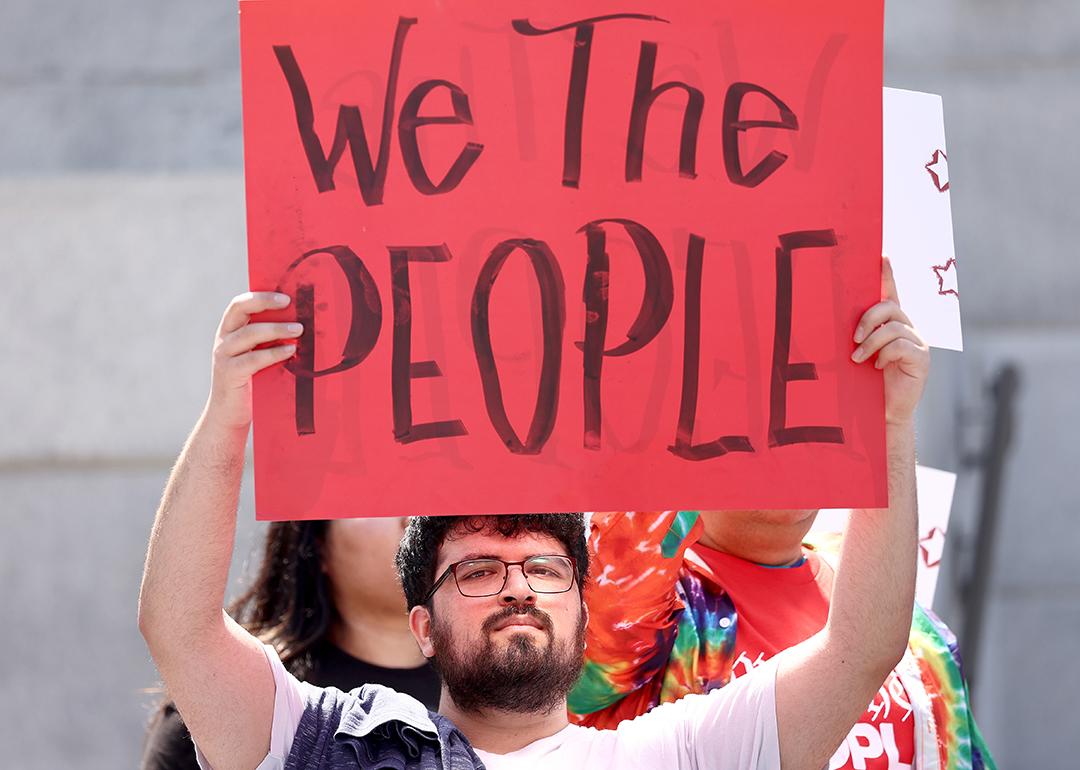
‘We the People’ includes all Americans – but July 4 is a reminder that democracy remains a work in progress
‘We the People’ includes all Americans – but July 4 is a reminder that democracy remains a work in progress
The United States’ founders firmly rejected King George III and the entire idea of monarchy 249 years ago, on July 4, 1776.
Political power does not come from some absolute authority of a king over people, the founders argued. Rather, political power comes from the . And these people must .
This is why the starts with the words “We the People,� and not “I, the ruler,� writes , a history professor at West Virginia University, for .
America’s founders did not trust everyone’s ability to equally participate in the , as laws at the time showed.
But, because of policy changes on issues like voting, the idea of who actually is represented in the phrase “We the People� has .
First steps
In 1776, only had the right to vote.
“Few men, who have no property, have any judgment of their own,� as former President John Adams .
As activists—i²Ô³¦±ô³Ü»å¾±²Ô²µ and —proclaimed their equality, , and social thinking shifted.
By about 1860, all state legislatures had lifted . Allowing only wealthy property owners to vote did not align with the democratic notion that “.�
While some states, , eliminated the property voting requirement in the 18th century, this shift became more popular in the 1820s and the 1830s.
Congress passed the 15th Amendment in 1870, and others the right to vote, regardless of race.
But some people, chiefly Native Americans and women.
An unfinished history
Despite the 15th Amendment, violence and intimidation in some states still .
State lawmakers also used bureaucratic measures, such as a poll tax, renewed attempts at a property requirement and literacy tests, to prevent African Americans from voting.
The fight over continued for decades, and many courageous Americans protested and were arrested or killed in the struggle to exercise their voting rights.
Thanks to the work of —i²Ô³¦±ô³Ü»å¾±²Ô²µ , and —public opinion shifted.
In the 1960s, Congress passed additional legal measures to protect the voting rights of Black Americans. This included the , which outlawed the use of poll taxes, and the , which prohibited any racial discrimination in voting.
Women’s turn
In 1920, the right to vote with the addition of the 19th Amendment, following another decades-long struggle.
Women’s rights activists made the first organized call for female suffrage at the .
In the following years, suffragists pushed for to in “We the People.�
Native American rights
Having self-governed for centuries, Native Americans were not legally recognized with voting rights until Congress approved the in 1924.
While that supposedly gave Native Americans the same rights as other Americans, , like violence, that white racists used to prevent Black Americans from voting.
Like other people excluded from “We the People,� have continued to push for voting rights and other ways to ensure .
Making democracy more democratic
In 1971 “We the People� again expanded, to include younger people, with the . The ongoing , and there was popular support for the idea that someone old enough to die fighting for their country should also be able to vote.
A government once described by Abraham Lincoln as “� was now going to technically include all of the people.
But equality for women, young people and racially marginalized groups did not change overnight.
Social equality remains far off for many people, including undocumented immigrants, for example, and LGBTQ+ individuals.
Current limitations to ‘We the People’
The government has recognized that citizens over 18 have a right to participate in self-government. But there are still political and legal attempts to ability to vote.
While some states have passed new laws that make it harder to vote in recent years, other states have made it easier.
North Carolina passed new in April 2023 that make it difficult for those without current state identification to vote.
, , and Idaho are also that from their rolls—if people do not regularly vote, for example.
Twenty-five states, meanwhile, including Hawaii and Delaware, have passed laws over the past few years that . One of these measures automatically registers people to vote when they turn 18.
There are . The bottom line is, voters have fewer protections when it becomes harder to vote, and American democracy is not as democratic as it could be.
The big picture
Voting is not the only form of in a democracy. People can be respected at work, paid what they are worth and treated with dignity. Community members can be treated fairly by police, school officials and other authorities, given an equal opportunity for justice and education to improve their lives.
People to the social and economic well-being of a democracy in ways other than voting, from planting a tree in a public park to attending a political rally.
But the overall expansion of voting rights and a historical understanding of “We the People� shows that everyone belongs in a democratic society, regardless of wealth, achievement or other differences.
was produced by and reviewed and distributed by Â鶹Դ´.