The skilled trades need workers. So why are there still so few Black plumbers, electricians and HVAC techs?
The skilled trades need workers. So why are there still so few Black plumbers, electricians and HVAC techs?
Demand for skilled workers in the trades is at a record high, as you . There’s a lack of workers currently employed in the trades — that is, welders, carpenters, plumbers, electricians, mechanics, HVAC technicians and the like — and an increasing number of available jobs. Even so, Black and African American tradespeople are seriously underrepresented in these fields. Black workers make up only , but represent almost .
Mathematically overrepresented in the trades are Hispanic and Latino workers, who make up 21.9% of tradespeople and just 19% of the population. White tradespeople account for 65.9% of all tradespeople, while being 75.3% of the total population.
examined the systemic barriers, pay disparities and pipeline challenges contributing to this gap — and what it might take to close it.
Systemic Factors
The underrepresentation of Black workers in these industries is, in part, the result of centuries of exclusion from skilled jobs. In the , most Black workers were employed as clerks, laborers, farmers and private household workers. By the year 2000, according to the , “a larger share of Black workers were employed in service occupations (which include healthcare support, protective service, food preparation, building and grounds maintenance, and personal care) than in any other occupational group” — numbers that, in many industries, persist to this day.
According to the , Black workers remain statistically overrepresented in positions like:
- Postal service clerks and other postal workers (38% to 40% of the industry)
- Bus drivers and other public transportation operators (36.6%)
- Security (34.5%)
- Home health aides (32%)
Additionally, many labor unions historically excluded Black workers from joining. According to , these unions often put in place restrictive membership policies that were designed to keep Black workers out, which, in turn, shut Black workers out of the unionized trades, like plumbing and HVAC.
Trade, technical and vocational schools are often located in “,” creating a lack of access for young people of color.
Carl Toussaint, former technician and current field supervisor for HomeServe Energy Services, said skilled trades likely aren’t discussed in urban areas or schools with a high population of minority students. He said many high schools in the New York City area aren’t offering shop classes or HVAC courses, so many young people simply aren’t exposed to these options.
“A lot of people have no clue how much money they can make in this industry or what it’s really about,” he said.
Perceptions of Prestige
At the same time, technical schools are often considered “less-than,” as compared to a college education. The trades themselves sometimes garner a reputation as less respected than white-collar jobs. When faced with the choice, many young people of color choose to pursue a bachelor’s degree instead of a technical education for these reasons.
Toussaint recalled working on a furnace one Christmas Eve, when he overheard the customer use his presence as a learning experience for his nephews. “Hey guys, you gotta make sure you stay in school. If not, you’re gonna end up like this guy; this poor guy has to work on a holiday,” he recounted.
Toussaint laughed to himself, knowing just how much he was being paid to work on a holiday — and he told the children as much. “Both of their jaws dropped. They couldn’t believe it,” he said. “Their next question was, ‘How do you get into this field?’”
Pay Disparity
Despite illustrating what is possible for Black tradespeople in terms of compensation, Toussaint’s experience is not necessarily reflective of the broader landscape. Black workers, on average, are not just underrepresented in the trades; they’re also underpaid. Compared to workers of other races, Black workers in the trades are the , making $36,816 per year. Comparatively, Asian tradespeople are the highest earners, at $40,710 per year, white tradespeople have an average salary of $39,552 and Latino and Hispanic workers earn $38,186 on average.
Black apprentices in the trades have the , too, starting at $16 per hour and capping out at $25. Hispanic and Latino apprentices start, on average, at $20 per hour, while white and Asian apprentices in the trades start at similar rates, but top out between $26 and $30 per hour
The Black workforce is , where the cost of living, as well as the wages, tend to be lower than in the North and on the East and West coasts.
Limited Advancement Opportunities
But perhaps the larger factor is that many Black workers still face hiring discrimination at higher levels, which bars them from opportunities for managerial roles and other higher-paying positions. According to a 2023 study by the , 41% of Black workers say they have experienced some level of discrimination in their jobs because of their race. They reported unfair practices in hiring, pay and promotions.
that they don’t experience the same on-the-job mentoring that their white colleagues get.
The need for a more level playing field is not lost on Toussaint. After his graduation from Lincoln Technical Institute, Toussaint said he returned to his alma mater to speak to students.
“I look like somebody who looks like them,” he said. “I’m not a teacher that’s in his 60s telling them how it was back in my day. … I literally graduated from here 12 years ago — or, at the time, five years ago — and this is what I’m making now. And, all of a sudden, you see the interest, you know?”
Black workers in the trades also report being blamed more when mistakes are made at the jobsite. The result is that Black workers may be held back from those opportunities to get pats on the back that turn into promotions and leadership roles.
The trades Black skilled workers are most often employed in matter, too. among Black workers — and it’s also common that general construction work doesn’t pay as well as specialized industries, like welding.
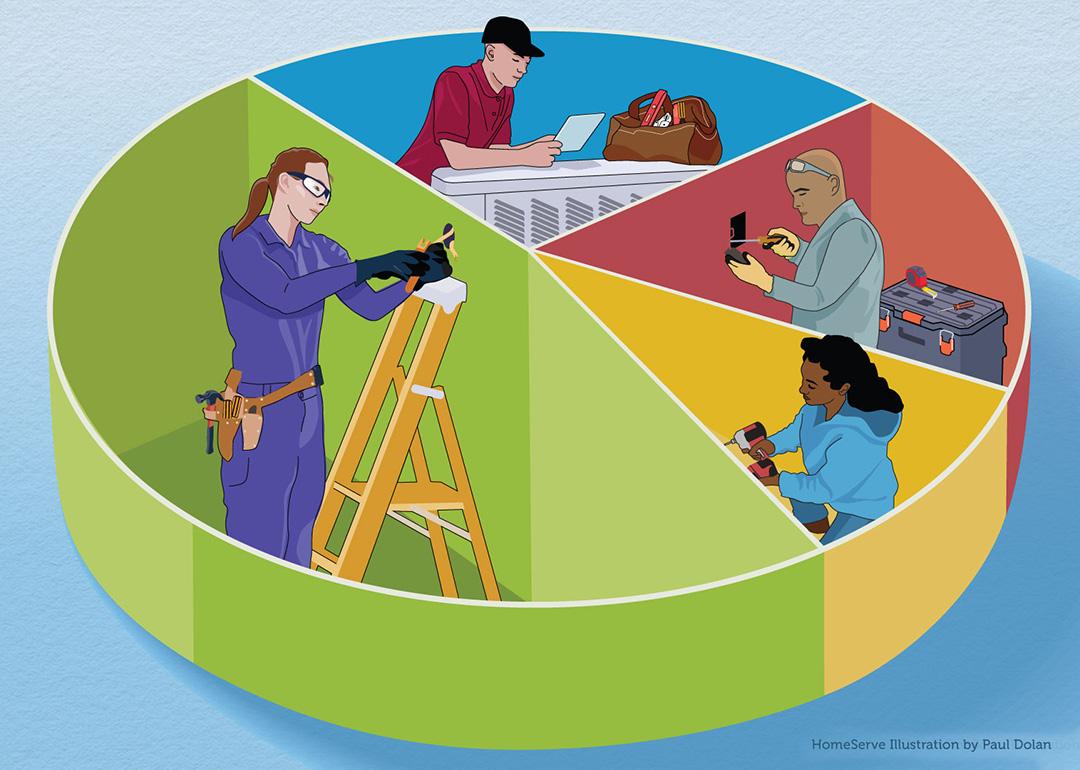
According to data from Zippia, Black tradespeople have representation in the home trades that is a bit higher than the national average for all skilled trades, though still disproportionate to the total population. About 8.5% of the country’s are Black, as well as 8.9% of and 8.3% of .
A Clog in the Apprenticeship Pipeline
Employment of Black workers in the skilled trades is, of course, attributable to the same historical social and systemic barriers Black Americans have faced elsewhere in the employment sector. But in many cases, opportunities in the skilled trades are not accessible to would-be Black plumbers, electricians and HVAC specialists primarily because of a lack of awareness and industry outreach regarding the opportunities themselves, what sort of training they need to land those jobs or how to go about getting it, according to industry experts quoted in Canadian construction publication .
Moreover, according to the nonprofit public policy organization, Joint Center for Political and Economic Studies, Black apprentices in the skilled trades face a host of challenges to their success. According to a , despite tripling its percentage share of apprenticeship programs since 1960, the Black demographic still represents just 9% of apprentices, compared with its 13.7% population share. Meanwhile, Black candidates complete apprenticeship programs at substantially lower percentages than other demographic groups examined, with cited causes being lack of supportive services such as childcare, transportation and housing assistance.
A Bigger Opportunity
That’s a miss both for the Black workforce and for America’s employment landscape as a whole, according to the , citing the fast-rising demand for skilled trades workers versus so-called white-collar jobs traditionally occupied by holders of four-year college degrees. The skilled trades, the institute states, offer an opportunity for upward mobility with high-paying jobs, earn-while-you-learn training and a meritocratic rewards system where quality of work is the measure of success versus cultural background or educational achievements.
“As infrastructure projects, construction activities, and technological advancements grow in sectors like renewable energy and advanced manufacturing, the need for tradespeople will only increase,” the . “By tapping into this demand and investing in training and education programs tailored to the needs of Black communities, policymakers and employers can facilitate greater participation and success for Black workers in the trades.”
Finding a Fix
So what can be done to bridge the gap between potential Black apprentices and a future in the skilled trades? The Joint Center recommends the following measures:
- Policy makers should establish permanent funding for increasing equity in apprenticeships in both representation and earnings.
- Apprenticeships should reduce barriers to entry for people with low incomes by providing assistance to mitigate the high costs of tools, equipment, books, supplies and uniforms, as well as issues related to transportation and scheduling inflexibility for parents or commuters.
- Apprenticeship programs and colleges should partner to offer college credit for training, thereby expanding opportunities for credential attainment and career advancement.
- Labor officials should develop a centralized national system to track unregistered apprenticeships that fall outside the scope of nondiscrimination and equity objectives currently required for registration.
Toussaint said awareness is key.
“It has to start, in my opinion, with the guidance counselors in the high schools,” he said.
Guidance counselors can help identify students who may excel in a hands-on career versus a desk job.
“You may not be able to do a term paper, but you may be fascinated by making things work,” Toussaint said. “[The skilled trades] are for everybody who’s like that.”
was produced by and reviewed and distributed by Â鶹ԭ´´.