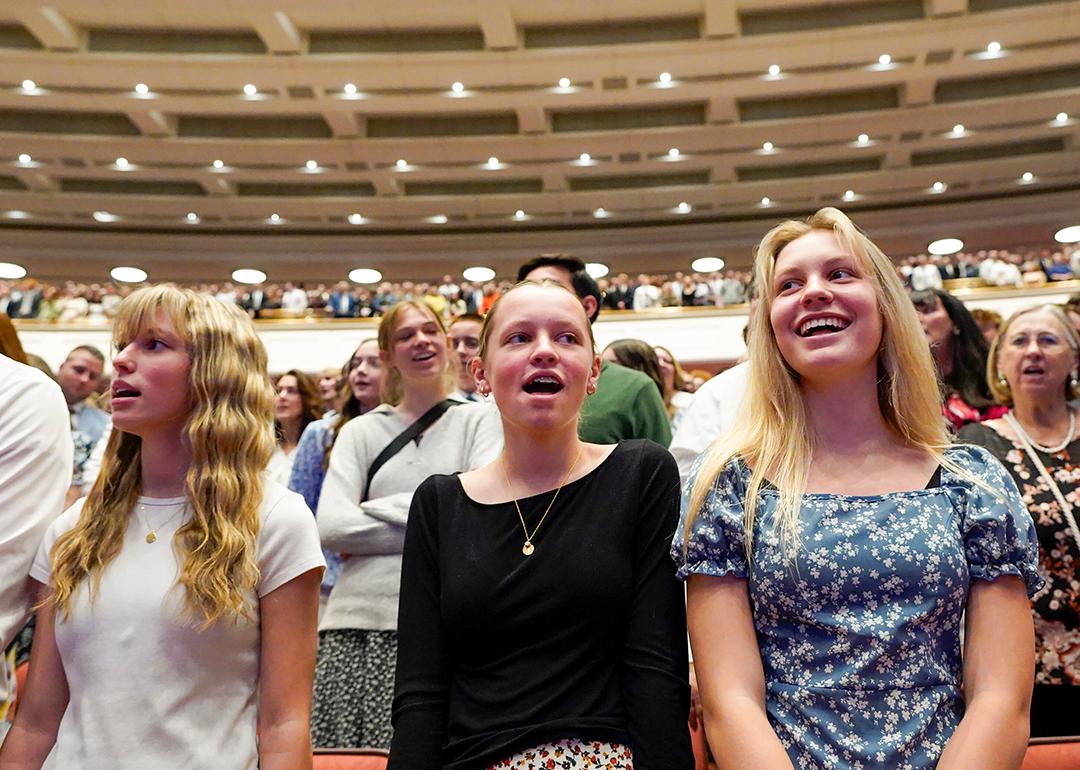
Active Latter-day Saints increasingly abandoning orthodox views
Ask Latter-day Saints — even regular churchgoers — if theirs is the one true faith leading to eternal life, and there’s a decent chance they’ll say no.
That’s due to a growing number of active U.S. members holding less-than-orthodox views.
Such is the (tentative) conclusion data scientist reached in his recently published study, “.”
Based on data he mined from three from the , the paper examines responses from nearly 2,000 self-identified members of The Church of Jesus Christ of Latter-day Saints and Mormons (the surveys and Bass used both “Latter-day Saint” and “Mormon” terms). This approach meant that people who had once been members, but no longer considered themselves part of the Utah-based faith, were unlikely to appear in the results.
From their responses, collected over the past nearly 20 years, he concludes that “the people in the pews are not the same as a generation ago.”
Put simply, he explains to , “What was once a faith defined by overwhelming uniformity — where the majority of members could be described as devout, orthodox and politically conservative — may have fractured into a more complex spectrum of identities.”
Exactly how common the orthodox once were and how diverse that spectrum has become remain unclear. Bass would need more data for anything approaching precise head counts. For this reason, he writes in the report, his findings are “exploratory rather than definitive.”
Nevertheless, he explains in an interview, he is “quite confident” in the overall trend. The graduate of church-owned Brigham Young University even has a few theories on what is driving it.
Mapping LDS/Mormon identities
Of all the statistical efforts to examine faith in America, few are as rigorous and respected as . The nationally representative questionnaire of U.S. adults has occurred in three waves to date — 2007, 2014 and 2023-24 — and has included a total of 1,810 self-identified Latter-day Saints.
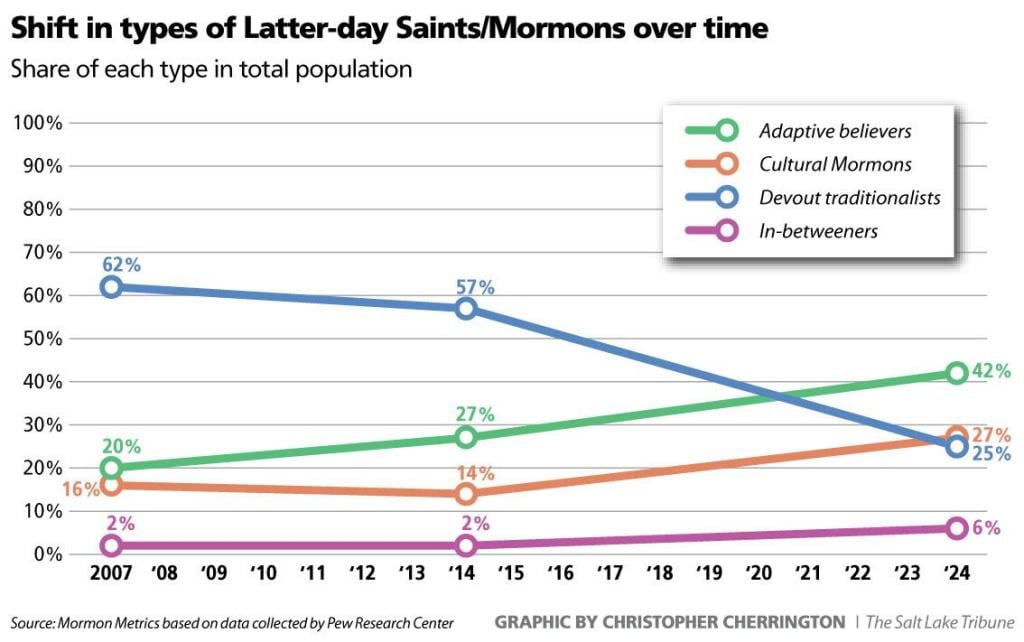
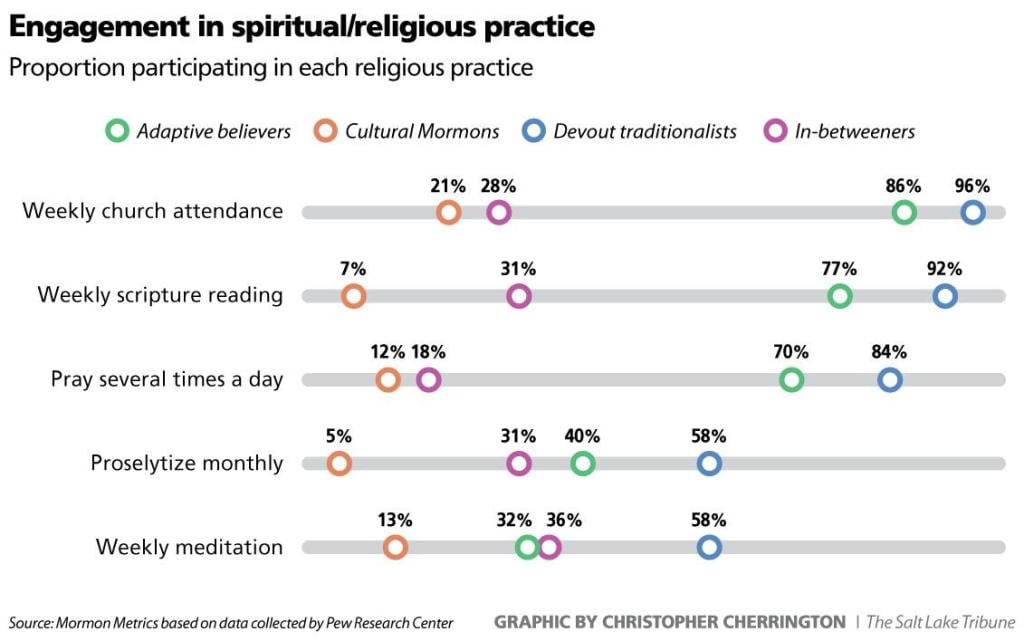
Harvesting to wide-ranging questions, Bass employed a mathematical algorithm to sort individuals with similar answer patterns. The approach yielded four “Mormon typologies”: devout traditionalists, adaptive believers, cultural Mormons and in-betweeners.
The four types of Latter-day Saints/Mormons
Devout traditionalists. Once the majority but no more, according to Mormon Metrics. “Avid” religious practitioners who believe in God with certainty. Trend older, more male and politically conservative. Represent roughly 25% of self-identified Latter-day Saints/Mormons.
Adaptive believers. The most common type today. Attend church regularly but are less consistent with prayer and scripture study. Roughly half believe the faith is the one true church. Trend female and more educated. Represent roughly 42% of self-identified Latter-day Saints/Mormons.
Cultural Mormons. Lowest rates of religious participation across all measures. Believe in God and heaven. Still view Mormonism as part of their cultural identity. Like adaptive believers, they appear to be experiencing meaningful proportional growth. Represent roughly 27% of self-identified Latter-day Saints/Mormons.
In-betweeners. Low belief in God and heaven yet more likely than cultural Mormons to attend church, read scriptures, etc. The smallest, youngest, least educated and most politically diverse group. Represent roughly 6% of self-identified Latter-day Saints/Mormons. (A caveat from the researcher: This group is especially small in the dataset, and thus even more “exploratory” in nature than the other three types.)
To be clear, Bass writes, these labels should not be viewed as “hard boundaries.” Constructing rigid categories would require much more Latter-day Saint-specific data (Pew researchers did not, for instance, inquire about , , or the many other ways members signal their devotion within the church).
Rather, his goal, he writes, “is to spark conversation and provide a clearer lens on Mormon diversity, even as future research refines or reshapes the typology.”
Adapting to the ‘modern era’
The more one moves down this list — from devout to in-betweener — (and more racially and politically diverse) the individual is likely to be. Bass was quick to stress, however, that he does not believe the shrinking number of traditionalists is solely the work of population turnover.
Today’s adaptives, he concludes in the study, are, in many instances, yesterday’s devout traditionalists who have “readily adapted” their social beliefs to match the “modern era.”
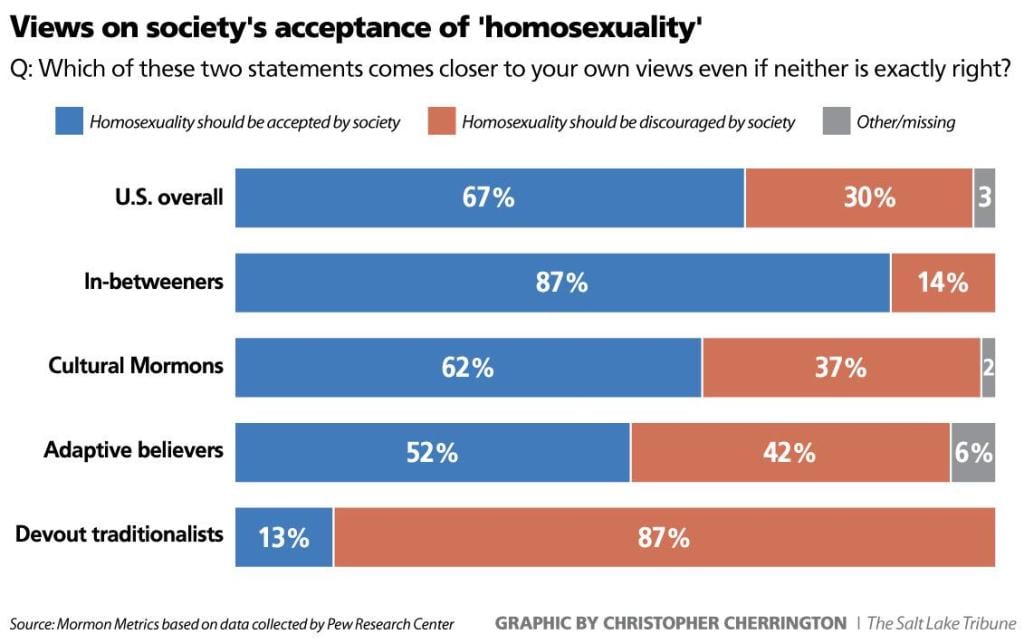
One likely driver he highlighted was growing acceptance of homosexuality both in and out of the church, . As part of the 2023-24 survey, Pew asked 565 Latter-day Saints whether society should accept homosexuality. Devout traditionalists blew away the competition, with nearly 90% saying no. Adaptive believers were almost split down the middle, while more than 60% of cultural Mormons and nearly 90% of in-betweeners said yes.
Belief in one hand, questions in the other
Take, for instance, Malinda Street, a 33-year-old mom of three who grew up in Enterprise, Utah, in what she called a devout traditionalist home.
“We had our pew,” the eldest of 12 kids said. “We prayed and read scriptures quite often, not perfectly. Devout does not equal perfect. We were just doing our best, and ours was the one true church.”
Nowadays?
“I’m definitely still committed to living the values and the gospel as I understand it,” explained Street, who attends church weekly in Millcreek, Utah, where she serves as the volunteer secretary in the women’s Relief Society. On the other hand, “a lot of my cultural and social beliefs are a little bit less conservative than people would normally think.”
Street said her goal, growing up, had always been to be a stay-at-home mom, . She tried, doing her best to meet her children’s needs despite her own struggle with depression, until her oldest turned 6 years old.
“I felt inspired that I needed to get to work,” she said. So she got a job as a paralegal. These days, she’s working on her law degree through an online program.
“It’s been a journey,” Street said, figuring out “how do I fit in the church, as a daughter of God, as a woman in the world? How do I reconcile those roles? There’s been a lot that I’ve had to question.”
That questioning extends to .
“I’ve got people very close to me, friends and family, that identify as members of the LGBTQ+ community, and it’s a very hard place for them,” she said, referring to the environment at church. “I wish we had more clear answers on where their place is and were more sensitive to their needs.”
Street still identified herself as a devout traditionalist but agreed some might view her as drifting into adaptive territory.
MAGA and Mormonism: A potential wedge
Looking at the data, Bass has a second suspicion about what may be driving scripture-reading, church-attending Latter-day Saints to adopt more nuanced beliefs.
Latter-day Saints are historically among the most reliable Republicans of any religious group in the country. The rise and return of Donald Trump and his Make America Great Again strain of conservatism have , , that relationship and, Bass suspects, led some to — and their religious identity with it. After all, devout traditionalists were, per 2023-24 data, the most likely to identify with the Republican Party; in-betweeners were the least.
Troy Hoyt is a lifelong Latter-day Saint and Republican (at least in name) living in Parowan, Utah.
Like Street, the 55-year-old said he wished the church was a . Related, he said, and just as distressing is the () for the president and the MAGA movement.
“I see all Christianity, the majority of LDS members included,” the retired lawyer lamented, “supporting a political party and a politician that abandons what I believe is central to being a Christian, and that’s to love one another.”
Living in Trump country doesn’t do much to ease this tension or the sense of loneliness that accompanies it, said the former missionary and father of five.
“There are people of like mind that I found,” said Hoyt, who grew up in Snowflake, Arizona, and spent much of his adult life in Chicago. “But they’re few and far between, and they stay very hidden.”
Hoyt still engages in family scripture study, attends church regularly and prays. But the self-described adaptive believer no longer holds the view that the church is the one the true faith.
“I would think the one true church,” he said, “would have better equipped its members to actually follow the teachings of Jesus Christ.”
‘A widespread secular surge’
Put all these narratives and numbers together, Bass said, and the story that emerges is this: Whereas, in the past, one was either an active, devoted Latter-day Saint or inactive, increasing numbers are claiming the label less as a religious identity but, as with many Catholics and adherents of Judaism, because it is part of their heritage.
“Cultural Mormons,” Bass writes, “are growing in numbers.”
What this means for this relatively young faith — it won’t even be 200 years old until 2030 — is unclear.
“Can Mormonism become an ethnic or cultural identity independent of belief?” the study’s author wonders. “Will the church embrace this looser affiliation or insist that real belonging requires orthodoxy?”
Notre Dame political scientist stressed a similar point. While more data is needed to confirm Bass’ trends, Campbell said, the findings match other stats suggestive of an in the church in tandem with one seen in other faiths.
“The results are further evidence that the United States is experiencing a widespread ,” he said, “and that the LDS community is not immune.”
was produced by and reviewed and distributed by Â鶹ԭ´´.