Alcohol ads are returning to the NYC transit system, alarming public health experts
Alcohol ads are returning to the NYC transit system, alarming public health experts
In 2018, hoping to curb underage drinking, the Metropolitan Transit Authority banned advertising for alcoholic beverages in New York City’s transit system.
But the MTA board backtracked this summer, approving significant carve-outs for alcohol ads in subways, buses, and stations. The move stunned public health experts and advocates, who say that the harmful health effects of alcohol consumption, particularly for young people, far outweigh any potential revenue.
“The research on the public health side at this point has concluded that alcohol marketing plays a causal role in kids’ decisions to drink,” said Dr. David Jernigan, an expert on alcohol policy and a professor of health law, policy, and management at the Boston University School of Public Health.
The MTA board the new policy in June, hoping to generate an $7.5 million to $10 million in annual revenue from the ads. Transit authority officials have cast the decision as a loosening of the policy, not a full-scale reversal, reports.
“We didn’t reverse the ban,” chief executive Janno Lieber told reporters . “We had adopted a couple of narrowly tailored, common-sense exceptions to it that make sure that the original purpose of the ban, which remains in effect, is achieved, which is the protection of school kids from exposure to that.”
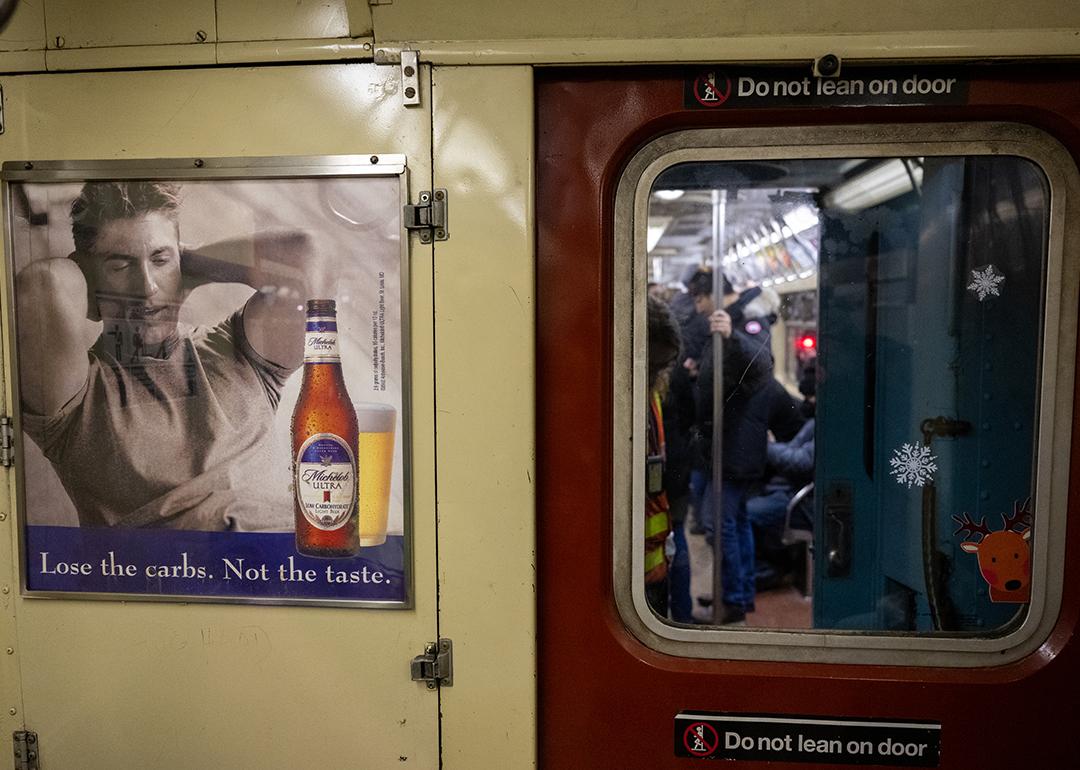
Under the new policy, alcohol ads will be permitted on digital displays inside and outside subway stations and within subways and buses, except during “typical student commutation hours” of 6 to 8 a.m. and 2 to 5 p.m. on weekdays when school is in session, according to from the transit authority.
Alcohol ads will also be permitted on “static displays” on major commuter rail hubs and stations next to large venues that sell alcohol. They will be allowed on advertising that wraps around the S shuttle train between Times Square and Grand Central. And they will be permitted on billboards, so long as they are not readable within 500 feet of a school, playground, or place of worship.
Dr. Michelle Morse, acting commissioner of the New York City Department of Health and Mental Hygiene, told Healthbeat her agency is “very concerned” about the MTA’s decision, particularly regarding its impact on young people.
“We’re very worried that this sends the wrong signal,” she said.
MTA seeks potential revenue
The MTA prohibited tobacco advertising more than 30 years ago and banned marijuana product ads in 2021. When the MTA approved the alcohol ad ban, which took effect in January 2018, chairman Joseph Lhota said the authority about making up the lost revenue, an estimated $2 million annually. The City of New York soon followed suit, banning alcohol ads on most city-owned properties, relinquishing about in annual revenue.
But now the leadership of the transit authority, which has a annual operating budget, says the ban was overly restrictive, and that the extra revenue would be beneficial.
“It does help. It really does,” Haeda Mihaltses, a board member, said during a June finance committee meeting.
In a statement, MTA spokesperson Kayla Shults said the original policy “prohibited ads for restaurants with a glass of red liquid on the table and told sponsors of major sports and entertainment venues — where alcohol is legally served — to spend their ad dollars elsewhere instead of in the subway stations connected to those venues.”
The decision has garnered praise from the Distilled Spirits Council, a trade association.
“Spirits advertising has been a responsible source of revenue for mass transit authorities in other cities, and the ads have been met with broad public acceptance,” the organization said in a statement. “We have long maintained that the NYC MTA ad ban was misguided and welcome the opportunity to participate in this market.”
Research shows harmful public health impacts
Opponents of the policy shift say that any profit to be made isn’t worth the harm to public health. Statewide, more than 8,050 New Yorkers die each year due to excessive alcohol use, to the state Health Department. A found that excessive drinking $843 per person each year in health care costs and lost productivity. Adjusted for inflation, that’s more than $1,200 today.
“It’s not worth it for the MTA to make some money in the short term if it’s going to increase costs in the long term in a way that’s going to harm New Yorkers,” said Dr. Betty Kolod, a primary care physician in Manhattan and the Bronx.
An extensive body of research links alcohol consumption to health risks. In January, then-U.S. Surgeon General Dr. Vivek Murthy that alcohol consumption increases a person’s risk of developing at least seven types of cancer. In 2023, the World Health Organization concluded that for human health.
Studies have found that alcohol advertisements tend to be in subway stations in neighborhoods with greater levels of poverty and higher percentages of Black and Hispanic residents. And researchers have established a strong link between alcohol advertising and underage drinking.
Jernigan, the Boston alcohol policy expert, said young people are especially susceptible to alcohol brand advertising — drinking precisely the brands shown to them — and that there are significant adverse health consequences to starting to drink early in life.
“Are you going to put alcohol ads on a school bus? I don’t think so, but that’s the equivalent of what the MTA is doing,” he said.
Concerns raised over youth protections
Public health experts and advocates are particularly skeptical of the MTA’s attempt to prevent student commuters from seeing alcohol ads.
Young New Yorkers use public transportation day and night, traveling to sports games, cultural events, jobs, and friends’ houses, said Dr. Sean Haley, an associate professor of health policy and management at the CUNY Graduate School of Public Health and Health Policy.
“Partial coverage is not effective,” he said. “It’s not what our children deserve.”
Robert Pezzolesi, a public health advocate who spearheaded the original campaign to ban alcohol ads, pointed out that the restrictions for young commuters don’t apply to half the year, when school is out of session. And digital ads — which were just emerging when the initial ban was approved — are now the norm in the subway system, with “extremely compelling visual imagery” made to hold audiences captive.
“It’s not like a magazine where you can turn the page, or television where you can change the channel,” he said. “It’s in your face and hard to avoid.”
Other cities across the country, including . and Boston, have banned alcohol ads only to bring them back.
A of alcohol advertising on Boston’s Massachusetts Bay Transportation Authority system estimated that alcohol ads reached more than half of Boston Public School students taking public transportation on an average weekday. Citing that high level of exposure, researchers concluded that the transit authority should ban the ads, which it did in . Five years later, the ads .
was produced by and reviewed and distributed by Â鶹ԭ´´.