
Americans are more connected than ever鈥攈ere's how much time people spend on their phones and how it's changed
This story originally appeared on Visible and was produced and distributed in partnership with 麻豆原创 Studio.
Americans are more connected than ever鈥攈ere's how much time people spend on their phones and how it's changed
Americans spend an average of every day, checking them at least 144 times a day, a 2023 Reviews.org survey found.
In today's world, communication is wireless, connected, always on, instant, and high fidelity. The smartphone has become so much more capable than anyone imagined at its invention; it's now our bank teller, research assistant, video game device, health monitor, and then some. More than now, up from 35% in 2011, per Pew Research Center survey data.
compared historical data from the Labor Department's to see how much time people spend communicating in their free time and how it's changed over the last two decades.
A landline phone used to be every American family and business' way of connecting with their homes and offices. In 2022, though, in their house. Businesses increasingly opt for voice calling over IP-calling software that uses broadband instead of phone lines for better quality calls and features. And consumers no longer communicate through voice calls alone, opting to publish thoughts, photos, and videos on social media platforms and send text messages. Against that backdrop, fewer Americans have made daily phone calls over the past two decades.
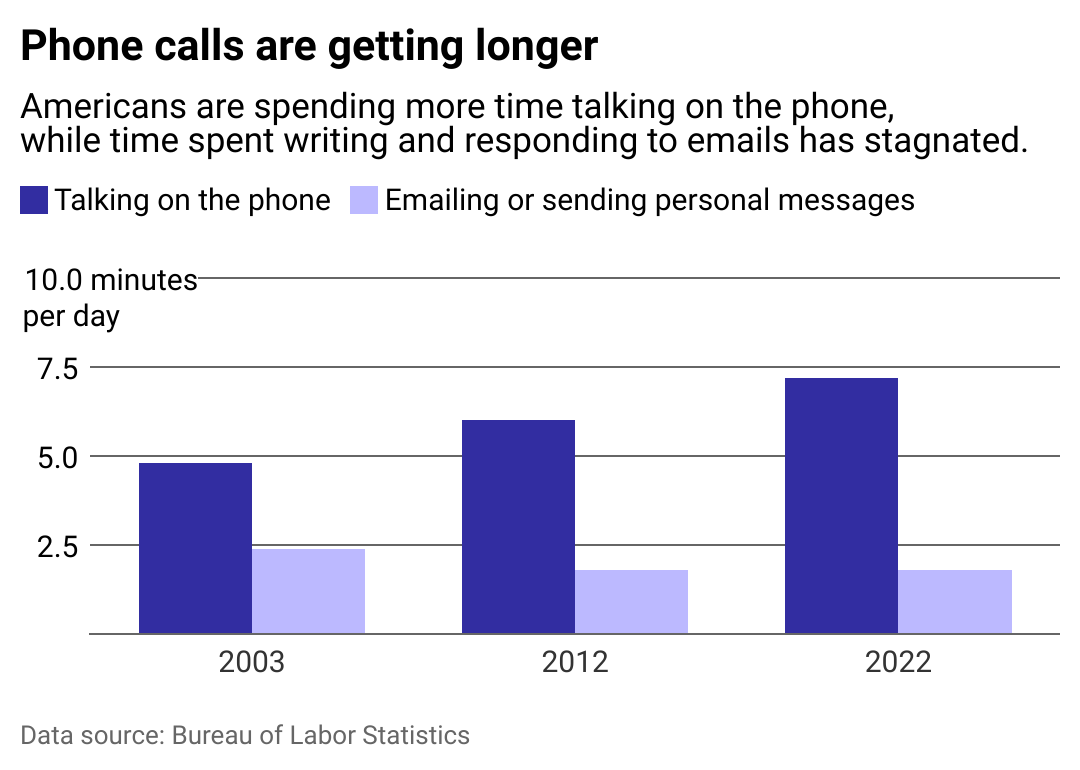
People are spending more time on the phone
According to Bureau of Labor Statistics survey data, phone calls are beginning to consume more time per call for the typical American. This could result from a cultural evolution in phone usage where people see a phone call as more of an event that requires planning ahead via text message rather than something done spontaneously and briefly.
But talking on the phone is also key to navigating issues with goods-and-services companies through their customer service departments.
In 2022, were employed as customer service representatives, per government data. That figure is forecast to decline by 5% over the next decade as technologies like artificial intelligence promise to save companies labor costs.
By implementing AI, companies can employ fewer people to answer calls, a trend the COVID-19 pandemic exacerbated when due to labor challenges. Bloomberg reported that the call center industry was still reeling last year, with CallMiner Chief Technical Officer Jeff Gallino estimating .
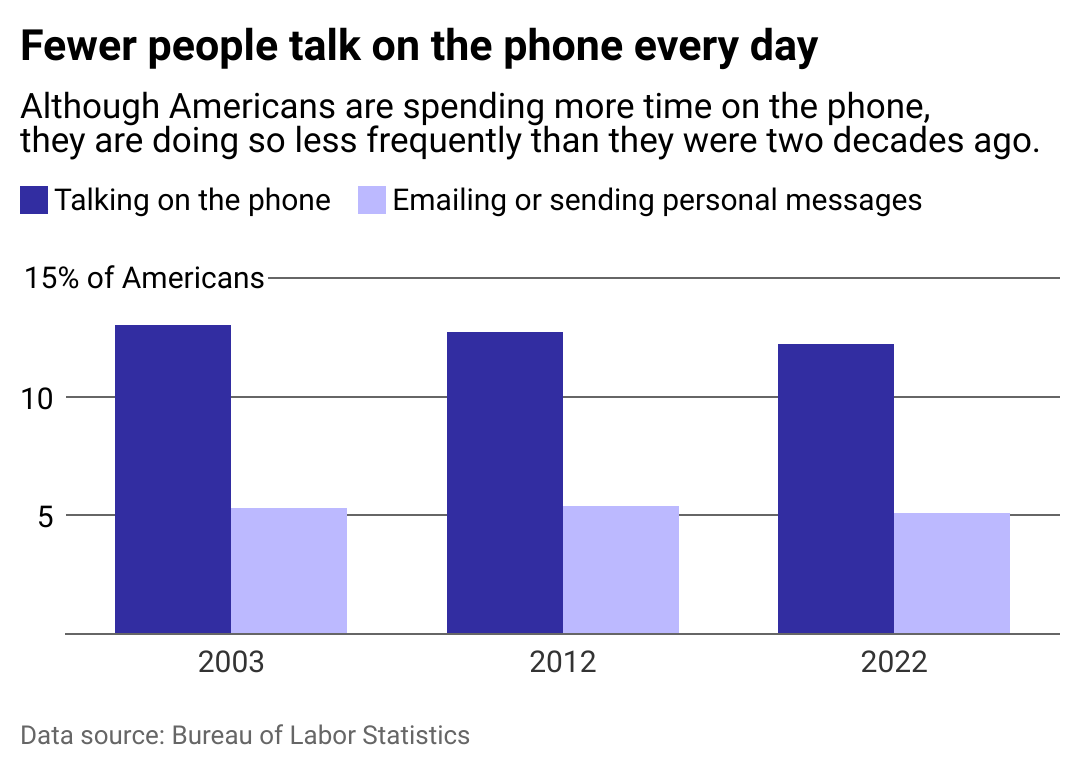
But are connecting less frequently
In another potential sign that other forms of communication have replaced the need for brief phone calls, Americans take fewer calls in the 2020s than they did in the 2000s.
At the beginning of the 2010s, people who sent more text messages a day , suggesting it wasn't text messaging that was stealing our attention away from chatting on the phone more often, according to the Pew Research Center.
But by 2012, social networking apps were widely available on smartphones and provided an always-on connection to the internet as well as updates about the social lives of friends and family鈥攊ncluding those we hadn't communicated with in years.
And in 2020, the pandemic warmed the public up to videoconferencing calls on platforms like Zoom, Skype, and Microsoft Teams. Pew Research Center found that fewer than a decade ago; since the pandemic, it's now . Of course, smartphones have video calling apps, too, which can help people remain connected on the go.
Story editing by Jeff Inglis. Copy editing by Paris Close. Photo selection by Clarese Moller.