Can you really beat loneliness online? What the data says about connection in virtual spaces
Can you really beat loneliness online? What the data says about connection in virtual spaces
Loneliness in the United States is climbing again. Twenty-one percent of U.S. adults said they felt lonely “a lot of the day yesterday,” according to Gallup’s latest , which is its highest rate since 2021, when COVID-19 restrictions were still in place. The U.S. Surgeon General has labelled loneliness an epidemic and warned in the that “the mortality impact of being socially disconnected is similar to that caused by smoking up to 15 cigarettes a day.”
Despite this, Americans are more digitally connected than ever before. Ninety-one percent of U.S adults say they spend time on social media each day, with a third racking up one to three hours of scrolling daily, according to the from the American Psychiatric Association’s Healthy Minds survey. Despite this level of connectivity, a significant portion of Americans still report feeling lonely. Could it be that the technology that was built to enhance connection is making people feel more alone?
To dig into this question, it’s important to look at how social media has evolved over the decades. Social platforms started as a way to help people connect with those they already knew offline, but have now transformed into "algorithmic content delivery media," as analyst Marko Jukic puts it in an .
In other words, social media platforms are now built less for connection and more for capturing attention. Having a phone is “more like a TV in your hand” than a device for social connection, Jukic added. Fitness entrepreneur Alex Hormozi : “Social media is dead—it’s just media now. The ‘social’ component has been removed.” Even Mark Zuckerberg has acknowledged the shift. During testimony at Meta’s 2025 antitrust trial, he Facebook’s evolution as moving away from interpersonal connection toward “the general idea of entertainment and learning about the world.” But what if online communities could be built differently?
Ahead, Foundation looks into the state of online connection, using data from its virtual world alongside findings from the American Psychiatric Association, U.S. Surgeon General and peer-reviewed studies on loneliness and digital interaction.
The scroll vs. the stay
Today, the “success” of most monetized social media content is measured by how long it can hold someone’s thumb in place, also known as the thumb-stop. This is where users pause their scrolling to watch, like, or comment before moving onto the next video or update fighting for a few seconds of their attention. This kind of design rewards stimulation over connection: every pause, click, or swipe releases a small burst of dopamine that keeps users hooked but rarely fulfilled. The result is a loop of passive engagement that feels busy but hollow.
This way of consuming and interacting with content is called “asynchronous” because users post, scroll and respond at different times. Asynchronous hubs, such as Instagram, TikTok and Facebook are built around this model of delayed interaction, which is flexible and convenient. A 2024 from the American Psychiatric Association shows that 64% of adults feel anxious when they don’t have access to their phones, which suggests that this cycle of scrolling and thumb-stopping perpetuates a heavy dependence on digital connection that doesn’t necessarily deliver emotional depth.
In contrast, synchronous hubs are real-time environments where feedback and communication happen instantly, through voice, chat, or even gestures of an avatar (a customizable digital character that represents each person). Platforms such as Discord, Twitch, Clubhouse, and virtual worlds such as Decentraland fall into this category. They allow people to share presence rather than just content.
Synchronous hubs are designed to be closer to what people experience in everyday life. They cannot be measured by thumb-stop metrics of likes or impressions, but rather by the length of time that was spent there and how much people engaged with each other.
What the numbers reveal
Data from Decentraland’s provides a rare look at what users actually do inside synchronous hubs. On average, participants spend about 41 minutes per session in active engagement, whether that’s socializing, exploring or attending digital events.
According to the report, activity spikes during live events, when users stay anywhere from 45 minutes to more than two hours. This pattern mirrors what happens during physical events: when there’s something happening, people linger, just like we do at open mic nights at our favorite coffee shops or when art pop-ups appear on the sidewalk.
In urban-design terms, these intentional moments function like “third spaces,” which are activated public realms designed to encourage informal, but beneficial, social interaction beyond our work and home. City planners often call these activity hubs “sticky spaces,” where the environment cues people to hang out, thus prompting friendships and relationships of all kinds.
What kind of social interaction actually happens in virtual worlds?
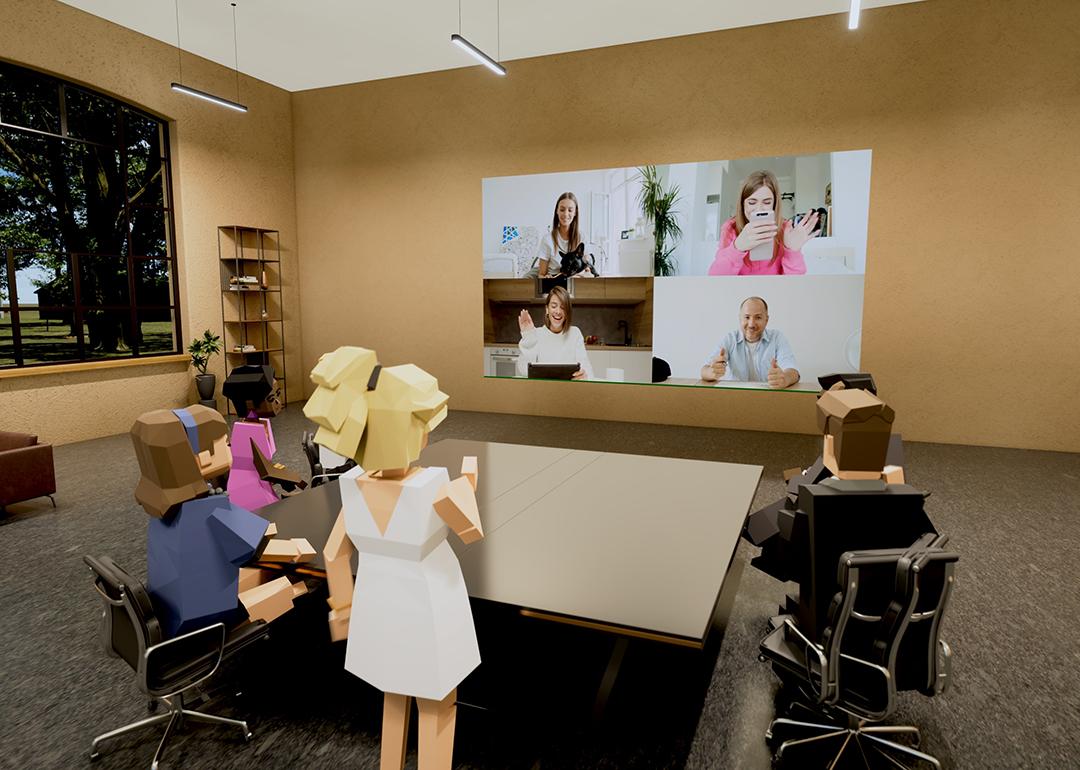
Social interaction mirrors real life inside virtual worlds—it just happens through avatars instead of physical bodies. Users gather, talk, collaborate and build relationships inside digital spaces that resemble towns, concert venues, classrooms or festivals. But unlike social media feeds, where engagement is mostly text or image-based, virtual worlds are shared 3D environments. Users can see and hear one another’s avatars moving through the same space. And instead of liking a post, someone might dance nearby, wave or start a spontaneous conversation like they would if you bumped into each other at a concert.
Different platforms highlight different forms of interaction, each with its own focus and community dynamic. For instance, Roblox centers on play and collaboration, which invites users to build their own games and environments, and even work together in teams. Popular activities like the pet adoption game encourage trading and creativity, while branded spaces like let players try on merch or compete in mini games.
Fortnite, meanwhile, has evolved beyond shooter games and into a social arena that hosts concerts, film screenings and other live events. Artists like Travis Scott and Ariana Grande have performed shows inside the digital environment. Second Life, one of the earliest virtual societies that launched in 2003, continues to support user-generated spaces for education, art and community-building, with initiatives such as and a . Decentraland, meanwhile, emphasizes synchronous, 3D social experiences hosted by users, such as and a music festival hosting performances by Deadmau5 and Grimes. Such headline events coexist alongside regular DJ nights and smaller social gatherings, illustrating how virtual worlds can function as both cultural stages and social meeting points.
How online connection contributes to wellbeing
Studies on the live-streaming service Twitch show that active chat participation in Twitch streams is positively linked to wellbeing. A 2022 Cornell on social live streaming and wellbeing found that viewers who actively engage have more socially satisfying experiences on the platform than those viewers who watch passively.
Other research highlights a different side of real-time connection. A 2025 Cornell compared three avatar-based worlds (Second Life, ZEPETO and Pigg Party) with three text-based social platforms (Facebook, X and Instagram). The study found that users who communicated through avatars (those capable of gestures and expressions) received more online social support and maintained more stable relationships than users of text-based networks. The researchers explained that “avatar communication, in which individuals with virtual bodies can display facial expressions and gestures in a virtual space, enables nonverbal and real-time interactions with online co-presence.”
Not everyone agrees that online interactions play such a huge role in wellbeing. While thought pieces and op-eds often warn that too much screen time can replace real-world connection, social media and loneliness research paints a more nuanced picture. A 2024 loneliness and social media published in Annals of the New York Academy of Sciences found that social media use is only weakly related to loneliness and shows no evidence of causing it. The review concluded that social media may help people feel a sense of belonging in the short term, but is less effective for coping with loneliness over time. Ultimately, the review suggests that life circumstances, personality traits and offline social networks play a larger role in loneliness than hours spent online.
Measuring connection differently
The U.S. Surgeon General has advised that “social connection is a fundamental human need, as essential to survival as food, water and shelter” in the . The report links chronic disconnection to increased risks of heart disease, dementia, stroke and premature death. This shows that relationships are as vital to health as diet or exercise.
Americans are deeply embedded in digital life, but being online doesn’t equal belonging. This shows us that the way we spend time online and the digital spaces we spend time in matter. The thumb-stop may keep people up to date on viral moments, but evidence suggests that doesn’t elicit enough of a sense of connection or belonging to meet humans’ social needs.
Synchronous hubs, in particular virtual worlds, propose a different model for belonging online that is based around co-presence. Evidence from streaming platforms and avatar-based studies suggests that this kind of interaction is redefining what connection online can look like.
was produced by and reviewed and distributed by Â鶹ԭ´´.