A deep dive into Americans' mobile habits in 2025
Smartphones aren鈥檛 just for calls and texts anymore; they鈥檙e how most Americans handle just about everything. As of 2023, , according to Pew, and the average person now spends glued to their screen, per a 2025 eMarketer study.
In this article, breaks down screen time: how much people are on their phones, which apps consume the most time, and how those habits shift by age, gender, and job status. The story will examine what this all means for digital well-being, using data from ConsumerAffairs, Demand Sage, and other top sources.
Total screen time on smartphones
Americans are spending more time than ever on their phones. A study released by Reviews.org in January 2025 found that the average person checked their phone , showing just how baked into our routines these devices have become.
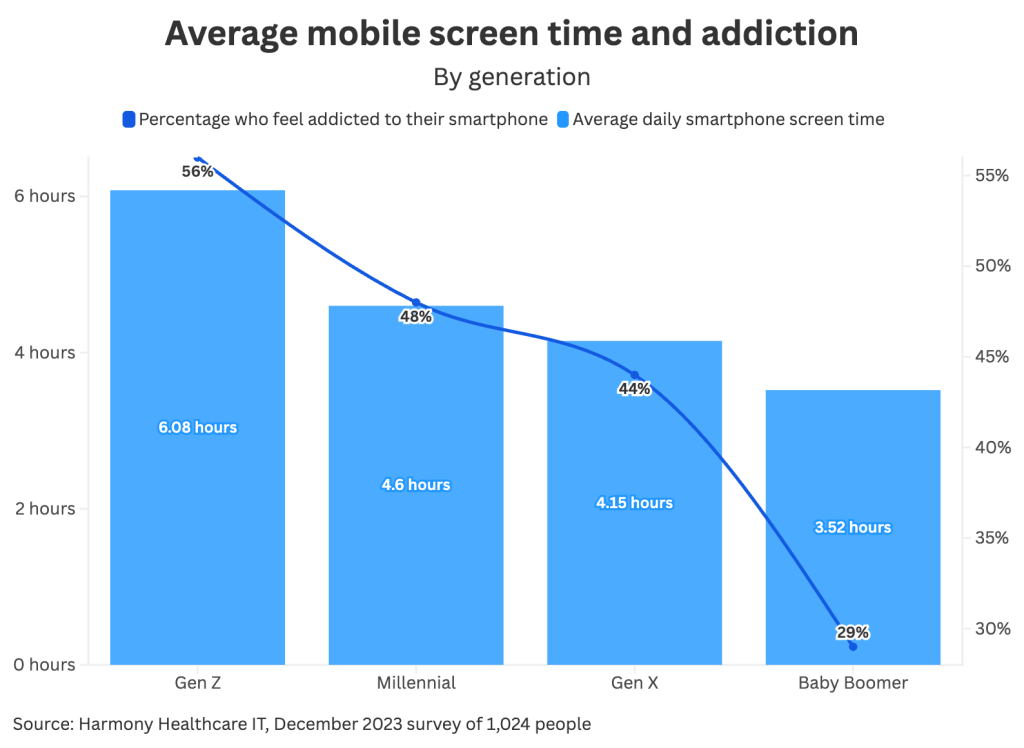
Younger generations lead the charge. A Harmony Healthcare IT survey conducted in January 2023 found that Gen Z averages over six hours daily on their phones, and . Including other screens, Gen Z clocks more than seven hours daily. Millennials follow at over 4.6 hours, with nearly half feeling addicted. Gen X hits 4 hours and some change, and Boomers trail at just under 4 hours.
Phones now also blur the line between work and downtime. An April-May 2022 survey of office workers by Zimbra found that say they reply to work messages after hours, showing how phones serve as both a productivity tool and a constant source of distraction.
What Americans do on their phones
Smartphones are central hubs for entertainment, shopping, and social interaction.
App usage shares
Smartphones today overwhelmingly favor apps over mobile browsers. According to , as of early 2025,
Social platforms
According to , YouTube, TikTok, Instagram and Snapchat are at the top of the list of apps or sites used by teens aged 13 to 17.
Search
Voice search is growing, with more than using it to search content hands-free, according to DataReportal鈥檚 Digital 2024 October Global Statshot Report.
Commerce and mobile money
Smartphones now drive and generate around 68% of orders globally, according to a Statista report. Global mobile e-commerce sales reached approximately $2.07 trillion in 2024 鈥� 鈥� and are expected to rise to , per Statista data highlighted in Oberlo鈥檚 Mobile Commerce Growth Report.
Mobile security tools
Smartphones aren鈥檛 just for scrolling. Many people also use tools like to identify unknown callers, and services to reconnect or verify identities directly from their mobile device.
Demographic differences in age and life stage
Most Americans get their on average, according to a 2022 Stanford Medicine study. Among teens, phone use is intense; as of 2024, just on social media, according to The Harris Poll in collaboration with author and social psychologist Jonathan Haidt.
Mental health and digital well-being debate
Smartphones may keep us connected, but they鈥檙e also raising new concerns about mental health, especially for younger users and anyone glued to their screens all day.
Addiction indicators
Smartphone reliance keeps climbing. A 2024 Reviews.org survey found that . Meanwhile, when they leave their phone behind.
Health impacts
Excessive use takes a toll. According to a 2024 study in the National Library of Medicine database, people logging more than two hours a day report and poor sleep. A literature review examining the relationship between among young people amid the pandemic found 鈥渃oncerning associations between prolonged exposure and behaviors such as self鈥恏arm and suicidal behavior.鈥�
Coping trends
Some are fighting back. According to The Harris Poll, have tried to cut back on screen time.
The American Academy of Pediatrics recommends , , and to build healthier phone habits.
Future trends to watch
Smartphones in 2025 are evolving fast, thanks to 5G, AI, and a growing push for healthier screen habits.
5G and AI integration
Phones are getting smarter. In 2025, more on-device AI, delivering smoother predictive text, more intuitive voice assistants, and highly personalized user experiences, according to Electronic Products.
Foldables and longer upgrade cycles
Foldable phones are gaining traction, with shipments , according to TrendForce. At the same time, Americans are keeping their devices longer 鈥� , according to Anthony Skiadas, Verizon鈥檚 chief financial officer, speaking at a conference in March. This trend points to a stronger consumer focus on durability and value over rapid upgrades.
The rise of digital wellness alternatives
More users 鈥� especially Gen Z 鈥� are resisting endless scrolling. In a 2024 ExpressVPN survey, from the U.S., the U.K., France and Germany said they take steps to limit screen time, showing a growing awareness and willingness to manage digital habits.
Emerging predictions to watch
Voice-first interaction is poised for growth as more people seek hands-free options, while mobile commerce gains ground in the South and Midwest. At the same time, 鈥渁pp-less鈥� super-apps could reshape the market by bundling services without crowding your home screen.
Redefining the relationship with our phones
Smartphones are part of daily life now: Most Americans have one, and most of us spend over four hours a day on them. They help us work, relax, and stay connected, but let鈥檚 be honest: They鈥檙e also taking over.
People are starting to notice issues with sleep and burnout, and the downsides of nonstop screen time are getting harder to ignore. The goal isn鈥檛 to quit phones, but to use them more thoughtfully.
was produced by and reviewed and distributed by 麻豆原创.