Stitch it, don’t ditch it: Resisting fast fashion through visible mending
Stitch it, don’t ditch it: Resisting fast fashion through visible mending
Once a month between April and October, a group of stitchers takes to the streets of Edinburgh, Scotland, making themselves comfortable on camping chairs decorated with hand-embroidered banners inviting people to #stitchitdontditchit. Equipped with sewing baskets and mending skills, they repair their garments in public and teach interested passers-by how to do the same.
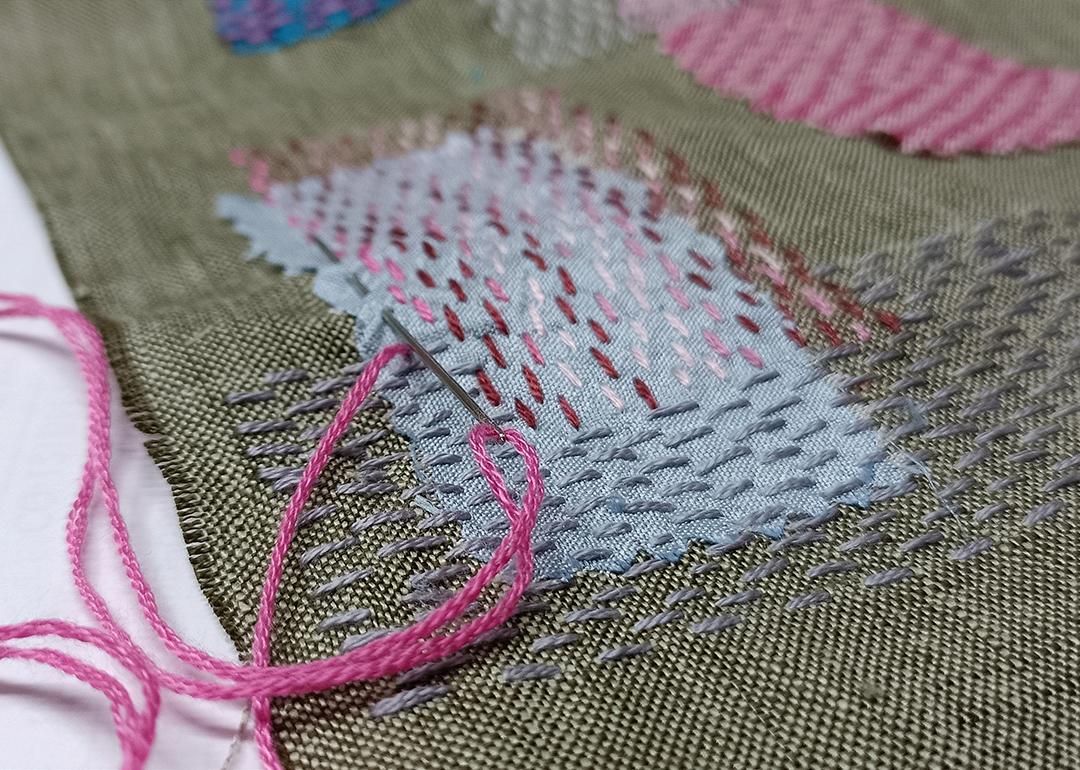
The Edinburgh Street Stitchers, as they call themselves, are part of a growing movement that is reclaiming the ancient art of mending. Historically, mending was done in private and in ways that concealed, rather than announced, the repair. Choosing instead to mend visibly—whether through the color of the stitching or by doing it in a public location—is a statement and a conversation starter, says.
“You are clearly stating that you have kept this from a landfill,” says Kate Sekules, a mender who teaches fashion history at the Pratt Institute in New York City’s borough of Brooklyn, and is pursuing a PhD in the history and theory of mending. “It’s also got the advantage of making everything you own unique and special. And when you’ve invested time and energy and thought and craft into your clothing, you value it so much more.”
Inspired by the global movement, the former pharmacist Mary Morton started the Edinburgh group in 2022, three years after a discussion with her son sent her down a rabbit hole of research and learning about the climate crisis. “At the end of all of that, I was absolutely horrified. I thought, ‘What can I do about it?’” she recalls.
Volunteering at the , which is working to reduce waste in Edinburgh, she learned about the high carbon impact of textiles—producing a kilogram of fabric . “I’ve always done a bit of sewing, so I thought teaching people how to sew and repair their garments was something I could do to help,” says Morton. She started teaching sewing at the cooperative’s Zero Waste Hub, but quickly realized she was preaching to the choir. “I wanted to do something to reach out to the broader community and make them aware of the situation,” she says.
The term “fast fashion” was coined by the New York Times in 1989 to describe Zara’s business model, which turned a designer’s idea into a garment available to consumers in only 15 days. Today’s ultra-fast fashion retailers have further accelerated the pace of production: Shein, for example, has created 52 micro-seasons per year and adds up to . With plummeting prices and a rising throwaway culture, by 2014, people were buying than at the turn of the millennium, and keeping them for only half as long.
Today the fashion industry is responsible for , and the dyeing and finishing of textiles causes . Due to energy-intensive production and long supply chains, the apparel industry is responsible for —more than aviation and shipping combined.
The quiet, simple act of mending can go a long way toward reducing these impacts: According to research by the climate action NGO WRAP, prevent the purchase of a new one, and extending the life of an item of clothing by only nine months reduces its carbon, water and waste footprint by .
“One of the other big benefits is to normalize mending again,” says Morton. For most of human history, textiles were time-consuming to produce and expensive to buy, so mending them was second nature, says Sekules. Repairs were often visible out of necessity, since matching thread to existing fabric was a costly and often impossible proposition. One of the oldest extant examples of visible mending is a in the Whitworth Geller’s collection in Manchester, England, though the practice is far older than that. Over millennia people across the world developed their own distinct techniques of darning, embroidery and appliqué, using colorful patches or designs to hide holes and stains. “It was made to seem deliberate, because it was a shameful sign of poverty to look as if you’ve been mended,” says Sekules.
As mending fell out of favor in Europe and the U.S. in the late 20th century, the skills associated with it were also lost over time. “As far as we can tell it used to be passed down the maternal line since time immemorial,” says Sekules. “Then we forgot about it—culturally, it was just no longer a skillset we needed.”
In recent years a growing opposition to fast fashion has coalesced under the umbrella of Slow Fashion, a movement championing quality over quantity and responsible use of resources. “People are becoming more aware that the way we produce is harmful to people and the environment,” says Sam Bennett, maker, researcher and one-half of the duo behind , which takes mending commissions and offers online and in-person mending workshops. “It’s a smaller, quieter form of activism that I think is really exciting.”
The resurgence of mending coincided with early Instagram, with visible mending especially well-suited to such a visual medium, and menders like Celia Pym and Tom van Deijnen started to document their mends on the platform in 2014. “Those posts and popularity then allowed for people to create public workshops, publish books and so on,” says Bennett, who is documenting how mending skills have been passed on over the past 300 years. Much of the skill-sharing has also moved to virtual spaces, which makes it accessible to anyone with an internet connection. But while they serve their purpose, online workshops don’t have quite the same magic, says Bennett: “It really started with community and sitting side by side with someone. And I think that in the end, that is still the most successful way to learn.”
also owes its popularity to Instagram, though the heart of the work remains resolutely analogue. In 2021 the artist and craftivist Suzi Warren sat in front of Primark in London to mend a pair of leggings bought there, inspired by Orsola De Castro’s book . “It was a lovely experience—the gentle act of repair outside on a warm day—and as many people stopped me to ask what I was doing, it was pleasantly conversational and rewarding,” remembers Warren.
Posting a photo on Instagram and inviting people to join her, she was blown away by the response as people across the world offered to do the same in solidarity: “We all gathered at the same time on the same day, and it was so well-received by the public, and so enjoyed by the stitchers, that it quickly became a regular event.”
Today, Street Stitching has groups in 40 locations across the U.K. and 30 countries around the world. “It was very important to me that this was not a protest,” says Warren. “It was a persuasion. To demonstrate what we want more of rather than get angry about what we want less of.” While the menders generally form a line through a popular shopping area, they are distanced far apart so as not to block passers-by, and silently work on their own mending, only offering information or a QR code that leads to mending resources if someone is interested. “That is the joyful disruption,” says Warren. “Disrupting their unconscious, automatic thinking by showing there is another option to buying new.”
The public’s response to their actions has been overwhelmingly positive, says Warren. Only once, a police officer approached to ask what they were up to. “I explained that we were mending our socks,” says Warren. “He laughed and asked if we’d sew the lining of his pocket up. Which we did.”
Unlike any other time in history, mending clothes now often requires more time, money and effort than buying a cheap new garment. “It’s a luxury because it requires so much time,” says Sekules. “There’s always that taint of it being only for rich white ladies in Europe.” But there’s a deep history and diverse community around mending that goes far beyond the white-skewing image presented on Instagram, says Sekules, who collaborates with people like Hekima Hapa of and Ngozi Okara of . Bennett, whose work through Repair Shop includes online courses as well as in-person projects with public institutes like the Brooklyn Public Library and the High School of Fashion Industries in Manhattan, also notes that the demographic can be very different depending on venue and format.
To many menders, the community aspect is just as important as the repaired garments. “It really helps people feel part of a community and to feel included and engaged, regardless of how excluded they feel from the rest of society,” says Morton, whose sewing group at SHRUB includes many young people from the LGBTQ+ community. Bennett finds that a mending circle is the perfect setting for deep meaningful conversations, and has set one up as part of her PhD work exploring the connections between caring for objects and caring for our bodies and other people: “When you’re working with your hands, a lot of times it allows for you to focus on something and have more honest conversations, rather than being nervous if you’re just staring at someone and talking.”
“Mending is a technique and a decision and a way of life,” says Sekules. “Once you mend, it changes you.”
Living Paradigms is a series about what we can learn from the customs and cultural practices of others when it comes to solving problems. It is sponsored by .
was produced by and reviewed and distributed by Â鶹ԭ´´.