
This story originally appeared on Medical Technology Schools and was produced and distributed in partnership with 麻豆原创 Studio.
How hospital employment has changed in Boston
Hospitals have added more than half a million jobs nationwide over the past decade. Just in the past year, , or about 3%, Bureau of Labor Statistics data shows. The U.S. population is growing and aging, and people are living longer. As a result, health care jobs鈥攊ncluding those at hospitals鈥攁re .
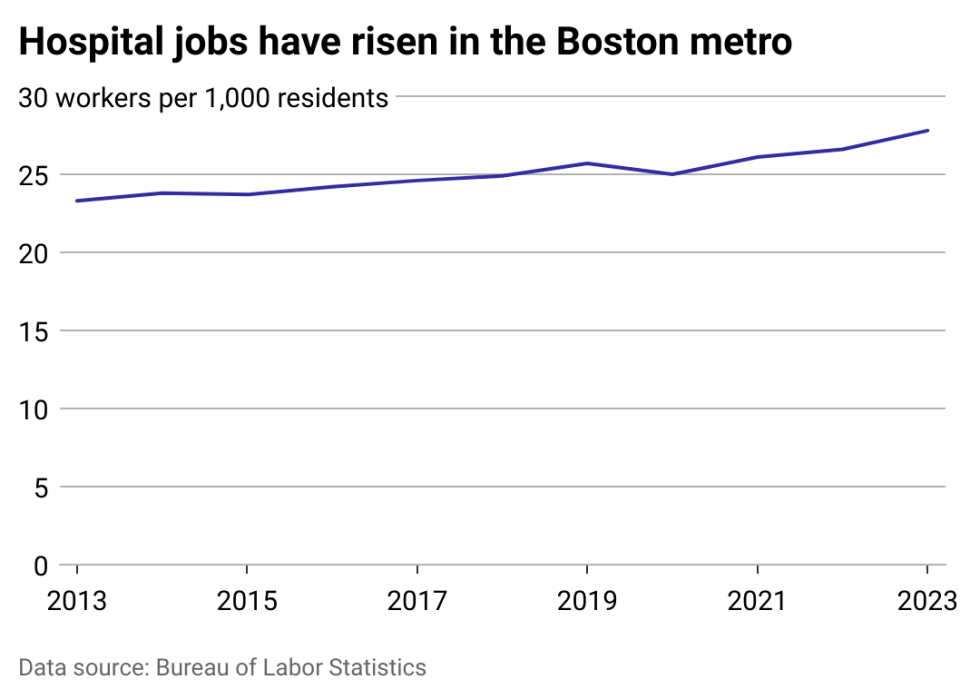
used to chart how employment at Boston hospitals has changed in recent years as part of a . Data were not seasonally adjusted.
Most metros saw sizable increases in hospital workers per capita over the past 10 years. However, a few saw those ratios decrease amid a shortage of doctors, nurses, and other medical professionals. U.S. health facilities may vacated by retirees and career switchers, let alone find professionals to fill new roles. Health care providers are experiencing , and some hospitals鈥攑articularly in rural areas鈥攆ace . Still, in addition to per capita figures, overall hospital employment grew in all but four of the metros included in the broader analysis.
Hospital jobs in Boston and beyond
There are about 136,200 people employed at hospitals in the Boston metro, up 26,800 workers (24.5%) from 2013. Since last year, hospital employment has grown about 4.4%.
By volume and per capita, most metros have grown their hospital staffs to some degree over the past decade.
Tampa led the cohort in hospital growth per capita. The metro's population is , and its hospitals have followed suit. In addition to , the region's leading . Last year, Tampa General opened a new rehabilitation hospital, and now it's in the midst of a 500,000-square-foot hospital expansion that will create nearly 6,000 jobs.
Tampa isn't the only part of the Sunshine State with an abundance of hospitals鈥攁nd for good reason. In 2019, Florida for new hospitals. Now, dozens of them are going up across the fast-growing state. While ease of access for many residents may improve, KFF Health News reported that having more hospitals could end up escalating health care costs.
That fear is what led Massachusetts to in Boston, where government approval is still required. Despite a few rejections and repeals, several hospitals throughout the metro are building capacity, including , , , and .
The COVID-19 pandemic , adding urgency to upgrade and add hospital beds throughout the city. Boston is an international hub for medicine and life sciences, so it's unsurprising it is among the metros leading the country in hospital employment gains.
Not every metro is experiencing the same surplus. Hospitals in San Francisco鈥攁nd across California鈥攈ave faced consolidations and closures due to financial and staffing challenges. Dr. Renee Hsia, a professor at the University of California San Francisco's Department of Emergency Medicine, that health care services are often reduced in areas where more patients rely on Medicare and Medicaid to pay their bills, rather than private insurers. In turn, remaining hospital resources are strained: Emergency room , often forcing ambulances to be rerouted to another facility due to a lack of hospital beds.
Hospitals in Maryland are facing more acute staffing shortages, particularly among nurses. A 2022 report found that , with the highest vacancy rates in the Baltimore and Washington D.C. metro areas. In addition to the nursing shortages plaguing the country as a whole, Maryland is also in the midst of a , exacerbating the situation and keeping travel nurses from entering the equation.
In Maryland and other parts of the country, hospitals, governments, and colleges are trying to close staffing gaps with higher pay for medical workers, increasing health care worker visas, new medical schools, tuition reimbursement programs, and stronger job placement pipelines.
This story features data reporting and writing by Paxtyn Merten and is part of a series utilizing data automation across 20 metros.