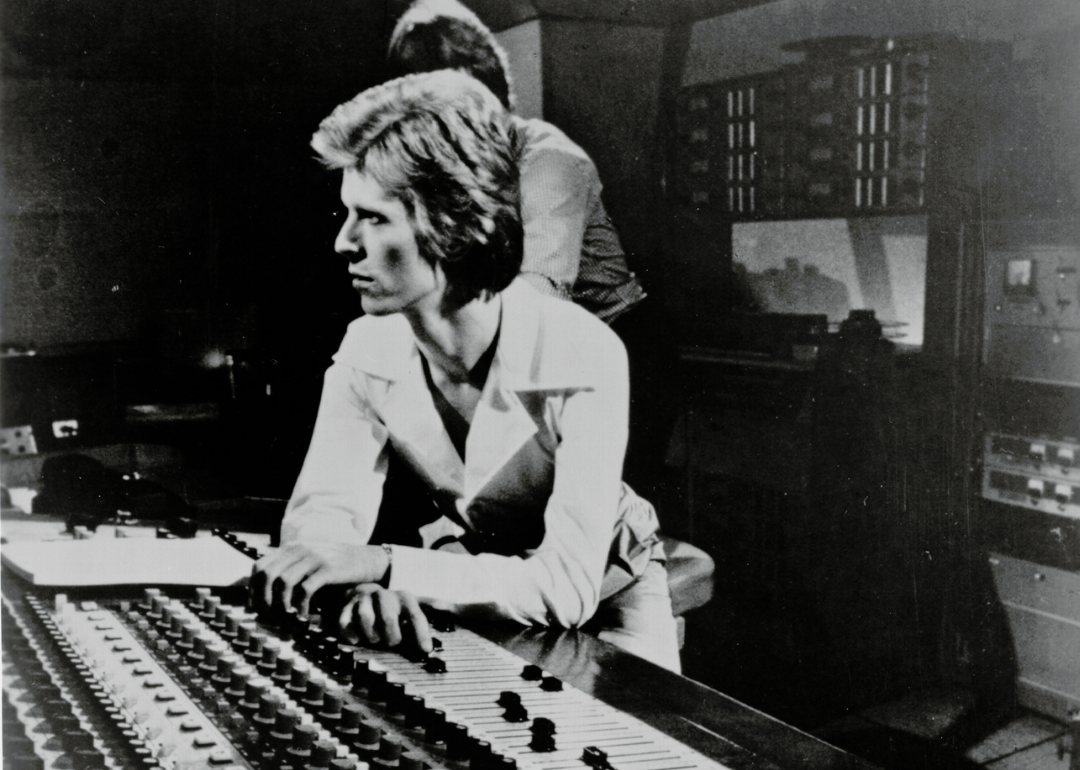
Stories from the studio for 25 of the best '70s albums
Stories from the studio for 25 of the best '70s albums
The recording studio's beginning dates back to the 19th century, and came about thanks to early inventors like Thomas Edison and Alexander Graham Bell. Studios began popping up in major cities worldwide around the time of World War I. The most well-known studios like Sun Studios, Abbey Road, Muscle Shoals, Electric Lady, Motown, Sunset, and Trident have become as famous as the musicians who have played behind within walls. With every album made inside the studio come stories that are awe-inspiring, funny, and sometimes heartbreaking.
Â鶹ԭ´´ compiled a list of 25 stories of famous 1970s artists and their albums from inside the recording studio using music news sites like The Guardian and Rolling Stone. Some artists are featured more than once.
Whether stories of studio screw-ups that often proved to be serendipitous happy accidents, haunted happenings, places that became makeshift studios to suit the band or the artistic demands of the album, or in-studio technologies and innovations, these stories from the studio shed new light on the fun and fascinating world of not only the music industry, but also the recording studios that are a major part of that world.
Join Â鶹ԭ´´ in a journey into some of the most beloved recording studios—from the major players to mobile recording studios to yachts and mansions that have served as studios away from the studio.
1970: ‘Fun House’ by The Stooges
The Stooges’ second album, “Fun House,” truly was fun—to record. After their first self-titled debut album generated little buzz, the pressure was off, and the band was able to return to the studio and get creative. With the help of former Kingsmen keyboardist Don Gallucci, who ran the recording sessions, the band simply played the songs they had written multiple times, and Gallucci sorted through them later to figure out what to use, which was no easy task, though the effort produced a memorable album.
1970: ‘Emitt Rhodes’ by Emitt Rhodes
Emitt Rhodes’ first band, The Merry-Go-Round split up after one successful single. Undeterred, he set up his own studio in his family’s garage, which was unorthodox and hadn’t really been done at the time. There the home recording pioneer played and recorded all the instruments onto one track and his vocals onto another using a second-hand Ampex 4-track machine. His home recording studio served him well, and his 1970 self-titled debut album would go on to become a hit and a successful cult classic.
1972: ‘Machine Head’ by Deep Purple
Deep Purple borrowed The Rolling Stones mobile studio to record its 1972 album, “Machine Head,” after a Frank Zappa concert in the Casino at Montreux, Switzerland, where a fire broke out after someone in the crowd shot off a flare gun. The incident inspired their hit, “Smoke on the Water,” which they wrote and recorded within days of the incident at a local hotel with help from the mobile studio. Band frontman Ian Gillan , “We set the gear up in the hallways and the corridors of the hotel, and the Rolling Stones’ mobile truck was out back with very long cables coming up through the windows. We tried to re-create an atmosphere in a technical sense the best we could.”
1972: ‘Exile on Main Street’ by The Rolling Stones
For arguably one of the greatest Stones’ albums ever, the cavernous basement of a French mansion served as a recording studio, with a little help from a mobile recording unit. The recording was frenetic with Keith Richards’ excessive drug use, the constant parties, and the rumored supernatural events that occurred at the Villa Nellcote, which the band used because they’d been kicked out of the United Kingdom for tax issues. The three-story basement was covered with shag carpeting to help with sound, and engineer Andy Johns and producer Jimmy Miller ran between the cellar and the mobile unit while played out in the mansion.
1972: 'Trilogy' by Emerson, Lake & Palmer
"The Sheriff," a song off Emerson, Lake & Palmer's 1972 album, featured an additional and unexpected lyric. When Palmer accidentally hit his tom-tom rim with a drumstick, during a drum solo, he uttered a brief expletive. The minor mishap was left in and added a bit of levity to the song and album.
You may also like: The best streaming services in 2021
1973: ‘Dark Side of the Moon’ by Pink Floyd
Pink Floyd’s epic 1973 album featured an interesting technique where Roger Waters interviewed staffers at Abbey Road, the studio where they were recording. After asking 20 people questions (including Paul McCartney, who Waters as in he tried to be funny, which made his responses unusable), the recorded material was edited and layered onto tracks throughout the album. The studio’s doorman, Gerry O’Driscoll, contributed one of the album’s classic lines during his interview, when he was asked, “What is the dark side of the moon?” and he responded “There is no dark side of the moon, really. Matter of fact, it’s all dark. The only thing that makes it look light is the sun.”
1973: ‘Burnin’’ by Bob Marley and The Wailers
It seems only fitting that an album called “Burnin’” has a story from the studio about a marijuana mishap. While piecing together different sections from different takes of “I Shot the Sheriff” for the 1973 album, bassist Aston Barrett handed Island Records’ engineer Phill Brown a large joint. Brown proceeded to almost ruin the only cut of the song and , “I was just about to cut, when the joint fell apart. It melted the tape. Outside the door are Bob Marley and The Wailers: heavy street guys from Trench Town—they weren’t a bunch of kids from Epsom. I don’t know what would have happened if they had seen it, but I managed to repair it, and no one ever heard about it.”
1973: ‘Sabbath Bloody Sabbath’ by Black Sabbath
When Tony Iommi, Black Sabbath’s songwriter and guitarist, sat down to write the band’s fifth album “Sabbath Bloody Sabbath” in 1973, he was plagued with a wicked case of writer’s block. They eventually headed to Clearwell Castle where the band members found themselves setting up equipment in the old castle dungeons, which would serve as their recording studio for the title track of the album. Once there, the block lifted, and the band finished up its time at Clearwell without incident, minus of the castle.
1973: ‘Band on the Run’ by Wings
Paul McCartney left Britain to record at EMI’s studio in Lagos, Nigeria, thinking it would be relaxing, but when he arrived with the remaining members of Wings, it was to a poverty-stricken place, under a military dictatorship. The conditions in the studio were no better. In the middle of one session, McCartney had a bronchial spasm from smoking too much and collapsed, and Nigerian musician and activist Fela Kuti accused the former Beatle of exploiting Indigenous music.
1974: 'Second Helping' by Lynyrd Skynyrd
Every Skynyrd fan, or person who has ever listened to the radio, is familiar with the opening to mega-hit "Sweet Home Alabama"—"Turn it up." What people may not know is that it was actually a studio mishap. The band's frontman Ronnie Van Zant couldn't hear the track when he was laying down vocals, so he asked producer Al Kooper and studio engineer Rodney Mills to turn the volume up and created an unintentional lyric that remained in the song, becoming an epic and well-loved part of the classic rock gem from its 1974 second album.
1974: ‘Pussy Cats’ by Harry Nilsson
When friends John Lennon and Harry Nilsson decided to head into the studio to record a 1974 album together, which Lennon produced, things got intense. For the drug-addled album, they tried to compete with each other to see who had the loudest voice, which caused Nilsson to blow out his voice and did irreparable damage. The album features an unusual arrangement of songs that make little sense.
1974: ‘Not Fragile’ by Bachman-Turner Overdrive
Bachman-Turner Overdrive’s 1974 album “Not Fragile” featured the Randy Bachman penned hit, “You Ain’t Seen Nothin’ Yet.” While in the studio, Bachman jokingly recorded a track of him stammering the song’s main line, “You ain’t seen nothin’ yet,” to poke fun at his brother Gary, who had a stammer. While the band never intended to use the track on the album, the record company heard it and insisted, and the song became the band’s only #1 hit.
1975: ‘Rock ’n’ Roll’ by John Lennon
John Lennon hired Phil Spector to help with his 1975 album “Rock ’n’ Roll,” and Spector’s wild behavior included shooting a gun in the studio control room inches from Lennon’s ear to which the singer yelled, “Phil, if you’re going to kill me, kill me. But don’t f**k with my ears. I need ’em.” Spector also chased Lennon through the studio with a gun while screaming threats and charged Capitol Records $90,000 for the album’s master tapes that he’d stolen.
1975: ‘The Original Soundtrack’ by 10cc
The third studio album from the British band 10cc featured its hit “I’m Not in Love,” which made it onto the Billboard Hot 100. Not only was the song a soaring success, but it featured some interesting techniques in the studio. To create the song’s unique-sounding background ‘choir,’ a 16-track mixing desk and a chromatic scale were used with each member singing one note, multiple times, on the chromatic scale, which created a “wall of sound” featuring 256 voices.
1975: 'Toys in the Attic' by Aerosmith
Steven Tyler has a shoddy memory when it comes to recording the band's 1975 album, though it contained some innovative ideas like the band's use of a talk box for its hit "Sweet Emotion," which Joe Perry made after learning how from a Led Zeppelin roadie. Perry also says they put amplifiers out by street dumpsters, which accounts for the traffic sounds that can be heard in the album's title song.
1975: ‘Wish You Were Here’ by Pink Floyd
For the legendary 1975 album, Pink Floyd was inspired—on the title track and the psychedelic “Shine On You Crazy Diamond”—by former frontman Syd Barrett. Barrett’s mental instability and drug issues forced him out of the band, and David Gilmour came in as a replacement. While the band was in the studio, working on “Shine On You Crazy Diamond,” Barrett showed up with shaved head and eyebrows, almost unrecognizable, looking as lost and distant as his bandmates remembered.
1976: ‘Station to Station’ by David Bowie
The musician’s 1976 album was a reflection of the singer’s dark, drug-fueled days in Los Angeles. The album focuses on an interesting character, The Thin White Duke, a tortured soul into cocaine and the occult and a reflection of Bowie. The interesting thing about the recording of “Station to Station” is that despite all the chaos in his life, those who were in the studio with the rock legend said he brought his A-game every single day, though that Bowie remembered little of his time recording the album and has said, “I know it was [recorded] in L.A. because I’ve read it was.”
1977: ‘Low’ by David Bowie
David Bowie left Los Angeles in 1976 after a difficult time with drugs and retreated to Château d’Hérouville in Paris to work on his 1977 album “Low.” The rock star both recorded and lived in the opulent chateau that housed some interesting ghostly visitors, which found Bowie refusing to stay in one of the bedrooms due to cold spots and a strange feeling, and producer Brian Eno swearing someone shook his shoulders early in the morning, but no one was there. Bowie was also going through a divorce and a custody battle, and when his ex, Angie, showed up to the studio, Bowie and the new boyfriend she brought along had a fight.
1977: ‘Rumours’ by Fleetwood Mac
The recording of rock band Fleetwood Mac’s 1977 album was a drama-filled, rock soap opera for the ages. Lindsey Buckingham and Stevie Nicks had split, Christine McVie and bassist John McVie were going through a divorce, and Mick Fleetwood and Nicks would begin an affair. While it was a turbulent time for the band, it was also a creative one as well, and the album was filled with the sort of brutally honest lyrics only romance’s beginnings and endings can bring.
1977: 'Rock 'n' Roll With The Modern Lovers' by The Modern Lovers
For their 1977 album, the band simply couldn't find the sound in the actual studio, so they got creative and moved all the equipment to a more fitting location, the bathroom. Once settled into the men's room at CBS Studios in San Francisco, things still didn't sound right, so they moved to the ladies' room. That didn't work, so they shifted back to the men's room.
1977: ‘Bat Out of Hell’ by Meatloaf
While recording his 1977 album “Bat Out of Hell,” with producer Todd Rundgren and songwriter Jim Steinman, Meatloaf swore he saw ghosts. The apparitions appeared to the musician at the house that was next to the acclaimed New York recording facility, Bearsville Studio, and led Meatloaf to take too many sleeping pills after the spirit became more aggressive and ripped the singer’s blankets off. He the disturbing incident on the Lifetime series, “The Haunting of … ,” in 2015.
1977: ‘Death of a Ladies’ Man’ by Leonard Cohen
While it was an unlikely match, Leonard Cohen worked for weeks with Phil Spector on a dozen songs for the 1977 album “Death of a Ladies’ Man.” Once the two headed into the studio, things went downhill. One evening, Spector pulled a gun on Cohen, shoved it against his neck, and told him he loved him. In response, Cohen pulled the gun away and said, “I hope you do, Phil.”
1978: ‘London Town’ by Wings
Most of the band’s 1978 penultimate album was recorded in an interesting makeshift studio on a boat. The luxury yacht cruised through the Virgin Islands, while the band swam and relaxed between recordings, which may have negatively impacted the album that many fans and critics didn’t consider the band’s best, though they did have a #1 song, “With a Little Luck.”
1979: ‘Breakfast in America’ by Supertramp
Supertramp’s album came out in 1979 and featured its mega-hit “The Logical Song,” which won an Ivor Novello award for best song musically and lyrically. While the song was based on Supertramp singer and keyboardist Roger Hodgson’s own life and penned by him, and he spent two weeks in the studio working on the final version, there was also a part of the song that was unplanned, the result of a happy accident. Someone in the studio was playing a Mattel electronic football game and as , “We’d hear that sound over and over, coming from the other room. I think, at some point, we decided: Why don’t we put the sound on it? And it worked. We were always looking to create new sounds,” which is how the distinctive stutter of “D-D-D-D-digital” came about.
1979: 'Unknown Pleasures' by Joy Division
"Unknown Pleasures," Joy Division's 1979 album, was recorded in a studio co-owned by two members of the British band 10cc, Eric Stewart and Graham Gouldman. Not only was Strawberry Studios in Stockport, England, outfitted with a state-of-the-art 24-track setup, but it was also freezing cold. Producer Martin Hannett, who was also a demanding perfectionist, liked to keep the air conditioning up and said it was helpful to Chris Nagle, the engineer, because he had diabetes.
You may also like: The best streaming services for sports in 2021