$50 a week for 40 weeks: How no-strings cash changed the lives of teens
$50 a week for 40 weeks: How no-strings cash changed the lives of teens
NEW ORLEANS — Kapri Clark used the $50 to help pay for her braces. Lyrik Grant saved half of it and used the rest for dance classes. Kevin Jackson said he squandered the cash on wings, ride shares for dates, and some DJ equipment he later tossed.
For the past five years, Clark, Grant, Jackson, and hundreds of high schoolers in New Orleans have shopped — or saved — as part of a project to explore what happens if you give cash directly to young people, no strings attached.
“That was the most helpful thing ever,” said Clark, now a student at the University of Louisiana at Lafayette, who said she could still use that extra cash.
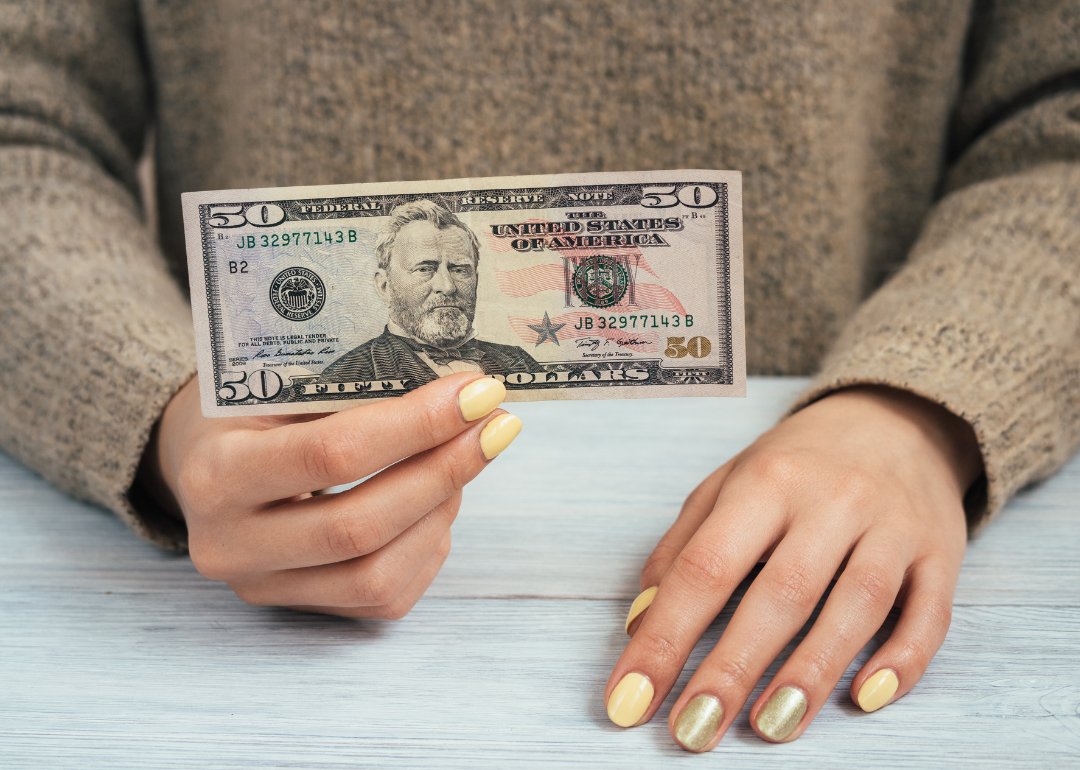
“The $50 study,” as it’s known, began at , a local charter school, as an experiment to increase attendance. The study has since grown to eight other high schools in the city, as well as Rooted’s sister campus in Indianapolis, with students randomly selected to receive $50 every week for 40 weeks, or $2,000 total. By comparing their spending and savings habits to a larger control group, researchers wanted to figure out whether the money improved a teen’s financial capability and perception of themselves. They also wanted to know: Could the cash boost their grade-point averages and reading scores?
Now, as the experiment expands to Washington, D.C., and perhaps Texas, a final report of the $50 study suggests a little bit of spending cash can make a difference in young people’s lives.
The report, , shows students who received the cash payments were slightly more likely to attend school than those who didn’t. Academic performance did not differ between the groups. But financially, the extra cash helped students acquire stronger long-term planning skills and familiarity with savings accounts and other financial products, explains. They ended the study, on average, with $300 saved away — a 15% savings rate, triple the for American adults.
“When young people are given the opportunity to manage money in low-stakes environments, they build the habits that shape long-term financial health,” said Stacia West, an associate professor at the University of Tennessee, Knoxville, and co-founder of the Center for Guaranteed Income Research, which partnered with the Rooted School Foundation to run the study. “The short-term habits we’re seeing are laying the foundation for lifelong financial capability.”
Across the United States and the globe, have tinkered with some form of universal basic income, or UBI, a social welfare program that provides people with regular cash payments to meet their needs. Direct cash transfer programs like the $50 study or the child tax credit for families are similar, but they often provide smaller amounts and target specific populations to boost a person’s income. have linked UBI to and better employment and .
In the U.S. and Canada, researchers have found links between cash transfer pilots that focus on low-income families and better test scores and graduation rates for their kids. So far, though, few experiments have targeted young people or examined how the programs influence their lives specifically.
“There’s a deep, deep distrust that we adults have of young people,” said Jonathan Johnson, CEO of the Rooted School Foundation, which operates the network’s four charter schools. “That distrust is to their detriment.”
In New Orleans, roughly four in five of Rooted students come from economically disadvantaged families, and during the pandemic, many struggled to prioritize school. Some students skipped class to provide child care for their working parents, or because they needed to work themselves, according to Johnson. With some seed funding from a , Rooted started a “micropilot” to test whether cash could help students make ends meet and get themselves to school.
The original cohort included 20 students, half of whom received the $50 payment. In that , those receiving the cash saw their material well-being improve, meaning their family could more easily afford rent or utilities, and they gained skills around setting financial goals. Rooted added students from its Indianapolis campus and another high school in New Orleans, G.W. Carver. And for their final report released this week, researchers sifted through the spending and survey data from 170 students who received the cash payments and 210 students who did not.
The two-year report found students in the treatment group attended 1.23 more days of school, and spent close to half their funds on essentials like food and groceries. The report also noted that 70% of all students at the participating schools qualify for subsidized meals, suggesting “this spending may reflect efforts to meet immediate nutritional needs.” One 12th grader in a survey mentioned using the money to feed their siblings.
Kapri Clark recalled waiting every Wednesday morning for the $50 deposit to appear in her banking app. And every Wednesday afternoon, during her senior year at Carver High School, she put that money toward her $200 bill for braces she covered out of pocket.
She braided hair to cover the rest, and still books clients when she has time in between her studies to become a nurse at the Lafayette campus. Even in college, Clark can see the need for some supplemental income for herself and her peers.
“I make enough to take care of myself, but I watch every dollar,” said Clark. “There’s a lot of people struggling in life to eat, to live. Think if they got kids.”
Read Irvin, chief of staff for Collegiate Academies in New Orleans, a network of five charter high schools that includes Carver High, said the $2,000 had provided the extra incentive a few students needed to stick it out until graduation. “That’s incredibly impactful for their life trajectories,” she said.
In January 2024, the city of New Orleans invested $1 million to bankroll another extension of the study, as part of an economic mobility initiative that tapped federal Covid relief funding. During the pandemic, a skyrocketing and in overall crime had convinced the city to help more residents, especially young people, find stability.
“Research shows that people who are economically stable are less likely to commit crime,” said Courtney Wong, the city’s deputy director of economic development.
The city funding not only expanded the $50 study to nine high schools, it also set a longer timeline for the research: About 800 seniors who participate will have their data tracked for 18 months after their graduation.
A former high school teacher and administrator, Wong said $50 could have made a difference in the lives of many of her former students.
“This targets young people in that perfect moment,” she said. “They’re in the right spot where even a little amount of help could have big, positive impacts before issues of crime or unemployment or things like that even come up.”
Researchers also found students who received the $50 reported greater agency. They felt more control over their finances and more confidence about making long-term financial decisions. Students, according to the report, aligned their spending to future goals such as college prep classes and getting a driver’s license.
Lyrik Grant, a rising junior at Carver High School, is the second-youngest of six kids with two working parents. She could ask them for help, but the $50 allowed Grant to afford the tights and tops she needed for dance class on her own. The money helped cover a college entrance exam, which she aced, and Grant wants to learn how to drive soon.
“My first thought was: What am I going to do with all this money?” Grant said, adding that the cash helped some of her classmates find financial stability. “Children don’t always want to spend their parent’s money, and some parents don’t always have money to give them.”
Still, for some students, the money wasn’t exactly life-changing. Irvin of Collegiate Academies said many used the cash to “just be teenagers.”
That was true for Kevin Jackson, a rising junior at Rooted School New Orleans.
“It’s cool to get free money,” he said. “I was spending it on the TikTok shop: posters, keyboards, lights — stuff I liked, not stuff I actually needed.”
Despite the studies that show a positive impact from UBI, many Americans of the idea of a federal program that gives unconditional financial support to people. Aditi Vasan, a pediatrician and researcher at PolicyLab at the Children’s Hospital of Philadelphia, said skeptics often worry about recipients using public dollars for drug use or other illicit behavior, even though does not support that.
Still, that fear will likely keep any large-scale cash transfer program from being adopted in the United States any time soon, she said.
“That concern exists certainly for cash transfers in general but might be particularly magnified for teens,” Vasan said. “We’ve not seen that play out in the evidence from the quality studies that have been done.”
Next year, in Washington, D.C., the nonprofit Education Forward will fund a pilot of the $50 study with 40 high schoolers. The Rooted school network resumed talks, meanwhile, to take the study to neighboring Texas, after state lawmakers earlier this year failed to pass that threatened to ban local governments from adopting guaranteed income programs.
Talia Livneh, senior director of programs for the Rooted School Foundation, said the politics may need to catch up to the research.
“I don’t think what we’re doing is so radical. I believe this just works,” she said. “Kids don’t lack character. They lack cash,” Livneh added. “They deserve deep, deep trust that students and people know what’s best for them.”
It’s been four years since Vernell Cheneau III received the $50 for 40 weeks while a student at Rooted in New Orleans, and his economic life isn’t easy. He struggled for months to find part-time work in his hometown. But on a recent summer morning, the same day he finally received a job offer, Cheneau recalled what he learned from the study.
“You learn that money goes fast, especially if it’s free,” said Cheneau, 22.
As a student, he tried to use the money to build some credit history. Since then, he’s learned the full cost of being an adult in America: health care, fuel, and maintenance for his car, getting your hair done before a new job. Cheneau has also spent that time trying to convince friends and family to support UBI.
Most oppose giving “free” money to people, he said. “How much does it cost to feed children? Get to work? We can’t just allow people to drown.”
“Everything costs something,” Cheneau added. “If you’re stuck in a rut, it’s expensive to restart. In this country, it’s expensive to be poor.”
was produced by , a nonprofit, independent news organization focused on inequality and innovation in education, and reviewed and distributed by Â鶹ԭ´´.