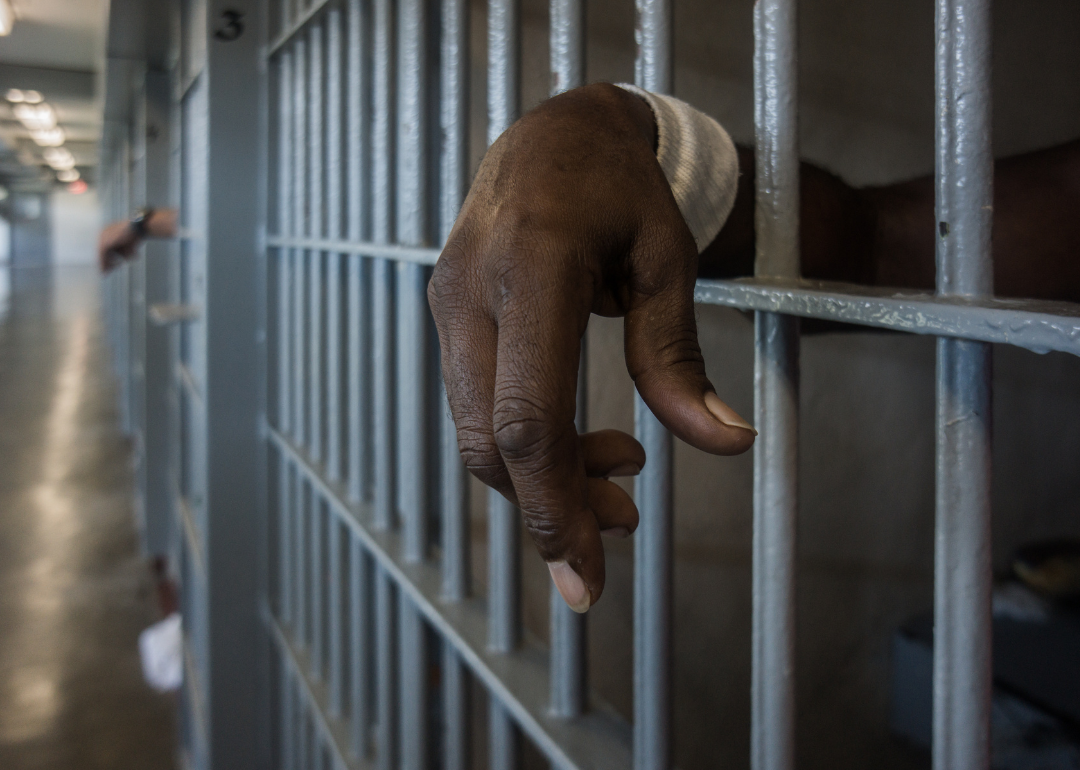
"Concrete Coffins": Surviving extreme heat behind bars
"Concrete Coffins": Surviving extreme heat behind bars
Sweltering doesn't even describe it.
In July of this year, more than a third of the U.S. population was . Dozens of major cities and states have , including Baton Rouge, Louisiana, which .
Less than an hour from the city is Louisiana State Penitentiary, better known as Angola Prison, where the state , in a building that once housed adults awaiting execution.
A federal court filing on July 17 from the Louisiana American Civil Liberties Union alleges that the youth at Angola face inhumane conditions, in large part because they are . In a statement to the court, medical expert Dr. Susi U. Vassallo called the practice "foolhardy and perilous," and said, "I would not dare to keep my dog in these conditions for fear of my dog dying."
This June and July at the prison, , which the National Weather Services classifies as .
In 2021, Louisiana to study what it would cost to cool all of its prisons with air conditioning, but . In the meantime, adults at Angola 鈥� the state's largest facility 鈥� struggle for relief. "It's over 100 degrees in there. I lie on the floor. I barely can breathe. God, it feels like it's suffocating!" an unidentified person told The Advocate.
took a close look at the dangerous and potentially negligent state of prisons in extreme heat zones and how extreme heat conditions are affecting both prisoners and prison workers.
It's hardly just a Louisiana problem. Texas is the state , as it is both the in the country, and one of the , second only to Florida. More than two-thirds of Texas state prisons . In May, 鈥� which had passed the state House 鈥� that would have invested half a billion dollars into air conditioning prisons over the next eight years.
Texas behind bars since 2012, But a concluded that 271 deaths in Texas prisons between 2001 and 2019 "may be attributable to extreme heat days." A separate nationwide found that for every 10 degrees above the average summer temperature, prison deaths increase by 5.2%.
The Texas prison system does have a program for sorting out which people are most sensitive to the heat and transferring them to so-called "cool beds" at prisons with air conditioning, largely because of lawsuits. Those left behind .
This past June, the New York Times interviewed more than a dozen currently and formerly incarcerated people about the during extreme heat. Several reported flooding their cells and lying on the wet concrete for relief, while others scream or light fires to draw attention from guards. In a newsletter about heat in prisons last summer, the Marshall Project covered that people employ .
In a powerful essay published in July for Prism Reports, Kwaneta Harris, who is in prison in Texas, writes that just to be transferred to the air-conditioned psychiatric unit, a tactic that guards try to dissuade with threats of tear gas. She also notes the in the prison store in the depths of the heatwave. "I guess price gouging is legal when the state is the gouger and prisoners are the customers. This all contributes to desperation," Harris writes.
Corrections officers don't spend as much time in prisons as incarcerated people, but many still face punishing conditions from the heat. It's not uncommon for guards to work 12- or 14-hour shifts outfitted in a bulky stab-proof vest, "It's comparable to if you go buy the heaviest coat possible, put that coat on and go to Texas Memorial Stadium and run up and down the stairs constantly," Executive Director Jeff Ormsby told the station.
Corrections officials and lawmakers have cited non-airconditioned prisons as a . As my colleague Maurice Chammah , "Part of that is that they don't want to live through the heat, but part of it is also the corrections officers don't want to live with the increased levels of violence, of suicide, and other problems that are in a prison during these hottest summer months."
Staff shortages, in turn, can worsen punishingly hot conditions. At the Dauphin County Prison in central Pennsylvania, prisoners were, according to county officials. That means people spend 23 hours a day in cells with no ventilation, air conditioning, or windows. Lack of staff can also hamper access to the "heat mitigation" strategies that most prison systems employ, which include .
Even facilities with air conditioning can face dangerous heat when those systems fail. That was the case in mid-July at the Perryville women's prison complex in Arizona, where some evaporative coolers failed. , and women there told KPNX that the cells were like "concrete coffins."
was produced by , a nonprofit news organization covering the U.S. criminal justice system, and reviewed and distributed by 麻豆原创 Media."