Football fantasy: Colleges add sports to bring men, but it doesn’t always work
Football fantasy: Colleges add sports to bring men, but it doesn’t always work
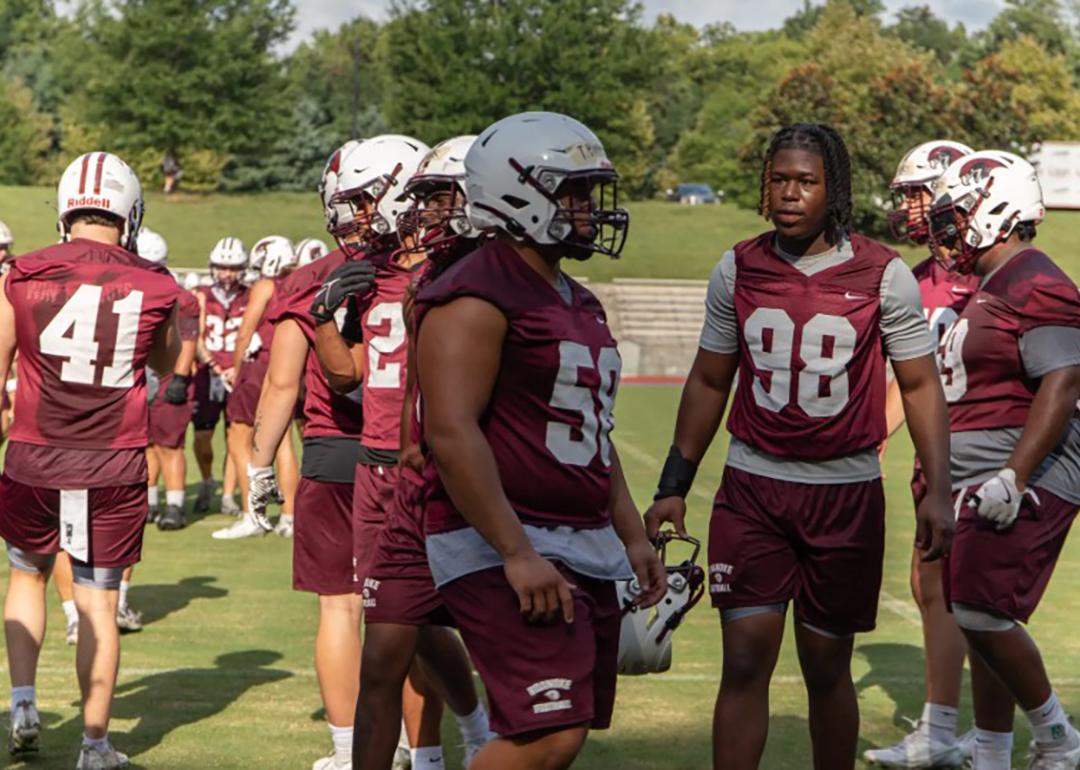
SALEM, Va. — On a hot and humid August morning in this southwestern Virginia town, football training camp is in full swing at Roanoke College. Players cheer as a receiver makes a leaping one-handed catch, and linemen sweat through blocking drills. Practice hums along like a well-oiled machine — yet this is the first day this team has practiced, ever.
In fact, it’s the first day of practice for a Roanoke College varsity football team since 1942, when the college dropped football in the midst of World War II.
Roanoke is one of about a dozen schools that have added football programs in the last two years, with several more set to do so in 2026, according to . They hope that having a team will increase enrollment, especially of men, whose ranks in college have been falling. Yet research consistently finds that while enrollment may spike initially, adding football does not produce long-term enrollment gains, or if it does, it is only for a few years.
Roanoke’s president, Frank Shushok Jr., nonetheless believes that bringing back football – and the various spirit-raising activities that go with it — will attract more students, especially men. The small liberal arts college lost nearly 300 students between 2019 and 2022, and things were likely to get worse; the country’s population of 18-year-olds is about to decline, and colleges everywhere are competing for students from a smaller pool.
“Do I think adding sports strategically is helping the college maintain its enrollment base? It absolutely has for us,” said Shushok. “And it has in a time when men in particular aren’t going to college.”
Women outnumber men by about 60% to 40% at four-year colleges nationwide. Roanoke is a part of this trend. In 2019, the college had 1,125 female students and 817 male students.
This fall, Roanoke will have 1,738 students altogether, about half men and half women. But the incoming freshman class is more than 55% male.
“The goal was that football would, in a couple of years, bring in at least an additional hundred students to the college,” said Curtis Campbell, Roanoke’s athletic director, as he observed the first day of practice. “We’ve got 97 kids out there on the field. So we’re already at the goal.”
That number was 91 players as the season began, on Sept. 6 — and the Maroons won their first game, 23-7, over Virginia University of Lynchburg, on what Shushok called “a brilliant day full of community spirit and pride.”
“Our students were out in force, side by side with community members spanning the generations,” he said via email. “In a time when we all need more to celebrate and opportunities to gather, it is easy to say our first football game since 1942 was both historic and invigorating.”
In the NCAA’s Division III, where Roanoke teams compete, athletic scholarships are not permitted. Athletes pay tuition or receive financial aid in the same way as other students, so adding football players will add revenue. For a small college, this can be significant.
Shushok said it’s not just about enrollment, though: He wants a livelier campus with more school spirit. Along with football, he started a marching band and a competitive cheerleading team.
“It plays to something that’s really important to 18- to 22-year-olds right now, which is a sense of belonging and spirit and excitement,” said Shushok, who came to Roanoke after being vice president of student affairs at Virginia Tech. Its Division I football team plays in a 65,000-seat stadium where in unison to Metallica’s “Enter Sandman” as the players take the field.
The Maroons play in the local high school stadium — it seats 7,157 — and pay the city of Salem $2,850 per game in rent. The college raised $1.3 million from alumni and corporate sponsors to get the team up and running.
Despite research showing limited enrollment gains from adding football, colleges continue to do so. About a dozen have added or relaunched football programs in the last two years, including New England College in New Hampshire and the University of Texas Rio Grande Valley. Several more plan to add football in 2026, including Chicago State University and Azusa Pacific University in California.
Calvin University in Michigan recently added football even though the student body was already half men, half women. The school wanted to broaden its overall appeal, Calvin Provost Noah Toly said, citing “school spirit, tradition, leadership development,” as well as the increased enrollment and “strengthened pipelines with feeder schools.”
A study examined the effects of adding football on a school’s enrollment.
“What you see is basically a one-year spike in male enrollment around guys who come to that school to help be part of starting up a team, but then that effect fades out over the next couple of years,” said Welch Suggs, an associate professor there and the lead author of that study. It found early modest enrollment spikes at colleges that added football compared to peers that didn’t and “statistically indistinguishable” differences after the first two years.
“What happens is that you have a substitution effect going on,” Suggs said. “There’s a population of students that really want to go to a football school; the football culture and everything with it really attracts some students. And there are others who really do not care one way or the other. And so I think what happens is that you are simply recruiting from different pools.”
Today, college leaders value . Most prefer the campus population to be balanced between the sexes, and, considering the low number of male high school graduates going to college at all (39% in ), many worry about too few men being prepared for the future workforce.
“I don’t know that we have done a good job of articulating the value, and of programming to the particular needs that some of our young men are bringing in this moment,” Shushok said. “I think it’s pretty obvious, if you read the literature out there, that a lot of men are feeling undervalued and perhaps unseen in our culture.”
Shushok said that Roanoke’s enrollment-building strategy was not centered on athletics. The college has also forged partnerships with local community colleges, guaranteeing students admission after they complete their associate degree, and has added nine new majors in 2024, including cannabis studies. Shushok pointed out that while freshman enrollment is down slightly this year, the community college program has produced a big increase in transfer students, from 65 in the fall of 2024 to 91 this fall.
About 55% of Roanoke’s students come from Virginia, but 75 of the football team’s 91 players are Virginians. The head coach, Bryan Stinespring, a 61-year-old Virginia native, knows that recruiting territory, having worked on the coaching staffs at several Virginia universities in his career.
When Stinespring took over as head coach in 2023, hoping to inspire existing students and potential applicants to join his new team, there was no locker room, no shoulder pads or tackling dummies, no uniforms.
“The first set of recruits that came on campus, we ran down to Dick’s, got a football, went to the bookstore, got a sweatshirt,” said Stinespring, referring to a local Dick’s Sporting Goods store. “These kids came on campus and they had to believe in the vision that we had.”
Students bought into that vision; 61 of them joined a club team last fall, which played four exhibition games in preparation for this year. The community bought in, too; 9,200 fans showed up to the first club game, about 2,000 of them perched on a grassy hill overlooking the end zone.
Before Ethan Mapstone, a sophomore, committed to Roanoke, he was on the verge of giving up football, having sustained several injuries in high school. Then Stinespring called.
“I could hear by the tone of his voice how serious he meant everything he was saying,” said Mapstone, a 6-foot-1-inch linebacker from Virginia Beach. “I was on a visit a week later, committed two weeks later.”
To him, the football leaders at Roanoke seemed to be “a bunch of people on a mission ready to make something happen, and I think that’s what drove me in.”
KJ Bratton, a junior wide receiver and transfer student from the University of Virginia, said he was drawn to Roanoke not because of football but because of the focus on individual attention in small classes. “You definitely get that one-on-one attention with your teacher, that definitely helps you in the long run,” said Bratton.
Jaden Davis, a sophomore wide receiver who was an honor roll student in high school, said, “The staff, they care about all the students. They’ll pull you aside, they know you personally, they’ll send you emails, invite you to office hours, and they just work with you to do the best you can.”
Not everyone was on board with football returning to college when the plan was first announced. Some faculty and administrators were concerned football would change the campus culture, said Campbell, the athletic director.
“There were just stereotypes about football players,” he said. “You know, they’re not smart, they’re troublemakers. They’re gonna do this and they’re gonna do that, be disruptive.”
But the stereotypes turned out to be unwarranted, he said. When the club team started, he said, “I got so many compliments last year from faculty and staff and campus security about how respectful and polite and nice our students were, how they behaved in the classroom, sitting in the front row and just being role models.”
Payton Rigney, a junior who helps out with the football team, concurred. “All the professors like them because they say ‘yes, sir’ and ‘no, ma’am,’” she said.
Like most Division III athletes, the Roanoke players know that they have little chance of making football a professional career. Mapstone said there are other reasons to embrace the sport.
“It’s a great blessing to be able to do what we do,” he said. “There’s many people that I speak to who are older and, and they reminisce about the times that they had to play football, and it’s very limited time.
“And even though there’s not a future for it, I love it. It’s a Thursday, my only problem in the world is that there’s dew on my shoes.”
was produced by , a nonprofit, independent news organization focused on inequality and innovation in education, and reviewed and distributed by Â鶹ԭ´´.