How a Supreme Court ruling could affect a case involving police abuse of youth
was produced by, a nonpartisan, nonprofit news organization that seeks to create and sustain a sense of national urgency about the U.S. criminal justice system, and reviewed and distributed by 麻豆原创 Media.
How a Supreme Court ruling could affect a case involving police abuse of youth
Amid a Supreme Court term that broadly diminished tools for for their actions, one decision could have the opposite effect. reports that the justices' ruling in raises the bar for companies by filing for bankruptcy when faced with lawsuits alleging harm.
Bankruptcy is a complex legal maneuver filed in federal bankruptcy court that allows a person or entity to seek relief from outstanding debt they cannot pay. of bankruptcy, but the most well-known is , which allows companies to reorganize in order to stay in business and pay creditors over time, without having to liquidate assets.
In recent years, , , and private prison medical company have all filed for Chapter 11, following a mountain of lawsuits that damaged both their finances and their reputations.
"They all have some distinctions, but they have a commonality," said , a law professor at the University of North Carolina at Chapel Hill, of the companies' use of bankruptcy.
"The commonality is using the bankruptcy of one party to protect other parties that may have more money and resources 鈥� and may be more accountable," she said.
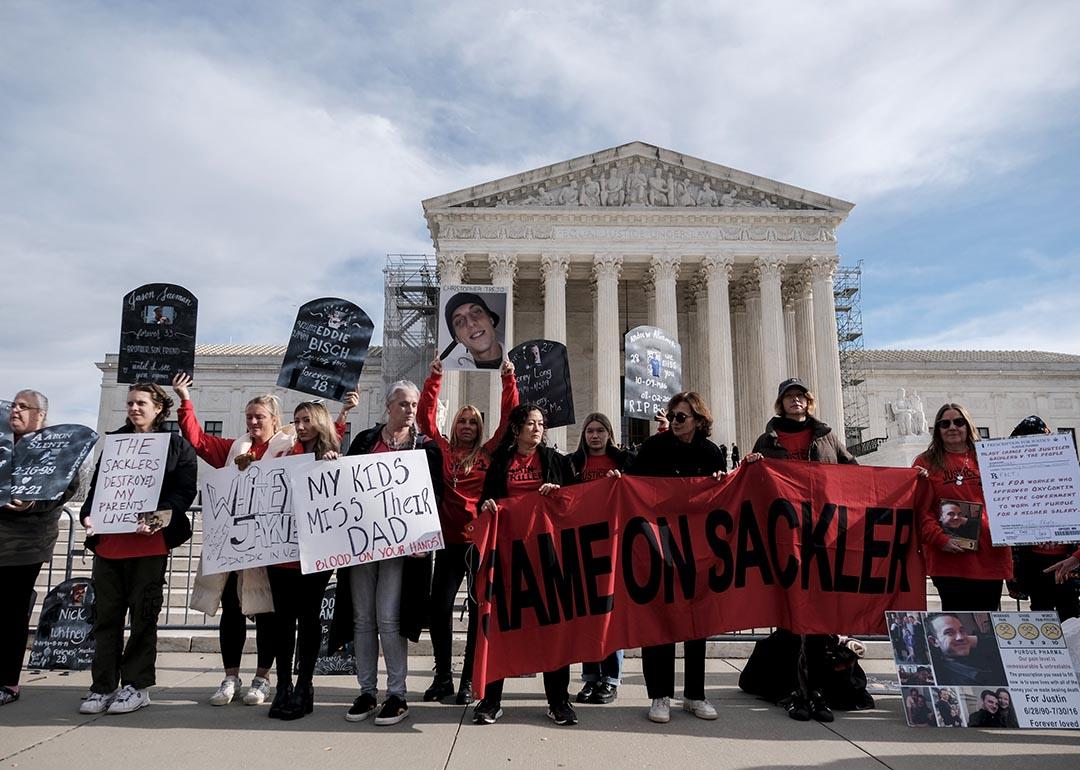
The Supreme Court's ruling focused on . The pharmaceutical company manufactured and " opioid medications for decades, notably OxyContin, fueling the country's . Facing thousands of lawsuits related to the drug, the Sackler family, which owns Purdue, 鈥� into personal accounts. In 2019, Purdue filed for bankruptcy and two years later, a U.S. bankruptcy judge approved its roughly with the Department of Justice.
The Sackler family is a third party to the bankruptcy and agreed to return $4 billion to the settlement estate. But as part of Purdue's proposed reorganization plan, the family members would also have without the consent of those still seeking a settlement. This means the Sacklers would have the protection of their company's bankruptcy without having to file for personal bankruptcy.
In a that , the justices ruled that the bankruptcy code doesn't allow third parties, like the Sacklers, to be released from potential claims without the consent of everyone seeking a settlement.
"In this case, the Sacklers have not filed for bankruptcy or placed all their assets on the table for distribution to creditors, yet they seek what essentially amounts to a discharge. No provision of the code authorizes that kind of relief," Justice Neil Gorsuch wrote in the majority opinion.
Justice Brett Kavanaugh dissented, arguing that the decision "rewrites the text of the U.S. Bankruptcy Code and restricts the long-established authority of bankruptcy courts to fashion fair and equitable relief for mass-tort victims."
Scouting America, formerly the Boy Scouts of America, was one of the organizations closely watching the court's decision.
In 2020, the Boy Scouts of America filed for Chapter 11 bankruptcy and later agreed to a nearly $2.5 billion settlement to compensate more than 82,000 victims of alleged sexual abuse. A central part of the reorganization plan shielded local councils, schools and churches that hosted or ran its programming from future lawsuits alleging harm.
In an supporting Purdue Pharma's position, the nonprofit Scouting organization argued that the release of these parties from liability 鈥� without the consent of everyone suing them 鈥� is essential to its reorganization. Scouting America also says it is in its settlement process to make major revisions. The majority of claimants agreed to the settlement plan, while , saying it stops them from pursuing lawsuits against the parties that aren't bankrupt.
Unlike Purdue Pharma, though, the Scouts are a nonprofit organization. Whereas the Sackler family heavily profited from the company, the same is not true for all parties that have volunteered for or hosted Scouts programming. And while Purdue's settlement plan has been on hold pending the court's ruling, the Scouts have already begun paying some of its settlements.
But there were parties on the Scouts' release list that were surprising: .
In May, The Marshall Project Created by the Scouts decades ago to allow more girls in its programming, Explorers is a co-ed mentorship program run by police departments across the country. Nearly 200 allegations that law enforcement officers 鈥� mostly male 鈥� sexually abused or engaged in inappropriate behavior with participants were identified. The majority of the victims were teenage girls, some as young as 13 years old. It's now up to the U.S. Third Circuit Court of Appeals to decide if and how the Supreme Court's decision applies to Scouting America.
"Right now, litigation against police departments is not possible because the Boy Scouts' plan is still in place and is going forward until the appellate court rules otherwise," says Gilion Dumas, an attorney who represents victims alleging abuse who appealed the Scouts settlement plan. "We believe the court will overturn the BSA plan, making litigation against police departments possible."
She says a continuation of the current Scouting America plan would be "grossly unfair" to victims.
Some attorneys are also eyeing how the ruling might affect the use of a controversial legal process known as the Texas Two-Step.
As explains: "It involves splitting a company in two, dumping the legal liability into one of the entities, and then putting that new firm into bankruptcy. Companies love it. Plaintiffs' attorneys hate it. Judges so far seem split on it."
The process in and of itself is legal, but it raises some of the same issues of consent for plaintiffs found in the Scouting and Purdue cases.
Last year, Beth Schwartzapfel , a private company that contracts with prisons to provide medical care to incarcerated people, used the "Texas Two-Step" maneuver to split its assets and debts into two different entities, moving most of its debts into one company called 鈥� which then declared bankruptcy. As part of her reporting, she reviewed documents 鈥� say Tehum owes them money.
That's money Tehum doesn't have because Corizon's assets were mostly transferred to a separate, profitable company called YesCare.
Corizon's use of the Texas Two-Step move makes it difficult for the people wronged by the company to access money that might be available in a civil settlement, said Val Early, an Alabama attorney representing a client suing Corizon.
"[Bankruptcy is] a method by which grace is given to those who cannot pay their debts," Early said, adding, "But in this particular instance, it's being misused for an improper purpose, which is to hide assets."
As for the Sackler family, that less than two weeks after the court's ruling, creditors and dozens of states are preparing legal actions to pressure the family to settle thousands of lawsuits filed against them, which were paused for nearly five years pending its bankruptcy case.
At a bankruptcy hearing on the lawsuits against Purdue earlier this week, : "And the family that many people blame for commencing the opioid crisis in America 鈥� and the family that has become one of the wealthiest in the world through owning the company that manufactured and sold OxyContin 鈥� sits richer than they were 1,759 days ago."