A new way to help some college students: Zero percent, no-fee loans
A new way to help some college students: Zero percent, no-fee loans
In Honolulu, Joshua Alferos was two semesters away from a bachelor’s degree in electrical engineering when he ran out of money.
Because engineering often takes longer than four years, Alferos had used up his financial aid and the savings his family had put aside for him. He was about to change his major or drop out.
Then he heard of a new, experimental program run by philanthropies and private businesses that would loan him what he needed to finish school, at zero interest and with no fees. The debt wouldn’t come due until he earned a minimum salary, and his employer would likely help him pay it off.
One of the best parts, to Alferos: The money would go back into a pool to do the same thing for other young, low-income Hawaii residents who come after him.
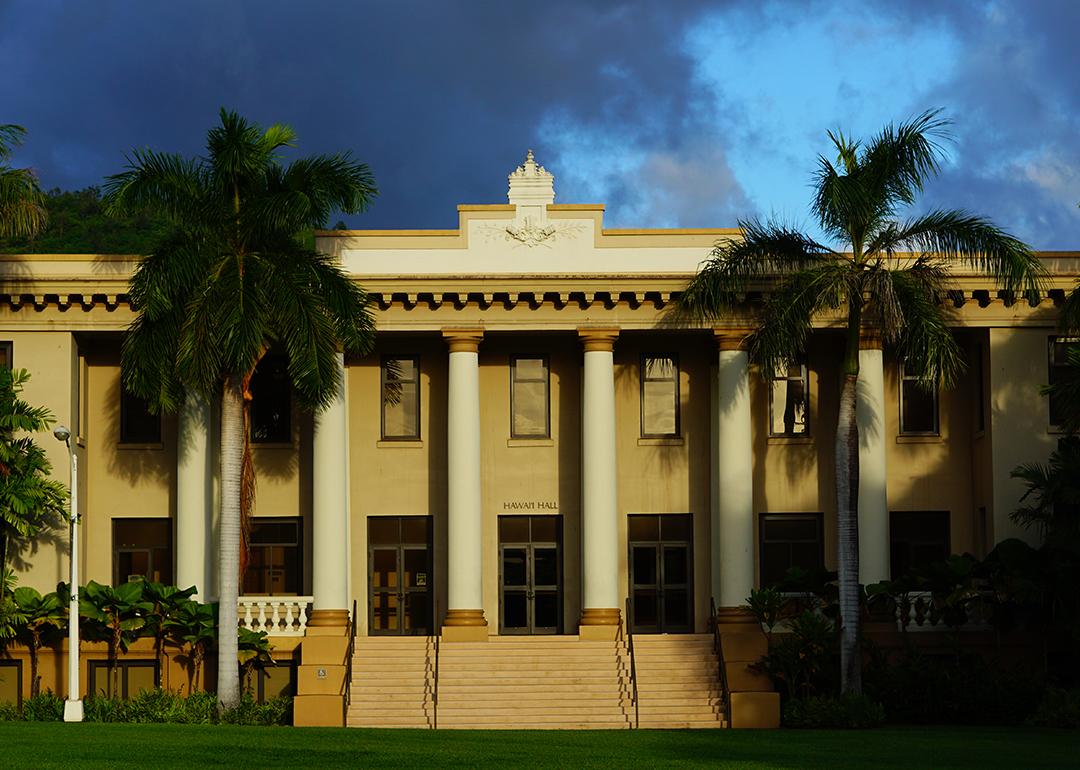
“It’s pretty empowering, because you can help future students,” he said, on an outdoor terrace of the student center on the campus of the University of Hawai'i, where the no-interest loan made it possible for him to stay and continue his studies.
This pay-it-forward approach to covering the cost of college multiplies the number of students who can benefit from a fixed supply of financial aid and can help fill shortages of workers in critical industries, writes .
Those are among the reasons it’s been proposed and considered in half of the nation’s state legislatures. Yet almost all have so far rejected the idea because of high startup costs and other issues.
Now charitable foundations and employers in Hawaii and elsewhere are setting up pilot programs to show that pay-it-forward works, in the hope that states will adopt and expand on it. Two, Massachusetts and New Jersey, have teamed up with these private efforts in small-scale experiments, at a time when millions of people who have defaulted on their student loans measures by the federal government.
Another program . A bill introduced in the California Assembly to for some students in the University of California and California State University systems stalled this session but is scheduled to be heard again in January.
As momentum builds, “I think of this as a really important proof of concept,” said Alex Harris, vice president at the Harold KL Castle Foundation, the lead funder of the .
In addition to removing the cost of interest for students on the money they borrow to pay tuition, Harris said, for states, “it’s a new way of thinking about scholarship support that lets you extend your dollars” further than by simply giving away the money. That’s because once it’s paid back, it can be loaned again.
This feature — that the debt repaid by graduates goes to future students rather than to an unforgiving, high-interest federal government loan program or a faceless bank — appears to have particular appeal in an era of division and fraying of the social fabric. And it especially resonates in Hawaii, which has a tradition of mutual support called “kokua.”
“There is that long cultural history that when one person succeeds, everyone is raised up,” said Harris, whose foundation office in Kailua overlooks the verdant green Nu'uanu Valley.
“It’s a big part of who we are,” echoed Brennon Morioka, dean of the University of Hawai'i College of Engineering. “I was taught that. I teach my kids that.”
Under the pilot, Hawaiian engineering students from families with low incomes can borrow from a $2.5 million revolving fund underwritten by the Castle Foundation and other donors.
Repayments to the fund don’t start until the students graduate and start earning $50,000 or more. There’s no interest and — to help fill open jobs — some of the state’s biggest engineering firms have agreed to help their new employees pay off the loans. The university helps to promote the program.
The pilot in Hawaii began with engineering majors because the state is heavily dependent on engineers in its important defense, construction and tourism industries but has a chronic shortage of them.
“We’re always looking for people,” said Kyle Kaneshiro, a principal in the civil engineering company the Limtiaco Consulting Group and a past president of the American Council of Engineering Companies of Hawaii.
“Now there’s an avenue to do this that’s a lot easier,” Kaneshiro said, scrambling between lunch and appointments in his busy office in a Honolulu industrial district. “It was, like, ‘How come nobody thought of this before?’ ”
In addition to Hawaii, pay-it-forward programs have been started or will launch in the fall in , , , and . Each is focused on a field in which there’s high demand and short supply — health care and information technology in Colorado and New Jersey, for example, climate careers in Massachusetts.
Under the bill now in the California Assembly, the proposed zero-interest pay-it-forward fund for California public university students would start in 2028 with a goal of supporting at least 10,000 students by the fall of 2030, who would repay the money as a proportion of their annual incomes.
It’s not focused on any particular field. But the separate pay-it-forward fund starting in the fall in San Diego and funded by the county will target majors in behavioral health, including clinicians, practitioners and psychiatric nurses — professions in which there is a collective in San Diego of 8,000 workers. Those loans will be entirely forgiven for graduates who work in behavioral health for five years or more.
“What you need to be looking at is where there is enduring demand for particular credentials or degrees,” said Kirstin Hill, president and chief operating officer at Social Finance, a nonprofit that designed and helps to manage pay-it-forward funds around the country.
Such programs must be “designed with economic development and employment needs in mind,” Hill said. That means most are so far limited to some professions and not others.
In 24 states with shortages or projected shortages of registered nurses, for example, a pay-it-forward fund has been set up to help residents at the national, online Western Governors University. Graduates repay the money, with no interest, once they make $60,000 or more, and it’s loaned out again to other students; if they work for partner employers, the new nurses’ employers pay it back for them. Google for students pursuing certificates in data analytics, digital marketing and e-commerce, IT support, project management and other fields.
“Repayments are recycled to serve the next student or students,” Hill said. “It takes every dollar and stretches it.”
At Hope College in Michigan, donors are pooling their money so that some students , with the understanding that they’ll pay back the fund after they graduate in whatever amount they can; 22 students in this year’s graduating class had their educations paid for that way, and there are plans to extend the program to everyone.
Pay-it-forward funds rely on students graduating with degrees and getting good jobs, unlike conventional loans, which have to be repaid even if students drop out or end up underemployed. That’s another argument in favor of the idea, its boosters say: Everyone has a vested interest in seeing participants succeed.
At least 24 states have considered pay-it-forward programs over the past 10 years — in Oregon, as in California, as recently as — but only Massachusetts and New Jersey appear to have so far put public money behind them, and only in collaboration with private sources.
“It’s a very innovative model, and innovation takes time,” said Tara Colton, chief economic security officer at the Economic Development Authority in New Jersey, which has teamed up with the New Jersey CEO Council to create to help residents in certain majors pay for college, with no interest, at designated public higher education institutions.
That’s because, while the approach looks simple from a student’s point of view, it runs up against government budgeting complexities and bureaucracy.
In Illinois, where a proposal for a universal pay-it-forward loan fund got as far as a feasibility study, researchers calculated that it would take billions of dollars in startup money and decades to pay for itself.
This isn’t the only problem, according to the study, done by the Illinois Student Assistance Commission. Giving students loans at zero interest might encourage colleges and universities to raise their prices, it speculated. Also, because the programs are so far focused on higher-paying jobs, students might be nudged away from important but less-well-compensated fields such as teaching and social work. And sorting out the red tape around such things as whether the loans can be taxed or discharged in bankruptcy is complex.
But, advocates of this new round of trial programs say, the way that people pay for college now is also complicated and expensive — and from going. The interest rate for undergraduate federal government-subsidized student loans is , and Americans hold in student loan debt; millions of borrowers in default who got a reprieve during the pandemic now are being told to or have their wages garnished.
“It’s rare that people will look at the existing system and say that it is perfectly designed and optimized,” Hill of Social Finance said. “It requires an enormous amount of risk and expense on the backs of students.”
This has led to another unexpected problem for these experiments with pay-it-forward funds: Students are surprisingly suspicious of them. Many have experienced of financial aid from universities and colleges, the for federal loans and .
“There was kind of an inherent skepticism that I wasn’t expecting,” Harris said. “It’s been slow going because of that, and we have fewer people in the pipeline than we’d like.”
No students responded to an initial email he sent out announcing the fund, said Morioka, the University of Hawai'i engineering dean. “‘Is this for real?’” he said some asked him around the engineering building. “We had to do a lot of outreach to tell people that it was,” including by explaining it to student clubs and other networks. “It’s all word of mouth. That’s how it works in Hawaii.”
A result is that, like the other pay-it-forward pilots, the Hawaii program is small. Since it began in the fall, 17 engineering majors have signed up, according to Harris at the Castle Foundation, which is fewer than anticipated.
“I thought it was too good to be true, but I took a chance,” said one, Melanie Habon, whose immigrant parents from the Philippines pushed her to become a structural engineer while they worked extra hours — her mother as a certified nursing assistant, her father as a custodian — to help pay for college for her and her sister.
Habon pointed to new graduate housing being built on campus, a project on which she worked as an intern for one of the firms that’s part of the pay-it-forward program. “I like that there’s a direct line from being a student to working in your industry,” she said. “And I like that I know where my money will be going.”
Few young people in Habon’s hometown of Waipahu have had the same shot, she said, adding, “Children from there don’t go to college.” in Waipahu have a bachelor’s degree or higher, according to the Census Bureau.
A lack of money often stymies students, including in majors that lead to high-demand jobs, proponents of new forms of financial aid say. The proportion of high school graduates going directly to college as Americans the return on the investment.
Hawaii has the nation’s , and almost all of the engineering majors at the University of Hawai'i work at least part time, said Morioka, the dean, who was previously director of the state transportation department. “That puts a lot of stress on them, or they fall behind.” Even as engineers are badly needed in the state, he said, “we know we are losing students because of the financial difficulties.”
Making students take all the risk while training for in-demand jobs “is frankly deeply unfair,” said Julie Stone, director of family economic mobility at one of the anchor funders of the Colorado pay-it-forward fund, Gary Community Ventures. Pay-it-forward loan funds, she said, ensure “the risk is borne not just by the student.”
Not until government adopts the pay-it-forward approach, however — instead of leaving it mostly to employers and philanthropies — will it make a significant difference, Stone said.
“We know it works. The question is, how do you get it to work everywhere? We believe that if we set this up and demonstrate how well it works, it will make so much sense to a public payer that we could hand it over to them.”
In the meantime — once they get past their initial skepticism — students seem to be drawn to the altruism of the concept.
“There’s something that feels very different in saying, ‘I’m repaying a loan and it’s not going off to some abstract place but it’s going to create this opportunity for someone else,’” said Hill, at Social Finance. “And I think that matters, at least to some people.”
For many students, said Colton, in New Jersey, that has been “a real source of pride. “No one’s getting rich off this. The money is going back to someone just like you. There’s really a sense of gratitude. And that’s a wonderful thing.”
was produced by , a nonprofit, independent news organization focused on inequality and innovation in education, and reviewed and distributed by Â鶹ԭ´´.