Rural Americans rely on Head Start. Federal turmoil has them worried
TROY, Ohio — For almost as long as she’s been a mother, Sara Laughlin has known where she could turn for help in this western Ohio town 20 miles north of Dayton.
For years, the local Head Start program provided stability and care for her oldest son, and it now does the same for her two younger children, twin boys. Head Start was there for Laughlin and her family through tough transitions, including the end of a long relationship. She credits the free federally funded program, housed in a blue building on the edge of this manufacturing hub of 27,000, for allowing her to keep her job as a massage therapist while raising three kids.
“If we had to pay for child care, I would not be able to work,” Laughlin said. “There’s no way I could do it.”
So, Laughlin said, she was “dumbfounded” when she heard this spring that Head Start was in an early draft of President Donald °հù³ܳ¾±è’s budget proposal. In small towns and rural areas throughout the country, voters like her were key to both of °հù³ܳ¾±è’s election victories. Laughlin was particularly attracted to his campaign promise to eliminate taxes on tips, which she relies on. She couldn’t conceive why cuts to early childhood programs would be on the table.
“Out of all the things in this country that we could get rid of, why do you want to attack our children’s learning?” she said.
Laughlin’s experience shows what’s at stake in towns and rural areas up and down the western side of Ohio — and across the country, according to In many of these communities, Head Start, which combines early childhood education, health, nutrition, and other family services, is the only game in town for child care, allowing thousands of parents to work. It’s often the only early childhood program where educators can make a decent wage in a chronically underpaid industry. And it’s a key source of connection and support for parents dealing with trauma, job loss, poverty and parenting challenges.
Head Start is often viewed as a program that caters primarily to urban areas. The numbers, however, tell a different story. Nearly 90% of rural counties in the United States have Head Start programs, which are funded with federal dollars and run by public or private agencies including schools and nonprofits. Almost half of the 716,000 children Head Start serves , compared to just 22% in urban districts.
“These are communities that are underinvested in by philanthropy or the states where they are,” said Katie Hamm, who during the Biden administration served as deputy assistant secretary for early childhood development at the federal Administration for Children and Families, which oversees Head Start.
In many rural communities, moreover, the program is not just about education and child care. Head Start is particularly crucial to the survival of these local areas in a way that it isn’t in larger urban areas with more diverse economies. The program not only employs local residents, it supports other local businesses as centers pay rent, buy food from local farmers and grocers, use local mechanics to repair buses, hire local technicians to service kitchens and pay local carpenters to outfit centers.
Head Start was created in 1965 to provide early learning, family support and health services to low-income families, part of President Lyndon B. Johnson’s War on Poverty. The program has long enjoyed bipartisan support: of Trump voters and 86% of Democrats said earlier this year that they support funding the program, according to a survey conducted on behalf of the advocacy group First Five Years Fund.
Although Head Start has survived elimination so far this year, its local centers are still trying to recover from what many say feels like death by a thousand federal cuts since Trump took office — with more likely to come.
It started last year, when conservatives with ties to the president published , a governing blueprint that called for , among dozens of other spending reductions.
In early February, many Head Start programs were caught up in a . Then, the Trump administration .
This spring, some rural programs shut down because the administration delayed Head Start payments in some regions. In April, the administration abruptly closed five regional Head Start offices, cutting off a main source of support for programs. Just three months after that, the administration announced that undocumented immigrant children, long eligible for Head Start, could no longer participate.
In the midst of all that turmoil, some local and regional Head Start programs have begun laying off employees. At the start of the year, the government in funding from local programs, a move that the Government Accountability Office in July. While the money has since been distributed, in the interim, several Head Start programs closed temporarily, and a few have told some staff they will be let go.
After all that, Head Start leaders in rural communities said, their futures feel more tenuous than ever. While urban Head Start programs are more likely to be supported by large, well-resourced organizations that receive donations from individuals and local philanthropies, those additional funding streams are often absent in rural communities.
The resulting “uncertainty and constant whiplash” is taking a toll on Head Start providers across America, said Hanah Goldberg, director of research and policy at the Georgia Early Education Alliance for Ready Students, a nonprofit that promotes quality early education in that state. “They need to be focusing on supporting kids and families, not putting out a new fire every day.”
Advocates say Head Start’s model of wraparound support is especially needed in remote parts of America. Rural children under five have the in the country. Rates of and are higher in rural areas than in urban ones. — areas with a dearth of care options — are most common in low-income rural communities.
In Greenville, Ohio, a town of about 12,700 that hugs the Indiana border 40 miles northwest of Dayton, the median household income is . The local Head Start program is one of just two licensed child care centers available in town for nearly 600 children under the age of 5 who live in Greenville. Run by the Ohio-based nonprofit Council on Rural Services, it serves children whose parents work in nearby retail stores, fast food chains or factories, as well as a growing number of grandparents raising their grandchildren.
Teachers there describe their work as far more than providing child care.
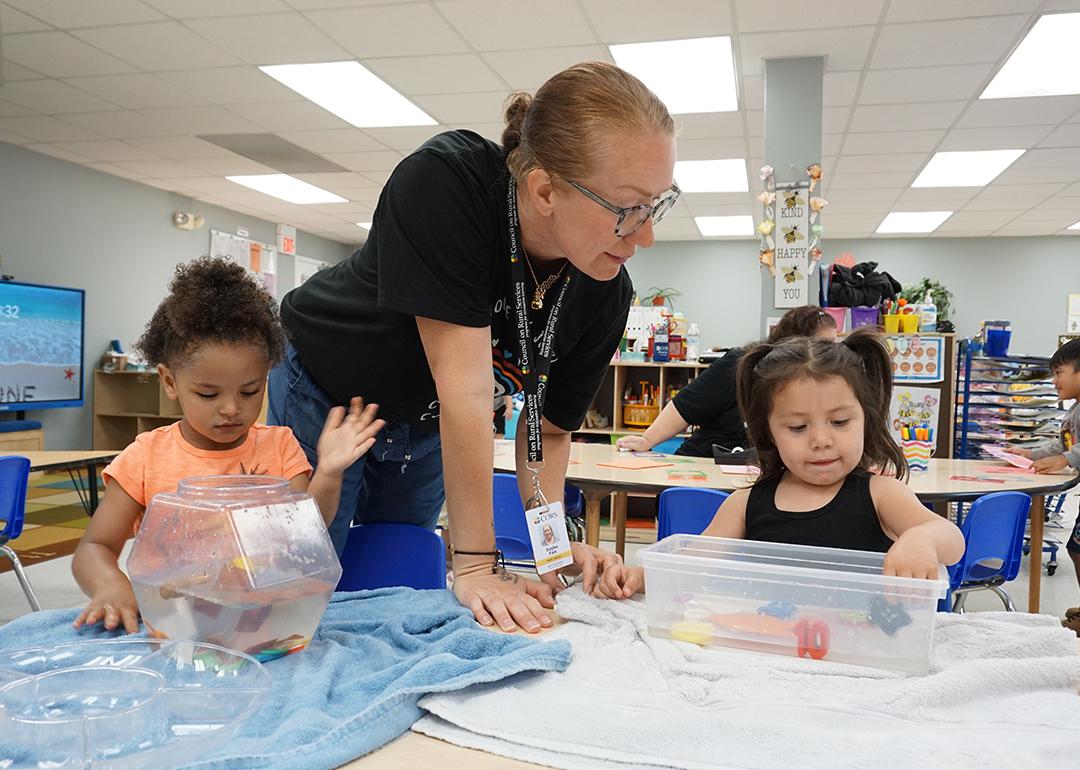
On any given day, in addition to teaching a group of preschoolers, Greenville Head Start teacher Sasha Fair may find herself lending an ear to parents who need to vent and helping caregivers track progress toward personal educational, parenting or employment goals. In her center, like many others in the region, Head Start workers pool their money to buy birthday presents for children who would otherwise go without. They track down car seats for parents who can’t afford them. And they go door-to-door to local dentists, trying to convince them to accept children who use Medicaid.
“It’s about connection and community,” Fair said.
Fair was terrified for the families she serves when she heard Head Start was on the chopping block. It’s even more worrisome, she said, considering that broader federal and state cuts are being made to other social supports like that Head Start families rely on. Educators and parents here have already seen federal budget cuts affect area food pantries and . Some locals, like Fair, say they fear cuts that could hit closer to home and affect Head Start more directly.
“These are our future,” she said, gesturing at the preschoolers playing in her classroom. “We need to give them the strongest, best possible start, and that includes their health care, their access to care, their education.”
Many residents would also be out of jobs if Head Start programs were to close. Nationally, nearly a quarter of the program’s teachers are parents with children currently or formerly in the program. In Ohio, Head Start is among the state’s 50 largest employers, providing work for more than 8,000 Ohioans and, by extension, additional area residents who rely on Head Start spending.
“We try to stay local and utilize whoever is local,” said Stacey Foster, who leads a Head Start program in Urbana, a town of about 11,000 that is 40 miles northeast of Dayton and surrounded by picturesque fields and farmhouses. On a summer afternoon, while workers from a local family-owned carpet company installed new flooring in Foster’s center, students from a nearby career technology center’s early childhood program cycled through her office, interviewing for part-time positions.
Foster’s Head Start rents space for its five classrooms and two playgrounds from a local organization that works with adults with disabilities, helping to support those services.
The program’s fleet of buses is serviced by Jeff’s Automotive Service, a local garage. Katy Leib, service manager at Jeff’s Automotive, said demand for work rises and falls, especially this year, with some people spending cautiously because of economic uncertainty. Being able to rely on Head Start as one of its larger, more consistent accounts has been helpful for the business’s stability, she said.
If Head Start were to lose its funding, it would affect Jeff’s Automotive, as well as other companies that contract with Jeff’s. “When we’re working on their vehicles, we’re also purchasing parts from local businesses. It’s affecting tire companies and our oil companies,” Leib said. ”It’s a domino effect.”
Heather Littrell is an example of a parent who found support, and eventually employment, through Head Start.
Littrell, who lives in Troy, was standing in line to apply for housing assistance when she spotted an ad for free preschool. At the time, she was 19 and struggling to keep a job while raising her two young children. Family members helped when they could, but without consistent child care, Littrell was forced to leave job after job at local factories and a gas station.
“Everything was unstable,” she said. “I wasn’t really knowing what direction I was going to take.”
Littrell ended up enrolling her girls in Head Start, where they learned their colors, numbers and social skills, while Littrell received parenting advice, diapers and meals for her daughters. Most importantly, she could work. A few years later, inspired by her experience as a Head Start parent, Littrell decided to pursue a degree in early childhood education.
Now, 17 years later, she has moved from being a Head Start student teacher to serving as a coordinator for mental health and disability services in Head Start programs across western Ohio.
“If I hadn’t seen that flyer that day, I wouldn’t be standing here now,” she said. “I really did use Head Start to help me become a better person and a better member of society.”
°հù³ܳ¾±è’s would not change the amount of money set aside for Head Start, but given inflation, keeping the program’s budget unchanged effectively amounts to a cut. And program officials say that years of inadequate funding has already compromised the program’s reach and stability. Lawmakers have until the end of September to settle on a federal budget. If the current budget doesn’t grow, federal estimates predict, Head Start will lose nearly across both urban and rural regions over the next year.
Laurie Todd-Smith, appointed by the Trump administration in June to oversee federal early childhood programs at the Administration for Children and Families, including Head Start, acknowledged that the programs play an important role in rural areas. “If Head Start wasn’t in rural areas where those most impoverished families are, we’d have very different outcomes for children,” she said.

But Todd-Smith isn’t convinced that the program needs more money. Rather, she said, programs should look for ways to be more efficient. In some places, state-funded offices already provide health services, employment assistance and mental health assistance. She said Head Start programs could tap into those services instead of offering their own.
“There might be some cost savings if we actually link state systems to some of the work of Head Start, instead of creating duplication of services,” Todd-Smith said.
At the local level, however, Head Start providers say that if they’re going to raise salaries, keep teachers and serve more children — there aren’t currently enough seats for all who qualify — they need more money.
Officials from the Council on Rural Services, which runs 17 Head Start sites scattered across western Ohio, said communication from higher-ups has been virtually nonexistent since a regional office in Chicago closed in April. Earlier this spring, money for CORS sites’ payroll was delayed. Staffers called state Head Start officials, who frantically reached out to federal counterparts. The money showed up just in time for CORS to send out paychecks, but it was a reminder of how precarious the system is. “We are one payroll away from shutting the doors at any time,” said Karin Somers, chief executive officer at CORS.
Even under friendlier administrations, Head Start’s finances have been shaky. For example, the program still distributes money to centers based on a formula developed in the 1970s, even as populations and community poverty rates have changed. The outdated system has led to wildly inequitable results: For example, the percentage of children in poverty who are served in Head Start
More recently, the that all Head Start teachers should . It didn’t supply more money for those raises, however, leading some programs to reduce how many kids they serve in order to afford the wage increases. CORS by more than $5 an hour in 2023, but had to cut 310 student slots to do so.
Head Start staffers say many parents in rural Ohio had no idea that Head Start was a federal program until funding was threatened in the spring. CORS officials sent emails to enrolled families explaining the funding situation and encouraging parents to advocate for the program.
“Typically, community members at large don’t understand” the funding source, said CORS CEO Somers. Some assume Head Start is paid for with state education money, she said, and others think the state foots the bill. “The system itself is hard to track.”
The federal money pays for more than just brick-and-mortar Head Starts and their staff. It also covers the cost of a traveling home-based education program that brings one-on-one support to parents in areas too small for a center-based program.
In the town of Paris, about 40 miles southeast of Akron and home to fewer than 1,900 people, mom Kirsten Mayfield welcomes weekly visits from CORS’ Gabrielle Alig, who drives many miles through the Ohio countryside each week to visit 11 families. During those visits, Alig serves as both an educator and counselor, providing lessons and games for children while talking to parents about their own needs and concerns.
Mayfield wants to find a play therapist to help her 5-year-old son with behavioral challenges, but that would involve a drive to a medical center more than 90 minutes away. In the meantime, Alig is working with the boy on skills like following directions, while also giving Mayfield parenting tips and connections to community resources.
Littrell, the former Head Start parent who now works for the program, hopes residents will realize programs like Head Start are critical for communities like hers and vote for politicians who will try to protect them. From her early years as a teen mom, she said, she knows how easy it is to end up in a situation where a family needs some help to move forward. “We had food stamps, we had [subsidized] housing, we used Head Start,” Littrell said. “We used them to help us build a life where we didn’t depend on those social services.
“But they were there for us when we needed them.”
was produced by , a nonprofit, independent news organization focused on inequality and innovation in education, and reviewed and distributed by Â鶹ԭ´´.