2.9 million votes: See the demographics of Oklahoma's voting population
2.9 million votes: See the demographics of Oklahoma's voting population
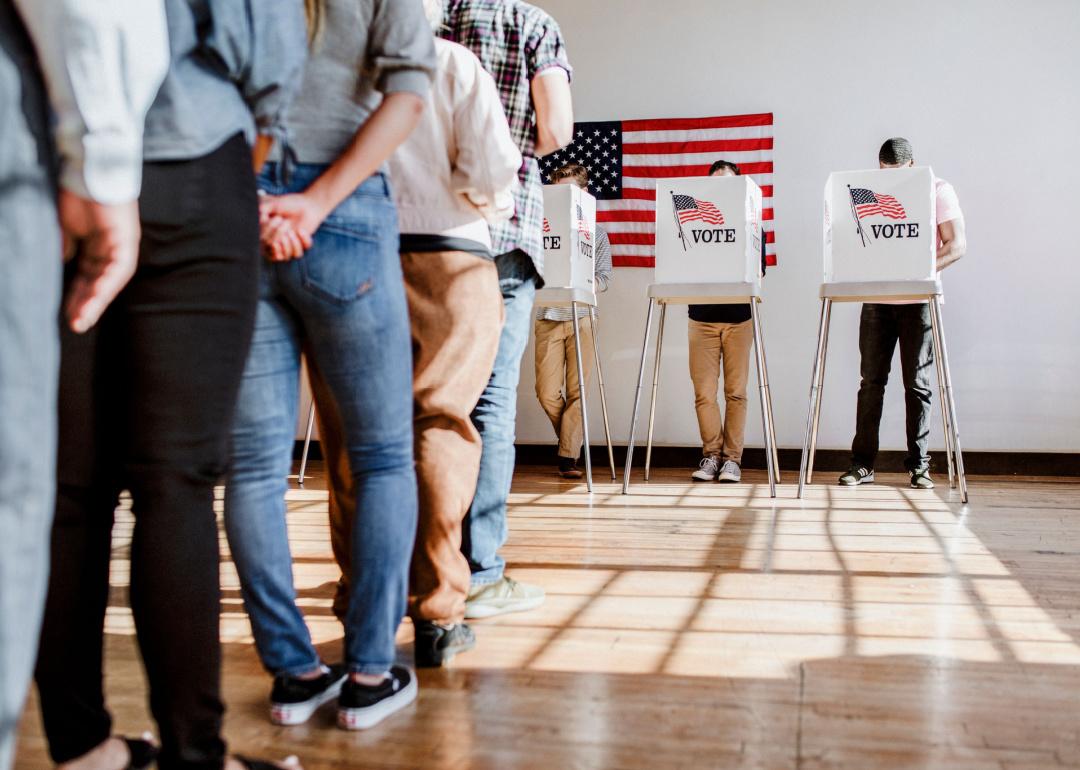
In 2020, 158.4 million citizens鈥攁lmost two-thirds of estimated eligible voters鈥攙oted in the presidential elections, according to the . The number represented a higher than average turnout, with people voting in numbers not seen since 1980 and possibly well before.
麻豆原创 compiled voter demographics for each state and Washington, D.C., using the 2019 (released in September 2020). Each slide shows the state's voting-eligible population (citizens who are 18 or older) and the breakdown of that population by sex, age, race, and education. Economic statistics are not included because the American Community Survey does not account for COVID-19, which affected unemployment, poverty, and medical insurance status for millions of Americans. In order to avoid making any assumptions about the data or the participants of the American Community Survey, 麻豆原创 used the exact wording of the "race" and "sex" framework that was provided in the census data.
Keep reading to see the voter demographics of your state.
Oklahoma by the numbers
- Voting-eligible population: 2,875,059
- Breakdown by sex: 48.8% male, 51.2% female
- Breakdown by age: 21.8% 18-29 years old, 24.8% 30-44 years old, 31.7% 45-64 years old, 21.8% 65+ years old
- Breakdown by race: 75.7% White, 7.2% Black or African American, 1.8% Asian, 6.3% Hispanic or Latino, 7.8% Native American or Alaska Native, 0.0% Native Hawaiian or Pacific Islander, 6.1% two or more races
- Breakdown by education: 2.5% less than high school education, 8.0% some high school (no diploma), 32.2% high school graduate or equivalency, 25.1% some college (no degree), 7.9% associate's degree, 16.3% bachelor's degree, 8.0% graduate or professional degree
The Sooner State's of Oklahoma's overall population. Residents ages 45鈥�64 have the highest number of voters, consistent with the rest of the U.S. In the 2016 general election, 56.6% of eligible voters cast their ballot, slightly under the national average of 61.4%.
By percentage, voters aged 45鈥�64 are the highest in every state, with comprising more than half the country's population. Older voters also trend toward turning out to vote at a higher rate and played a significant role in former .
Along racial lines, Black or African American voters in Louisiana and Georgia comprise more than 30% of the state's registered voters. California and Texas鈥攚hich award the most electoral votes at 55 and 38, respectively鈥攂oast the highest numbers of Latino voters. On the other end of the spectrum, West Virginia and Maine boast the . A number of states had already seen with 16 seeing more than half of its registered voters casting a ballot before Election Day.
Continue reading for a glimpse into the voter demographics of neighboring states.
New Mexico
- Voting-eligible population: 1,522,171
- Breakdown by sex: 48.9% male, 51.1% female
- Breakdown by age: 21.0% 18-29 years old, 23.7% 30-44 years old, 31.1% 45-64 years old, 24.2% 65+ years old
- Breakdown by race: 75.8% White, 2.3% Black or African American, 1.3% Asian, 43.6% Hispanic or Latino, 9.6% Native American or Alaska Native, 0.0% Native Hawaiian or Pacific Islander, 2.8% two or more races
- Breakdown by education: 3.8% less than high school education, 8.4% some high school (no diploma), 27.8% high school graduate or equivalency, 24.9% some college (no degree), 9.1% associate's degree, 15.0% bachelor's degree, 11.0% graduate or professional degree
New Mexico has the highest number of Hispanic or Latino voters in the country. This is since Hispanic and Latino voters prefer the Democratic ticket, which only lost the state once in the last seven presidential elections. That , with October 2020 showing that Joe Biden led by double digits in the Land of Enchantment.
Texas
- Voting-eligible population: 18,875,542
- Breakdown by sex: 48.9% male, 51.1% female
- Breakdown by age: 23.5% 18-29 years old, 26.3% 30-44 years old, 31.6% 45-64 years old, 18.6% 65+ years old
- Breakdown by race: 75.6% White, 13.4% Black or African American, 3.9% Asian, 30.9% Hispanic or Latino, 0.6% Native American or Alaska Native, 0.1% Native Hawaiian or Pacific Islander, 2.2% two or more races
- Breakdown by education: 3.9% less than high school education, 7.2% some high school (no diploma), 26.9% high school graduate or equivalency, 25.1% some college (no degree), 7.8% associate's degree, 19.5% bachelor's degree, 9.6% graduate or professional degree
With 38 electoral votes, . The Lone Star State joins others in , with a record number of residents casting their ballots before November 3, 2020. "About 735,000 more people voted early this year in Texas than voted in the entire 2016 presidential election, including on Election Day," according to Austin American-Statesman's Madlin Mekelburg and Nicole Cobler.