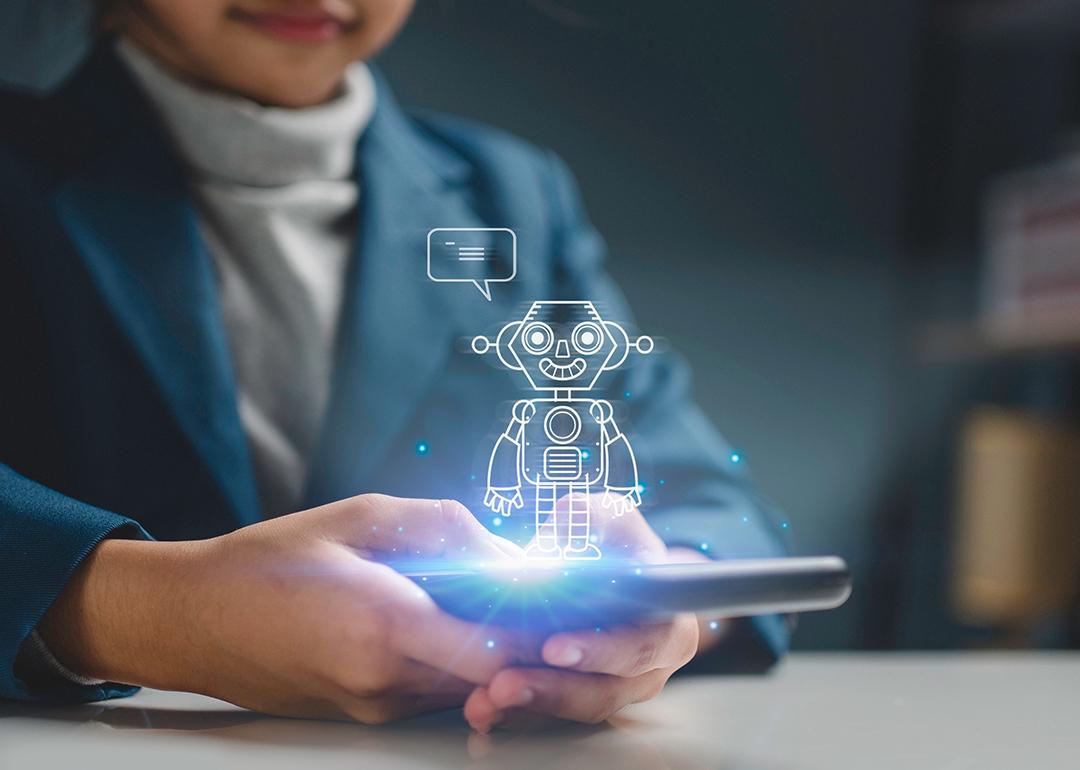
What parents should understand about AI chatbots in social media apps
What parents should understand about AI chatbots in social media apps
Most kids on social media have likely interacted with an artificial intelligence (AI) chat buddy. Some well-known examples: Meta has a new AI assistant that explains how to change a tire or lose weight. Snapchat’s My AI buddy will explain a science topic in a simple way. Even X has an AI chatbot named Grok (available with a subscription upgrade).
For most families, the first interactions with these AI chatbots on social media are pretty harmless—like asking a chatbot to write silly song lyrics. Children can quickly realize, though, that they can use these chats to ask questions they might avoid bringing to adults about topics like . Or they might simply ask an AI chatbot to do their homework.
“The temptation to use artificial intelligence to do schoolwork is strong,” says , an adjunct associate professor at the New York Institute of Technology who designs chatbots for . Her AI chatbot characters seek to give students factually accurate information about historical events—something she says is a positive use of AI for students. But she’s also aware that they struggle with drawing the line regarding how to use AI.
“You have to persuade them that it’s in their best interests to gain critical literacy skills rather than let AI do their work,” she says.
offers practical ways to build that literacy. Understanding how these tools actually work can make those conversations more useful and more grounded in reality.
1. An AI chatbot is not a real person.
Whether it’s a standalone app like ChatGPT or a feature incorporated into social media like X’s Grok, these humanlike personalities might seem like digital buddies, but . Instead, they use complex algorithms to generate answers from information found online, from sources like books and websites, and can present those answers and solutions in a conversational way. They can even crack a joke or two—but that doesn’t mean they have a sense of humor, either.
2. AI chatbots are often inaccurate.
AI chatbots can give false information. Asking a question about an upcoming event could generate a suggestion related to something that happened in the past. History questions can regularly produce muddy, biased, or wrong answers. One found that ChatGPT gave inaccurate answers to computer programming questions more than half the time.
“[AI chatbots] may be pretty good at seeming real,” says , Ph.D., associate professor of communication at the University of Pittsburgh. “But that isn’t the same as being accurate.” Experts say this is likely to improve over time, but it’s a reason for caution.
3. Beware of ‘ghost sources.’
Most kids are accustomed to typing a query into a search bar and getting a list of articles, research papers, and book suggestions. And while teachers may help kids learn the difference between credible and dubious sources, chatbots can provide chunks of information without a source.
AI chatbots can sometimes list sources that don’t exist (these are called “ghost sources”). That means that any specific data or research provided by an AI chatbot needs to be checked and verified.
4. It’s easy to plagiarize with AI, even unintentionally.
A by the Pew Research Center found that 1 in 4 teens have used ChatGPT for schoolwork, roughly double the number from the previous year. And that’s only for one type of AI. As AI chatbots become more available, the number of teens who use the technology when doing homework is almost sure to increase.
That’s why kids need clear boundaries about the right and wrong way to use . For example, chatbots can help brainstorm ideas, but AI-generated homework is getting easier for teachers to spot. Even when it’s unintentional, chatbot responses are built on other people’s work. And beyond AI-detection tools, it raises a more basic issue: Understanding what counts as their own work.
“I want to reinforce to my [students] that their character and their integrity matter,” says Ghilani. “It matters to me; it should matter to them. It certainly matters for the good of the world around them.”
5. AI chatbots can be fun, too.
Jamie Davis Smith, a mom of four in Washington D.C. says her family used an AI chatbot to plan a summer road trip, which turned out to be mostly accurate. As a journalist, she knows accuracy and sourcing are crucial skills for kids to learn. That’s why she talks through what AI gets right and wrong. And she uses these fun activities to help teach what AI can (and can’t) do.
Ask low-stakes questions.
Recently, Smith’s son asked her if barn owls actually live in barns. Not knowing the answer, they turned to an AI chatbot. (Spoiler alert: Barn owls do prefer to live in barns.) Low-stakes questions are a great way to familiarize children with the pros and cons of artificial intelligence, Smith says.
Play games with bots.
Some popular AI chatbot tools have game features built in. Playing 20 questions or trivia games can help kids understand how these tools respond—and may highlight when they are wrong. Kids might catch a mistake when a chatbot turns up the wrong answer about a favorite sports team, for example, which could lead to a great conversation about the importance of accuracy.
Ask a bot to tell jokes.
Artificial intelligence isn’t only for research—these AI chatbots can be funny, too. Ask an AI chatbot or smart speaker for a knock-knock joke. These jokes can show how artificial intelligence can communicate with them.
The bottom line
Artificial intelligence tools require supervision and guidance. Smith is cautiously having fun with these new tools even as she worries about kids using them to cut corners or even plagiarize work.
“It’s important to start talking with your kids about how to use them responsibly, and their limitations,” Smith says. “And start now if you haven’t done so already.”
was produced by and reviewed and distributed by Â鶹ԭ´´.