
AI prompts to help you manage your household finances
Over the past couple of years, you’ve probably seen online articles and social media posts sharing how people use AI (short for artificial intelligence) to be more productive, using it as a personal assistant of sorts or a way to hack their lives. But AI isn’t just for productivity hacks — it can also help you .
You might be surprised to learn just how useful AI can be in helping you with your real-life money management. In fact, a 2024 Experian study found that use AI to manage their finances.
When you’re using AI, and especially if you’re just getting started, prompts can be helpful in learning to communicate with it. They’ll give you an idea of what type of questions and instructions will get you the best results when using tools like ChatGPT and Gemini. And you’ll probably find that the more you use AI, the less help you’ll need coming up with the right prompts.
If you’re ready to improve your finances, shares 35 AI prompts to help you with everything from budgeting and household planning to saving and investing.
Just remember that AI is simply a tool, and it’s not 100% accurate. It shouldn’t be a replacement for , especially for your most important financial questions.
Why Use AI for Household Finances?
Using AI to help manage your household finances , from saving time to verifying the accuracy of your numbers. Here are just a few benefits:
- Saves time on routine planning and calculations: AI tools can help you with some of the more tedious and routine financial planning activities, such as tracking your expenses and investment returns. It can also help you run important calculations, like determining how much to save to meet a certain financial goal.
- Helps create personalized financial frameworks: AI can give you personalized financial frameworks in a way that an article or blog post just can’t. Because you can plug in specifics about your finances, such as your income and expenses, you can get frameworks that are customized for your unique situation.
- Encourages financial literacy through conversational assistance: While it’s not a replacement for speaking with an actual financial professional, using AI offers the opportunity for some back-and-forth conversation. You can ask questions and get personalized answers, and AI may bring up insights to help you improve your financial literacy.
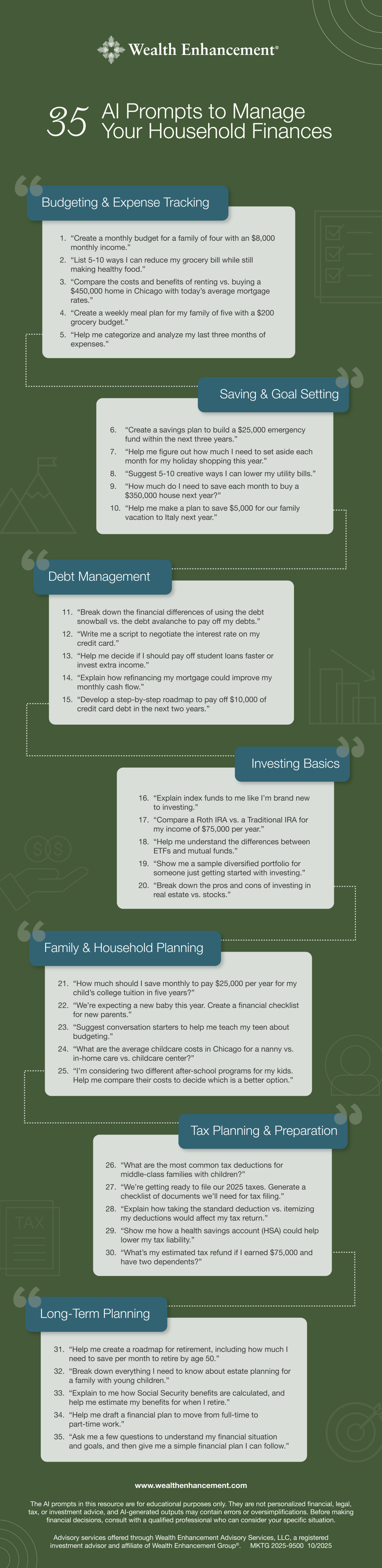
35 AI Prompts to Manage Your Household Finances
Budgeting and Expense Tracking
- “Create a monthly budget for a family of four with an $8,000 monthly income.”
- “List 5-10 ways I can reduce my grocery bill while still making healthy food.”
- “Compare the costs and benefits of renting vs. buying a $450,000 home in Chicago with today’s average mortgage rates.”
- “Create a weekly meal plan for my family of five with a $200 grocery budget.”
- “Help me categorize and analyze my last three months of expenses.”
Saving and Goal Setting
- “Create a savings plan to build a $25,000 emergency fund within the next three years.”
- “Help me figure out how much I need to set aside each month for my holiday shopping this year.”
- “Suggest 5-10 creative ways I can lower my utility bills.”
- “How much do I need to save each month to buy a $350,000 house next year?”
- “Help me make a plan to save $5,000 for our family vacation to Italy next year.”
Debt Management
- “Break down the financial differences of using the debt snowball vs. the debt avalanche to pay off my debts.”
- “Write me a script to negotiate the interest rate on my credit card.”
- “Help me decide if I should pay off student loans faster or invest extra income.”
- “Explain how refinancing my mortgage could improve my monthly cash flow.”
- “Develop a step-by-step roadmap to pay off $10,000 of credit card debt in the next two years.”
Investing Basics
- “Explain index funds to me like I’m brand new to investing.”
- “Compare a Roth IRA vs. a Traditional IRA for my income of $75,000 per year.”
- “Help me understand the differences between ETFs and mutual funds.”
- “Show me a sample diversified portfolio for someone just getting started with investing.”
- “Break down the pros and cons of investing in real estate vs. stocks.”
Family and Household Planning
- “How much should I save monthly to pay $25,000 per year for my child’s college tuition in five years?”
- “We’re expecting a new baby this year. Create a financial checklist for new parents.”
- “Suggest conversation starters to help me teach my teen about budgeting.”
- “What are the average childcare costs in Chicago for a nanny vs. in-home care vs. childcare center?”
- “I’m considering two different after-school programs for my kids. Help me compare their costs to decide which is a better option.”
Tax Planning and Preparation
- “What are the most common tax deductions for middle-class families with children?”
- “We’re getting ready to file our 2025 taxes. Generate a checklist of documents we’ll need for tax filing.”
- “Explain how taking the standard deduction vs. itemizing my deductions would affect my tax return.”
- “Show me how a health savings account (HSA) could help lower my tax liability.”
- “What’s my estimated tax refund if I earned $75,000 and have two dependents?”
Long-Term Planning
- “Help me create a roadmap for retirement, including how much I need to save per month to retire by age 50.”
- “Break down everything I need to know about estate planning for a family with young children.”
- “Explain to me how Social Security benefits are calculated, and help me estimate my benefits for when I retire.”
- “Help me draft a financial plan to move from full-time to part-time work.”
- “Ask me a few questions to understand my financial situation and goals, and then give me a simple financial plan I can follow.”
Best Practices for Using AI Prompts Effectively
Before using AI to manage your personal finances, it’s important to understand these best practices that can help you get the most out of these prompts and avoid potential negative outcomes.
- Be specific: When you’re enlisting AI to help you manage your finances, be as specific as possible. For example, when you’re , be specific about your income and expenses. When you’re looking for help with financial goals, be specific about dollar amounts and timelines. The more specific you can be, the more tailored your responses will be.
- Ask AI to explain: A key benefit of AI is its ability to break down complex topics as much as you need. If AI returns a response with too much jargon or complicated language, ask it to explain it in plain language. Make sure you walk away from the conversation with a solid understanding of everything.
- Challenge AI’s responses: You don’t have to settle for the first answer that AI sends back, especially if you don’t feel like its recommendation fits your goals or situation. You can ask AI to improve its answer, ask AI questions for clarification, or give AI additional context to help it better answer your prompts.
- Experiment with different tools: ChatGPT is the most well-known AI tool on the market, but there are others as well, including Gemini and Claude. Consider experimenting with different options to see if there’s one that resonates with you the most.
- Avoid sharing sensitive information: Your ChatGPT conversation may seem private, but it’s still online. Don’t give ChatGPT or any other AI any sensitive personal or financial information, such as your Social Security number, bank account numbers, or passwords.
- Understand AI’s limitations: AI isn’t foolproof, and it can make mistakes (known as hallucinations). Take everything AI says with a grain of salt and either fact-check its responses yourself or check in with your financial advisor before implementing any of its advice.
When to Rely on a Financial Advisor
While AI can be an excellent tool for helping with certain financial tasks, it’s not a replacement for a financial advisor. It’s always important to vet information from AI when you’re making major financial decisions. And there are some situations where human experience is crucial, such as when you’re , optimizing your taxes, or doing your estate planning.
There are also plenty of things that AI simply can’t do at all, including addressing some of the emotional aspects of financial planning. You also can’t build trust and a long-term relationship with AI the same way you could with a financial planner.
And perhaps even more importantly, AI has no legal or ethical responsibilities to you. A financial planner, especially a fiduciary, is held to certain standards for their advice and recommendations. The same can’t be said about AI, and there’s no way to guarantee its recommendations are actually in your best interests.
Rather than choosing between AI and a financial advisor, find the sweet spot between the two. Consider using AI for your day-to-day planning, data gathering, and basic education, and rely on your financial planner for your major money moves.
Frequently Asked Questions (FAQs)
Q: Can I trust AI for financial planning?
While AI can be a helpful tool in managing some aspects of your personal finances, from setting up your budget to creating a savings plan, it shouldn’t replace professional finance advice. AI can make mistakes (known as hallucinations), and isn’t to be trusted with sensitive financial information.
Q: How accurate is ChatGPT for budgeting?
ChatGPT is generally reliable for putting together sample budgets, tracking your spending, and running financial calculations. However, because it doesn’t have access to your personal finance data, it may not necessarily provide accurate advice for your situation. Additionally, it doesn’t always return accurate information when you’re using it for educational purposes.
Q: What are the limitations of AI in managing money?
AI doesn’t have the insight a human advisor would, which can be important in making big financial decisions. Additionally, unless you give it access to your bank account, all of its advice is based on theoretical numbers rather than your actual situation. For those reasons and more, it’s best to think of AI as a guide rather than the final decision-maker for your finances.
Q: When should I use a financial advisor instead of AI?
It’s best to use a real financial advisor rather than AI when you’re making big financial decisions, including retirement planning, tax optimization, and other situations where there can be a major impact on your finances. If you need personalized advice to make a big decision, AI likely isn’t the right answer.
Q: Are AI financial prompts safe to use?
AI prompts are safe to use because they don’t give AI access to your sensitive information. However, it can quickly become unsafe if you share your Social Security number, bank account numbers, or passwords with AI, or if you rely on AI’s advice without fact-checking it or verifying it with another source.
Q: Can AI help families teach kids about money?
Yes, AI can help teach kids about money. In fact, given younger generations’ frequent use of AI, it may even be the best way to get through to them. You can use AI to come up with age-appropriate financial lessons, generate financial conversation starters, and use it to create mock budgets for your kids. You could also use it to run calculations to show how much money your child could earn over a set period of time if they saved their money rather than spending it.
Conclusion
AI can make your household money management easier by helping you create a family budget, set , pay off your debt, grow wealth through investing, plan your household finances, and plan your taxes. But AI isn’t a substitute for professional guidance, especially since it can make mistakes.
Rather than thinking of how AI can replace your financial advisor, consider how you can use the two together to maximize your financial progress. Use AI for your day-to-day financial tasks, and let a financial advisor help you with the big decisions.
If you’re ready to get started, try the prompts provided here and experiment to find what works best for you.
Content in this material is for general information only and not intended to provide specific advice or recommendations for any individual.
was produced by and reviewed and distributed by Â鶹ԭ´´.