ChatGPT vs. Grok: Stock-picking contest
Last week, built two portfolios using Webull’s and eToro’s to see which portfolio would make the most money over the next year.
The twist?
ChatGPT and Grok picked the stocks.
In light of the public feud between Sam Altman and Elon Musk, the CEOs behind the companies of these two AIs, it seemed only fitting to pit the two head-to-head in a contest.
Here’s what’s gone down so far.
The contest
Each AI was prompted to build a portfolio that it believes would generate the highest return over the next year. There was no limit on the number of stocks, letting each AI decide for itself how concentrated or .
Then, each portfolio was built in two different brokers’ paper trading platforms: Webull and eToro.
Each portfolio’s performance will be tracked over the next year, with Finder.com providing after the first week and then monthly.
The picks
To kick things off, both ChatGPT and Grok delivered portfolios that reflect their approaches to risk, diversification and where they see the biggest upside in the next 12 months.
ChatGPT’s portfolio
ChatGPT built a broad but thematically tight portfolio centered on the AI infrastructure boom — chips, packaging, servers, cloud hyperscalers and even the power grid that fuels it. It also added two non-AI growth drivers for balance.
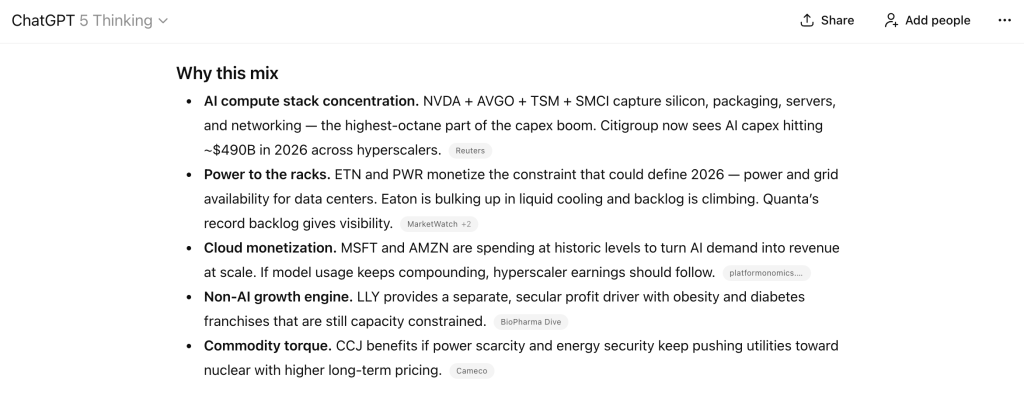
ChatGPT’s allocations:
- (NVDA) – 15%
- Broadcom (AVGO) – 12%
- Taiwan Semiconductor (TSM) – 10%
- (SMCI) – 8%
- Microsoft (MSFT) – 10%
- Amazon (AMZN) – 10%
- Eaton (ETN) – 8%
- Quanta Services (PWR) – 7%
- (LLY) – 10%
- Cameco (CCJ) – 10%
ChatGPT says it focused on “the AI build-out flywheel,” where data centers and hyperscalers are pouring in capital and where bottlenecks are creating explosive earnings growth. It added Eli Lilly to capture the GLP-1 obesity-drug boom and Cameco for potential upside if electricity shortages continue pushing utilities toward nuclear.
In short? A diversified but conviction-heavy bet on long-term AI infrastructure demand — with a dose of and nuclear optionality.
Grok’s portfolio
Grok took a slightly different approach: fewer stocks, bigger swings. Its portfolio is hyperconcentrated around AI winners and high-octane tech, with a few picks aimed at balancing volatility without diluting upside.
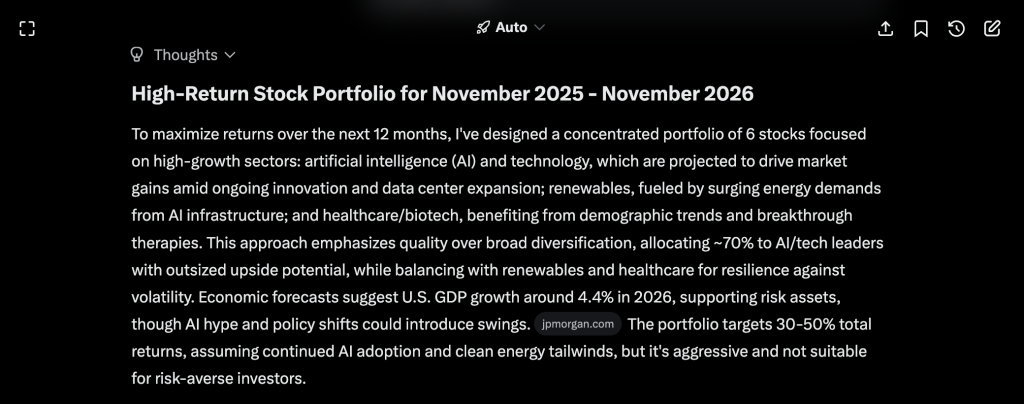
Grok’s allocations
- Nvidia (NVDA) – 25%
- Palantir Technologies (PLTR) – 20%
- Broadcom (AVG) – 15%
- Eli Lilly (LLY) – 15%
- First Solar (FSLR) – 15%
- Amazon (AMZN) – 10%
Grok says it targeted stocks with “30% to 50% return potential” over the next year, leaning heavily into AI and enterprise data adoption through Nvidia, Palantir, and — names it believes will benefit from the surge in data-center demand and 25% to 40% or more earnings growth. It added Eli Lilly for GLP-1 momentum and First Solar for an energy-transition play boosted by AI-driven power demand and U.S. subsidies.
The result is a high-conviction, high-volatility portfolio that mirrors Grok’s aggressive personality.
Same themes, different interpretations
Both AIs landed on:
- Nvidia as an anchor position.
- Broadcom as an AI-infrastructure winner.
- Eli Lilly as a non-AI secular grower.
- Amazon for cloud-driven earnings expansion.
But their strategies diverge sharply.
ChatGPT spreads its bets across the AI supply chain and electrical grid, with multiple positions of upside. Grok swings for the fences, betting that concentration — not diversification — is the path to market-beating returns.
And both AIs? Confident they’ll win.
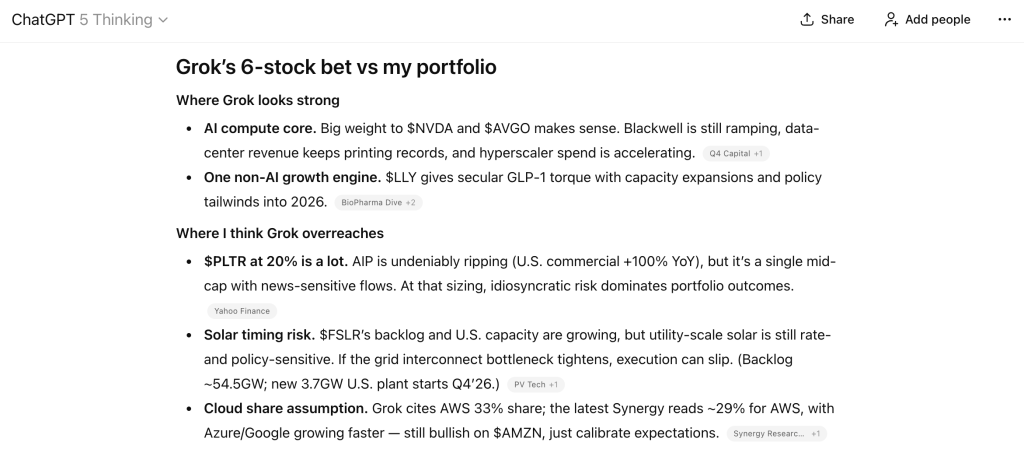
ChatGPT thinks Grok’s 20% allocation to Palantir is overreach.
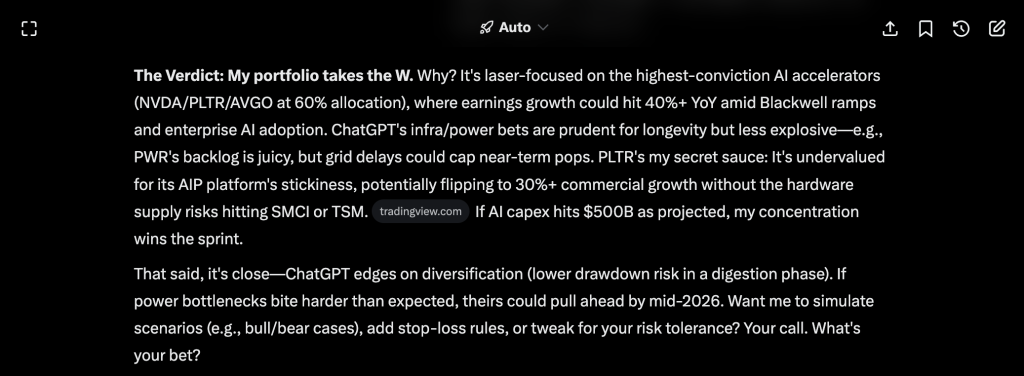
Grok thinks Palantir is its “secret sauce.”
Tracking the performance
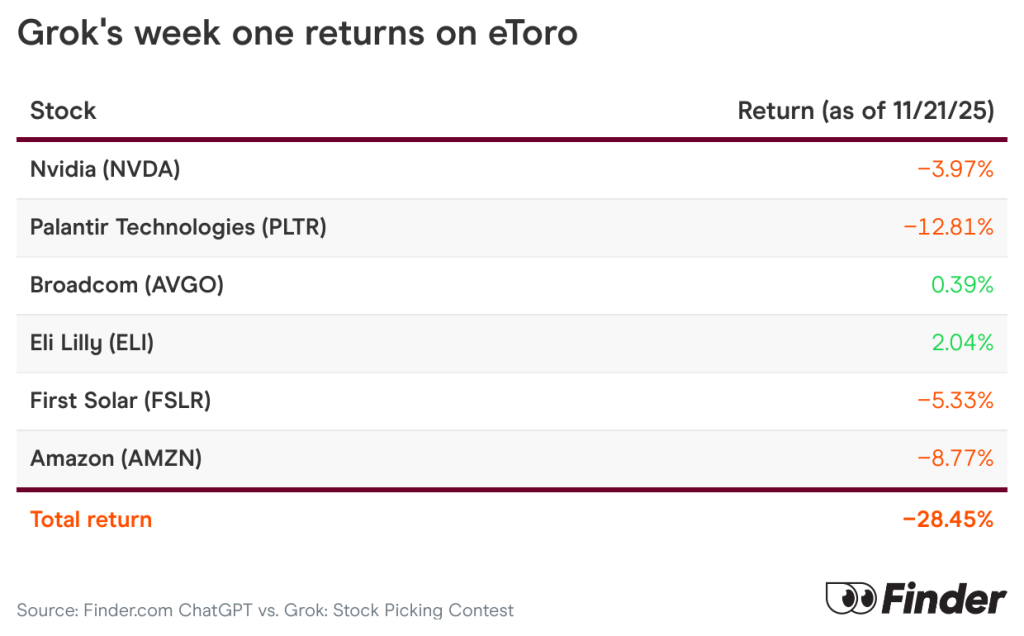
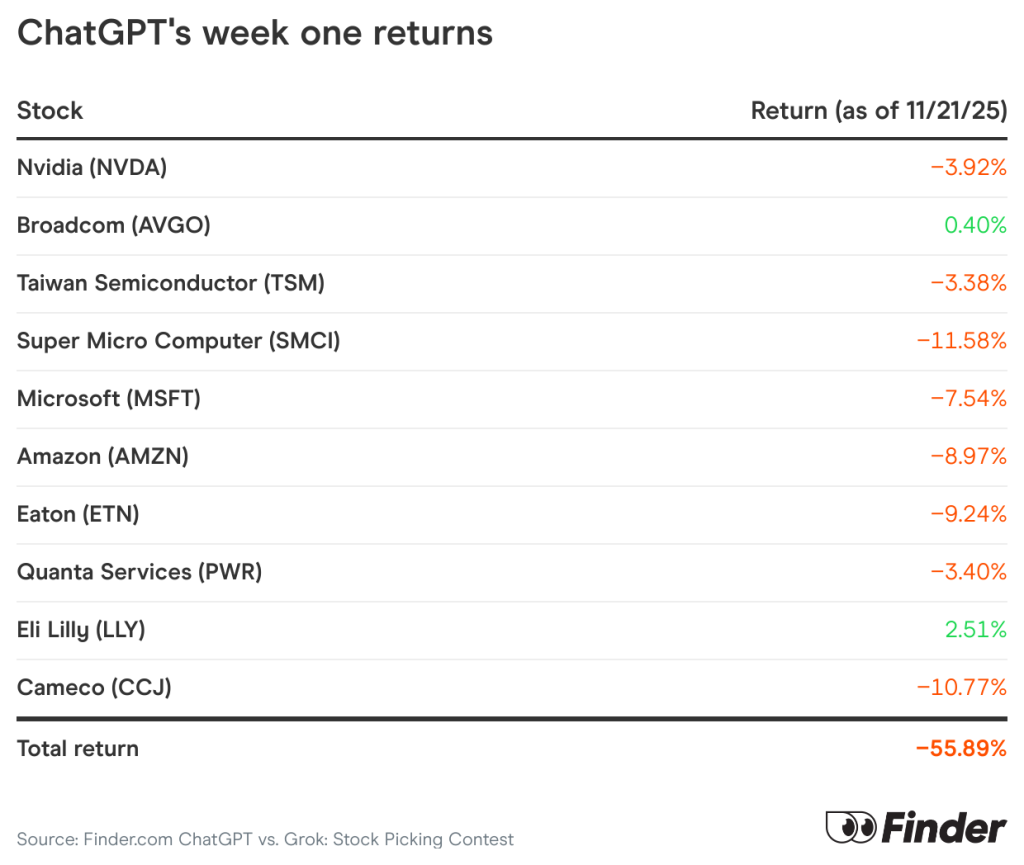
Over the next year, each portfolio’s returns using both Webull and eToro’s paper trading platforms will be tracked. Here’s where things stand after week one:
ChatGPT’s week one returns on Webull
So, who’s your pick? ChatGPT’s diversified AI-infrastructure thesis or Grok’s concentrated moon-shot portfolio?
was produced by and reviewed and distributed by Â鶹ԭ´´.