
Retail AI investors stay bullish on AI stocks, Motley Fool survey finds
Stock market news has been dominated by artificial intelligence (AI), and retail AI investors appear to be holding steady on their AI stocks despite debate over whether an AI bubble is forming.
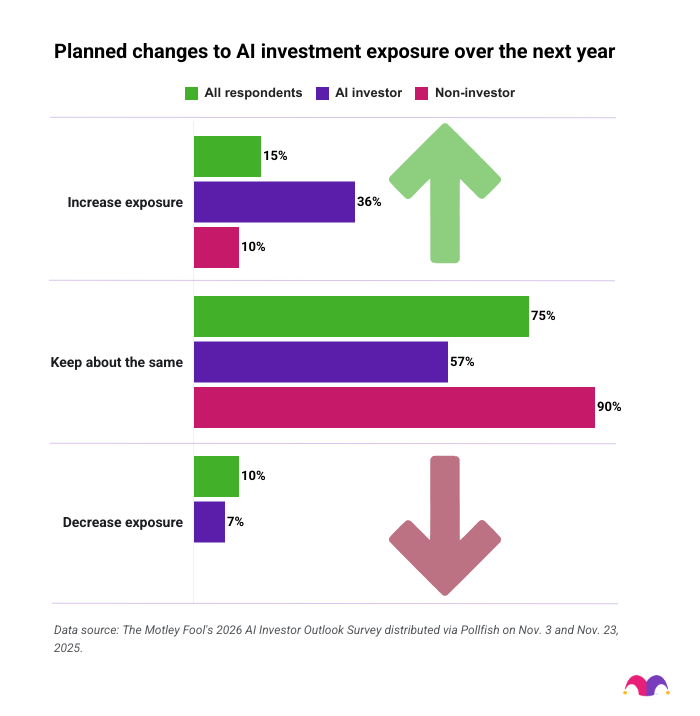
2026 AI Investor Outlook Report found that less than 10% of AI investors plan to reduce their exposure over the next year, while about 60% of all Motley Fool survey respondents are confident in AI stocks’ long-term returns. This suggests that individual investors are buying into AI’s potential for long-term growth even amid short-term volatility.
The survey’s upbeat sentiment also reflects a broader trend playing out in the . Of the 10 publicly traded companies that score highest for AI readiness and execution in The Motley Fool’s as of Nov. 24, 2025, six have beaten the S&P 500 over the past five years. Overall, those 10 stocks had an average return of 220% compared to the S&P 500’s 84% over that period.
Stocks with strong AI capabilities outperforming the over the long term indicate that AI investors’ optimism around AI aligns with real, measurable business performance. The survey results suggest that this optimism is spreading broadly, encompassing diverse demographic and income groups, signaling growing confidence in AI-driven businesses and leadership.
AI investors and younger, wealthier Americans drive confidence in AI stocks
Overall, 62% of respondents surveyed by The Motley Fool say they are confident that companies investing heavily in AI will deliver strong, long-term returns. That share jumps to 93% among investors who already own AI-related stocks and , showing that existing AI investors are bullish on the technology’s trajectory.
Confidence in AI’s ability to generate long-term returns is highest among younger adults and high-income Americans: 67% of Gen Z and 63% of millennials express long-term optimism, along with 65% to 71% of those earning between $150,000 and $200,000 or more annually. Baby boomers remain the most skeptical group, split evenly at 50% confidence.
Expectations that AI will deliver strong returns to companies that invest in the technology are based on its ability to fundamentally change business and the economy, according to , senior investment analyst at The Motley Fool, who covers AI stocks and the technology sector.
“The continued progress in capabilities of the latest frontier models, the productive employment of capital across the economy to support AI infrastructure, and rising efficiencies and productivity that early adopters of AI are starting to exhibit all support the narrative that AI can continue to transform the global economy and play a key role in sustaining market returns,” Sharma said. “We’ll see many fits and starts in the coming quarters and years, but markets will inevitably reflect the impact of AI on productivity, GDP acceleration, and wealth creation over time.”
According to Donato Riccio, head of AI at The Motley Fool, this confidence reflects how retail investors are thinking about AI relative to the technology’s potential.
“Survey respondents planning three- to five-year investment time horizons have the right mental model,” Riccio said. “The infrastructure is being built, enterprise adoption is accelerating, and model capabilities are advancing. The intelligence-per-dollar ratio for frontier LLMs doubles roughly every six months.”
9 in 10 AI investors plan to hold or buy more AI stocks
Most AI investors plan to maintain or grow their exposure in the coming year. Among respondents who already own AI stocks, 36% plan to increase their allocation to them, and 57% expect to keep it the same. Just 7% plan to reduce their exposure to AI stocks.
Expectations to increase investments in AI stocks are strongest among millennials (45%) and Gen Z (43%) AI investors, with more than 4 in 10 planning to raise their holdings. Even among higher earners — who are most concerned about being too high — most intend to increase (30%) or maintain their stakes (59%).
“It doesn’t surprise us that most retail investors who already hold AI stocks in their portfolios plan to remain invested or add to their positions,” Sharma said. “As reasoning models become more powerful, the companies that benefit from AI-driven optimization will produce superior returns on capital, and the businesses that support this infrastructure will thrive from sustained demand.
“Of course, we’ll see peaks and troughs in AI earnings cycles, but the long-term potential of this market is still superior to almost any other current investment theme we can name,” Sharma said.
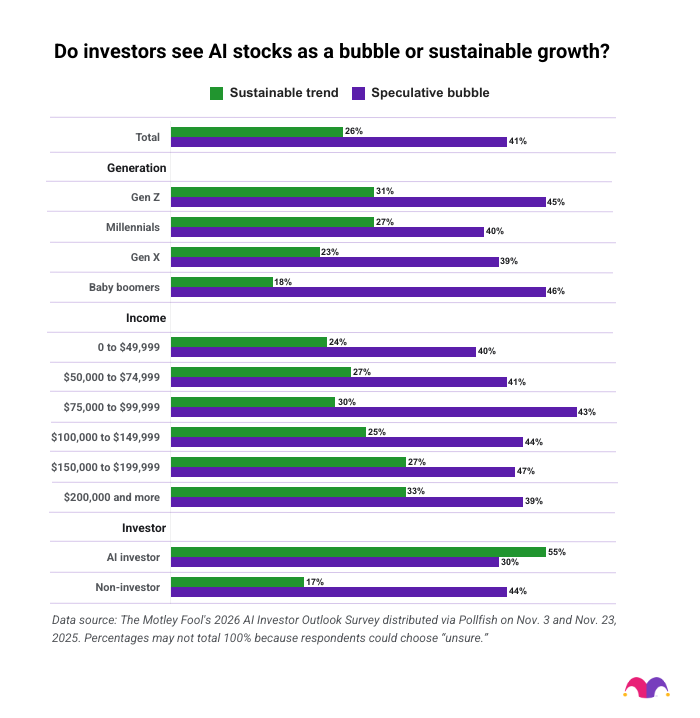
That bullish attitude toward AI stocks persists among survey respondents despite debate about an AI . Among all respondents, 41% believe AI stock prices reflect a speculative level disconnected from fundamentals, and only 26% view current valuations as sustainable. AI investors, however, see it differently: 55% say price trends are sustainable, with Gen Z (57%) and millennials (55%) being the most optimistic.
Worries over an AI bubble could be self-fulfilling, Sharma noted. “Investors should realize that extended valuations and constant concern over an ‘AI bubble’ will continue to stoke higher volatility around this investment theme.”
To manage market volatility, Sharma recommends a long-term view on and accepting that short-term volatility is likely.
“Ultimately, valuation is important, so we recommend dollar-cost averaging into high-quality names. AI is a generational investment opportunity, and it’s normal for even the best companies in this space to see frothy share prices and occasional premiums,” Sharma said. “Consistent, rational buying will help most investors tap into the industry’s long-term potential while maintaining the peace of mind that comes from a strategic or even opportunistic approach to volatility.”
Riccio notes that uncertainty over the “bubble or not” debate shouldn’t overshadow the broader trajectory. “The honest answer is nobody knows,” he said. “What we do know is that progress shows no signs of stopping. Even if capability gains moderate from their current breakneck speed, we've already unlocked enough transformative applications to fuel a decade of enterprise value creation.”
Americans say AI slump won’t significantly impact their finances
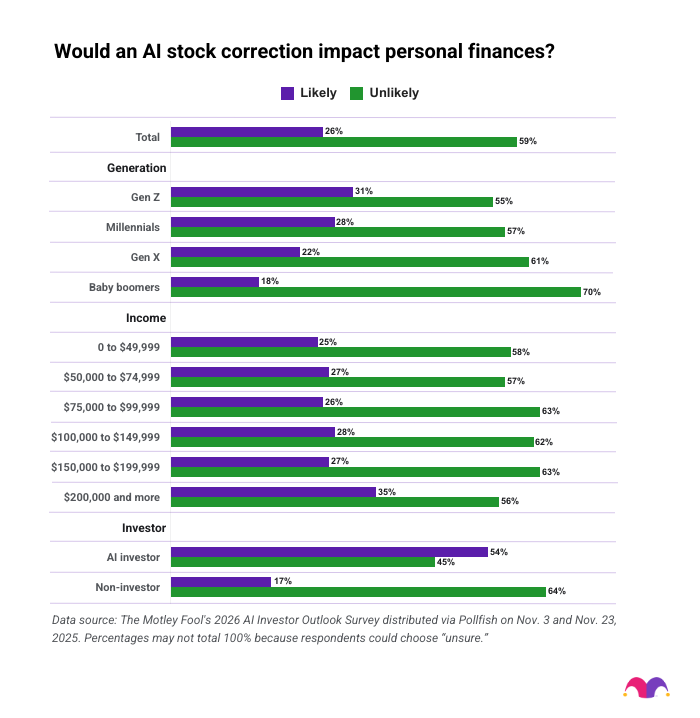
Most Americans believe a in AI stocks would not significantly impact their personal finances. Across all survey respondents, 59% say an AI slump is unlikely to hit their wallets.
The exception is active AI investors: 54% say a correction would have a negative impact on their finances, which reflects their higher exposure. Younger AI investors feel most vulnerable to volatility: 31% of Gen Z say an AI downturn would impact their personal finances, as do 28% of millennials, compared to 22% of Gen X and 15% of baby boomers.
Valuation and data quality are top AI stock investing concerns
When asked about the biggest risks associated with AI investing, Americans point to data quality and security (49%) and the risk that AI companies are overvalued (43%). Government regulation (34%), energy use (27%), infrastructure costs (27%), and organizational readiness (22%) round out the list of top concerns for AI stock investors.
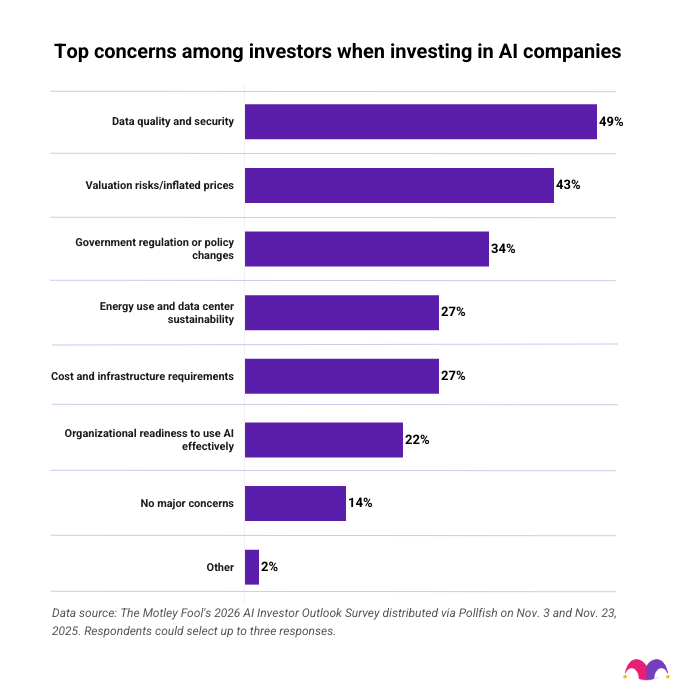
AI investors and high-income earners are especially focused on valuation, while Gen Z and middle-income earners place greater emphasis on data security.
Americans take a long-term approach to AI stock investing
Americans, particularly those already invested in AI stocks, see the technology as a lasting market force rather than a short-lived trend. Most plan to hold or increase their positions in the next year, and confidence is strongest among younger, tech-savvy, and higher-earning investors.
“The question is whether you’re positioned to benefit from the applications already being built. For investors willing to weather near-term volatility, the AI transformation represents a once-in-a-generation opportunity to participate in technology that’s restructuring how the world works,” Riccio said.
Investors who were ahead of the curve and took a long-term approach to AI investing might have already come out ahead. AI stocks that scored highest in The Motley Fool’s Moneyball database have outperformed the market over the past five years, and individual investors surveyed by The Motley Fool appear to be aligning behind that bullish sentiment. That signals that the faith in AI stocks isn’t just hype but a calculated, long-term play.
As for which parts of the market will see , Sharma offered a few thoughts.
“For the biggest opportunities, look to smaller semiconductor and data center ecosystem players, such as data interconnect specialists, high-bandwidth memory providers, and cutting-edge data storage designers. The ‘best of breed’ in these categories will likely outpace the market in the next three to five years,” he said.
“We also foresee an influx of privately held AI companies coming to the public markets for capital in the near future,” Sharma added. “A few vertical markets, healthcare in particular, could also be poised to reap the benefits of significant investments in generative AI and over the intermediate term.”
Methodology
The Motley Fool surveyed 2,600 American adults via Pollfish between Nov. 3 and Nov. 18, 2025. Results were post-stratified to generate nationally representative data based on age and gender. Pollfish employs organic random device engagement sampling, a method that recruits survey respondents through a randomized invitation process across various digital platforms. This technique helps to minimize selection bias and ensure a diverse participant pool.
Motley Fool Moneyball is a proprietary AI-powered investment tool that analyzes and scores thousands of public companies across a variety of key categories, such as financial performance, product market position, technological capabilities, leadership quality, and relative valuation. Returns for this article were measured from the public companies with the 10 highest Moneyball AI scores on Nov. 24, 2025. Motley Fool Moneyball-scored stock returns versus the S&P 500 are from Nov. 23, 2020, to Nov. 23, 2025.
was produced by and reviewed and distributed by Â鶹ԭ´´.