50 of the world's most endangered species
Humans are very good at a lot of things. But our greatest, most terrible skill may be making other species go extinct. Our , according to many scientists, with species across the globe dying off at an alarming rate. In the last century, animals than the normal "background" rate. That means the global rate of extinction, which should have taken 800 to 10,000 years, occurred in just 100.
The (IUCN) keeps track of how endangered a species is with its authoritative . The global organization cites factors like residential and commercial development, climate change, and energy production as the reasons species become endangered, and tracks species populations from year to year. There are currently over , according to IUCN's findings, representing almost 30% of all assessed species. Specifically, those numbers represent about 41% of all amphibians, 34% of conifers, 33% of reef corals, 30% of sharks and rays, 27% of crustaceans, 25% of mammals, and 14% of birds.
Â鶹ԭ´´ consulted the Red List to find species deemed "critically endangered" or "extinct in the wild" across four major biological kingdoms: Animalia, Plantae, Fungi, and Chromista. Read on to learn about these fascinating species that may not be long for this world—and what, if anything, can be done to protect them.
You may also like:
Species: Vaquita (Phocoena sinus)
Called “,” the vaquita has seen a numbers from more than 500 in 1997 to under 20 in 2017. The five-foot-long porpoises live in the Gulf of Mexico and were only discovered in 1958. They’ve been brought to the brink of extinction primarily by illegal fishing. Fishing nets often accidentally trap and kill vaquitas, which share the waters with other fish deemed valuable by the Chinese market. The was established in 1997 to study and protect this small porpoise.
Species: Starry breck lichen (Buellia asterella)
Mostly found in western European dry grasslands at low elevation, this variety of (a cross between fungi and algae) is now only found in three or four locations around the globe. The number one cause of its vulnerability is habitat change and destruction, which accounts for its low numbers in Germany, Norway, and the United Kingdom.
Species: Great Orme berry (Cotoneaster cambricus)
First recorded as abundant in 1783, there are now only left in Wales, thanks to plant collectors and grazing by animals like rabbits, sheep, and feral goats. In Welsh, ” which translates to “rock apple of Gogarth.” If the Great Orme berry disappears, humans will never again know the taste of its yellow pear-shaped berries that turn reddish-orange when fully ripe.
Species: Galapagos stringweed (Bifurcaria galapagensis)
Before 1983, was a type of algae readily found in the Galápagos Islands and beyond. Since then, it has virtually disappeared. The major culprit seems to be El Niño and associated climate change. The IUCN will reassess the alga in the next five or ten years; if no further specimens are discovered, they plan to label it completely extinct.
Species: Black clubshell (Pleurobema curtum)
In the river waters of Alabama and Mississippi, is holding on for dear life—unless, of course, it's already gone. Listed as "possibly extinct," there hasn't been a live specimen discovered in at least a decade. Dredging and sediment shifting as a result of the construction of the Tennessee-Tombigbee Waterway appears to be the most logical factor in the disappearance of the black clubshell.
*Image of Pleurobema riddellii
Species: Rove beetle (Atheta caprariensis)
The habitat barely takes up a five-square-mile forest patch of the small Azore island chain off the coast of Portugal. They live underneath tree bark and in the soil, and as nocturnal predators, they hunt for sustenance at night. As changes in the Azores economy dictate changes in the way land is used, the rove beetle’s habitat continues to be threatened.
Species: Boreal felt lichen (Erioderma pedicellatum)
This lichen lives on both sides of the Atlantic, with its main habitat in Newfoundland and other parts of eastern Canada. The has become endangered due to a rise in logging and air pollution; recent estimates claim that its population will .
Species: Tropical acidweed (Desmarestia tropica)
El Niño is to be blame for the decimation of this Galápagos alga. Found in only two locations and not seen since 1972, there’s a high likelihood that is extinct. The cold water species is not at all amenable to rising sea temperatures.
Species: Devils Hole pupfish (Cyprinodon diabolis)
, the Devils Hole pupfish can only be found in a single limestone pool in one of the hottest places in America: Devils Hole, a 93°F offshoot of the Death Valley National Park in Nevada. The is just an inch long, and while their habitat is fenced in for protection, their pool is still subject to human interference—which is said to be the main cause for their population decrease.
Species: Fitzroy Falls crayfish (Euastacus dharawalus)
This is indigenous to the state of New South Wales in Australia, specifically Fitzroy Falls in the Wildes Meadows Creek. There are upwards of 600 mature crayfish of the species, but the introduction of fish like rainbow trout and carp into the area for recreational purposes represents a major problem for the crustaceans, who have to contend with new predators.
*Image of Euastacus bispinosus Clark
Species: Javan rhinoceros (Rhinoceros sondaicus)
The Javan rhinoceros hails from Vietnam and Indonesia; today there are left in the world. A on the western tip of the island of Java. Demand for rhino horn, mainly in China, is the most prominent reason why this species is in severe decline. Conservation groups like the are actively working to protect this rhinoceros but time is running out.
*Image of Rhinoceros sondaicus Desmarest
Species: Little chamal (Zamia vazquezii)
is a plant from the Mexican state of Veracruz. Known as “amigo de maiz” (“friend of corn” in Spanish), habitat loss has taken it from endangered in 1998 to critically endangered in 2003. With , the remaining cycads (fewer than 50) are struggling to survive.
Species: Desroches cockroach (Delosia ornata)
Cockroaches have with the ability to survive just about anything, but the in the Seychelles has met an enemy it may not be able to surmount: the hotel industry. As it only inhabits a little over a half of a square mile, the opening of a hotel property on their native habitat could spell the end of the Desroches, which was down to less than 1,000 total individuals back in 2006.
*Image of Malocampa delosia Schaus
Species: Golf ball (Mammillaria herrerae)
bears a striking resemblance to a golf ball, which explains the name. In fact, its flowers are so appealing to cactus lovers that illegal collection is the main reason it’s listed as critically endangered. Over the past 20 years, 95% of the species has been removed or destroyed even though it’s legally protected by the Mexican government. Conservation efforts are underway by the Cadereyta Regional Botanical Garden to encourage reproduction of the cactus.
*Image of Mammillaria herrerae Werderm
Species: Bridgeoporus nobilissimus
The fungus can only be found on extremely old, large Abies trees and tree stumps in Oregon, Washington, and northern California. As the population of Abies trees dwindles because of logging and forest fires, the number of trees large enough to support Bridgeoporus nobilissimus has dropped significantly. Only 9% of the tree population still exists, which has whittled the fungus population down to 140 mature individuals.
Species: Geometer moth (Eupithecia ogilviata)
In May 1903, the first and only of this species was discovered in Faial Island, in the center of the Azores island chain. The laurel forest in which it was found has since been destroyed. While the Geometer moth is likely already extinct, of many other subspecies of its family lend hope that there may be more of this species yet to be discovered.
*Image of Eupithecia miserulata Grote
Species: Torrey pine (Pinus torreyana)
Known as , the is a magnificent tree originally from southern California, with sub-populations in both San Diego and Santa Barbara. Extensive conservation practices are in place for the San Diego trees, which are part of Torrey Pines State Park and have . A long history of fire damage in Southern California is cause for concern, as the current population of the pines counts less than 5,000 mature individuals.
*Image of Pinus torreyana var. torreyana Parry ex °䲹°ù°ù¾±è°ù±ð
Species: Lord Howe Island stick-insect (Dryococelus australis)
Lord Howe Island is over 400 miles from the mainland of Australia and that’s where the resides. and introduced rats to the island, which devoured all the species of stick-insects on Lord Howe Island. to eradicate the rats on Lord Howe Island, and the absence of the predators will have a positive impact on all the stick-insects of the island.
Species: Saola (Pseudoryx nghetinhensis)
The has been called the “” because the cattle/antelope hybrid has rarely been seen by humans. When it was discovered in 1992 in Vietnam, it was the first new mammal discovery in 50 years. , the already small numbers of this Southeast Asian creature are being further reduced by hunting and the value placed on its scarcity.
Species: Destuntzia rubra
Originally named Hymenogaster ruber back in 1899, this fungus was re-christened in 1985. Out of 13 sites surveyed in the past 30 years in California and Oregon, only five remain. Urban development in the San Francisco area and the West Coast has greatly impacted the viability of the Destuntzia rubra.
Species: Piedmont quillwort (Isoetes malinverniana)
Quillwort is an aquatic plant that thrives in fresh, rushing spring water as well as near rice fields. can be found in the northern Italian regions of Piedmont and Lombardy. It received “critically endangered” status when 88% of the population was found to have disappeared. It’s recognized by several major conservation directives like the , but water pollution and inadequate land management are still contributing to the Piedmont quillwort’s demise.
Species: Desertas wolf spider (Hogna ingens)
First described in 1857 by John Blackwall, the is both large (1.5 inches) and rare as a major predator in its home of Desertas Island, Portugal. When rabbits were expelled from the area in 1996, a previously controlled invasive grass species flourished. This pushed out native herbs and creatures, taking away most of the spiders’ food sources and leading to the decline of their species.
*Image of Hogna carolinensis
Species: Golden bamboo lemur (Hapalemur aureus)
Only found in the rainforests of Madagascar, the golden bamboo lemur is named for its unique fur and diet consisting . Like other lemurs in its family, this species is endangered by the slash-and-burn agriculture that causes its home to be cut down for houses and other buildings.
Species: Visayan warty pig (Sus cebifrons)
The central Philippine islands are home to these , which have already been eradicated from three of the six islands where they were originally found. While they’re officially protected by law, lax enforcement has led to a significant increase in hunting for their meat, which commands a premium at market. The was established in 1992 to save the species, although the once vulnerable population has descended into critically endangered status.
Species: Tahina palm (Tahina spectabilis)
Named one of the top 10 species of 2008 by the International Institute for Species Exploration, the so-called " " got its nickname because it and then dies soon after. in Madagascar in 2005, there are only 30 known mature palms in existence—they're threatened mainly by the increased frequency of fires in the region.
Species: Yellow-gilled Lepiota (Lepiota luteophylla)
Mycologists believe the last living fungus is somewhere in the groves of Monterey Cypress in central and northern California. That said, it hasn’t been seen since 1976 and there’s a strong chance it’s already extinct. The fungus only grows in larger groves of Monterey Cypress—and the trees themselves are listed as vulnerable, leading to a distressing prognosis for this fungus.
*Image of Lepiota luteophylla Sundb
Species: Florida cave shrimp (Palaemonetes cummingi)
The last known was seen in 1973 in the Squirrel Chimney Cave in Alachua County, Fla. While there haven’t been any recent sightings, there are enough unexplored sinkholes in the cave to merit a “critically endangered” label—for the possibility that these elusive crustaceans may still exist. If that’s the case, the discovery of high numbers of invasive Redeye Chub fish could lead to all-out extinction of P. cummingi, as the fish are known to eat larval shrimp.
*Image of Lepiota luteophylla Sundb
Species: Many-fruited beardless moss (Weissia multicapsularis)
Originally found in both France and England, the many-fruited beardless moss is now completely extinct in France. The only remaining wild specimens are in the U.K.’s historic region of , where it grows in two tiny patches measuring less than eight square inches. To save the species, a sample from one of its locations is .
*Image of Cornwall, England; the species is endemic to this region
Species: Black softshell turtle (Nilssonia nigricans)
The IUCN Red List designates the as extinct in the wild. That’s because it only exists in a very surprising location: a single man-made pool at a temple in Bangladesh. First classified in 1875, anyone who would like to view the last of the turtles will have to venture to the Bayazid Bostami shrine outside of Chittagong.
*Image of Nilssonia sp.
Species: Dictyota galapagensis
Listed as not only "critically endangered" but also "possibly extinct," is a shallow-water seaweed from the Galápagos Islands. Like other algae in the area, the species has been affected so greatly by climate change (specifically El Niño activity), that it hasn't been observed since the mid-1970s.
*Image of Dictyota crenulata J.Agardh
Species: Honolulu cyanea (Cyanea acuminata)
Hawaii has already been , but the main threat for the isn’t the environment—it’s attacks by feral pigs. Also known locally as “Haha,” this bellflower shrub on the island of Oahu is already the subject of rehabilitation plans at and the National Tropical Botanical Garden.
*Image of Dictyota crenulata J.Agardh
Species: Fat-whorled pondsnail (Stagnicola bonnevillensis)
Thought to be extinct until 1985, the , sometimes known as the Bonneville snail, exists in a very small region of Utah. Human disturbance and pollution (particularly from energy waste and cleaning solvents) are the main reasons it’s earned “critically endangered” status. It only lives in five spring-fed pools, none of which are currently protected.
*Image of another species in the Stagnicola genus
Species: Gumushanian tulip (Tulipa gumusanica)
Found on the rocky slopes of Mt. Zigana in Anatolia, Turkey, this is threatened by logging, construction, and ironically, the negative effects of ecotourism. While national regulations prohibit the collection of wild tulips, the isolated location and small population of the Gumushanian tulip makes it vulnerable to extinction.
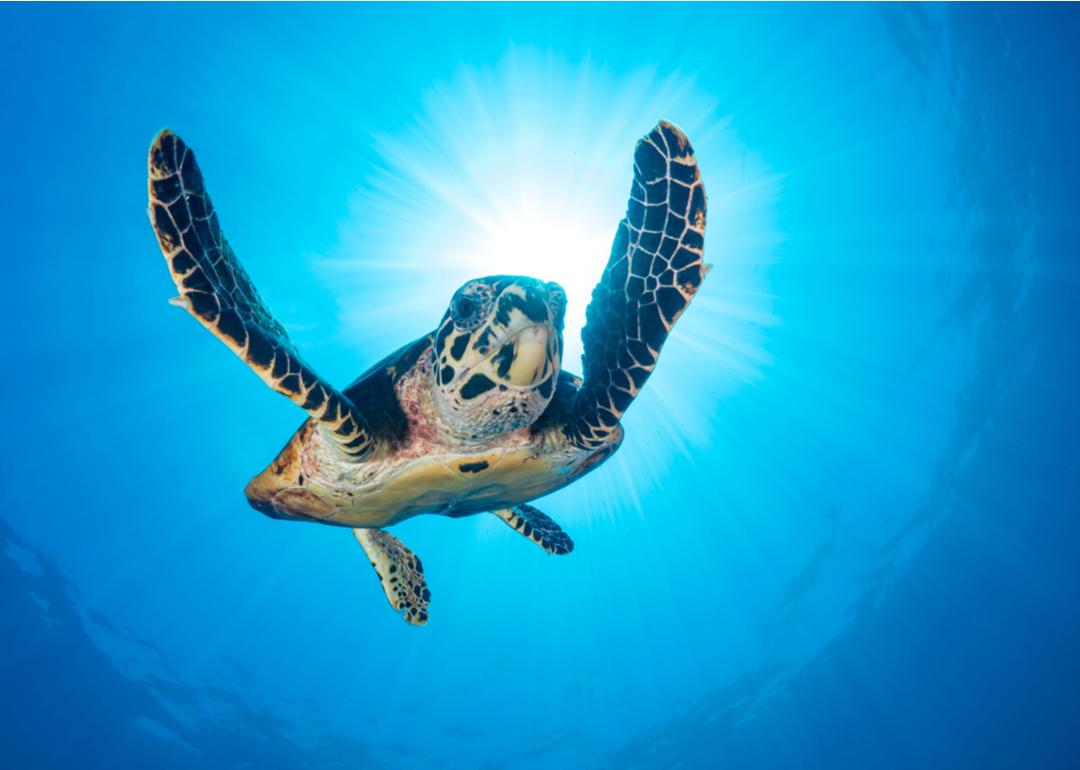
Species: Hawksbill turtle (Eretmochelys imbricata)
, the hawksbill turtle is known for its pointy beak and beautiful shell, which is and makes it . Hawksbills can be found in over 70 countries, but their primary habitat is in tropical waters near coral reefs. Sea turtles and their ancestors have existed for 100 million years and serve a vital part of marine ecosystems.
Species: Rumplestiltskin pygmy grasshopper (Agkistropleuron simplex)
These curiously named are losing their habitats due to deforestation. They only exist in one location in Madagascar; the more forest that's cut down, the fewer Rumplestiltskin pygmy grasshoppers the world will know.
*Image of Thalictrum simplex subsp. simplex
Species: Sinai Primrose (Primula boveana)
The lives in Egypt's Sinai desert—specifically, the St. Katherine Protectorate National Park. Limited to just one area of less than four square miles, the long-stemmed perennial’s population is currently less than 200 plants. Climate change is responsible for the plant’s decline; the Medicinal Plants Conservation Project is attempting to store seeds to preserve its place in the world.
*Image of Primula boveana Decne.
Species: Bornean orangutan (Pongo pygmaeus)
The has become a bit of a celebrity, thanks to the success of the . Native to Borneo, it is present in both the Indonesian and Malaysian parts of the island. Unfortunately, the orangutan's numbers have dwindled significantly because of and hunting, which has led to an 86% population decrease since 1973.
Species: Floreana coral (Tubastraea floreana)
Many species of the Galápagos archipelago and is no different. The species is found mainly on cave ceilings, rock overhangs, and ledges. Scientists link the rise in ocean temperature, specifically due to the , to the coral’s troubled fate.
*Image of Tubastraea diaphana
Species: Black-breasted puffleg (Eriocnemis nigrivestis)
Deforestation is the main culprit behind the near-eradication of the , a type of hummingbird. A massive 93% of its suitable habitat in the volcanic regions of Ecuador has been degraded or destroyed. Dubbed the “emblematic bird of Quito,” groups like the are doing their best to keep the species alive.
Species: Clanwilliam cedar (Widdringtonia cedarbergensis)
South Africa’s Cederberg Mountains are home to the , a tree that used to be abundant in the area—until European settlers arrived in the 1800s and used the majority of it for timber. Now only 5% of the original stocks remain, and fire is a serious threat to the cedar’s survival. , but few have proven successful thus far.
Species: Perionychella ngakawau
These live in the Happy Valley site of the , one of New Zealand’s 268 ecological districts that resides on the northwest coast of the island nation. Coal mining in the region has led to a rapid decline in the species’ habitat, which could lead to further degradation of the population.
*Image of Phyllocladus alpinus Hook.f.
Species: Lepiota rhodophylla
Easily identifiable by its pink outer membrane and short sporocarps (the area where spore-producing structures develop), the fungus is another endangered species that relies on large Monterey Cypress groves of California for its habitat. As the groves fall prey to diseases like Cypress Canker and forest fires, the fungus is at risk of losing its home.
Species: Red-legged fire-millipede (Aphistogoniulus corallipes)
The forest of Manantantely is a private reserve near the southern coast of Madagascar, and it’s the only place on the planet to find the . Logging and a history of slash-and-burn agricultural practices have created an atmosphere of doom for this crimson-legged crawler.
Species: Spatoglossum schmittii
Add Spatoglossum schmittii to the list of Ecuadorian/Galápagos Island casualties from El Niño-related climate change. Mainly found in the Galápagos Marine Reserve, has been . If no more specimens can be found, the possibility of using S. schmittii to aid humankind will disappear.
Species: Southern bluefin tuna (Thunnus maccoyii)
One of the most tragic stories in the fishing world, the has seen its numbers rapidly decline because of . Native everywhere from Argentina, to South Africa, to New Zealand, this species can grow close to 450 pounds—but overfishing is so pronounced that worldwide stocks of the bluefin tuna could reduce to just 500 mature fish in the next 100 years.
Species: Greater fungus weevil (Homoeodera major)
Found in just three locations on the island of St. Helena in the Atlantic Ocean, the makes its home primarily in the dead wood of so-called cabbage trees. Invasive predators have impacted their survival rates, as has the lack of newly dead wood for the weevil larvae feast upon.
Species: Franklin tree (Franklinia alatamaha)
Franklinia, more commonly known as Frankin tree, is a small tree that commonly grows 10-to-20 feet high with large white flowers . First discovered by Philadelphian botanists in 1765, the tree for unclear reasons around 1800 to 1850, and now exists only in botanical gardens around the world.
Species: Wood's cycad (Encephalartos woodii)
Similar in appearance to a palm tree, Wood’s cycad is named after John Medley Wood, the South African botanist who discovered the plant in 1895. Incredibly rare, the plant only survives as hybrid clones, and has been dubbed the “.”
Species: Polynesian tree snail (Partula rosea)
There are several species of Polynesian Tree Snails, some of which . Partula rosea, which is extinct in the wild, exists , a long ways away from their native French Polynesia.
Species: Hawaiian crow (Corvus hawaiiensis)
The Hawaiian Crow is considered the most endangered of the family Corvidae, which includes common birds like crows and ravens, being extinct in the wild since 2002. However, the species thrived in captivity, and in 2017 a reintroduction of the birds to Hawaii .