Deadliest animals in the world
On June 20, 1975, Stephen Spielberg's summer smash "Jaws" hit theaters across the country, forever changing the way people view sharks. Dozens of movies in the decades since have been inspired by the story of a man-hunting shark, which leads to increased fear of shark attacks. Humans have taken to killing sharks to prevent such attacks, and in doing so have despite the fact that sharks only kill every year.
While every death is tragic, shark attacks represent a small fraction of the number of humans killed by animals each year: an estimated 1,537,166 in 2014. To find which animals deserve their lethal reputations, 麻豆原创 analyzed a list of the world's deadliest animals as , Microsoft founder and philanthropist Bill Gates' blog.
Gates collected data from sources like the World Health Organization, the Norwegian Institute for Nature Research, National Geographic, the National Science Foundation, the Center for Disease Control, and the World Wildlife Fund to estimate how many people worldwide were killed by animals in 2014. The 15 species on this list were ranked by the total number of people killed by each that year.
As it turns out, the world's deadliest animals may actually be the smallest ones. Which tiny pest tops the list? Read on to find out the world's deadliest animals.
#15. Elephant
Number of people killed: 100
Percent of total worldwide deaths from animals: 0.01%
The African elephant is , with the Asian elephant not far behind. These far-ranging animals need plenty of land to forage, but as human populations continue to grow, elephants and humans find themselves . Only is protected, and when people encounter elephants outside those areas, the results can be fatal for both species.
#14. Lion
Number of people killed: 100
Percent of total worldwide deaths from animals: 0.01%
Every year in , tourists get a close-up look at in its natural habitat. Perhaps unbeknownst to them, lions as potential prey. In the wild, attack humans, which they see as easier prey. Lions are also more likely to attack during the .
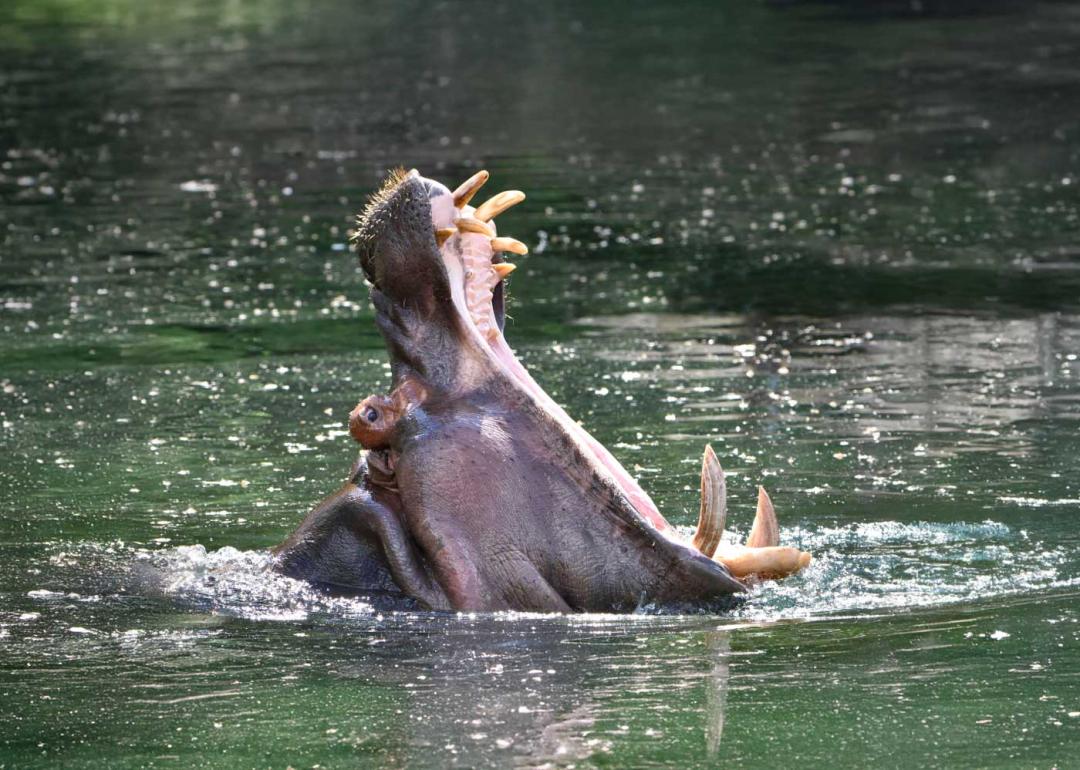
#13. Hippopotamus
Number of people killed: 500
Percent of total worldwide deaths from animals: 0.03%
The hippopotamus, Greek for "river horse," are semi-aquatic mammals of sub-Saharan Africa that of their day submerged in water. They're not gentle giants, however; male hippos , can run up to 20 miles an hour, and attack with 20-inch canines.
#12. Crocodile
Number of people killed: 1,000
Percent of total worldwide deaths from animals: 0.07%
Though sharks are often pointed to as the most common underwater menace, crocodiles are historically . Their bite is three and a half times more powerful than a lion's, and these opportunistic predators hunt to kill. Saltwater crocodiles are more deadly than their freshwater counterparts, and their attacks between October and March when the water is warmer.
#11. Tapeworm
Number of people killed: 1,600
Percent of total worldwide deaths from animals: 0.1%
Tapeworms can't digest food on their own, so they live in hosts' intestines to get the nutrients they need to survive out of food that's already been digested. in parts of the world where free-range livestock are more common, but the condition can be easily treated. Avoid getting one in the first place by ensuring all food is thoroughly cooked in regions that harbor the parasite.
#10. Ascaris roundworm
Number of people killed: 2,700
Percent of total worldwide deaths from animals: 0.18%
Roundworms, also called hookworms, are parasites . Like tapeworms, they live in the intestines of hosts who eat contaminated foods. The CDC estimates that between 807 million and 1.2 billion people are infected with roundworms worldwide, which accounts for most parasitic diseases. Luckily, most show few symptoms, and the parasites are only considered deadly in parts of the world with inadequate health care facilities.
#9. Scorpion
Number of people killed: 3,500
Percent of total worldwide deaths from animals: 0.23%
of scorpion will only cause minor pain and irritation if they sting you. Cousins to spiders, mites, and ticks, only 50 species to be dangerous to humans. Luckily, only one species in the U.S. poses a danger: found in southern Arizona and western New Mexico.
#8. Tsetse fly
Number of people killed: 3,500
Percent of total worldwide deaths from animals: 0.23%
Tsetse flies , but these insects are far deadlier. Like mosquitos, they feed on the blood of mammals, like trypanosomiasis, also known as "." Early symptoms include aches, pains, and itching. As the disease progresses, victims experience confusion and disruption of the sleep cycle. Left untreated, the condition is frequently fatal.
#7. Freshwater snail
Number of people killed: 4,400
Percent of total worldwide deaths from animals: 0.29%
Unlike the snails you might find in your garden, certain freshwater snails carry the second-most devastating parasitic disease on the planet: schistosomiasis. These snails shed the parasites into the water, contaminating it and infecting hosts who come in contact with it. Once inside the host, the parasites that embed into internal tissue. Schistosomiasis is fatal in about 10% of cases.
#6. Kissing bug
Number of people killed: 8,000
Percent of total worldwide deaths from animals: 0.52%
Kissing bugs might sound sweet, but they're carriers of the deadly Chagas disease, of trypanosomiasis, or "African sleeping sickness." The bugs near their eyes or mouth ("kissing" them) and leave behind droppings that infect through the wound. They're mostly found in Latin America, but there have been reported sightings throughout the southern U.S. as well.
#5. Dog
Number of people killed: 17,400
Percent of total worldwide deaths from animals: 1.13%
As much we love them, and, like wolves, they bite. While dying from a dog bite on its own , you should make sure your four-legged friend has had its shots regardless. That's because of rabies deaths in humans, accounting for 99% of cases. Africa and Asia experience the most dog bite-related deaths, due to large stray dog populations.
#4. Sandfly
Number of people killed: 24,200
Percent of total worldwide deaths from animals: 1.57%
Sandflies live in Africa, the Mediterranean, the Middle East, Latin America, and Asia鈥攅specially India. Their diet consists largely of plants, but females also while producing eggs and transmit the Leishmania parasite in the process. Most infected people never get sick, but those who get Leishmaniasis can develop . The most deadly is visceral Leishmaniasis, which is fatal in 95% of untreated cases.
#3. Snake
Number of people killed: 60,000
Percent of total worldwide deaths from animals: 3.9%
Snakes are one of the most commonly feared animals, and rightfully so. The World Health Organization estimates that snakes bite 5.4 million people , with 2.7 million of those bites are from poisonous snakes. Snake venom can . There are usually snakebite-related fatalities per year in the U.S., while India the most with about half of the world's snake bites each year.
#2. Human
Number of people killed: 580,000
Percent of total worldwide deaths from animals: 37.73%
As serious as animal attacks and parasitic diseases can be, you're much more likely to be killed by another human. The Gates Notes homicide accounted for around 409,000 deaths, with war casualties comprising the other 172,000. 2016 marked the first year in more than a decade that the while recent studies have found that wars may have led to in the last 50 years than estimated.
#1. Mosquito
Number of people killed: 830,000
Percent of total worldwide deaths from animals: 54%
Mosquitoes , including malaria, West Nile virus, Zika, dengue fever, yellow fever, and chikungunya. and eliminating the insects' breeding ground of standing water have been among the proposed solutions to this rampant problem. Nevertheless, it has proven complicated to implement an effective plan. The Gates Foundation has recently pushed : using gene-editing technology to eliminate malaria-transmitting mosquitoes altogether.