Endangered animals to watch out for in every state
Endangered animals to watch out for in every state
Some of the most common threats to the survival of animals across the globe are habitat loss and loss of genetic diversity, . The reasons for the endangered status of 50 species across the U.S. are as wide-ranging and varied as the shapes, sounds, and colors of the animals themselves. Previous examples of animal endangerment include collisions wiping out many West Indian manatees off the coast of South Carolina, forest logging robbing the ivory-billed woodpecker of much of its habitat in Arkansas, and the extinction of the passenger pigeon unleashing a domino effect on Rhode Island's American burying beetle.
No matter what is causing the decline of each of these 50 species—presented here without ranking, with one per U.S. state—it is undeniable that climate change has played a role. According to the World Wildlife Federation, the forcing animal species across the globe to scramble to acclimate to erratic and constantly-shifting habitats. According to CBS News, species loss is now , with over 500,000 land animals facing extinction before the end of this century.
Â鶹ԭ´´ consulted the to find endangered animals to watch out for in every state. To identify the animals most threatened, Â鶹ԭ´´ focused on animals classified as "Critically Endangered" by the except in instances where critically endangered animals were unavailable. New Hampshire and Maine animals are near threatened and not threatened, respectively, due to a limited amount of animals available for those states.
However, there is a silver lining. Since conditions are more desperate now than ever before, calls for action and change are also stronger than they've been in the past. Read on to discover what species to look out for and how to help with conservation efforts.
Alabama: Spring pygmy sunfish
- Scientific name: Elassoma alabamae
- Other states with species: N/A
- IUCN category: Critically Endangered
since it was first discovered in Cave Spring in Lauderdale County in 1937, the spring pygmy sunfish was rediscovered twice after that, most recently in Beaverdam Spring in 1973. Partial to colorless or slightly stained spring water, breeding males are more colorful than their female counterparts, with shimmering blue-green lines across their bodies. The , mostly due to water pollution and shrinking spring bodies.
Alaska: Polar bear
- Scientific name: Ursus maritimus
- Other states with species: N/A
- IUCN category: Vulnerable
Habitat loss and climate change are battering the remaining population of polar bears. As as the rest of the world, polar bears are struggling to maintain their habitat. Several factors distinguish polar bears from other bear species, including their size (they are the largest member of the bear family), narrow heads, and lack of true hibernation season.
Arizona: Bonytail
- Scientific name: Gila elegans
- Other states with species: California, Colorado, Nevada, Utah
- IUCN category: Critically Endangered
Bonytail chubs were ” with its population completely wiped out from the dam’s lower basin by 1950. Today, habitat disturbances from dams still constitute one of the biggest threats to the bonytail, which is similar to other desert fish with its camouflage-pigmented skin.
Arkansas: Ivory-billed woodpecker
- Scientific name: Campephilus principalis
- Other states with species: N/A
- IUCN category: Critically Endangered
Conservationists of the ivory-billed woodpecker in the early 20th century. Still, the species has persisted for a full century since then, with the discovery of a new population at the Cache River National Wildlife Refuge in Arkansas in 2004. A large bird, growing to over 1.5 feet long, the species can be identified by the bright red crests of males and white feathers, on the back. has caused the endangered status of this bird, taking away much of its habitat.
California: California Condor
- Scientific name: Gymnogyps californianus
- Other states with species: Arizona, Utah
- IUCN category: Critically Endangered
The California condor is the largest land bird in North America and weighs up to 25 pounds with a wingspan of up to 9.5 feet. The California condor is distinct from other birds of prey by its lack of sharp talons. This condor's range stretched across North America ; by 1940, however, habitats had been reduced to southern California. Today, human-made disturbances , including lead contamination, micro-trash, powerlines, and wind turbines.
Colorado: Gunnison sage-grouse
- Scientific name: Centrocercus minimus
- Other states with species: Arizona, California, Nevada, New Mexico, Utah
- IUCN category: Endangered
Perhaps the most noticeable characteristic of the Gunnison sage-grouse is its ‘ponytail:’ from the back of males’ necks and heads. Though historically the bird was found wherever sagebrush habitats existed, including New Mexico and Arizona, today its range is limited to southwestern Colorado and southeastern Utah. This is largely due to habitat loss, degradation, and fragmentation from commercial and housing development.
Connecticut: Puritan tiger beetle
- Scientific name: Cicindela puritana
- Other states with species: Maryland, Massachusetts
- IUCN category: Endangered
In the late 19th and early 20th centuries, Puritan tiger beetles were contributing to their decline. Today, the two remaining populations in Maryland and Connecticut are vanishing due to dam construction, riverbank stabilization, and human recreation. They are with white markings on the edges.
Delaware: Hawksbill sea turtle
- Scientific name: Eretmochelys imbricata
- Other states with species: Alabama, California, Connecticut, Florida, Georgia, Hawaii, Louisiana, Maine, Maryland, Massachusetts, Mississippi, New Hampshire, New Jersey, New York, North Carolina, Oregon, Rhode Island, South Carolina, Texas, Virginia, Washington
- IUCN category: Critically Endangered
At 3 feet long and weighing up to 154 pounds, the hawksbill sea turtle is on the smaller spectrum of sea turtles. The beak-shaped jaws for which it is named allow it to scavenge squid, shrimp, and sponges from the crevices of coral reefs. The greatest threat to this species has long been the harvesting of its distinctive, colorfully-patterned shell, which is .
Florida: Red wolf
- Scientific name: Canis rufus
- Other states with species: N/A
- IUCN category: Critically Endangered
With a range that previously spread across the central U.S., red wolves were Although its 1967 endangered designation offered some protection, today humans remain the red wolf’s biggest dangers, diminishing populations through vehicle accidents, hunting, and the like. Highly social animals, red wolves live in close-knit packs of up to eight and often form lifelong pair-bonds.
Georgia: Conasauga logperch
- Scientific name: Percina jenkinsi
- Other states with species: Tennessee
- IUCN category: Critically Endangered
Known for its dark tiger stripes and piglike snout, the Conasauga logperch to search for food. In , multiple subspecies of percina were elevated to full species, increasing the multitude and diversity of the fish. Its habitat is jeopardized by pollution from agricultural and urban development.
Hawaii: Laysan Duck
- Scientific name: Anas laysanensis
- Other states with species: N/A
- IUCN category: Critically Endangered
Shipwrecks have long spelled out destruction for the Laysan duck, which was first recorded on Lisianski Island in 1828. When shipwrecked sailors , they hunted the population to survive. A second shipwreck two years later deposited another hoard of duck-hungry sailors and mice that destroyed the species’ habitat. Today, this brown and green/blue/purple bird is protected on the Hawaiian Islands National Wildlife Refuge, with some ducks in an attempt to regenerate the species.
Idaho: Northern Idaho Ground Squirrel
- Scientific name: Urocitellus brunneus
- Other states with species: N/A
- IUCN category: Critically Endangered
The northern Idaho ground squirrel’s decline has been rapid and recent: just 34 years ago, their population in Adams and Valley counties , a number that sank to 1,000 by 1998. Fire suppression methods of this species, which hibernates for eight months of the year after gorging itself on grass seeds and stems.
Illinois: Orangefoot pimpleback (pearlymussel)
- Scientific name: Plethobasus cooperianus
- Other states with species: Illinois, Kentucky, Tennessee
- IUCN category: Critically Endangered
A filter feeder, this mussel——siphons water inside its shell, where gills filter out food and oxygen. Historically rare, thanks to dam construction and hydroelectric power generation are the main culprits contributing to the orangefoot pimpleback’s decline.
Indiana: Gray bat
- Scientific name: Myotis grisescens
- Other states with species: Alabama, Arkansas, Florida, Georgia, Illinois, Kansas, Kentucky, Mississippi, Missouri, North Carolina, Oklahoma, Tennessee, Virginia, West Virginia
- IUCN category: Vulnerable
Be careful not to disturb gray bats inside the few caves where their populations are concentrated. Human disturbances have led to bats depleting energy by waking too soon from hibernation, fleeing their caves and dying, or dropping their young in a panic, This species is distinct from other bats by its wing membrane connecting to its ankle rather than toe. Though population numbers steadily declined throughout the 20th century, between 1992 and 2001, the species continuing to increase after that.
Iowa: Pallid sturgeon
- Scientific name: Scaphirhynchus albus
- Other states with species: Arkansas, Illinois, Kansas, Kentucky, Louisiana, Mississippi, Missouri, Montana, Nebraska, North Dakota, South Dakota, Tennessee
- IUCN category: Endangered
An the pallid sturgeon's population has dwindled since the 1960s, largely thanks to river interruptions from channels and dams restricting its habitat and food sources. the species has a toothless mouth under its snout that's perfect for sucking up food from the silty river base.
Kansas: Neosho mucket
- Scientific name: Lampsilis rafinesqueana
- Other states with species: Arkansas, Missouri, Oklahoma
- IUCN category: Endangered
the Neosho mucket has a brownish-yellow shell interspersed with “green rays.” It was first described in 1927 , and today faces threats from and other industrial developments that encroach on its habitat.
Kentucky: Duskytail darter
- Scientific name: Etheostoma percnurum
- Other states with species: Tennessee, Virginia
- IUCN category: Critically Endangered
This species has only recently come into the public eye, by two scientists, Eisenhower and Burr. With a dark head and brown body, males develop golden knobs on the tips of their fins during the spring to help them protect the female’s eggs. Habitat limitations due to siltation and pollution have greatly harmed population numbers.
Louisiana: Kemp's Ridley sea turtle
- Scientific name: Lepidochelys kempii
- Other states with species: Alabama, Florida, Georgia, Mississippi, North Carolina, South Carolina, Texas, Virginia
- IUCN category: Critically Endangered
Conservation efforts for this sea turtle species began in 1966 in Tamaulipas, Mexico, which remains the only place globally where large nests of Kemp’s ridley sea turtle occur. The U.S. joined Mexico’s efforts in 1978, helping to expand the number of camps along the Tamaulipas and Veracruz coasts to curt tail the nest Juvenile turtles can spend up to two years drifting on currents around the Gulf of Mexico or the northwestern Atlantic Ocean, after which they return to their native areas and complete their maturation.
Maine: Roseate tern
- Scientific name: Sterna dougallii
- Other states with species: Rhode Island
- IUCN category: Least Concern
The roseate tern’s decline first began in the late 1800s, when they were heavily hunted in the northeastern U.S. for use as materials in hats. Though populations peaked in the 1930s after the Migratory Bird Act Treaty introduced a level of protection to the species, its number has steadily lowered since then, largely due to habitat disruption and predators. The roseate tern : rapidly diving down and completely submerging underwater to catch fish.
Maryland: Hay's spring amphipod
- Scientific name: Stygobromus hayi
- Other states with species: District of Columbia
- IUCN category: Endangered
A "white, eyeless, shrimp-like crustacean" that only grows to around half an inch long, the Hay's Spring amphipod has an extremely small range, limited only to Hay's Spring within Rock Creek Park, which stretches across both Washington D.C. and Maryland. , the tiny population is particularly vulnerable to extinction, with flooding, urban waste, and otherwise minute changes to water quality having detrimental effects.
Massachusetts: Leatherback sea turtle
- Scientific name: Dermochelys coriacea
- Other states with species: Alabama, California, Connecticut, Delaware, Florida, Georgia, Hawaii, Louisiana, Maine, Maryland, Mississippi, New Hampshire, New Jersey, New York, North Carolina, Oregon, Rhode Island, South Carolina, Texas, Virginia, Washington
- IUCN category: Vulnerable
The leatherback sea turtle holds many superlative titles: It is not only the largest sea turtle in the world but also . They are also the only sea turtle that lacks a hard shell. They once filled every ocean beside the Arctic and Antarctic, but , marine pollution, predators, and commercial fisheries have all contributed to this species’ endangered status.
Michigan: Clubshell
- Scientific name: Pleurobema clava
- Other states with species: Illinois, Indiana, Kentucky, Mississippi, New York, Ohio, Pennsylvania, Tennessee, West Virginia
- IUCN category: Critically Endangered
With a bright yellow-to-brown, triangle-shaped shell, the clubshell is a small but easily recognizable mussel, in the Wabash, Ohio, Kanawha, Kentucky, Green, Monogahela, and Allegheny Rivers and tributaries. Pollution from agricultural and industrial development has contributed to its reduction, particularly within the Ohio and Wabash Rivers. a non-native mussel that multiplies rapidly and suffocates native species such as the clubshell.
Minnesota: Sheepnose mussel
- Scientific name: Plethobasus cyphyus
- Other states with species: Alabama, Illinois, Indiana, Iowa, Kentucky, Mississippi, Missouri, Ohio, Pennsylvania, Tennessee, Virginia, West Virginia, Wisconsin
- IUCN category: Endangered
Medium-sized, with a smooth, shiny shell, the sheepnose mussel spends its entire adult life buried in sand and gravel within shallow areas along rivers and streams. throughout the Mississippi River, have all diminished its population.
Mississippi: Bayou darter
- Scientific name: Etheostoma rubrum
- Other states with species: N/A
- IUCN category: Endangered
First , the bayou darter is known for its quick movements and red-tipped fins. have sullied the waters it occupies, endangering the species.
Missouri: Benton County cave crayfish
- Scientific name: Cambarus aculabrum
- Other states with species: Arkansas
- IUCN category: Critically Endangered
Distinct from other crayfish due to its complete lack of pigment, the Benton County cave crayfish . Only , its biggest threat is lowering water quality—though limited distributions and reproductive opportunities also threaten the species.
Montana: Whooping crane
- Scientific name: Grus americana
- Other states with species: Kansas, Nebraska, North Dakota, Oklahoma, South Dakota, Texas, Wisconsin
- IUCN category: Endangered
The tallest North American bird at nearly 5 feet, the whooping crane has a widely varied diet, including everything from frogs, rodents, and smaller birds to acorns, insects, and berries. Historically, the bird populated a range stretching from longitudinally from Utah to New Jersey and latitudinally from Canada to central Mexico. Though its population was projected to be between 500 and 700 in 1870, and continues to lower today as a result of hurricanes, contaminant spills, and power lines.
Nebraska: Eskimo curlew
- Scientific name: Numenius borealis
- Other states with species: Alaska, Texas
- IUCN category: Critically Endangered
So many Eskimo curlew migrated from South America to the Alaskan and Canadian Arctic in the mid-19th century that “historic reports tell of the skies being full of Eskimo curlews at they migrated through the prairie states and provinces.” The extinction of the Rocky Mountain grasshopper, a major food source, and habitat loss due to agricultural development nearly to extinction. The Eskimo curlew can be identified by its
Nevada: Devils Hole pupfish
- Scientific name: Cyprinodon diabolis
- Other states with species: N/A
- IUCN category: Critically Endangered
The inch-long, blue-colored Devils Hole pupfish will spend most of its life in a narrowly-defined habitat, a pool inside of the Ash Meadows National Wildlife Refuge. Though the population appeared unthreatened throughout the 1970s, 1980s, and 1990s, a decline began in 1997, for reasons still not entirely clear. From there, numbers continued to fall, hitting a record low of 65 in 2013. Though biologists are not entirely sure what is to blame for the Devils Hole pupfish’s demise, it is thought that the species’ small range plays a role, as this results in a lack of ability to adapt to a shifting environment.
New Hampshire: Piping plover
- Scientific name: Charadrius melodus
- Other states with species: North Dakota, South Dakota, Nebraska, Virginia, North Carolina, Maryland, New Jersey
- IUCN category: Near Threatened
Piping plover chicks the small, sand-colored bird runs in short bursts through the outer beaches where it resides. Though the species was commonly seen along the Atlantic coast throughout the 1800s, their feathers were prized for use in hats, and commercial hunting severely lowered population numbers in the early 20th century. Today, due to coastal development and recreation play the largest roles in the piping plover’s endangered status.
New Jersey: Dwarf wedgemussel
- Scientific name: Alasmidonta heterodon
- Other states with species: Connecticut, Maryland, Massachusetts, New Hampshire, New York, North Carolina, Pennsylvania, Vermont, Virginia
- IUCN category: Vulnerable
Rarely growing beyond 1.5 inches, the dwarf wedgemussel, like other mussels, is yellow-brown and resides on the sandy bottoms of creeks and rivers. Its including dam construction, pollution, sedimentation, and fluctuating water temperatures. Though this species once had an additional population in New Brunswick, .
New Mexico: Noel's amphipod
- Scientific name: Gammarus desperatus
- Other states with species: N/A
- IUCN category: Critically Endangered
Groundwater depletion and spring channelization shrank populations of Noel’s amphipod before 1988 in three springs near Roswell, New Mexico, a hit that was made worse by a 2002 fire inside the Bitter Lake National Wildlife Refuge which suffocated surviving populations. Today, oil and gas drilling constitute the largest threats to this species, with at least 190 oil wells in the Roswell Basin threatening to contaminate its habitat. During the breeding season, ” with pairs physically bonding together for up to a week before separating again.
New York: Rayed bean
- Scientific name: Villosa fabalis
- Other states with species: Indiana, Kentucky, Michigan, Ohio, Pennsylvania, Tennessee, Virginia, West Virginia
- IUCN category: Endangered
The rayed bean—named after its bean shape, with male shells slightly more elongated and female shells slightly more elliptical—was historically found in 10 states stretching from Tennessee to the Canadian border. It was first placed on the waiting list for inclusion under the Endangered Species Act during the ’80s. , which requires flowing water to survive, with effects ranging from disrupting habitats, changing water temperatures, and causing water habitats to lie still.
North Carolina: Green sea turtle
- Scientific name: Chelonia mydas
- Other states with species: Florida, Hawaii, South Carolina, Texas, Virginia
- IUCN category: Endangered
Easily identified by its uniquely heart-shaped shell, the green sea turtle Perhaps most prominent is commercial hunting for sea turtle eggs and meat, closely followed by fibropapillomatosis, a disease that riddles sea turtles with tumors that render them unable to swim, breath, see, or eat. It was , often described as the ‘father of modern taxonomy.’
North Dakota: Dakota skipper
- Scientific name: Hesperia dacotae
- Other states with species: Iowa, Minnesota, South Dakota
- IUCN category: Endangered
As ” the historical range of the Dakota skipper is not known but is anecdotally recorded to have stretched across the north-central U.S. and south-central Canada. The development of prairie habitat for agricultural and residential use has long been the major factor in the decline of this species, which has an orange-brown dust color and a wingspan of merely 1 inch.
Ohio: Fanshell
- Scientific name: Cyprogenia stegaria
- Other states with species: Alabama, Illinois, Indiana, Kentucky, Tennessee, Virginia, West Virginia
- IUCN category: Critically Endangered
Once known to reside in the Ohio River and its tributaries across Pennsylvania, West Virginia, Ohio, Indiana, Illinois, Kentucky, Tennessee, Alabama, and Virginia, have majorly reduced the population of the fanshell. The mussel, which is classified as medium-sized at a maximum length of 3.2 inches, has a and gleaming white interior.
Oklahoma: Arkansas River shiner
- Scientific name: Notropis girardi
- Other states with species: Arkansas, Kansas, New Mexico, Texas
- IUCN category: Vulnerable
Though the Arkansas River shiner was once across the Arkansas River basin in Kansas, New Mexico, Oklahoma, and Texas, this 2-inch, silvery minnow is now only found along the Canadian River in the latter three states. Its population diminished mainly due to habitat destruction. It is , meaning that barely any of its population lives longer than one year.
Oregon: Oregon spotted frog
- Scientific name: Rana pretiosa
- Other states with species: California, Washington
- IUCN category: Vulnerable
Named for the black spots that dot this species’ head, torso, and legs, the Oregon spotted frog’s . Loss of habitat, the introduction of non-native plant species, and fluctuating water quality have all contributed to this species’ decline. Included under the Endangered Species Act in 2014, its
Pennsylvania: Snuffbox mussel
- Scientific name: Epioblasma triquetra
- Other states with species: Alabama, Arkansas, Illinois, Indiana, Kentucky, Michigan, Minnesota, Mississippi, Missouri, Ohio, Tennessee, Virginia, West Virginia, Wisconsin
- IUCN category: Endangered
Like the Oregon spotted frog, the snuffbox mussel’s colors darken with age, with green markings fading and yellow, green, or brown shell color deepening as mussels mature into adulthood. The species . Dam construction, pollution, sedimentation, and nonnative zebra mussel invasions have restricted the snuffbox mussel’s range to 14 states and Ontario today.
Rhode Island: American burying beetle
- Scientific name: Nicrophorus americanus
- Other states with species: Arkansas, Kansas, Massachusetts, Nebraska, Ohio, Oklahoma, South Dakota, Texas
- IUCN category: Critically Endangered
The disappearance of the American burying beetle from 31 of the 34 states it had historically occupied is still a mystery to scientists, who have raised new populations in labs and released them on Penikese Island in Massachusetts in hopes of stimulating species growth. The are thought to be possible culprits, however. The species is recognizable thanks to the distinct reddish-orange markings on its wing covers and head, as well as its strong flying abilities.
South Carolina: West Indian manatee
- Scientific name: Trichechus manatus
- Other states with species: Alabama, Florida, Georgia, Louisiana, Mississippi, North Carolina, Texas
- IUCN category: Vulnerable
Hunting played a huge role in the vanishment of manatees from coasts stretching from the American Atlantic to the Brazilian Atlantic, with Today, watercraft collisions are hugely responsible for the continuing diminishment of manatee populations. At lengths of over 14 feet and weights of over 3,000 pounds, the West Indian manatee is a highly mobile marine mammal, traveling in the summer months to locations across the Atlantic and Gulf coasts.
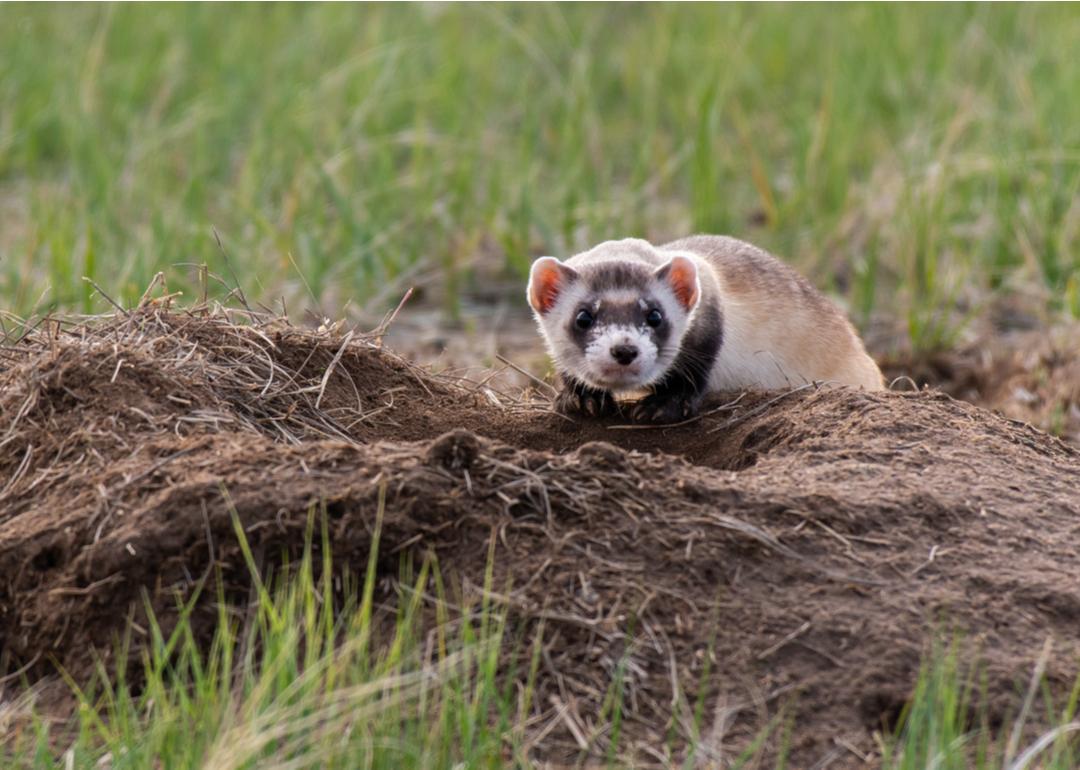
South Dakota: Black-footed ferret
- Scientific name: Mustela nigripes
- Other states with species: Arizona, Colorado, Kansas, Montana, New Mexico
- IUCN category: Endangered
As the black-footed ferret relies on prairie dogs for food and prairie dog habitats for shelter, prairie dog decline due to grassland urbanization leads to the subsequent shrinkage of the ferret population. So low did population numbers sink that the species was thought to be extinct twice during the 1900s. At only 1.4 to 2.5 pounds and up to 2 feet long, the black-footed ferret is “slender” and “wiry,” with advanced senses of hearing, sight, and smell.
Tennessee: Pygmy madtom
- Scientific name: Noturus stanauli
- Other states with species: N/A
- IUCN category: Endangered
The pygmy madtom is the smallest of the madtoms, growing only to 1.5 inches long, but is nonetheless threatening, . The species population has dwindled mainly due to poor water quality, including pollution, siltation, and waste runoff. It was .
Texas: Texas hornshell
- Scientific name: Popenaias popeii
- Other states with species: New Mexico
- IUCN category: Critically Endangered
A case of mistaken identity has further decreased already-diminishing numbers of Texas hornshell, as were recently discovered to be another, undescribed species. Habitat loss and diminished water quality are the largest threats to this freshwater mussel, which grows to roughly 4.5 inches and can live for more than two decades.
Utah: Razorback sucker
- Scientific name: Xyrauchen texanus
- Other states with species: Arizona, California, Colorado, Nevada, New Mexico
- IUCN category: Critically Endangered
So prominent is the sharp bulge between the head and fin atop the razorback sucker’s back that sometimes also called the “humpback sucker.” and dam construction all negatively alter the species’ habitat, leading to its endangered status. California first classified it as endangered in 1974, 20 years before the U.S. government. the first time it had been seen there since the 1990s.
Vermont: Rusty patched bumble bee
- Scientific name: Bombus affinis
- Other states with species: Illinois, Indiana, Iowa, Maine, Massachusetts, Minnesota, Ohio, Virginia, West Virginia, Wisconsin
- IUCN category: Critically Endangered
Habitat loss, disease, and pesticide use have cut rusty patched bumble bee populations over the past two decades. The species is also the While all rusty patched bumble bees have black heads, workers and males have a on their backs—as distinguished from the queens, of which there is one per colony.
Virginia: Madison Cave isopod
- Scientific name: Antrolana lira
- Other states with species: West Virginia
- IUCN category: Vulnerable
The Madison Cave isopod may owe its alien appearance—it has no eyes, no pigment, and seven pairs of legs—to its storied history. It is the direct descendant of similar-looking ancestors that , surviving for thousands of centuries to now be sequestered to a few caves across Virginia and West Virginia. Today’s Madison Cave isopod is struggling to maintain its historical resiliency against the threats of .
Washington: Bull trout
- Scientific name: Salvelinus confluentus
- Other states with species: Idaho, Montana, Nevada, Oregon
- IUCN category: Vulnerable
As the bull trout require cold water for survival, rarely residing in bodies of water with temperatures above 60 degrees Fahrenheit or so, on its populations by warming water temperatures and rendering many previous habitats unsuitable. The species— by its spot-less dorsal fin and the orange spots that appear on its back—was included under the Endangered Species Act in 1999, with the U.S. Fish and Wildlife Service designating 9,000 miles of rivers and streams as critical habitat in 2010.
West Virginia: Diamond darter
- Scientific name: Crystallaria cincotta
- Other states with species: N/A
- IUCN category: Critically Endangered
So named the diamond darter was historically spread throughout the Ohio River basin, before dam constructions interrupted and altered its habitat. Today, its population struggles to hold up against threats from coal mining, oil and gas drilling, timber harvesting, and sewage runoff, all degrading water quality in the darter’s habitat.
Wisconsin: Higgins eye
- Scientific name: Lampsilis higginsii
- Other states with species: Illinois, Iowa, Minnesota, Missouri, South Dakota
- IUCN category: Endangered
The Higgins eye pearlymussel has always been rare, as it was Sedimentation, invasive nonnative species, and agricultural runoff all continue to threaten the species today. Besides use as buttons and pins, however, these mussels carry out a plethora of other jobs, including on river bottoms for other species to thrive in.
Wyoming: Colorado pikeminnow
- Scientific name: Ptychocheilus lucius
- Other states with species: Arizona, California, Colorado, New Mexico, Utah
- IUCN category: Vulnerable
The largest minnow in North America, the Colorado pikeminnow, was previously a common food source so abundant that early settlers The 1931 construction of the Hoover Dam had detrimental effects on populations. However, are also to blame for dwindling population numbers. The pikeminnow’s scientific name, Ptychocheilus lucius, , with no teeth present.