Flying with whales: Drones are remaking marine mammal research
Flying with whales: Drones are remaking marine mammal research
In 2010, the Deepwater Horizon oil rig exploded in the Gulf of Mexico, causing one of the largest marine oil spills ever. In the aftermath of the disaster, whale scientist Iain Kerr traveled to the area to study how the spill had affected sperm whales, aiming specialized darts at the animals to collect pencil eraser-sized tissue samples.
It wasn鈥檛 going well. Each time his boat approached a whale surfacing for air, the animal vanished beneath the waves before he could reach it. 鈥淚 felt like I was playing Whac-A-Mole,鈥� he says.
As darkness fell, in front of Kerr and covered him in whale snot. That unpleasant experience gave Kerr, who works at the conservation group , an idea: What if he could collect that same snot by somehow flying over the whale? Researchers can glean much information from whale snot, including the animal鈥檚 DNA sequence, its sex, whether it is pregnant, and the makeup of its microbiome.
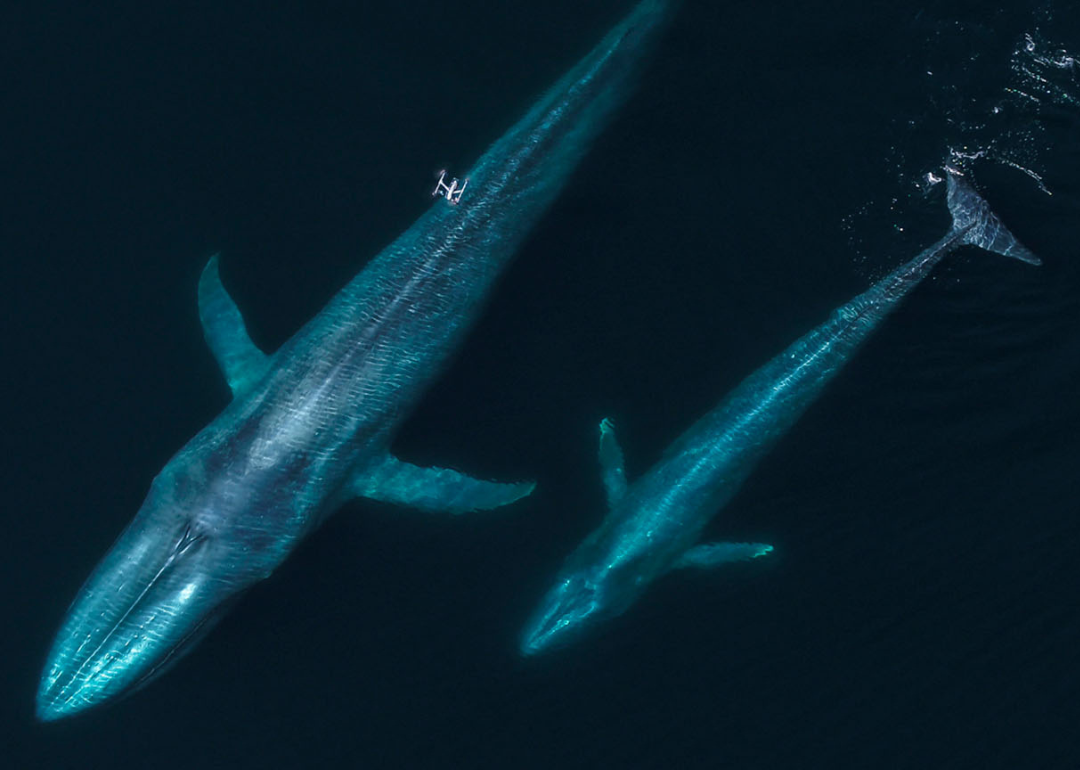
After many experiments, Kerr鈥檚 idea turned into what is today known as the : a drone fitted with six petri dishes that by flying over the animal as it surfaces and exhales through its blowhole. Today, drones like this are deployed to gather snot all over the world, and not just from sperm whales, reports. They鈥檙e also collecting this scientifically valuable mucus from other species, such as blue whales and dolphins. 鈥淚 would say drones have changed my life,鈥� says Kerr.
S鈥檔ot just mucus
Gathering snot is one of many ways that drones are being used to study whales. In the past 10 to 15 years, has made great strides, becoming affordable and easy to use. This has been a boon for researchers. Scientists 鈥渁re finding applications for drones in virtually every aspect of marine mammal research,鈥� says , an ecologist at the Marine Mammal Institute at Oregon State University.
Crucially, drones reduce the need to get close to whales with a boat. This means less disturbance for the animals, and it鈥檚 also safer for scientists, since being on a small boat close to a giant whale can be dangerous. Drones also have significant advantages over aircraft, which have historically played a large role in collecting whale data. Using an aircraft is expensive and requires a whole crew of people to operate it, while drones are cheaper, easier to use, and need just one or two operators, says Stewart.
Drones allow scientists to 鈥渟ee things from an absolutely new perspective,鈥� says , a marine conservation ecologist at the Nicholas School of the Environment at Duke University. The oblique angle from which scientists can view a whale from a ship 鈥渄oesn't actually give you very much to work with,鈥� says Johnston. The new world of information supplied by drones hovering above is allowing researchers to more easily measure whale size, body condition and health, to identify individual animals from features on their bodies, and more.
Although much drone research happens without close contact with whales, some scientists are using drones to drop movement- and behavior-tracking tags onto the animals. Without drones, researchers must approach whales from a boat, usually using a long pole or an air rifle to attach the tags to the whales. A drone, meanwhile, can simply fly overhead and that 鈥渏ust pops it right on the whale,鈥� says Stewart. Or, as in a study published in August 2025, drones can apply a tag directly on the whale .
The that drones can provide is revealing novel behaviors. 鈥淚 have seen more unique behaviors in the last five to eight years with drones than I saw in the 30 years previous,鈥� says Kerr. In 2025, for example, scientists reported that some whales regularly by rolling lengths of it against podmates鈥� bodies 鈥� an observation gleaned from nine hours of drone footage of 25 killer whales, filmed off the coast of Washington state.
This unusual example of tool use among cetaceans would otherwise have been almost impossible to capture. 鈥淲e would never have seen this behavior without the bird鈥檚 eye view that the drone gives us,鈥� says study author , a behavioral ecologist at the Center for Whale Research in Friday Harbor, Washington.
While drones are opening a world of possibilities to whale scientists, there鈥檚 still room for improvement. Many drones, especially small ones, have battery limitations. 鈥淵ou can only fly for maybe 45 minutes or an hour with a small drone, if you're really lucky,鈥� says Johnston. Drone regulations limit flight range in many countries 鈥� in the United States, for example, operators must keep the machines within their line of sight unless they have a special license.
Kerr and other scientists are testing more ways to use drones, including freeing whales that have become entangled in fishing nets. His team is developing a 3D-printed metal cutting hook that drones can drop onto the nets. As the whale moves, the device slices through the tangle.
The rapid advancement of drone technology makes it difficult to predict what marine mammal research will look like in the future, says Stewart. 鈥淚t鈥檚 hard to imagine what the next thing might be.鈥�
was produced by and reviewed and distributed by 麻豆原创.