What to do when you encounter these 21 animals in the wild
What to do when you encounter these 21 animals in the wild
Statistically speaking, most Americans don't come into contact with wild animals daily. More than , where they probably won't see anything more exotic than a squirrel or blue jay, according to the U.S. Census Bureau. It's easy to forget we share this land with all manner of four-legged, winged, and hoofed beasts when the only form of nature you see regularly is the well-manicured park in your subdivision.
The one time a person is likely to run into some animal neighbors is while on vacation. You might spot a raccoon dumpster-diving in the campground, startle a deer while hiking, or notice a pair of beady eyes popping out of the river. That's when things can turn dangerous quickly—if wild animals feel you are a threat, they can be quick to attack.
Â鶹ԭ´´ compiled expert advice from the National Park Service, wildlife conservationists, and researchers on how to safely react if you encounter 21 animals in the wild. Read on to find out the surprising place you might run into a coyote—and learn how to tell if an owl is going to attack.
You may also like:
Bears
- Where you’ll see them: Black bears can be commonly found all over North America, according to the National Park Service, while brown bears primarily live in forested regions in the northern part of the United States. You might also see a polar bear in Alaska but won’t find one in the lower 48.
As the population of the United States increases, . Bears aren’t naturally vicious animals, but when they feel threatened, they won’t hesitate to attack. When hiking in bear country, try to avoid startling a bear at all costs. carrying bear spray, avoiding high-risk times like dusk and dawn, always hiking with a group, and periodically calling out “hey, bear!” to alert the animals to your presence. If you do see a bear, and it is stationary, so you can keep an eye on it.
Cougars
- Where you’ll see them: Cougars live all over the United States.
Puma, cougar, mountain lion, panther—these big cats go by many names. Though the 200-pound beasts look intimidating, . Odds are, you will never come into contact with a cougar, even if you’re hiking through their habitat. If you do meet one face-to-face, standing up tall, looking the cat right in the eyes and backing away slowly. Whatever you do, do not run away—that might trigger the cougar’s instinct to chase its prey.
Moose
- Where you’ll see them: In the United States, moose inhabit the forests of the Northeast, upper Midwestern states, Rocky Mountains, and Alaska.
These gargantuan creatures can and often have antlers that measure up to 6 feet wide. Imposing as they might seem, they’re solitary creatures and when they feel threatened. If a moose starts to move toward you, .
Bison
- Where you’ll see them: American bison live in the Great Plains region.
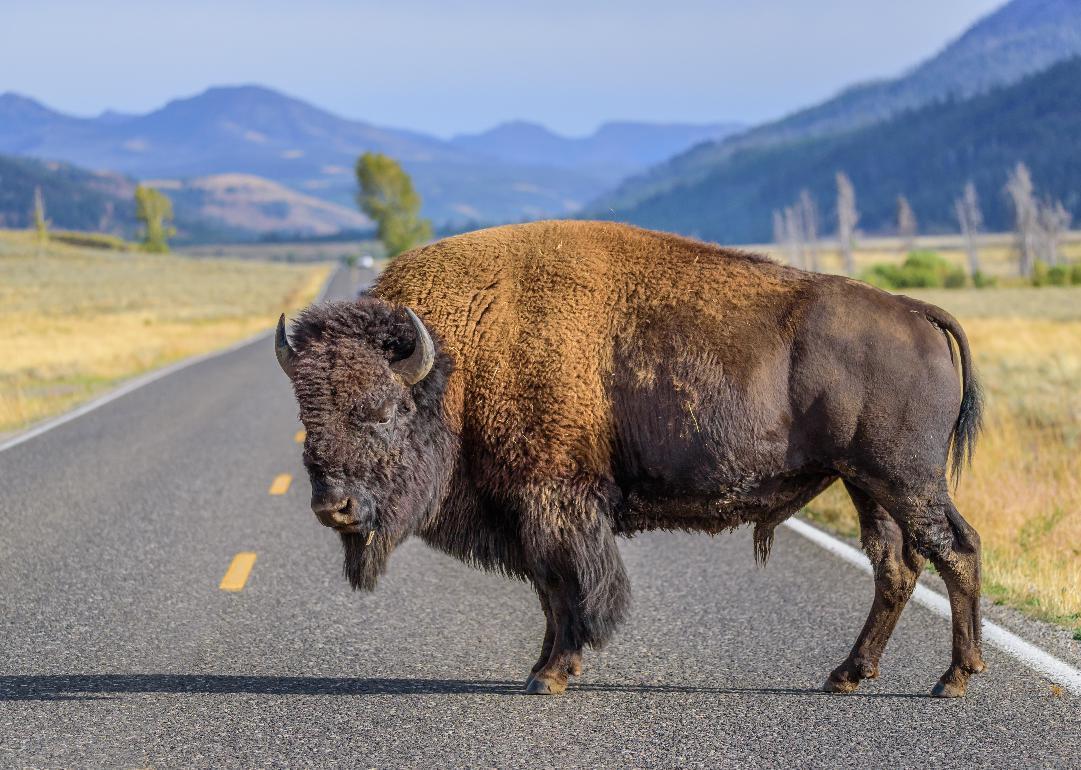
These formidable creatures can weigh up to 2,200 pounds, making them the largest indigenous land mammal in North America. Don’t think their size slows them down: Adult bison can reach speeds of up to 40 miles per hour. If you see a bison while driving, just drive past them slowly and stay inside your car. If you are on foot, be careful not to startle them—call out to them to signal your presence, then walk away slowly.
Elk
- Where you'll see them: Elk live primarily in the western United States, especially in protected landscapes.
Thanks to their resemblance to deer, elk might appear docile—but these majestic beasts can attack if they feel threatened. , stay close to your companions, avoid eye contact, and walk slowly away while watching the animals for signs of aggression. If the elk starts to chase you, take cover behind an obstacle like a boulder or climb a tree to get away from it. Be especially wary in May through June, when female elk can be especially defensive of their newborn calves, and the fall rut from August through October, when bulls become extra aggressive.
Deer
- Where you’ll see them: Three species of deer inhabit North America—white-tailed deer, which live anywhere between southern Canada and South America; mule deer, which are native to western North America; and black-tailed deer, which live along the Pacific coast from central California to British Columbia.
The average American is much more likely to see deer than most other animals on this list, thanks to the deer’s widespread habitat in North America. As with elk, you want to (between September and December). If you encounter a deer on foot, simply remain calm and back away slowly. If the deer starts charging you, put a backpack or another obstacle between you and get away as quickly as possible. You might also see a deer while driving, a dangerous situation for both the deer and the driver. Experts recommend to avoid hitting them.
Wild boars
- Where you’ll see them: Also known as wild pigs or feral swine, these non-native animals have spread to 35 states, but are most concentrated in the South.
, wild pigs have since spread all over the country and show no signs of slowing down. In fact, that these animals will wreak environmental havoc on the country as they continue to spread, since these omnivores will eat anything in their path. Though they aren’t particularly dangerous, feral swine carry as many as 30 diseases and 40 parasites that can be harmful to the health of humans, livestock, and pets. If you see them in your community, report wild boars to wildlife officials immediately.
Fox
- Where you’ll see them: Four types of foxes inhabit North America—red foxes, which live anywhere between the Arctic Circle and Central America; gray foxes, which live all over the United States except for the Rocky Mountains; arctic foxes, which live in Alaska and Canada; and desert kit foxes, which live in open deserts of the United States.
Since foxes are naturally afraid of humans, you shouldn’t be frightened if you see one outside during the day. The fox will most likely flee. However, foxes can be dangerous to your pets, as they have been known to prey on small animals like rabbits, guinea pigs, and chickens. If a fox has been hanging around your home, by leaving shiny balloons, urine-soaked cat litter, and capsicum-based repellant in the area. Making loud noises—like banging on pots or pans or blasting the radio—can also deter foxes from coming back.
Coyotes
- Where you’ll see them: Though coyotes once lived on the country’s prairies and deserts, they now roam all over the United States.
Like the cartoon Wile E. Coyote, coyotes are shrewd and highly adaptive. When the threatened their existence in rural areas, they simply moved into cities. Smart and sneaky, coyotes live largely out of sight of humans—even if one is living in your neighborhood, you’ll likely never see it. If you do spot a coyote, and it doesn’t run from you, by making yourself as big as possible, yelling at it, waving your arms, throwing small rocks toward it, or spraying it with water.
Wolves
- Where you'll see them: Gray wolves once ranged all over North America, but today have dwindled to populations in Alaska, northern Michigan, northern Wisconsin, western Montana, northern Idaho, northeast Oregon, and Yellowstone National Park in Wyoming. You might also see red wolves in eastern North Carolina.
The howl of the wolf is enough to send chills down your spine, but these powerful animals . They're more likely to go after small pets or farm animals—a tendency which led them to be hunted to near extinction by settlers and farmers. If you do meet a wolf in the wild, .
Crocodiles and alligators
- Where you’ll see them: American alligators live throughout the southeast, but the only place you’ll see crocodiles in the U.S. is in Florida.
Both crocodiles and alligators belong to the same group of reptiles, crocodilians, which explains the similarities between these two predators. American alligators have darker skin and wider snouts than crocodiles, but both have extremely powerful jaws. If you make eye contact with an alligator on land, don’t waste any time: . If you’re unlucky enough to be bitten by an alligator or crocodile in the water, go straight for the animals’ most sensitive spots: or the snout. You won’t be able to pry open its jaws, so gouging at its two most vulnerable points is your best chance of survival.
Sharks
- Where you’ll see them: Several species of shark live in both the Pacific Ocean and the Atlantic Ocean.
The “Jaws” soundtrack may always strike terror into the hearts of beachgoers around the world. Terrifying as these predators seem, by remaining calm and swimming away slowly and methodically—if the shark does not seem aggressive. , maintain eye contact, make yourself as big as possible, and hit them on sensitive spots like the nose or gills.
Owls
- Where you’ll see them: Several species of owls live all over North America.
It’s extremely rare for owls to attack humans, . Owls hunt rats, mice and other rodents, but in the absence of prey, they might be tempted to go after other animals like small dogs—attacking their owners as they try to reach the dogs. These birds might also react defensively if humans get too close to their nests. If you hear an owl hissing or clicking its beak, . Stand back, give it space, and leave the area, if you can.
Raccoons
- Where you’ll see them: Raccoons can be found throughout the United States.
Though these medium-sized mammals aren’t nearly as dangerous as cougars or bears, they are . Most raccoons are perfectly harmless, but it’s still best not to interact with them. If you see one in the wilderness, simply ignore it and walk away. However, if a raccoon is hanging around your home, you’ll want to . Keep these pests from coming back by securing garbage cans, keeping pet food indoors, and sprinkling cayenne pepper around the outside of your home.
Opossums
- Where you'll see them: Opossums can be found in the eastern, central, and western United States, though they're absent from the Rocky Mountains and some states in the Northeast.
The only marsupial in North America, opossums are usually only active at night. They typically aren't very aggressive; they might hiss at you, but they're much more likely to play dead than attack when approached. Still, they can become a nuisance if they choose to make a den underneath your house. Close any holes into garages, chicken coops, or other structures to keep them out. If they do find somewhere to make a nest, wait until the opossum leaves and close the hole with netting or straw.
Snakes
- Where you’ll see them: Several species of snakes live all over North America.
Though seeing any snake might frighten you, the only snakes you actually need to worry about are venomous ones. , , and are some of the most common species in North America. With most snakes—venomous or not—: Walk away slowly and give them room to escape. Rattlesnakes will give you an extra warning through their signature tail rattle. If you’re hiking or backpacking in venomous snake territory, , use trekking poles, and stay on cleared sections of trail.
Feral cats
- Where you’ll see them: You might see feral cats anywhere in the world.
We’re not talking about your neighbor’s cat that regularly comes to your house for a little treat, or even a neighborhood stray that lives outside. Feral cats are the descendants of stray cats—felines that have never had contact with humans. These cats are often and will lash out if you make an attempt. If you see feral cats in your neighborhood, you can try feeding them and see if they become more friendly. If the cat is still unapproachable after several days, contact a local group that practices . Neutering feral cats helps keep the population under control.
Stray or feral dogs
- Where you’ll see them: Like feral cats, you might see stray dogs anywhere in the world.
Lost or abandoned dogs that have adapted to living on the streets can become feral as well. Feral dogs often live in low-income communities and rural areas. By some estimates, Detroit had a in 2012. Unlike feral cats, however, experts say that you can rehabilitate a stray or feral dog into a domesticated pet with . If you find a free-roaming dog, and consult your local animal management department before doing anything else.
Rats
- Where you’ll see them: Since their introduction to the United States in 1775, brown rats have spread all over the country.
These pesky rodents will eat just about anything, making them particularly adept at living among humans. Rats can transmit a plethora of human diseases . Even if rats have infested your neighborhood, you likely won’t see them much, as they tend to be most active at dusk and dawn. If you see droppings, burrows or bite marks around your home, Clean up any trash, plug any holes into the building, and use rodent repellent.
Scorpions
- Where you'll see them: Scorpions are common to the southern and southwestern United States.
Though all species of scorpions in the United States are venomous, only one is threatening enough to cause serious alarm: . If you're stung by a bark scorpion, . Otherwise healthy adults usually don't need medical treatment for most scorpion stings. Children and the elderly, however, might be at risk of a more serious reaction.
Local symptoms like intense pain, tingling and swelling at the site of the wound are normal; widespread symptoms like difficulty breathing, muscle twitching, nausea, vomiting, and accelerated heart rate are a sign you should go to the doctor immediately. The best way to prevent scorpion stings is by . Keep your grass closely mowed, eliminate hiding places such as trash and loose stones, fill any holes in the building, and repair any broken window screens.
Black widow spiders
- Where you’ll see them: Black widow spiders live primarily in temperate regions in the southern and western United States.
Known for , black widow spiders might be some of the most notorious arachnids. Though they are venomous and will attack when threatened, black widows rarely bite humans. When they do, the bites , let alone death. You’ll usually encounter a black widow in a . If you know you’ll be working in an area where black widows are common, wear long sleeves and pants to protect yourself from potential bites. If you’re unlucky enough to be bitten, call the Poison Control Center right away. In the meantime, you can , ice it on and off for 10 minutes at a time, and keep the affected area still so you don’t spread the venom.