Congressional seats, even the safe ones, don’t come cheap
Congressional seats, even the safe ones, don’t come cheap
To run for Congress, candidates must satisfy three constitutional qualifications: Meet the minimum age requirement, be a U.S. citizen and reside in the state they seek to represent.
But, heading into the 2026 cycle, it is clear there is one additional, unofficial requirement: They must be able to raise several million dollars.
The total cost of congressional races in 2024 was $9.5 billion, including spending by outside groups, according to . And that high cost of a political campaign comes at a cost to constituents — who can see their lawmaker become beholden to wealthy donors outside the district. It also results in fewer candidates, particularly among the middle class, women and underrepresented communities.
“The price of campaigning is just a very tough barrier for everyday people to overcome,” said Marina Pino, an expert on money and politics at the Brennan Center for Justice. “2014 was the first time in the country’s history that the majority of Congress were millionaires. And its members from the working class backgrounds comprise only 2% of Congress.”
A found that “white men running for office consistently dominate in fundraising. Whatever fundraising advantages may help women seem to primarily help white women, and whatever fundraising advantages may help people of color seem to primarily help men.”
Senate contests are often costlier than House races due to their statewide scope. Still, winning a House seat can require raising millions.
Consider Republican Rep. Robert Aderholt, who represents an Alabama district considered one of the safest in the nation. It has fewer than a million people, per the 2020 census, and is in the rural, northern part of the state. He still to win another term in office.
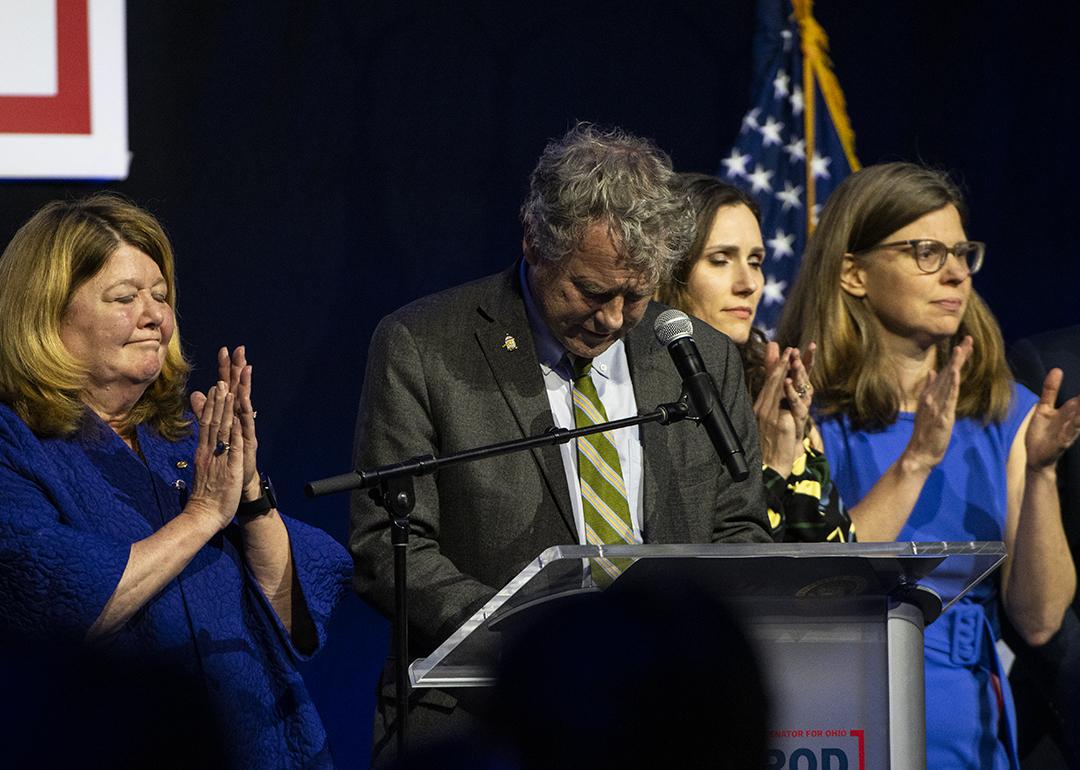
Meanwhile, Democratic Sen. Sherrod Brown for re-election to his Ohio seat.
And he lost.
Republican candidate Bernie Moreno raised $26.6 million to defeat Brown. But outside spending — the money spent by groups that are not formally connected to a candidate or their campaign — was a huge factor in the race. OpenSecrets was spent to support or oppose the candidates.
The contest ended up being one of the most expensive nonpresidential races in history.
Several House races hit the eight-figure mark, including in , where the Democratic candidate, Lt. Col. Yevgeny “Eugene” Vindman, raised nearly $18 million to win the election.
It was one of the most competitive House races in 2024, with Republican candidate Derrick Anderson raising just $3.4 million, yet he only lost by 10,400 votes. Outside groups contributed another $14 million in spending.
Democrat Derek Tran raised $6.4 million and won , beating incumbent Republican Michelle Steel, who raised $10.4 million. Outside groups spent $34 million on that House race, which OpenSecrets found was . spent almost $800,000 supporting Steel’s campaign and more than $500,000 running ads against Tran.
In the end, Tran, a U.S. Army veteran and the son of Vietnamese refugees, won by roughly 650 votes.
For candidates, raising money to become a member of Congress can be a full-time job.
Rep. Maxwell Frost, a Democrat who became the first member of Generation Z to join Congress, maxed out his credit cards to win Florida’s 10th district seat in 2022.
In the aftermath, his credit rating plummeted and he struggled to rent an apartment in Washington, D.C.
“It isn’t magic that we won our very difficult race,” Frost . “For that primary, I quit my full-time job ‘cause I knew that to win at 25 yrs old, I’d need to be a full-time candidate. 7 days a week, 10-12 hours a day.”
He worked part-time as an Uber driver to try to make ends meet.
Critics have long fretted that the high cost of campaigns makes it prohibitive for regular Americans to run for office.
The Federal Election Commission, in March 2024, helped ease that with a new rule making it easier for federal candidates to draw salaries from their campaign to support themselves during their election bids.
“Federal candidates can begin to draw salaries from their campaign committees when they file their statement of candidacy with the @FEC at a rate of up to 50% of the minimum US house salary or the average income they earned in the last five years, whichever is lower,” FEC Commissioner Dara Lindenbaum .
That rule is in full effect for the 2026 midterm campaign.
Money raised by a candidate goes to a variety of expenditures, including advertising, events, fundraising, payroll, field operations and consultants.
But there’s also another path where it flows — to fellow lawmakers.
Part of the pressure to raise money isn’t just to win a seat in Congress, it’s to earn a spot on one of the top committees, where legislation is formed and tax dollars can be directed as a lawmaker wishes.
“We’re seeing donations to leadership PACs, and those are political action committees controlled by a candidate or elected official,” Pino explained. “They are primary ways which members give to their colleagues.”
Super PACs have become the answer to many lawmakers’ fundraising needs. These PACs can raise and spend unlimited amounts of money from corporations, unions, associations, and individuals to support or oppose political candidates. However, the spending must be “independent,” meaning the PACs cannot donate directly to candidates or coordinate with campaigns.
Pino points out donations to super PACs often come from the wealthy, not the district or state in which the candidates are running, giving these donors real influence.
“They’re not coming from within the state or the district of where the candidates are running, which takes away the power of the very constituents that are supposed to be voting this candidate in.”
And an OpenSecrets analysis found that candidates are of nationalizing their campaign fundraising. For example, in that Virginia House race that Vindman won, money flowed in from across the nation with donors from New York, Texas, California and Florida contributing to the candidates.
Vindman also got support from fellow Democratic lawmakers, raising $10,000 from members of Congress.
And it will just get more expensive.
Experts are already predicting the 2026 midterms will be the most expensive elections to date, surpassing the $10 billion mark.
“It’s just discouraging,” Pino said.
was produced by and reviewed and distributed by Â鶹ԭ´´.