Major crises during every US presidency
Major crises during every US presidency
Every American president has had to manage and navigate emergencies, disasters, wars, scandals, blunders, upheavals, and revolts of all stripes. The crises each president has faced range dramatically from George Washington presiding over an experimental and fledgling government when he took office 231 years ago to Donald Trump today dealing with a pandemic that by Aug. 26 had killed more than 182,000 Americans.
Serving as the leader of the free world is a tough gig, and the American presidency is believed to be the hardest job in the world. Even those presidents who serve only one term appear to have aged well beyond their years when they come out the other end. The position comes with extraordinary stress, pressure, and responsibility, and that's when things are going well.
Each generation of Americans has faced its own era-defining challenges and struggles, and the president of the United States is called upon to meet those challenges, manage those struggles, and to lead, soothe, console, and reassure the nation that its people are in good hands.
This is not easy work.
Some presidents rise to the challenge, and others are consumed by it. All, however, are shackled to the crises of their day, and their legacies are defined by how they led during times of uncertainty and danger.
Using a variety of sources, including presidential biographies and historical records, created a list of crises that defined every American presidency. It's important to note that many presidents endured and managed several crises—often simultaneously—during their time in office. Many were so consequential that it's difficult to choose just one.
From Washington to Trump, people find out what their leaders are made of when the going gets tough. These are the crises that made—or broke—every one of America's presidents.
George Washington (1789–1797)
The father of the Revolution, George Washington was America's first president, and his presidency's true crisis was exactly that—the fact that no one else had come before. Although the Constitution offers a loose outline of the president's duties and powers, Washington had to build the office from the ground up or prototype for what it means to hold the highest position in an experimental government. That included what bills to veto, how to interact with lawmakers and other officeholders, both domestic and foreign, how to wield executive privilege, how to manage a Cabinet, how to host events, and even how to dress and present himself.
[Pictured: A painting of President George Washington riding into New York.]
John Adams (1797–1801)
The entirety of John Adams' one term in office was consumed with continuously escalating tensions with France and Britain. In the wake of the French Revolution, the British monarchy was terrified that the same thing could happen there and eventually went to war with France. Adams attempted to maintain friendly relations with both nations, a move that pleased neither and enraged both, while also causing intense friction between his young country's staunchly pro-British and pro-French factions.
[Pictured: A political cartoon depicts the XYZ Affair that occurred during the John Adams presidency—in the painting, America is a woman being plundered by Frenchmen.]
Thomas Jefferson (1801–1809)
Like Adams, Jefferson also faced daunting foreign policy challenges that started with trouble on Africa's Barbary Coast, but the real crisis was that would ultimately lead to the War of 1812. Great Britain was now at war with Napoleonic France, and America profited handsomely by selling goods and materials to both sides. This compelled Great Britain to seize American ships, impress U.S. sailors into British service, and even launch a deadly attack on a U.S. Navy frigate, a move that stirred cries for war among the American public.
[Pictured: A painting of The Corps of Discovery (an established unit of the United States Army that Jefferson formed) meeting Chinooks on the Lower Columbia, October 1805.]
James Madison (1809–1817)
Adams' and Jeffersons' chickens came home to roost during the presidency of James Madison in the form of the , which is considered to be America's second war of independence. At the start of the 19th century's second decade, the British continued to seize U.S. ships, impress American sailors, and arm Native American tribes to attack settlers. When Madison responded with embargoes and other punitive measures, it wasn't long before Redcoats were once again landing on America's shores. The U.S. eventually drove the British out after decisive battles in New Orleans and Baltimore, but not before the British wreaked havoc across the young country, including torching the White House, which sent Madison—a sitting U.S. president—scrambling into the wilderness for cover.
[Pictured: A painting of the British Raid On Chesapeake Bay during the War of 1812.]
James Monroe (1817–1825)
The hallmark crisis of James Monroe's presidency was the , a major depression that was worse than any economic downturn since the 1780s—although Monroe was mostly powerless to stop it, the buck stopped with him, and much of the nation held the president accountable. It's important to note, however, that Monroe dealt with another simmering crisis that would go on to shape America's future much more starkly than any recession. When Missouri attempted to enter the Union as a slave state, Monroe punted on the heated issue of the expansion of slavery with the Missouri Compromise, a move that would force the next generation to answer the question—to disastrous consequences.
[Pictured: Portrait of James Monroe.]
John Quincy Adams (1825–1829)
Domestic politics were the bane of John Quincy Adams' single term in office—his crisis was . George W. Bush and John Quincy Adams are the only presidents in history to follow their fathers into office, and also like the younger Bush, the younger Adams is to gain the office without winning the popular vote. When the Electoral College failed to produce a winner, a shady back-room deal led to the House of Representatives electing Adams president even though he had received 84 electoral endorsements to Andrew Jackson's 99.
[Pictured: Portrait of John Quincy Adams.]
Andrew Jackson (1829–1837)
The hero of the Battle of New Orleans in the War of 1812, Andrew Jackson's biggest presidential crisis was that tens of thousands of Native Americans were still living in the Southeast—and they were in the way of the rapidly expanding country. In response, Congress passed, and Jackson signed the , which brutally forced several tribes to unsettled land west of the Mississippi River in what has come to be known as the Trail of Tears—many historians consider it an act of genocide. The misery wasn't limited only to Native Americans—the move opened up the land that would give rise to the Deep South's booming cotton economy and a massive expansion of slavery.
[Pictured: Andrew Jackson talks with Muscogee Chief William Weatherford (Red Eagle) in this drawing.]
Martin Van Buren (1837–1841)
Martin Van Buren was limited to one term in office, mostly because of a crushing depression known as the . British banks were the primary source of America's previous economic expansion. They cut off the flow of cash to the U.S. to deal with economic problems of their own. That compelled U.S. banks to call in loans to hordes of American borrowers, all of which was complicated by Jacksonian economic policies that favored "hard" money like gold and silver over cash.
[Pictured: An 1837 caricature depicting the depressed state of the American economy, particularly in New York, during the financial panic of 1837.]
William Henry Harrison (1841)
Previous presidents grappled with political, economic, and foreign crises, but a health crisis doomed William Henry Harrison's presidency. The 68-year-old Harrison delivered the longest inaugural address in history when he was sworn into office—it took him nearly two hours to read his more than 8,000-word address on that cold and rainy day. A few days later, he came down with pneumonia and died after just 31 days in office, the shortest presidency in American history.
[Pictured: Lithograph of the presidential inauguration of William Henry Harrison in D.C., 1841.]
John Tyler (1841–1845)
Like John Quincy Adams before him, John Tyler struggled from the outset with a after Harrison's death propelled him to the presidency. As Harrison's vice president, many Americans assumed Tyler would play the role of placeholder, but Tyler took the full mantle, had himself sworn in immediately, and refused to behave as a temp who was waiting for the next election. Although his actions received widespread criticism, they later served as a template for the smooth transition of power down the road when Zachary Taylor, Abraham Lincoln, William McKinley, Franklin Roosevelt, and John F. Kennedy died in office.
[Pictured: A drawing of John Tyler.]
James K. Polk (1845–1849)
James K. Polk was a radical expansionist and a proponent of "manifest destiny," the idea that God wanted the United States to stretch from the Atlantic to Pacific oceans—the problem was that Mexico was in the way and wasn't willing to sell. Polk's chief crisis, the , was a crisis of choice—Polk instigated a fight with the weak and unprepared country to force it to cede territories that Polk wanted for America. The first war that America fought on foreign soil, the conflict ended with the , which forced Mexico to forfeit more than a half-million square miles of land and gave the U.S. the present-day states of Arizona, California, Colorado, Nevada, New Mexico, Utah, and Wyoming. Through treaties, Polk also won the present-day states of Oregon, Washington, Idaho, and much of Montana.
[Pictured: The Texas flag waving over the Alamo, San Antonio, after being admitted to the Union, 1845.]
Zachary Taylor (1849–1850)
By the time Zachary Taylor came to office, the simmering tensions over slavery were coming to a boil. Although he was a Southerner who had owned enslaved people, Taylor shocked the country when he sided against the expansion of slavery. Taylor's most pressing crisis—like all presidents who would follow through the Civil War—was whether new states would enter the Union as free or slave states. As Taylor pressed for New Mexico and California to tip the delicate balance by entering the Union as free states, slave states threatened secession, but Taylor died unexpectedly before the issue was resolved.
[Pictured: President Zachary Taylor dies at home, surrounded by his family and friends, including his vice president and successor, Millard Fillmore, in this drawing.]
Millard Fillmore (1850–1853)
With all the new territory gained from the Mexican-American War, the question of the was more pressing than ever. Taylor's little-known Vice President Millard Fillmore inherited that showdown. He opposed Taylor's anti-expansion policies and signed the Compromise of 1850, which included the Fugitive Slave Act of 1850. The act enraged the North as it forced everyone in the free states to serve as de facto slave-catchers under the penalty of law and threatened every free African American in the country with a life of bondage, whether they had ever been enslaved or not.
[Pictured: Drawing of Millard Fillmore.]
Franklin Pierce (1853–1857)
By the time took office, North and South were all but mortal enemies. Pierce advocated for and signed the Kansas-Nebraska Act, which repealed the ban on slavery in Kansas that was established by the Missouri Compromise 34 years earlier. The move led to an extended and brutal outbreak of deadly violence known as and set America on the path to civil war.
[Pictured: Drawing of Franklin Pierce.]
James Buchanan (1857–1861)
Widely considered to be among the worst presidents—if not the worst—in American history, downplayed and waffled on the issue of slavery, failed to act as the nation marched toward civil war, and consistently angered and inflamed both sides of the political aisle. He supported the Dred Scott Supreme Court decision, which denied African Americans Constitutional rights and forbade Congress from excluding slavery in the territories. He attempted to leave the issue of slavery to the states, which had long been a lost cause. Seven Southern states seceded from the Union during his tenure, and the first shots of the Civil War were fired just one month after he left office.
[Pictured: Cabinet of President James Buchanan.]
Abraham Lincoln (1861–1865)
The South was organizing into the Confederate States of America when took office, and the 16th president of the United States oversaw the bloodiest period in American history. More than 600,000 Americans died in the Civil War—more than in all other wars combined until Vietnam—and the American South was largely destroyed before Robert E. Lee surrendered at Appomattox Court House in Virginia. With the Civil War over, the Union preserved, and African Americans free citizens—on paper, at least—Lincoln was elected to a second term but was assassinated by John Wilkes Booth at Ford's Theatre shortly after his inauguration.
[Pictured: Abraham Lincoln making his famous "Gettysburg Address" at the dedication of the Gettysburg National Cemetery.]
Andrew Johnson (1865–1869)
Abraham Lincoln's vice president was , who was left to pick up the pieces of the Civil War, but the crisis of his presidency was political. The first president ever to be impeached by the House of Representatives, he avoided being convicted in the Senate by a single vote. A Southerner and former enslaver, Johnson vetoed civil rights legislation, allowed Southern states to pass restrictive "black codes," stymied Reconstruction protections, advocated for amnesty for white Southerners who took up arms against their government, worked to immediately readmit Southern states into the Union without any concessions or protections for newly freed formerly enslaved, and allowed former Confederate officers to govern defeated Southern states.
[Pictured: Drawing of Andrew Johnson.]
Ulysses S. Grant (1869–1877)
was the hero general of the Union Army who won the Civil War. The crisis of his presidency was the gargantuan task of reassimilating the defeated and largely destroyed Southern states into the Union, along with the more than 4 million newly freed formerly enslaved people who lived there. He also had to deal with the newly formed Ku Klux Klan and other white supremacist organizations that targeted Black citizens, white Republicans, and Southern sympathizers with campaigns of terrorism and murder.
[Pictured: King Kalākaua of Hawaii meets President Grant at the White House on his state visit, 1874.]
Rutherford Birchard Hayes (1877–1881)
A staunch abolitionist, came to power in one of the most drawn-out, corrupt, and hotly contested presidential races in the country's history, and his chief crisis dealt with political legitimacy and his failure to honor America's commitment to the formerly enslaved people it fought to free. Hayes lost both the popular vote and the Electoral College, but the Democrats agreed to recognize him as president on the condition that he would end Reconstruction, remove federal troops from the South, and let Southern states govern themselves.
In what African Americans called "The Great Betrayal," Hayes agreed, leaving millions of newly freed people at the mercy of their enraged and beaten former enslavers, who immediately snatched away the freedom and power they'd only briefly gotten to taste. For the better part of a century to come, the central organizing principle of every Southern state would be to keep Black Americans as close to a condition of slavery as possible.
[Pictured: Portrait of Rutherford B. Hayes.]
James A. Garfield (1881)
instituted several consequential reforms during his short presidency, but his chief crisis was one of personal security. He was shot in the back by a mentally disturbed and disgruntled office seeker and died from blood poisoning and infection a few weeks later. He served just 200 days in office.
[Pictured: A sketched scene of the assassination of President James A. Garfield.]
Chester A. Arthur (1881–1885)
Garfield's vice president took office upon Garfield's assassination, and his biggest crisis was a combination of domestic politics and immigration. Garfield enraged labor organizations—who worried about the influx of Chinese workers—when he vetoed the first Chinese Exclusion Act. The bill would have banned immigration from China for 20 years and denied citizenship to Chinese Americans already living in the U.S.—a revised bill eventually became law.
[Pictured: Portrait of Chester A. Arthur.]
Grover Cleveland (1885–1889)
The only American president to serve two nonconsecutive terms in office, crisis, dealt with the government's role in aiding its citizenry during his first term. A staunch business advocate who believed it was not the government's place to rescue American citizens in financial distress, he issued more vetoes than any other president in history, including bills that would have provided pensions to military veterans. His most famous and controversial veto, however, denied relief to drought-stricken Texas farmers on the grounds that, "Federal aid in such cases encourages the expectation of paternal care on the part of the government and weakens the sturdiness of our national character."
[Pictured: Grover Cleveland at his desk.]
Benjamin Harrison (1889–1893)
major crisis was the rise of corporations that had gotten so big, they stifled capitalistic competition and almost functioned as governments unto themselves. A relentless reformer, he sent government troops to restore order when thousands of militiamen and Pinkerton agents began murdering striking Carnegie steelworkers. However, his most ambitious reform was the passage of the monopoly-busting Sherman Antitrust Act, which would be rarely used until the arrival of Theodore Roosevelt, the greatest corporate reformer in American history.
[Pictured: An 1889 political cartoon depicting corporate monopolists that led to the Sherman Antitrust Act.]
Grover Cleveland (1893–1897)
After Harrison, Grover Cleveland was back again, but his second term would be marred by the . When the Philadelphia and Reading Railroad and the National Cordage Company—two of the country's largest employers—collapsed, panic swept the stock market, and the nation went into a period of economic turmoil. Banks called in loans, and farms, steel mills, and railroads went bankrupt. In the end, more than 15,000 businesses collapsed.
[Pictured: Poster for "The War of Wealth" play on Broadway, inspired by the Panic of 1893.]
William McKinley (1897–1901)
oversaw an era of extraordinary foreign turmoil that culminated in a U.S. victory in the Spanish-American War. When Spain refused McKinley's demands to give Cuba its independence, tensions rose, and a series of escalations culminated in the sinking of the U.S. Battleship Maine, which America blamed on Spain. War broke out, and America prevailed, wrestling from Spain controlling interests in Cuba, Guam, Hawaii, Puerto Rico, and the Philippines before McKinley was killed by an assassin's bullet six months into his second term.
[Pictured: President William McKinely speaking in 1897.]
Theodore Roosevelt (1901–1909)
One of the most consequential presidents in American history—his face is etched into Mount Rushmore— most significant crisis was the looming annihilation of the American wilderness due to decades of corporate excess during the Industrial Revolution. While wielding the Sherman Antitrust Act to break up monopoly corporations, Roosevelt embarked on a campaign of conservation and ushered in the Progressive Era. He used his executive power to preserve hundreds of millions of acres of game preserves, bird reserves, and forestland and created the United States Forest Service and the National Park System.
[Pictured: Theodore Roosevelt sitting at his desk working.]
William H. Taft (1909–1913)
The crisis that led to the downfall of was a rift between himself and his friend, mentor, and predecessor Teddy Roosevelt. Roosevelt hand-picked Taft as his successor and helped him coast to victory, but the two soon began drifting apart as Taft continuously sided with the conservative wing of the Republican party on key issues like conservation and antitrust cases. As the gulf between Taft's conservative leanings and Roosevelt's progressive movement grew wider, Roosevelt ran as a third-party candidate to split the Republican vote and guarantee Taft's defeat to Woodrow Wilson.
[Pictured: Incoming President William Howard Taft and outgoing President Theodore Roosevelt on their way to Taft's inauguration.]
Woodrow Wilson (1913–1921)
The first Southerner elected since the Civil War, took office one year before World War I, the most destructive conflict in all of recorded human history before World War II broke that unenviable record. America tried to stay neutral as Europe burned, but when a German U-boat sunk the British passenger ship Lusitania in 1915, killing 114 Americans, the population clamored for war, and Wilson began making preparations. In 1917, America declared war on Germany and the influx of green, but supremely equipped and enthusiastic U.S. forces spelled the end for the Central Powers and four of the war's five great empires.
[Pictured: President Woodrow Wilson asks Congress to send U.S. troops into battle against Germany in World War I, in his address to Congress in Washington, D.C. on April 2, 1917.]
Warren G. Harding (1921–1923)
Before he died while serving out his first term, time in office was plagued with a seemingly nonstop stream of personal and political scandals. One involved a romantic affair but most dealt with corruption. The most daunting was the Teapot Dome scandal, in which Harding's secretary of the interior leased valuable oil reserves to private corporations without competitive bidding in exchange for bribes.
[Pictured: Former U.S. Secretary of the Interior Albert Fall shakes hands with American oil magnate Edward Doheny, flanked by their lawyers, after their acquittal during the Teapot Dome scandal.]
Calvin Coolidge (1923–1929)
was sworn into office during a time of seething racial tension as scores of African Americans who fought bravely in World War I began clamoring for rights denied to them in much of the country since the end of Reconstruction. The response was a campaign of terror, lynchings, and a massive resurgence of the Ku Klux Klan, which was stronger, more prominent, and more socially mainstream in the 1920s than at any time before or since. Despite Coolidge's efforts to promote anti-lynching laws and civil rights legislation, African Americans—particularly in the South—were denied America's promise yet again.
[Pictured: President Calvin Coolidge at a desk.]
Herbert Hoover (1929–1933)
Shortly after came to office, the stock market crashed and the United States and the world sunk into the Great Depression. Hoover pursued several toothless policies but refused to directly involve the federal government in any relief efforts as the country sank into economic quicksand. He is widely considered one of the least effective presidents in history.
[Pictured: President Herbert Hoover speaking before the Senate committee on the government organization.]
Franklin D. Roosevelt (1933–1945)
The longest-serving president in history, successfully navigated not one crisis, but the two greatest crises of 20th century American history—the Depression and World War II. Taking the exact opposite approach as Hoover, Roosevelt put the federal government's full weight into Depression-relief efforts in the form of the New Deal in the 1930s. The rise of fascism, Hitler's conquest of Europe, and America's role in World War II dominated his third and fourth terms.
[Pictured: President Franklin D. Roosevelt signs the United States' declaration of war against Japan on Dec. 8, 1941.]
Harry S. Truman (1945–1953)
took office when Roosevelt died in 1945, and he oversaw the Allied victory in World War II, but his biggest crisis was the rise of America's World War II ally, the Soviet Union. It was a dangerous time as the Soviets displayed global imperialistic ambitions, and communism spread across the world. The two competing superpowers were mortal enemies at the dawn of the Cold War, and in 1949, the Russians achieved what had been exclusive to the United States since the end of the war—an atomic bomb of their own.
[Pictured: British Prime Minister Winston Churchill, President Harry S. Truman, and Soviet Premier Joseph Stalin sit together at the Potsdam Conference in 1945.]
Dwight D. Eisenhower (1953–1961)
administration witnessed a flurry of activity that drove two simultaneous crises, one home and the other abroad: the Cold War expansion of the Soviet Union and—once again—Black America's demand for the civil rights they had been denied for nearly a century since the end of the Civil War. The former included the Korean War, the Soviets' acquisition of a hydrogen bomb, the launch of Sputnik, the execution of the Rosenbergs, the McCarthy hearings, the U-2 incident, the ascension of Khrushchev, and the severing of diplomatic relations with Cuba. The latter included Brown v. Board of Education, the formation of the White Citizens' Councils in Mississippi, the murder of Emmett Till, the Rosa Parks incident, integrating the University of Alabama, the Montgomery bus boycott, the formation of the SCLC and the rise of Dr. Martin Luther King Jr., Strom Thurmond's filibuster, the Civil Rights Act of 1957, federal troops sent into Little Rock, Arkansas, the Greensboro sit-ins, the formation of the Student Nonviolent Coordinating Committee (SNCC), and the Civil Rights Act of 1960.
[Pictured: Eisenhower meeting with civil rights leaders.]
John F. Kennedy (1961–1963)
The 36th president of the United States, was the fourth president to be assassinated when he was killed in 1963—that's more than one American president in nine murdered while in office. The event that defined his presidency more than any other was the Cuban Missile Crisis. For 13 days, the world held its breath as the United States and the Soviet Union threatened each other with nuclear annihilation. In 1962, the Soviet Union clandestinely established a nuclear weapons base 90 miles off the coast of Florida in communist Cuba, compelling Kennedy to install a naval blockade that the Russians at first ignored, but eventually acknowledged before their ships approaching the blockade turned around.
[Pictured: President John F. Kennedy signing the U.S. Arms Quarantine against Cuba.]
Lyndon B. Johnson (1963–1969)
oversaw one of the most tumultuous periods in American history, but the backdrop of it all was his administration's chief crisis, the Vietnam War. Although American "advisors" had been there since the 1950s and the war ended on Gerald Ford's watch, Johnson oversaw the bulk of the world's first televised war. The conflict divided the nation, fueled outrage and rebellion at home, and ultimately killed over and millions of North and South Vietnamese civilians and soldiers.
[Pictured: President Johnson looks at documents on his desk in the Cabinet room of the White House preparing for an address on Vietnam.]
Richard M. Nixon (1969–1974)
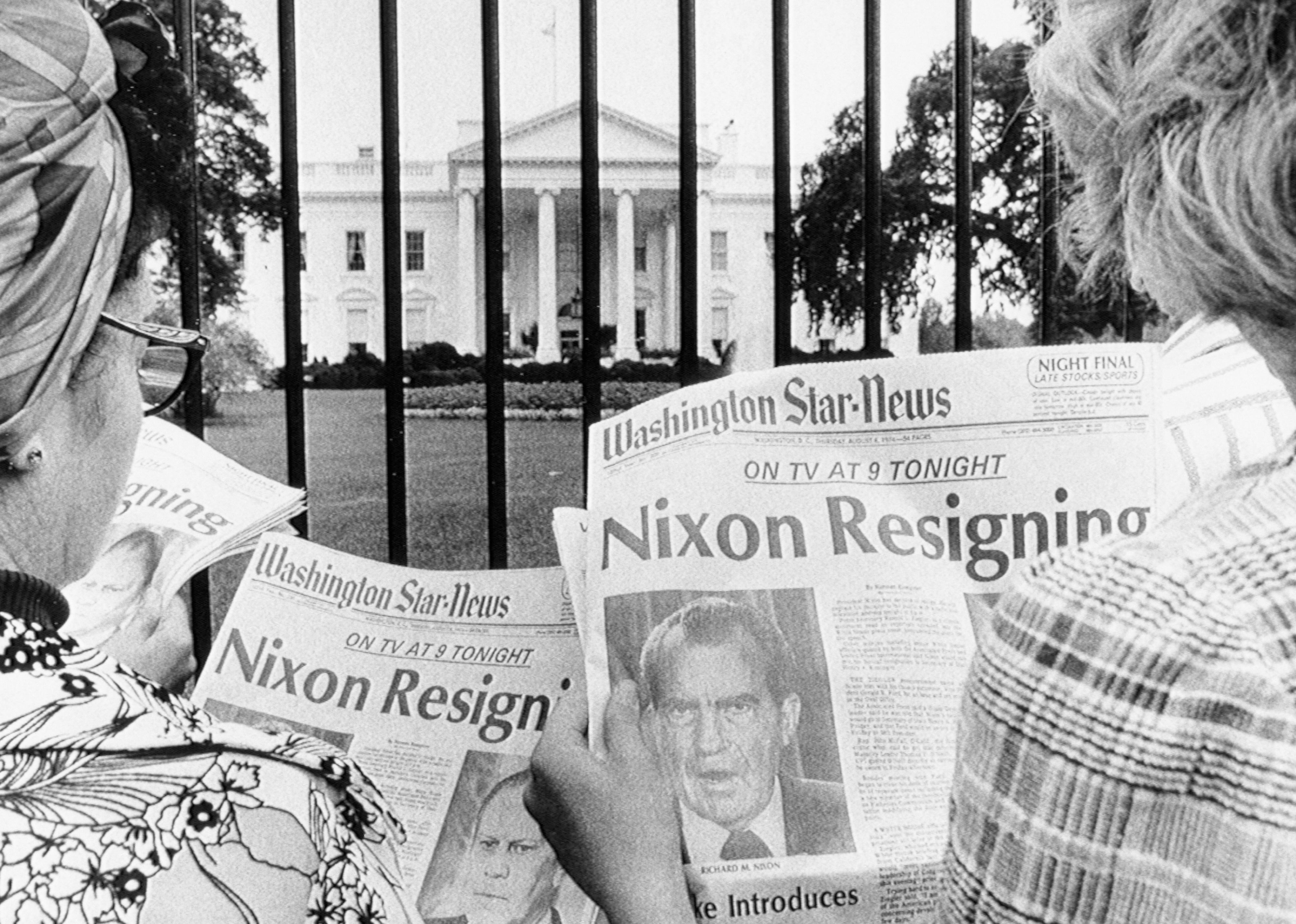
, too, oversaw a period of extraordinary upheaval, but his administration was defined by the crisis that forced him to resign in the face of almost certain impeachment and removal from office—the Watergate scandal. When Republican operatives were caught breaking into Democratic party headquarters at the Watergate Hotel in Washington, D.C., Nixon initially denied involvement, but dogged reporting by the Washington Post and other publications revealed that the scandal reached all the way to the Oval Office.
[Pictured: Richard Nixon at the White House with his family after resigning as president.]
Gerald R. Ford (1974–1977)
Nixon's vice president, came to power when America was deeply distrustful of its government, but the crisis that shackled his presidency was a failing economy. He hiked—and later cut—taxes and reduced spending, but unemployment rose to its highest level since 1941, an oil embargo from 1973 kept energy prices high, and inflation soared.
[Pictured: President Gerald Ford addressing the nation on March 24, 1976.]
Jimmy Carter (1977–1981)
An energy crisis and sky-high inflation plagued Jimmy Carter's presidency, but the Iranian Revolution and hostage crisis would be his downfall. In 1979, Iranian revolutionaries overthrew the American-backed Shah Mohammad Reza Pahlavi and installed an Islamic fundamentalist regime led by Ayatollah Ruhollah Khomeini. Iranian students stormed the U.S. Embassy and took 52 U.S. citizens and diplomats hostage for 444 days, the longest hostage situation in American history.
[Pictured: Demonstration outside the U.S. embassy during the hostage crisis.]
Ronald Reagan (1981–1989)
Actor-turned-politician crushed Jimmy Carter in a landslide and emerged as the voice of modern conservatism. The AIDS and crack epidemics ravaged the country while he was in office, but the Iran-Contra affair was his administration's most daunting crisis. Reagan eventually admitted that his administration illegally sold tens of millions of dollars worth of arms to America's mortal enemy Iran and secretly diverted the profits to fund Nicaraguan contras without Congress's approval.
[Pictured: President Ronald Reagan informs congressional leaders about the apparent diversion of funds from the arms sale to Iran.]
George Bush (1989–1993)
Reagan's vice president, , faced a foreign crisis that led to the War in the Persian Gulf—and that crisis would have dramatic implications in the next century. As Bush was managing the dissolution of the Soviet Union, Iraqi dictator Saddam Hussein invaded his tiny oil-rich neighbor Kuwait, a strategic American ally. Bush responded by organizing an international coalition and—through a remarkable display of American military might—quickly liberated Kuwait but did not remove Hussein from power.
[Pictured: Secretary of Defense Dick Cheney reports to President George H.W. Bush at the White House after his mission Feb. 12, 1991, in Washington, D.C.]
Bill Clinton (1993–2001)
will always be synonymous with Monica Lewinsky, a young intern with whom Clinton engaged in an affair inside the White House. When the news broke, a salacious and all-consuming scandal ensued, and Clinton lied about the affair both to the American people directly and while under oath. The Republican-held House of Representatives impeached him for his actions—the first president impeached since Johnson 130 years earlier—but, like Johnson, he was acquitted in the Senate.
[Pictured: Former White House intern Monica Lewinsky meeting President Bill Clinton at a White House function.]
George W. Bush (2001–2009)
In modern American history, there was the United States before 9/11 and the United States after—and the worst attack on U.S. soil since Pearl Harbor happened on the watch of Roughly 3,000 Americans died, and the nation's sense of security was shattered as al-Qaida terrorists destroyed the World Trade Center in New York City and damaged the Pentagon in Washington, D.C. Osama bin Laden became a household name and America embarked on a perpetual War on Terror, which included the disastrous invasion and occupation of Iraq in pursuit of weapons of mass destruction that didn't exist.
[Pictured: President George W. Bush speaks to Vice President Dick Cheney by phone aboard Air Force One on September 11, 2001, after departing Offutt Air Force Base in Nebraska.]
Barack Obama (2009–2017)
The end of George W. Bush's second term witnessed the greatest economic calamity since the Great Depression, and —the country's first African American president—inherited the Great Recession. America's GDP dropped by 2.8%, unemployment breached double-digits at its peak, and millions of Americans faced foreclosure. Obama signed the American Recovery and Reinvestment Act of 2009, which provided relief, but not one banker or Wall Street CEO who caused and profited from the disaster ever saw the inside of a jail.
[Pictured: Vice President Joe Biden stands with President Barack Obama as he signs the American Recovery and Reinvestment Act at the Denver Museum of Nature and Science in Denver, Colorado, on Feb. 17, 2009.]
Donald J. Trump (2017–present)
Real estate magnate, reality TV star, and tabloid celebrity Donald Trump shocked the country and the world when he defeated Democratic candidate Hillary Rodham Clinton in one of the greatest political upsets in history. Trump's presidency was controversial from the outset, and he's mired in a three-headed crisis that continues to unfold: COVID-19, a struggling economy, and ongoing protests over systemic racism and police violence.
[Pictured: President Donald Trump holds a Bible while visiting St. John's Church across from the White House after the area was cleared of people protesting the death of George Floyd.]