A monumental mess: The Antiquities Act is at risk
A monumental mess: The Antiquities Act is at risk
In 2021, U.S. Supreme Court Chief Justice John Roberts made an extraordinary statement in response to a case called Massachusetts Lobstermen’s Association v. Raimondo, which challenged presidential use of the Antiquities Act to establish a huge marine preserve in the Atlantic Ocean: the Northeast Canyons and Seamounts Marine National Monument. Created in 2016 by President Barack Obama, this sanctuary protects 4,913 square miles of underwater geology and habitat that slant down from the continental shelf, about 130 miles southeast of Cape Cod.
“Which of the following is not like the others,” Roberts began, “(a) a monument, (b) an antiquity (defined as a ‘relic or monument of ancient times’) … or (c) 5,000 square miles of land beneath the ocean? If you answered (c), you are not only correct but also a speaker of ordinary English. In this case, however, the Government has relied on the Antiquities Act of 1906 to designate an area of submerged land about the size of Connecticut as a monument.”
The Antiquities Act was designed largely to protect Native American archaeology and artifacts from looters, who were more of a problem in 1906 than they are now. Alluding to this goal, Roberts sniped that the very existence of Canyons and Seamounts demonstrates “how far we have come from indigenous pottery.” The monument in question, he said, “contains three underwater canyons and four undersea volcanoes. … The ‘objects’ to be ‘protected’ are the ‘canyons and seamounts themselves,’ along with ‘the natural resources and ecosystems in and around them.’”
The immediate purpose of this statement was to tell the lobstermen and the public that the Court had decided against taking the case—which happened, Roberts stressed, due to technicalities originating in the court’s rules for procedure, not because the arguments lacked merit. His comments have been widely seen as an open invitation for somebody, somewhere to try again.
If you’re somebody who happens to support the Antiquities Act and its legacy, should you be worried? Probably, since not one but two branches of the federal government—judicial and executive—now appear to be lined up against it, reports. President Donald Trump made his views on the subject clear back in 2017, when he drastically reduced a pair of national monuments in Utah: Bears Ears (established in 2016 by Obama) and Grand Staircase-Escalante (Bill Clinton, 1996). He hasn’t done anything as dramatic this time around, but the pieces for rapid action are in place.
Project 2025, the Heritage Foundation policy blueprint released in advance of Trump’s second term, called for the abolition of the Antiquities Act, arguing that the restrictions it places on activities like drilling, mining, grazing, commercial fishing, and motorized recreation are unfair to some user groups and a drag on the economy. Shrinking more monuments, its authors urged, could prompt a fresh round of litigation by Antiquities Act supporters—cases that could start winding their way toward the Supreme Court.
Meanwhile, the chief justice has made his desires known. And while it’s impossible to predict whether he’ll get what he asked for, there are cases in the pipeline that could fit the bill. One is called Utah v. Biden, and it focuses on what may be the most fought-over national monument of our time: Bears Ears.
For the past 120 years, the Antiquities Act has served as a powerful tool for conservation. Seventeen presidents—nine Democrats and eight Republicans—have used it roughly 180 times, creating or expanding more than 160 monuments, including many famous sites that later became national parks, such as Acadia, Carlsbad Caverns, Mount Olympus, and Wrangell-St. Elias. Over time, some have been abolished by Congress, like a small 1908 monument in Wheeler, Colorado, that became part of the Rio Grande National Forest in the 1950s.
In the early 20th century, when the act was born, two of its biggest boosters were Iowa Congressman John F. Lacey and Edgar Lee Hewett, an anthropologist who worked all over the American Southwest. Traveling together in 1902, they saw places where plunderers had done lasting damage, and Lacey was inspired to sponsor legislation that gave presidents the ability to save threatened treasures that sit on federal land. Several sites that preserve indigenous ruins and objects have been set aside under the act, including Chaco Culture National Historical Park, Navajo National Monument, and Hovenweep National Monument.
But the act was always about more than just historic preservation, a point Roberts glossed over. It also gives presidents the power to protect places of “scientific interest,” a term that can cover a lot of different terrain. On the subject of size, it doesn’t set an upper limit, stipulating only that monuments should be “confined to the smallest area compatible with proper care and management of the objects to be protected.”
The meanings of “smallest area compatible” and “scientific interest” have long been controversial, but Theodore Roosevelt, the first president to use the act, interpreted both in a typically robust way. While some of T.R.’s designations were small, he went big in 1908, protecting 808,120 acres of the Grand Canyon. Eleven years later, Congress merged most of that into one of our most popular national parks.
Roosevelt was also expansive about what qualified for protection. Carla C. Mattix, a retired Interior Department attorney, discusses this in a forthcoming book called “National Parks and the Supreme Court,” which examines a number of cases that have shaped the trajectory of U.S. public lands management.
“The first national monument was neither a ruin nor a relic,” Mattix points out. “On September 24, 1906, [Roosevelt] created Devils Tower National Monument in Wyoming to protect a unique geological formation.” In all, she wrote, 12 of the 18 monuments T.R. established “consisted of objects of scientific interest.”
For Roosevelt, the mention of science was key. His proclamation hailed the Grand Canyon as “an object of unusual scientific interest, being the greatest eroded canyon within the United States.” As other presidents have done, he decided that the “smallest” area required for protection of the canyon’s geology and ecosystems was, by necessity, quite large. This idea was challenged in a 1920 Supreme Court case, Cameron v. United States, that the federal government won unanimously.
Among the many presidents who followed Roosevelt, Obama has used the act most often, designating 29 monuments and authorizing five expansions. His predecessor, George W. Bush, created the largest preserve to date: Papahānaumokuākea Marine National Monument, which has grown to cover 583,000 square miles in the northwestern Hawaiian Islands, an area twice the size of Texas. Among post-World War II GOP presidents prior to Trump, Dwight Eisenhower was the only other one to create any monuments—two of them, both small. Over time, the Antiquities Act has increasingly come to be seen as a policy tool for Democrats.
Trump arrived on the scene with a level of hostility toward the act that hadn’t been seen in the White House before, even during the Sagebrush Rebellion heyday that accompanied Ronald Reagan’s presidency. In 2017, early in Trump’s first term, he issued an executive order calling for a review of any monument “designations or expansions” made since 1996 that involve more than 100,000 acres. As a result of this review, he downsized Bears Ears by 85% and Grand Staircase-Escalante by nearly half.
President Joe Biden restored both in 2021, an action that Trump supporters would like to see reversed again—and then some.
That hasn’t happened yet, but it could at any time. Last May, the Justice Department’s Office of Legal Counsel—which provides advice to the president and all executive agencies—issued an opinion labeled “Revocation of Prior Monument Designations.” It declared that presidents have the right to shrink or abolish monuments, reversing an opinion issued in 1938 by Franklin Delano Roosevelt’s attorney general.
Environmental law expert Justin Pidot—a professor at the University of Arizona who worked for both the Obama and Biden administrations—wrote about the OLC’s action last summer in the Yale Journal on Regulation, using understatement when he said it has the potential to be “a big change.” He added, however, that in the short term it doesn’t do anything.
“The OLC opinion will not be the last word and, indeed, it has no immediate legal effect,” he said. “Now, it’s up to President Trump to decide whether to abolish one or more national monuments …. If he does, litigation will surely follow, and courts will decide the meaning of the Antiquities Act.”
The case known as Utah v. Biden dates back to 2021, when President Biden, newly installed, restored Bears Ears to its original size, inserting himself into an old and bitter dispute between Obama and Trump.
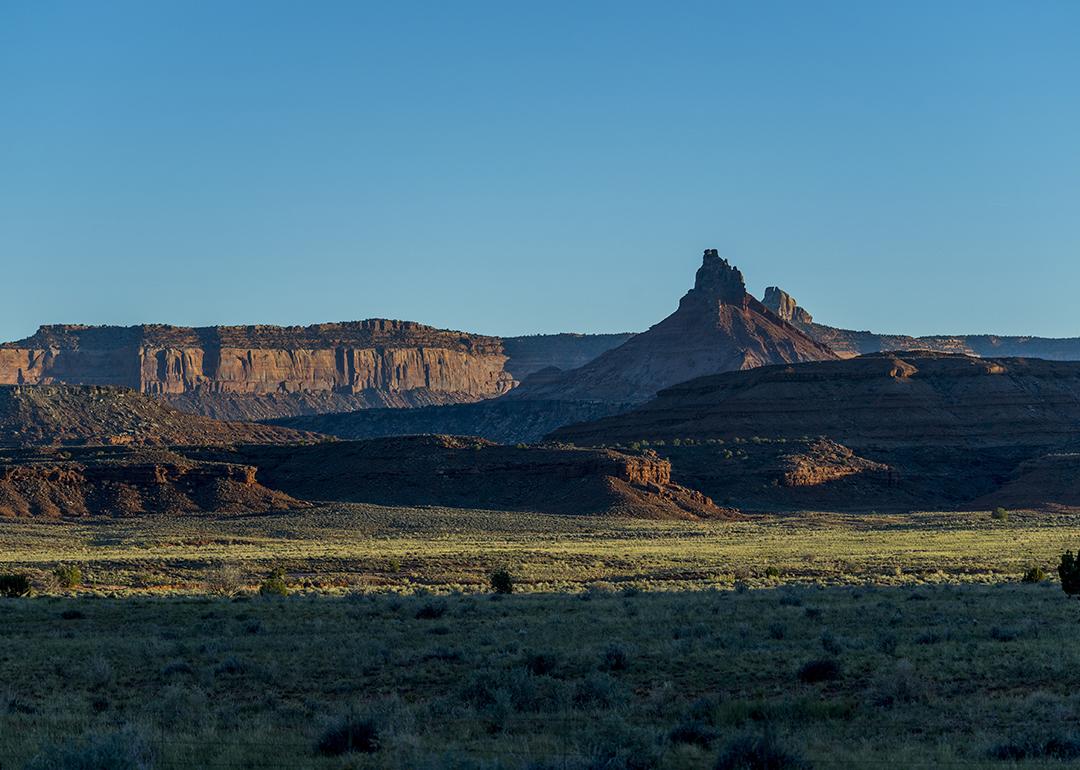
Bears Ears sits inside southeastern Utah’s San Juan County, taking its name from two tall buttes—both around 9,000 feet high—that stand near the geographical center of the overall preserve, looking like a pair of rounded ursine ears rising from the horizon.
These features are surrounded by rugged, beautiful landscapes and Puebloan ruins. To the south lies Cedar Mesa, a vast plateau famous for sites like Moon House, a multiroom cliff dwelling that dates back 700 years. Another popular area is the Valley of the Gods, 150 square miles of redrock backcountry. The Indian Creek Unit, which lies northeast of the monument’s center, is home to more pueblo ruins and world-class sandstone-crack climbing.
Discussions about giving Bears Ears monument status date back to the early 1900s; the specific proposal that swayed Obama came from a group called the Bears Ears Inter-Tribal Coalition, which includes the Hopi, Navajo, Zuni, Ute Mountain Ute, and Ute Indian tribes. Working with relevant federal agencies, including the BLM, they developed a collaborative plan for overseeing the monument.
In 2016, Obama created Bear Ears National Monument at a total size of 1,351,849 acres. In 2017, Trump slashed it to 201,876 acres, a process that included adding 11,200 acres of previously unprotected lands. Biden revived the original monument and kept Trump’s add-on. Current acreage: 1.36 million.
Biden’s actions prompted two lawsuits that have been consolidated into a single case. The plaintiffs include Zebediah George Dalton, a cattle rancher who says that three-quarters of his 730,000-acre spread now lies within Bears Ears, adding layers to the already complicated task of operating in accordance with all the federal regulations that govern his enterprise. Another affected constituency is the BlueRibbon Coalition, a group for off-roaders who say this will lose access to many trails that they have used in the past.
Utah presents various objections to Bears Ears in its brief to the 10th Circuit, with size and land use at the top. “This case is about limiting the unlawful ‘trend of ever-expanding antiquities,’” the state argues, citing Roberts’s statement in the Lobstermen’s appeal. “Congress intended the Act to allow only ‘small reservations.’ But recent Presidents have, despite judicial reproach, ‘transformed’ the Act ‘into a power without any discernible limit to set aside vast and amorphous expanses of terrain.’”
Both Obama’s and Biden’s proclamations had expended more than 5,000 words cataloguing the splendors of Bears Ears. “From earth to sky, the region is unsurpassed in wonders,” Obama’s version said. “The star-filled nights and natural quiet … transport visitors to an earlier eon. Against an absolutely black night sky. … Bears Ears has that rare and arresting quality of deafening silence.”
Utah’s brief snorts at this sort of prose, in the same way Roberts did in his Lobstermen’s statement. By declaring “entire landscapes” to be “other objects of historic or scientific interest,” they write, Biden also “declared as national monuments ‘soil,’ ‘shrubs,’ ‘grasses,’ ‘bees,’ ‘bighorn sheep,’ ‘minnow[s]’ … ‘wheel ruts,’ ‘unimpeded views of the night sky,’ and hundreds of other random things.”
Biden’s poetic list of Bears Ears wonders, the plaintiffs allege, ignores the needs of people who actually use the land. When he restored the size of Bears Ears and Grand Staircase-Escalante in 2021, they write, “he made it a crime for southern Utahns to go on land that they have lived and worked on for generations to turn over soil, do roadwork, prevent wildfires, remove invasive species, or care for wildlife.”
The consolidated case has been litigated by lawyers with the state attorney general’s office in Salt Lake City, and a firm called Consovoy McCarthy, which has offices in Salt Lake City and Arlington, Virginia. According to CNN, this conservative firm has attracted notice in recent years for a in getting cases heard by the Supreme Court, including a landmark decision that restricts the use of race-based admissions by colleges and universities.
In September of 2024, both sides—the state of Utah and the U.S. government—presented arguments to a three-judge panel of the U.S. Court of Appeals for the 10th Circuit. Their decision is pending; lawyers who follow appellate courts say that it’s taken an unusually long time to come down. So far, it’s been 16 months.
Chris Winter, the executive director of the Getches-Wilkinson Center for Natural Resources, Energy, and the Environment at the University of Colorado School of Law, teamed up with 29 law professors around the country to file a friend of the court brief in Utah v. Biden that asked the court to reject Utah’s challenge. He says it’s not unusual for a circuit court to take a long time with a case like this, which “involves important and difficult issues regarding the proper role of federal courts in reviewing presidential actions.”
One possible complicating factor, Winter says, is that Trump has signaled that he might shrink Bears Ears yet again. “If that were to happen, it might render Utah’s case moot or otherwise impact the litigation,” he says, adding that federal courts have sometimes been hesitant to rule on important issues of law in cases where different administrations take different positions over time.
When the ruling finally arrives, will that put the Antiquities Act one step closer to its fateful date with the Supreme Court? Perhaps, but not necessarily. As lawyers like Mattix and Pidot point out, Utah v. Biden could even move in reverse, first getting sent back to the U.S. District Court in Salt Lake City where it was originally filed. This would not prevent it from eventually finding its way to the Supreme Court.
Utah v. Biden sets up what sounds like a vigorous debate that’s worth having, since it might settle fundamental questions. For example, whether there should be size limits on monuments, and whether the process of creating management plans for monuments sufficiently takes into account the impacts on user groups. Though ocean-based monuments aren’t at issue in Bear’s Ears, they are still a major point of contention.
One of the quirks of this case, though, is that it never made it to the oral argument phase at the federal district court level, and the fundamental disputes were never litigated. In August of 2023, the presiding judge, David Nuffer, dismissed the case, saying that Biden’s judgment in “drafting and issuing the Proclamations as he sees fit is not an action reviewable by a district court.” In this matter, the judge said, Biden has sovereign immunity that a district court can’t question.
So, who would be in a position to question it? Congress, for starters. In Nuffer’s decision, he mentioned that legislators have chosen on two occasions to “aggressively” respond when they thought a president had overreached with the Antiquities Act.
The first happened in response to FDR’s 1943 establishment of Jackson Hole National Monument (210,950 acres), which has since been incorporated into Grand Teton National Park. His decision inspired fierce local opposition that led to a 1950 amendment to the act that prohibits creating or expanding any national monuments in Wyoming without Congressional approval. There haven’t been any since then.
Over the years, bills have been introduced designed to introduce more restraints. In 2014, for example, the House of Representatives passed one called Ensuring Public Involvement in the Creation of National Monuments Act. Among other changes, it would have limited the minting of new monuments to one per state per presidential term. Introduced by then-Rep. Rob Bishop (R-Utah), it passed the House and died in the Senate.
Utah’s Congressional delegation now seems to be challenging the act from a different angle. This January, the Government Accountability Office—acting at the request of Rep. Celeste Maloy (R.-Utah), a vocal opponent of the Antiquities Act—released a report concluding that the Bureau of Land Management’s land-use plan for Grand Staircase-Escalante could be treated as a “rule.” According to various advocacy groups, this means that the plan might be subject to the 1996 Congressional Review Act, which in theory could allow lawmakers to rescind the whole plan.
As for Utah v. Biden, what happens next depends on what the appeals court does. Mattix, who has gamed all the possibilities, says that if the 10th Circuit reverses the district court, the case could go back there for full consideration of the issues raised by plaintiffs. If the 10th Circuit upholds the district court, then Utah could seek an appeal to the Supreme Court. As always, the odds of their case being heard are long.
Meanwhile, there’s yet another case to keep an eye on. In 2017, when Trump downsized Bears Ears and Grand Staircase-Escalante, several tribes filed a lawsuit in the federal district court in D.C., arguing that Trump (or any president) lacks the constitutional or statutory authority to dismantle monuments, period. Two other groups of plaintiffs filed similar suits. These have been consolidated into one case, which has been stayed until the 10th Circuit issues its decision in Utah V. Biden.
Whichever direction Utah V. Biden goes, Trump has awarded himself the right to alter monuments in the here and now, and one can imagine a strategy that goes like this: He , touching off litigation that will eventually arrive at several different federal appeals courts.
One person cheering Trump on is William Perry Pendley, a Wyoming attorney who headed the Bureau of Land Management during Trump’s first term, and who has long opposed what he calls “abuses of the Antiquities Act.” In 1997, as the leader of a Colorado public-interest law firm, he sued President Clinton over the creation of Grand Staircase-Escalante. He hopes for major change during this latest round of attacks on the law.
“The purpose of the Antiquities Act was pretty clear: to protect items of antiquity in 1906, essentially from grave robbers,” he says. “But public land law is not what it was in the early 1900s—with passage, for example, of the Wilderness Act and the Wild and Scenic Rivers Act. I’d like the courts to restore its original intent and prevent these vast land closures by Democrat presidents. They have unilaterally created vast wilderness areas, ending economic uses of those lands, including recreation, that are important to local residents.”
Mattix is a passionate supporter of the Antiquities Act, so when asked the obvious question: From where you stand, what’s the worst thing that seems likely to happen? She doesn’t seem especially worried that Trump or the Supreme Court will actually strike down the law. “The most realistic negative outcome I can see is the Court interpreting parts of the Act too narrowly,” she says.
Under such a narrow interpretation, for example, Theodore Roosevelt could have only protected the relatively small portions of the Grand Canyon known at the time to contain indigenous artifacts. In theory, a president with Trump’s mindset could shrink Bears Ears drastically, or could abolish some land- and sea-based monuments outright.
“If the Justices rely on dictionary definitions, as Roberts did in his Lobsterman statement,” Mattix says, “and don’t bother to fully understand the history of the development of the statute, I believe that would thwart the intent of the original visionaries.”
Whatever happens next, one thing is clear: This law is still at risk.
was produced by and reviewed and distributed by Â鶹ԭ´´.