Most Americans see unlimited election spending as a threat to democracy: Poll
The vast majority of Americans — no matter their partisan identification — say unlimited political spending weakens democracy and wealthy donors have too much power in elections, a analyzed by indicates.
And they’d like the government to do something about it.
Nearly 8 in 10 respondents agreed with the statement that “anti-corruption rules strengthen our democracy and constitutional rights by ensuring everyone has equal political representation, regardless of money,” according to the YouGov poll commissioned by the political watchdog group Issue One, which advocates for stricter money-in-politics regulations.
Just 1 in 10 respondents agreed with the statement that “anti-corruption rules weaken our democracy and constitutional rights by infringing on free speech protected by the First Amendment.”
Nearly 8 in 10 also said they either “strongly agree” or “somewhat agree” that large independent expenditures by wealthy donors and corporations in elections give rise to corruption, or the appearance of corruption.” Just over 1 in 10 said they “somewhat disagree” or “strongly disagree” with the statement.
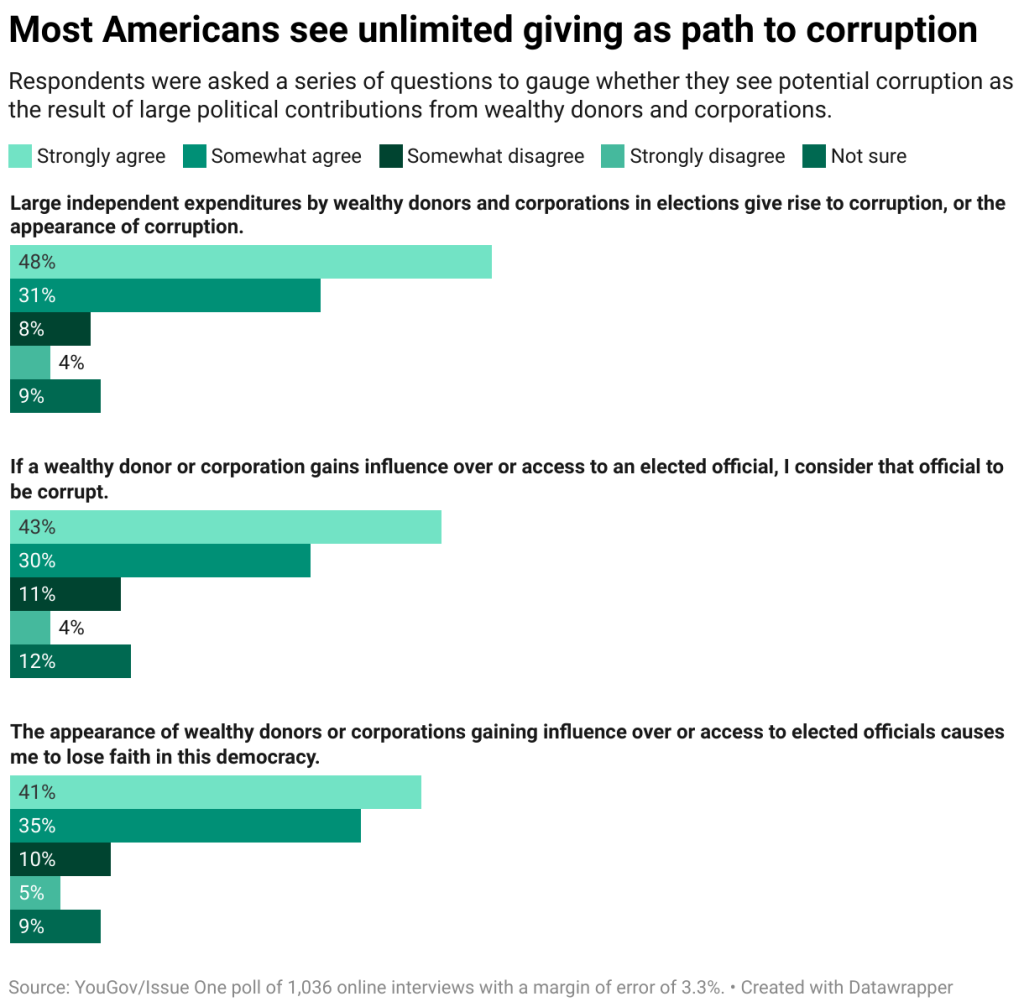
“These perceptions of corruption are corrosive to the foundation of our democracy. Our political system cannot function if the public assumes the government is for sale to the highest bidder,” said Michael Beckel, Issue One’s senior research director. (Beckel previously worked at OpenSecrets.)
The Supreme Court’s 2010 decision in Citizens United v. Federal Election Commission, which allowed corporations, unions and political nonprofits to spend unlimited amounts of money to advocate for and against political candidates, received relatively stronger support among those polled.
Nevertheless, it remained unpopular overall: Almost two-thirds of Americans — including 73 percent of Democrats, 53 percent of Republicans and 61 percent of independents — said they disagree with the Citizens United decision, which gave rise to unlimited, difficult-to-trace “” in politics and helped supercharge political vehicles such as .
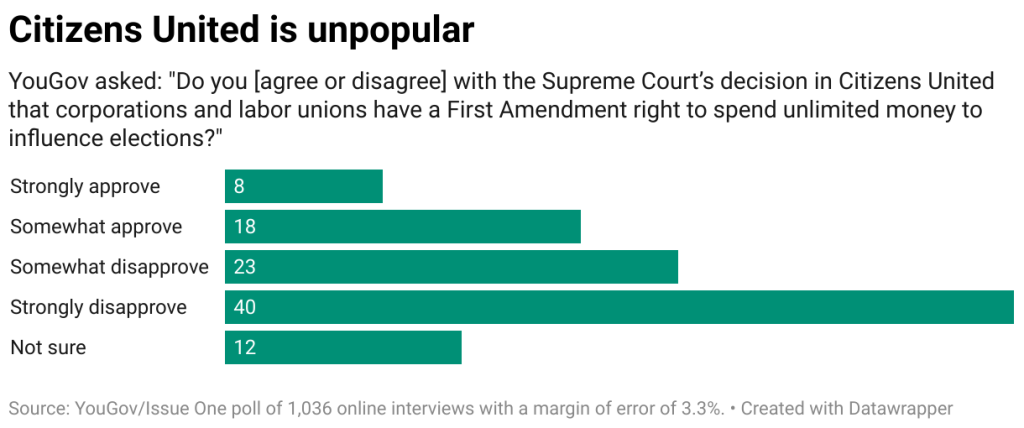
Fewer than 1 in 10 respondents said they “strongly agree” that corporations and labor unions have a First Amendment right to spend unlimited money to influence elections. In contrast, 4 in 10 said they “strongly disagree” with the decision.
Still, the influence of money in politics didn’t crack the top five issues cited as the most important facing the United States today, ranking behind “inflation and rising costs,” “jobs and the economy,” “too much power in the hands of the president,” “polarization and extremism,” “immigration and border security,” “housing and homelessness,” “healthcare policy, including Medicare and Medicaid” and “crime and public safety.”
But it did poll higher than numerous other national issues, including “climate change and the environment,” “education,” “LGBTQ rights,” “substance abuse and the opioid crisis,” “infrastructure and transportation” and “income inequality.”
Men (31 percent) and the college educated (28 percent) were most likely to list money in politics among their top five issues, the poll.
The survey also specifically polled voters in Montana regarding a proposed 2026 ballot measure known as the “,” which aims to curb corporate and dark money spending in the state’s elections by novel means: amending state corporate charter laws.
This, too, proved popular among voters, with nearly 3 in 4 Montana voters saying they’d vote in favor of the ballot measure.
“These new findings show that people in every corner of the state — and across party lines — want a government that works for all of us, not just those with the deepest pockets,” Issue One Policy Lead Liana Keesing said.
But some election law scholars and First Amendment advocates about the Montana Plan’s legality.
“The state cannot condition a benefit (in this case, the right to incorporate) on citizens giving up their constitutional rights,” Institute for Free Speech President Brad Smith, a former Federal Election Commission chairman.
Beyond money
The poll also indicated a strong majority of Americans are dubious about the role technology and social media companies play in politics.
Nearly seven in 10 polled — including 76 percent of Democrats, 61 percent of Republicans and 64 percent of independents — said they have “too much” influence in politics.
Politicians and political parties didn’t fare much better, as a majority of voters considered President Donald Trump (52 percent), billionaire Elon Musk (53 percent), the Republican Party (54 percent) and the Democratic Party (56 percent) to either be “very unfavorable” or “somewhat unfavorable.”
The poll was based on 1,036 online interviews conducted by YouGov of registered voters. It has a margin of error of 3.3 percent.
was produced by and reviewed and distributed by Â鶹ԭ´´.