Proof of citizenship to enroll in school? GOP lawmakers eye barriers for undocumented students.
was produced by and reviewed and distributed by 麻豆原创.
Proof of citizenship to enroll in school? GOP lawmakers eye barriers for undocumented students.
Republican lawmakers in at least five states are seeking to block undocumented children from attending public school for free or to inquire about students' immigration status in ways that courts have held violate children's educational rights, reports.
: Proponents say states and local school districts are spending too much to educate undocumented immigrants and that their parents should bear the financial responsibility for their education. Having data about how many undocumented children attend public school, and where, is necessary to tally up costs and take stock of needs, they add.
If any of these proposals become law, they would likely violate the , which held that children are entitled to a free public education regardless of their immigration status.
. They've said they want to enact a policy that would likely draw a legal challenge so it could potentially make its way up to the Supreme Court, where the conservative majority may be open to overturning the Plyler ruling.
When Plyler was decided, the justices in the majority said that educating children without legal immigration status wasn't a significant burden for the state. But circumstances have changed over the last 40 years, said Ira Mehlman, a spokesperson for the Federation for American Immigration Reform, which advocates for dramatic reductions in immigration.
"You could probably make a case in just about every school district in the country these days that it is a significant burden, and a particularly onerous one in certain parts of the country," Mehlman said. "It's a lot of money, and it comes at the expense not just of taxpayers but of the quality of education for other kids in those school systems."
Schools have had to hire additional bilingual staff and , and as the sponsors of these bills.
But schools also report that immigrant students have and .
. But some say in this legal and political climate鈥攚here President Donald Trump is and .鈥攖hat one or more of these proposals could become law, forcing schools to decide whether to comply or resist.
"These legislatures are trying to provide the case" that reaches the Supreme Court, said Brett Geier, a professor of educational leadership at Western Michigan University, who wrote a book about the Supreme Court's effects on public schools since 2005. "You also have a Supreme Court that is probably ready to look at that."
"We know that the court is in no way fearful of overturning precedent," Geier added.
Bills Would Block Undocumented Students, Collect Immigration Info
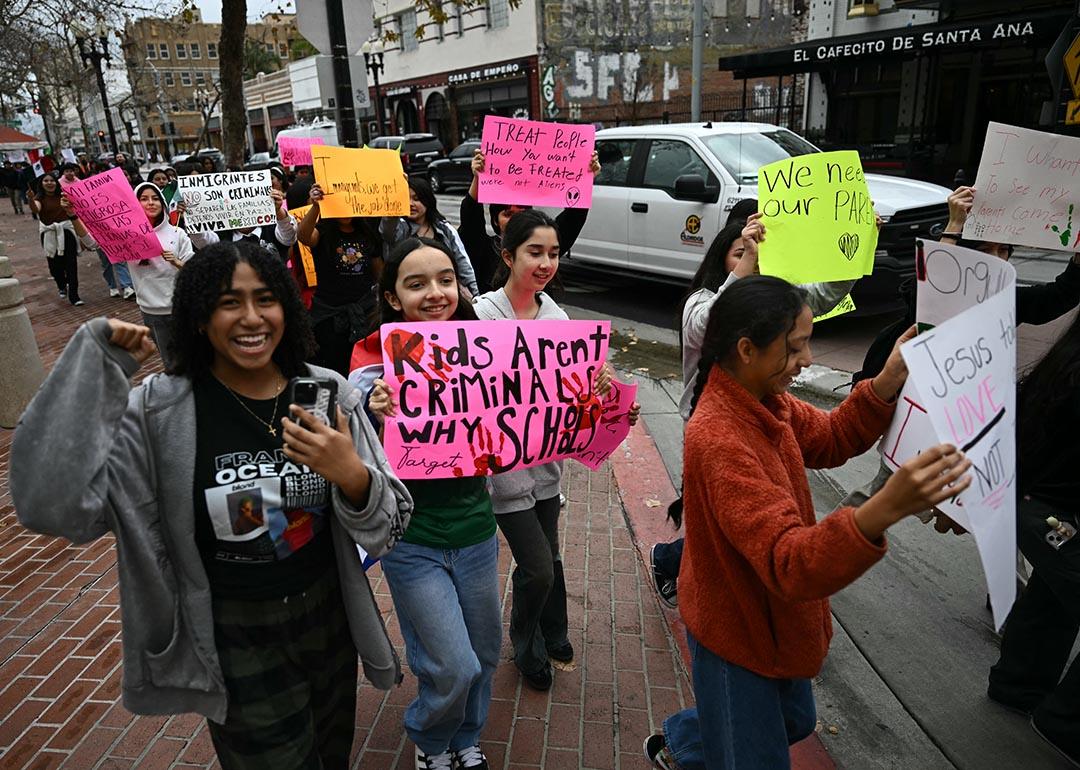
The Republican-backed state bills seeking to affect the education of undocumented children come as and families in a moment of heightened anti-immigrant sentiment.
at schools, child care centers, playgrounds, and other places where kids gather. In the past, those were treated as "sensitive" locations that were highly restricted when it came to immigration enforcement.
Now lawmakers in at least four states are seeking to give schools the power to turn undocumented students away, or to charge their families tuition for public school鈥攁 move that led to the Plyler ruling over 40 years ago.
In Texas, where the Plyler challenge originated, a Republican lawmaker filed a bill one week after Trump was reelected that , unless the federal government stepped in to cover the costs. The idea mirrors one put forward by The Heritage Foundation, a conservative think tank with close ties to the Trump administration.
In Indiana, two Republican lawmakers introduced legislation last month that if school officials determined by "a preponderance of the evidence" that the child was not legally present in the U.S. That proposal comes with backup: The state attorney general would defend a school district if it were sued due to the law.
In New Jersey, , a Republican lawmaker if a student couldn't prove their citizenship or legal immigration status鈥� in a state where Democrats control both chambers of the legislature and the governor's seat.
And in Tennessee, where Republicans have a supermajority in both chambers, lawmakers are going after the issue on multiple fronts. of would require students to prove they are U.S. citizens by producing a birth certificate or other approved document. Without that, families could only enroll their child if they paid the district what it would usually spend per student.
Another set of bills introduced this week by the Tennessee House majority leader and the chair of the powerful Senate finance committee would allow school districts and charter schools to That would likely sweep up a larger category of children, such as those with temporary protected status that expired or whose families overstayed their visas.
GOP Gov. Bill Lee hasn't weighed in directly on the proposal. But the that recently passed the legislature carries a similar provision that says .
Judith Clerjeune, the advocacy director for the Tennessee Immigration & Refugee Rights Coalition, a nonprofit that advocates for immigrant rights across the state, worries the bills could have wider support among Republicans in the statehouse.
"In months or years before, the idea of attacking innocent children and taking away their public education would have been unheard of," Clerjeune said. "Unfortunately, the narrative has become so extreme that this is legislation that we're seeing coming from Republican leadership."
, Justice William Brennan wrote that "legislation directing the onus of a parent's misconduct against his children does not comport with fundamental conceptions of justice."
But in his dissent, Chief Justice Warren Burger wrote that "there can, of course, be no presumption that a state has a constitutional duty to include illegal aliens among the recipients of its governmental benefits." Yet he also wrote that it would be "senseless" to "deprive any children鈥攊ncluding illegal aliens鈥攐f an elementary education."
Mehlman, of FAIR, agrees that it's not good policy to have children who aren't in school. But he says parents who broke immigration law when they came to the U.S. are responsible for the consequences of their decisions, including any effects on their children.
"You would expect, or hope, that parents who put their kids in this situation might do the right thing and decide: If my kids can't be educated here, then we're going to leave," he said.
To Clerjeune, it's "short-sighted" to argue that immigrant children are a burden on public schools. Often, she noted, their parents contribute to public education funds through property, sales, and income taxes.
"They're trying to distract people and redirect attention to immigrant students by blaming them for the challenges that public schools are facing," Clerjeune said. "We're not thinking of the longer-term impacts on the economy, on our society at large."
Proposals Would Make Parents Prove Children's Citizenship
Republican lawmakers in at least four states are also seeking to collect information about children's immigration status or to verify children's citizenship status during the enrollment process. , it faced numerous legal challenges, and the provision was ultimately blocked.
In Indiana, a bill written by four Republican lawmakers to the state's education department each year. That includes the number of "unlawfully present students" enrolled in their schools, whether those children are English learners, how many staff are employed to provide bilingual instruction, and the attendance and truancy rates for "unlawfully present" students.
It would also require schools to report the number of enrolled students who are not U.S. citizens and the immigration status of every non-citizen student.
, though it goes even further: It would require school districts to count children they know or "reasonably believe" are not U.S. citizens.
In Oklahoma, a Republican lawmaker is advancing a proposal first crafted by state Superintendent Ryan Walters that would or has "legal immigration status" when they enroll them in school. (Walters has on .)
Parents would have to produce a document such as a birth certificate, a U.S. passport, a Social Security card, or a teen's Oklahoma drivers license.
The bill says children wouldn't be prevented from enrolling if they are undocumented, and to figure out what students need and where staff and resources should be directed.
Walters has .
But courts have held that checking immigration status like this infringes on children's educational rights because it can instill fear and lead parents to keep their kids out of school.
"I can tell you that their citizenship makes no difference to their needs," said Angela Baumann, who teaches English learners in Oklahoma's Lawton Public Schools, , which unanimously backed the proposal. "They don't need to feel ostracized by a community because they may not be from here."
Some school districts would likely resist complying. Last year, they would not check students' immigration status if they were asked to by the state education department.
"I will have to go with the U.S. Supreme Court over a state elected official," Rob Miller, the superintendent of Bixby Public Schools, told NBC News at the time. "Part of my job as superintendent, and for other superintendents around our state, is to follow the laws of the land."
Cari Elledge, the president of the Oklahoma Education Association, which represents teachers, school administrators, and other school staff, said the union will urge its some 30,000 members to keep calling state lawmakers to express their concerns about the bill.
Already, some schools have seen immigrant families withdrawing their children, Elledge said, which could reduce funding for those school districts in the long run.
"These are the reasons why we tell our legislators: You're trying to do something that's just going to cost us more money in the end, because ultimately it's not constitutional," she said. "We hope that people will start paying attention."