Trump administration declares timber emergency after decades of employment decline in the industry
Earlier this year, the Trump administration issued an executive order to increase timber production by at least 25%, citing wildfire risk reduction and economic development as the primary drivers behind the order. Whether President Donald Trump鈥檚 forest management policies will improve rural economies in communities formerly dependent on logging is a point of contention, however.
reporters Sarah Melotte and Ilana Newman spent a week in mid-August interviewing sources for a series of articles about mining, natural resources, and human health in the rural Northwest. On their first day out in the field, they met logger Bruce Vincent, owner of Vincent Logging, at his office in the small town of Libby, Montana. Vincent Logging is a small timber operation that Bruce鈥檚 parents started in 1968.
They spent the majority of the day riding in Bruce鈥檚 truck, listening to him tell them about the history of natural resource extraction in Libby, his passion for creating a better place for the next generation of Montanans, and the many projects he takes on around town to help realize that vision. For fun, he said he has 20 grandkids, who tend to keep him busy. He smiled, his blue eyes squinting beneath an old baseball cap.
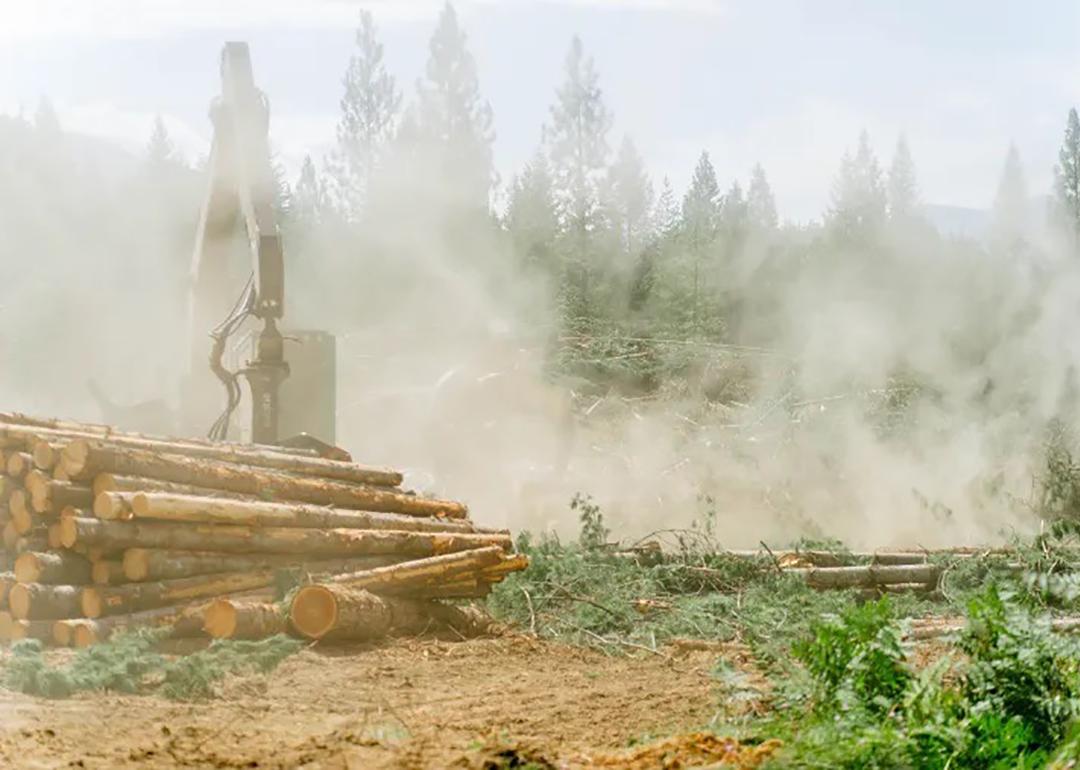
After lunch, Bruce took the reporters to an active logging area where his son, Chas Vincent, was operating a machine, aptly referred to as a delimber, that strips branches from felled trees. After delimbing the logs, Chas separated them into neat stacks by species.
Employment in the natural resource extraction industry, like logging and mining, used to be the primary driver of economic activity in many small Northwestern towns like Libby. But those jobs have dwindled in recent decades, leading to the socioeconomic challenges associated with unemployment, including low wages and high poverty. In 2023, , more than twice as high as the national rate of 11%.
Timber jobs have been on the decline nationwide. Timber employment went from about 1.2 million jobs in fiscal year 2001 to about 845,100 jobs in 2023. In this analysis, timber jobs include, harvesting, and transportation of trees.
This county-level data comes from the Quarterly Census of Employment and Wages (QCEW), a Bureau of Labor Statistics (BLS) measure meant to capture economic changes over time. Timber went from about 1% of total employment in 2001 to 0.58% of employment in 2023, representing a decline of almost half a million jobs.
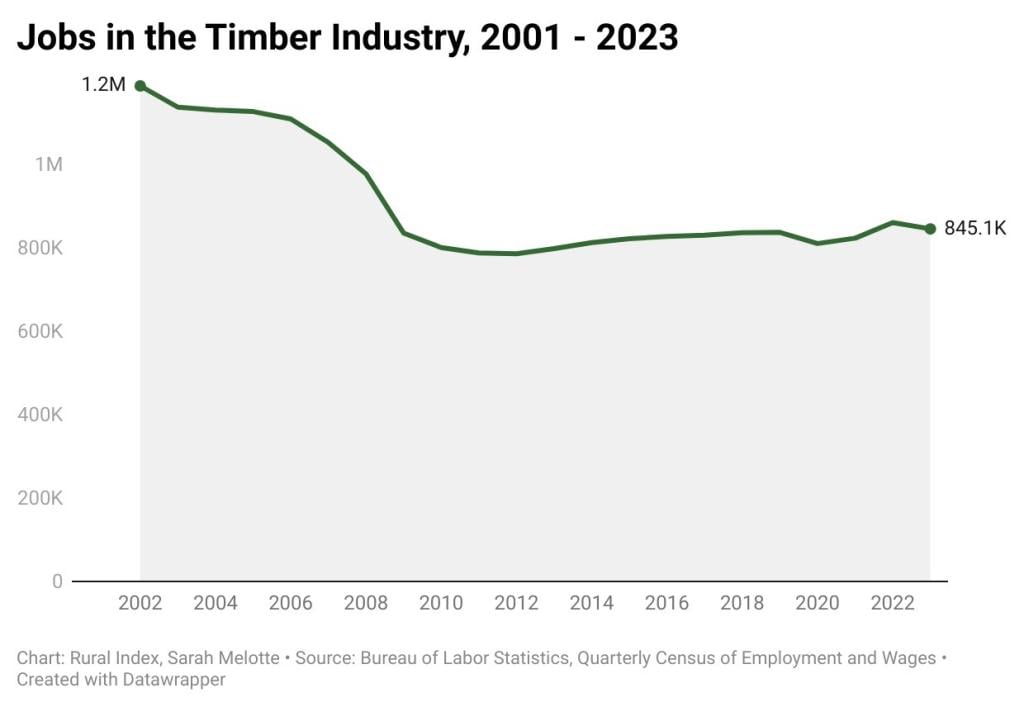
In contrast to most of Melotte鈥檚 other figures in the Rural Index, this analysis includes data from metropolitan counties. That鈥檚 because over 65% of timber industry jobs were in metro counties in 2023. Most of those jobs were likely within rural tracts of metropolitan counties, since logging requires wide swaths of forestland. But because the federal system Melotte usually uses to categorize rurality is a county-level binary, it doesn鈥檛 allow her to capture the nuances within an individual county. Including timber employment data of all counties, not just officially rural-categorized ones, lets her demonstrate the timber employment trends at a larger scale.
On April 4, 2025, an Emergency Situation Determination (ESD) that would expedite environmental permitting on . Rollins鈥檚 action came a month after Trump鈥檚 Executive Order to . Enacting the ESD would allow the Forest Service to roll back environmental protections to expedite the logging process.
According to Rollins, issuing the and support rural economies, but experts say the truth is more complex than that.
Assistant Professor at Washington State University, Austin Himes, (OPB) that Trump鈥檚 orders don鈥檛 address the main issues that led to timber decline. Himes said logging economies need a steady supply of timber over several decades, not a temporary jolt in production. But the Trump administration鈥檚 forestry plans don鈥檛 address sustainable long-term planning, according to Himes.
鈥淲hat we鈥檙e going to see, I suspect, are areas that are hit particularly hard by very intensive harvesting practices that lead more to sort of lose-lose situations for communities who enjoy those forests and the ecological sustainability of those forests,鈥� Himes told OPB.
But many industry experts and rural people disagree, saying that Rollins鈥檚 memorandum will ensure that forests are managed sustainably while growing rural economies by truncating environmental regulations like the National Environmental Policy Act (NEPA), believed by many in the timber industry as an unnecessary bureaucracy.
鈥淏y streamlining permitting and empowering forest managers, this initiative will create jobs, support rural economies, and ensure our forests are properly managed for future generations,鈥� House Agriculture Committee Chairman Glenn Thompson told the, a multimedia news source.
But the national timber emergency declaration might , professor of law at the University of California, Davis. In an article for the , Lin said the Trump administration鈥檚 ESD doesn鈥檛 qualify as a legal emergency under the , which stipulates that a situation qualifies as an emergency if it results in 鈥渁n unacceptable hazard to life, a significant loss of property, or an immediate, unforeseen, and significant economic hardship.鈥�
According to a , an emergency situation can include natural disasters, like earthquakes and floods, or 鈥渃atastrophic 鈥� failure to a facility,鈥� like a collapsed bridge. The Trump administration鈥檚 ESD doesn鈥檛 qualify as an emergency under The Corps鈥檚 own guidance, Lin argued.
Bruce said there was more to a timber economy than just felling trees.
鈥淵ou need a market to deliver the product to,鈥� he said. 鈥淲e used to have a sawmill in town. We had a plywood plant in town. We had a pres-to-log plant in town. We have none of that 鈥� so we need to have a small processing plant in town. And in order to get that, we鈥檝e got to have this certainty that the forest is going to be managed.鈥�
In May of this year, Bruce and Vincent Logging between Lincoln County, Montana, where Libby is the county seat, and the U.S. Forest Service to manage forest lands with the twin goals of economic development and wildfire risk reduction. Lincoln County is surrounded by the 2.2 million-acre Kootenai National Forest.
that he hopes the county鈥檚 partnership with the Forest Service will have a 鈥渢rickle down effect 鈥� with industry investing in wood fiber manufacturing, providing jobs to a community that is suffering economic hardship.鈥�
This story was produced with support from the . LOR works with people in rural places to improve quality of life.
was produced by and reviewed and distributed by 麻豆原创.