Trump says federal deployments make cities safer. Local officials disagree.
Trump says federal deployments make cities safer. Local officials disagree.
The Trump administration’s deployments of federal agents and National Guard troops to cities across the country, in the name of reducing crime, are having the opposite effect, according to local leaders — eroding the trust required for them to police effectively, making it harder for them to prosecute violent crimes, and leaving residents feeling less safe, reports.
These concerns are noted repeatedly in interviews with policing experts and community members, and in lawsuits challenging troop deployments in several , including Los Angeles, Washington D.C., Chicago, and Memphis, Tennessee.
In Chicago, during what President Donald Trump dubbed “Operation Midway Blitz.” It was a response, ICE said, to crimes committed by migrants in Illinois without documentation. The scenes have been dramatic by design: an overnight raid on an apartment building, with Blackhawk helicopters and U.S. citizens dragged into the street in zip-ties. The tactics have resulted in at least one death: In September, an immigration agent while attempting to pull him over and arrest him.
Locals in Chicago have turned out in force to protest, leading to daily demonstrations outside Chicago and . In response, Trump sent 500 National Guard soldiers to the area, but a judge blocked their deployment to the city.
Nevertheless, the presence of immigration agents in the city — with their military-style uniforms and tactics — has made it harder, prosecutors argue in a federal lawsuit, to pursue cases against people accused of violent crimes in Chicago.
In one case, the wife of a man who had been murdered did not want to come to court to testify for fear of being arrested by Homeland Security agents. Her fear of arrest “makes it more likely that her husband’s murderers will go free and justice will be denied,” wrote Jose Villarreal, a prosecutor with the Cook County State’s Attorney’s office, .
Villarreal listed a wide array of crimes that his office can no longer prosecute because of ICE’s presence in the city: children who are victims of sexual assault, whose mothers fear that bringing them to court might lead to their arrest by immigration agents; domestic violence cases where victims fear testifying because of immigration agents stationed at the courthouse, meaning “the predators who victimized them may walk free.”
Amid the Trump administration’s insistence that its immigration enforcement is meant to ensure law and order, Villarreal argued that Homeland Security’s actions in and around courthouses in Chicago have made it harder “to protect the victims of violent crime and uphold the law through criminal prosecution.” A spokesperson for the Cook County State’s Attorney’s office declined a request to interview Villarreal, citing the pending litigation.
Calls to 911 have dropped precipitously in the city since the start of “Operation Midway Blitz,” , especially in the predominantly Mexican-American neighborhood of Little Village. “They don’t really want to call the police because they associate the police with ICE,” Dolores Castañeda, a community activist, told the Tribune. As a result, residents “are feeling more unsafe than ever before.”
After the Trump administration began to flood Memphis with both National Guardsmen and other federal law enforcement agents in October, residents said that traffic stops by officers armed with assault rifles dressed in military garb made them feel less safe. “It makes everyone feel like a criminal. So you just literally criminalize the whole of Memphis,” said Keedran Franklin, a community organizer there.
In Memphis, where local police have struggled to build trust with communities of color — under the Biden administration, the Memphis Police Department was under investigation for using excessive force and — local police officers have been working side-by-side with the federal agents, doing traffic stops and executing warrants. In one case, a woman was dragged out of her house naked while federal agents .
“That's only made the relationship even more strained,” said Amber Sherman, a community activist and a member of a police reform task force in the city. “And I didn't think there was a chance of repair anyways, but I definitely don't think there is one now. Just because of the level of trauma that's being inflicted every single day.” The Memphis Police Department did not respond to a request to comment on Sherman’s concerns.
The playbook in Memphis was different from the other cities, because unlike governors in California and Illinois, Tennessee Gov. Bill Lee, a Republican, . Several hundred federal law enforcement officers — from the National Guard and a wide range of other federal agencies, — arrived to participate in an action the government called “.” But the county’s Democratic mayor, Lee Harris, has since . The enormous influx of troops led to over 1,000 arrests, and local jails do not have the capacity to hold that many people. Weeks after the task force began operating, Harris declared a state of emergency to deal with . By the end of October, troops were still there and had made .
In Los Angeles, where the Trump administration began deploying troops in June, Trump said that the aim was to protect federal employees and property from when they descended on the city in tactical gear, conducting large-scale workplace raids. In response, California Gov. Gavin Newsom and other state officials sued the Trump administration, arguing that military presence would “only escalate tensions” and “erode public trust.”
Their warnings were prescient. When the National Guard arrived, protesters redoubled their efforts, briefly blocking access to U.S. Highway 101 and amassing at a downtown jail, where officers with the National Guard, ICE, and Homeland Security to clear them.
“Soldiers patrolling the streets of Los Angeles have not made anyone safer; indeed, the opposite is true,” according to court filings in California’s lawsuit to end the National Guard deployment. The Trump administration’s “confrontational decision to deploy the military in a civilian city serves only to spread fear and heighten tensions in Los Angeles. If anything, the presence of the military threatens to further destabilize the community and escalate a situation that calls for cool heads and steady hands.” About 100 troops remain stationed there, according to military officials.
In interviews with The Marshall Project and in court documents, police experts argue that National Guard troops and other militarized federal law enforcement make it harder for police to keep cities safe. “For some chiefs, this is their worst nightmare,” said Christy Lopez, a Georgetown Law professor who oversaw Constitutional policing enforcement at the Justice Department during the Obama administration. “They've been working with communities for years — decades — building trust with immigrant communities, marginalized communities. All it takes is one raid to destroy years of goodwill,” she said.
That’s because modern-day policing depends on trust. To prevent and solve crimes, police need community members to call them in emergencies and to cooperate in investigations — actions the public won’t take if they don’t trust that their concerns will be taken seriously. “True public safety is only possible when the community believes that their police department exists to serve them with fairness, equity, and respect,” wrote U. Renee Hall, former Dallas police chief, in a declaration filed in the Washington D.C., litigation, which began in early September, weeks after troops began patrolling the city with fatigues and armored vehicles.
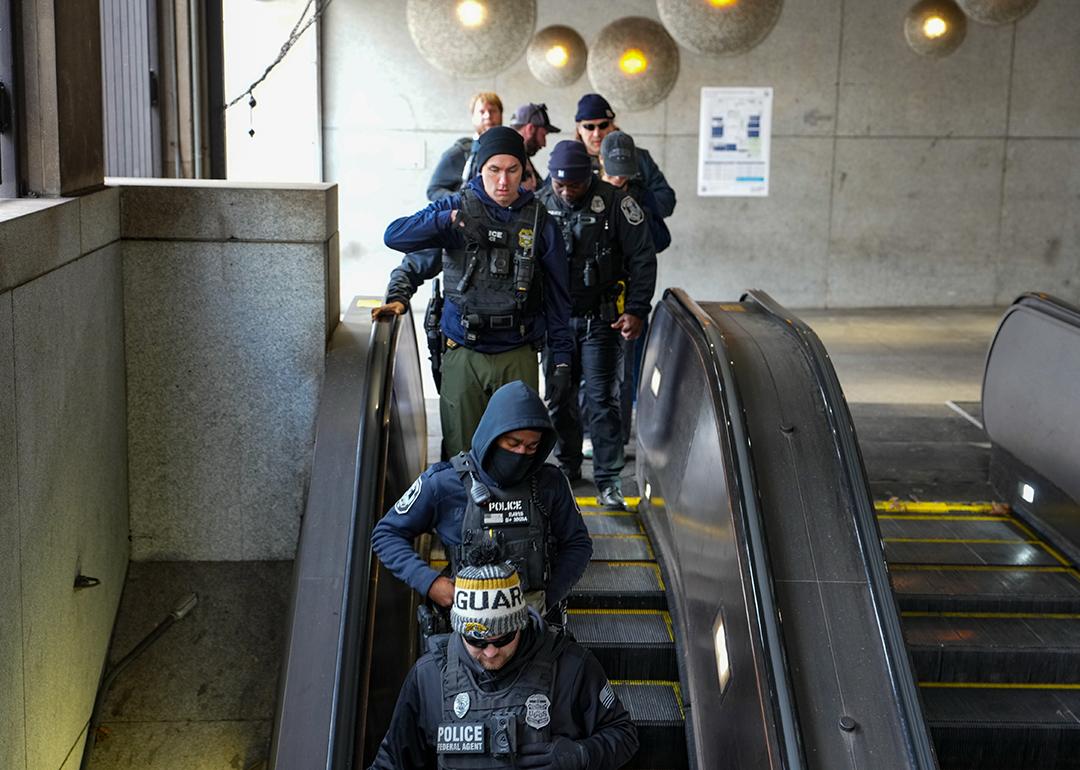
Many people don’t differentiate between Immigration and Customs Enforcement, Homeland Security agents, National Guard troops, and local officers, Lopez, the Georgetown professor, said. “It’s all just people with guns who can tell you what to do.” Federal agents often wear tactical vests that say “POLICE” — although technically they are not — which further confuses people, said Peter Moskos, a professor at John Jay College of Criminal Justice and a former police officer. “I don’t want the line blurred, because I don’t want ICE giving a bad name to police departments.”
Since the end of the Civil War, the idea that the military should not intervene in the country’s civil government — except in emergencies — has been enshrined . A handful of such emergencies took place during the civil rights movement, when the federal government sent the National Guard to Southern states to assist with desegregating schools, at times over segregationist governors’ objections. The last time the National Guard was called into an American city was in 1992, when California’s governor requested assistance in Los Angeles amid riots after the acquittal of the White police officers caught on videotape .
But certainly the most infamous example of the National Guard being used to quell protests was at Kent State University in 1970. , including a building on campus set ablaze, the mayor of Kent, Ohio, asked the state’s governor to send in troops. Shortly after arriving on campus, soldiers , killing four college students.
In October, federal circuit court Judge Ronald M. Gould warned in a written dissent that “to have an armed military faced off against civilian protesters, whatever the motivation of the President, threatens to produce another tragedy, such as that occurring at Kent State University in 1970.” A majority of his colleagues on the Ninth Circuit Court of Appeals .
And this trend may yet continue. A Pentagon memo drafted in October outlined plans to train across all 50 states to respond to civil unrest and be ready to deploy to American cities. And last week, speaking . Trump told U.S. troops that deploying the National Guard to U.S. cities was just the beginning of his plans for dealing with crime. “If we need more than the National Guard, we’ll send more than the National Guard, because we're going to have safe cities.”
was produced by and reviewed and distributed by Â鶹ԭ´´.