Where every U.S. president went to college
Where every U.S. president went to college
More than 66% of high school grads between the ages of 16 and 24 , up from just between the ages of 20 and 24. That nation-wide trend is reflected in the educational histories of America's presidents. While a college degree is mostly standard for modern politicians, this wasn't always the case. In fact, several American presidents never went to college, opting instead to pursue work, politics, or the military. Abraham Lincoln never attended college. William Henry Harrison did, and even enrolled in medical school鈥攂ut he never completed his studies.
麻豆原创 pored through presidential historical societies and libraries, , and the Library of Congress to create a list of where every U.S. president went to college鈥攊f they did at all. Read on to discover where your favorite presidents went to school, which programs they did or didn't finish, and what they studied. Perhaps you even share an alma mater with an American leader.
You may also like:
George Washington
School: Never attended college
George Washington's education is a bit contested. Some sources say he never went to college, while others say he enrolled for a time at the College of William and Mary. Nonetheless, he 鈥攖hough William and Mary did .
John Adams
School: Harvard College (undergraduate)
John Adams started the legacy of Harvard alumni-turned-presidents, . He attended . His time at the school helped develop his love of books.
Thomas Jefferson
School: College of William and Mary (undergraduate)
Thomas Jefferson enrolled at the when he was 17. He graduated after two years and .
James Madison
School: Princeton University (undergraduate)
Due to poor health, James Madison before heading to college. When he did eventually attend in 1769, he enrolled at what was then the College of New Jersey鈥斺�攁nd studied a full range of subjects. He graduated in 1771, but stayed another year to study Hebrew and political philosophy, making him the
James Monroe
School: College of William and Mary (undergraduate, did not graduate)
James Monroe enrolled at the College of William and Mary in 1774, . Two years later, however, in the American Revolution.
You may also like:
John Quincy Adams
Schools: University of Leiden (undergraduate, transferred), Harvard University (undergraduate)
When John Adams, former president and father of John Quincy Adams, relocated to Amsterdam in 1780, . John Quincy left the school in 1781 and traveled around Europe. When he returned to the U.S. in 1785, he went to Harvard as an advanced student and graduated two years later.
Andrew Jackson
School: Never attended college
As a young man growing up in the Carolinas at the end of the 18th century, . As an older teenager, he decided to read law and became a lawyer in Tennessee after two years.
Martin Van Buren
School: Never attended college
Like many other young men at the time, Martin Van Buren . Instead, he worked as a law clerk, eventually learning enough to become a lawyer in 1803.
William Henry Harrison
Schools: Hampden-Sydney College (undergraduate, did not graduate), University of Pennsylvania (medical school, did not graduate)
William Henry Harrison was just 14 when he began undergraduate studies at Hampden-Sydney College. He studied the classics and history there for three years before his father insisted he withdraw. Next, he briefly enrolled at the University of Pennsylvania's , dropping out when his father died and joining the military in 1791. Harrison was the first president to die in office.
John Tyler
School: College of William and Mary (undergraduate)
John Tyler was destined to go to the . He enrolled in the college's prep school when he was 12, then graduated from the actual college in 1807 when he was 17.
You may also like:
James K. Polk
School: University of North Carolina at Chapel Hill (undergraduate)
James Polk was educated at home except for . He enrolled at University of North Carolina in 1816 as a sophomore and graduated with honors in 1818.
Zachary Taylor
School: Never attended college
Zachary Taylor knew from a young age that he wanted to join the military. Instead of attending college, he .
Millard Fillmore
School: Never attended college
Although Millard Fillmore did not receive a college education, he attended in New York. There he met his wife, Abigail Powers, a .
Franklin Pierce
Schools: Bowdoin College (undergraduate), Northampton Law School (law school)
Franklin Pierce almost flunked out of Bowdoin College, during his initial time there that he was last in his class. He refocused and ended up graduating fifth in his class in 1824. Following that, he studied law at the short-lived Northampton Law School.
James Buchanan
School: Dickinson College (undergraduate)
Because James Buchanan went to a college prep high school, . He was expelled for poor behavior the following year but convinced the school to readmit him. He graduated with honors in 1809.
You may also like:
Abraham Lincoln
School: Never attended college
Abraham Lincoln had virtually no formal education. He practiced as a lawyer, but like most lawyers of the time, 鈥攁 law degree was not necessary for the work.
Andrew Johnson
School: Never attended college
After a tumultuous youth , Andrew Johnson returned home to start a tailoring business. He married in 1827 and began his political career two years later.
Ulysses S. Grant
School: United States Military Academy
Because his family couldn't afford college, Ulysses S. Grant's father . At first, the boy didn't want to attend, but he went to West Point at his father's urging. Grant attended the school from 1839 to 1843. By all accounts, he was a subpar student with excellent military potential.
Rutherford B. Hayes
Schools: Kenyon College (undergraduate), Harvard University (law school)
Rutherford Hayes was an excellent student and from Kenyon College in 1842. He took a year off to study law in an office before entering Harvard Law School and graduating in 1845.
James Garfield
Schools: Western Reserve Eclectic Institute (now Hiram College) (undergraduate, transferred), Williams College
When James Garfield was growing up, . When that didn't work out, he went to study at the Western Reserve Eclectic Institute from 1851 to 1854. He transferred out to enter Williams College as a junior, graduating in 1856.
You may also like:
Chester A. Arthur
Schools: Union College (undergraduate), State and National Law School (law school, did not graduate)
The first year of Chester Arthur's college career was spent at home. in 1845, graduating in 1848. He then went to State and National Law School鈥攏ow closed鈥攚hile .
Grover Cleveland
School: Never attended college
Grover Cleveland was born into a poor family. Though his father was a Yale-educated man, when Grover was just 16. Grover had to skip college to support his family.
Benjamin Harrison
Schools: Miami University (undergraduate)
Benjamin Harrison's , a prep school. He stayed there for two years, until 1850, when he entered Miami University. He graduated among the top students in his class in 1852.
Grover Cleveland
School: Never attended college
Grover Cleveland served two non-consecutive terms as both the 22nd and 24th president of the United States. His initial win in 1884 was due in part to the support of activist Republicans calls Mugwumps who switched parties to vote for Cleveland.
William McKinley
Schools: Allegheny College (did not graduate), Albany Law School (law school, did not graduate)
William McKinley thought education was incredibly important and enrolled in Allegheny College in 1860 after studying at a seminary school. before dropping out due to lack of finances and health concerns. After the Civil War, he entered Albany Law School. He , passed the bar, and started his own practice.
You may also like:
Theodore Roosevelt
Schools: Harvard University (undergraduate), Columbia Law School (did not graduate)
Theodore Roosevelt entered Harvard in 1876. Two years later, his father died, but it only made him work harder. He graduated in 1880. After getting married, he enrolled in law school but .
William Howard Taft
Schools: Yale University (undergraduate), University of Cincinnati (law school)
William Taft was always a good student, graduating second in his high school class. In 1878, he at Yale in as well. While at Yale, Taft became a member of the Skull and Bones Society鈥� the society in 1832. After college, Taft went to law school, graduating in 1880.
Woodrow Wilson
Schools: Davidson College (undergraduate, transferred), Princeton University (undergraduate), University of Virginia (law school, did not graduate), Johns Hopkins University (graduate, Ph.D.)
Woodrow Wilson's early education was sporadic and hampered by . He was 16 when he enrolled at Davidson College in 1873. He left after a year and in 1875 went to Princeton, where he earned his degree after four years. He next attended the University of Virginia for law school but dropped out after two years. Wilson earned a Ph.D. in history and political science from Johns Hopkins University in 1886.
Warren G. Harding
School: Ohio Central College (undergraduate)
Warren Harding entered Ohio Central College in 1879 . He earned his B.S. in 1882. While in college, he edited the campus newspaper, a role that would prepare him for his eventual job as the owner of the .
Calvin Coolidge
School: Amherst College (undergraduate)
In 1891, Calvin Coolidge enrolled at Amherst College, for his humor and wit. He participated in debate, public speaking, Republican Club, and the Phi Gamma Delta fraternity. He graduated cum laude in 1895, giving the facetious Grove Oration at graduation.
You may also like:
Herbert Hoover
School: Stanford University (undergraduate)
in high school, but he was determined to go to the then newly opened Stanford University in 1891. He passed the entrance exam and , graduating in 1895.
Franklin D. Roosevelt
Schools: Harvard University (undergraduate), Columbia Law School (did not graduate)
After attending an exclusive prep school for boys, . He was an average student but was the editor of the college newspaper and an ; he graduated in 1903. In 1905, he registered at Columbia Law School but left two years later after he passed the bar exam.
Harry S. Truman
Schools: Spalding's Commercial College (did not graduate); University of Missouri, Kansas City (did not graduate)
Harry Truman is . That's not for lack of trying, though鈥攈e attended business school at Spalding's Commercial College in 1901 but quit to help with the family business. He then attended a few night classes at the University of Missouri's law school before dropping out.
Dwight D. Eisenhower
School: United States Military Academy at West Point (undergraduate), Command and General Staff School (graduate), Army Industrial College (graduate), United States Army War College (graduate)
Before going to college, Dwight D. Eisenhower and his brother that they would pay for one another's college education. Dwight paid for his brother's but (where tuition is free). He graduated in 1915. After some time in the military, he enrolled at Command and General Staff School and graduated first in his class in 1926.
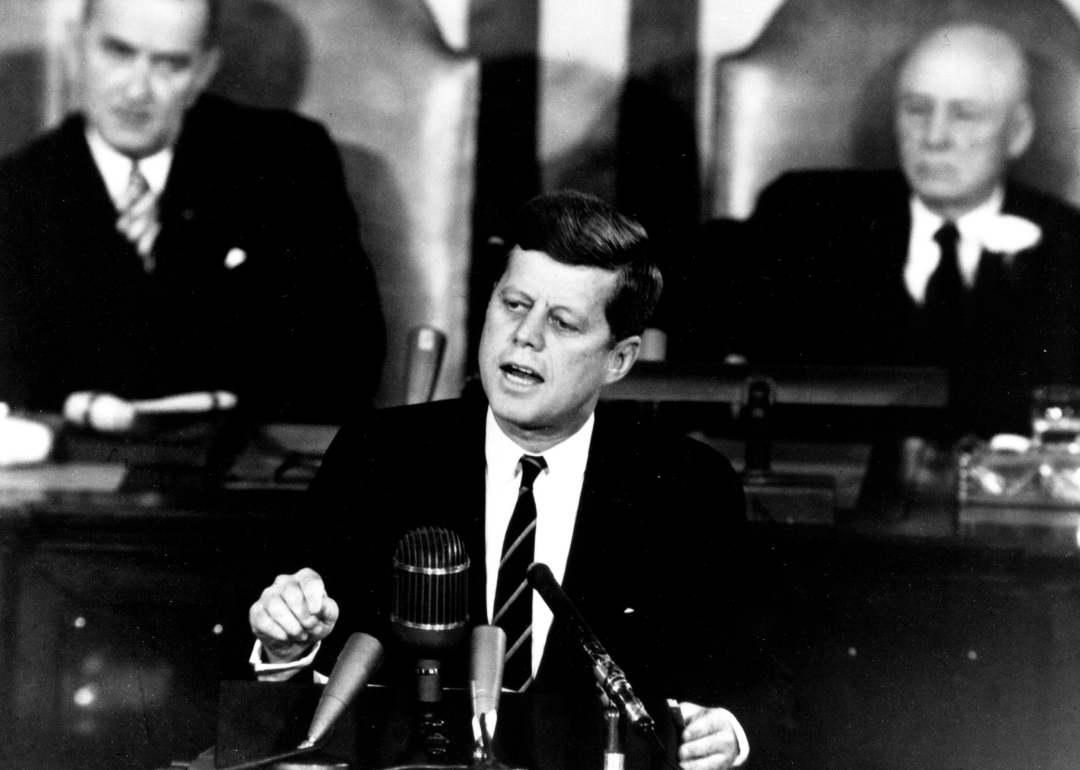
John F. Kennedy
Schools: London School of Economics, Princeton University (withdrew due to illness), Harvard University (undergraduate), Stanford University (graduate, did not graduate)
, where he stayed only a short while before withdrawing due to chronic illness that plagued him all his life. In 1936, he enrolled at Harvard, earning a degree in government and international relations. Following Harvard, he went to Stanford but , leaving early to join the military.
You may also like:
Lyndon B. Johnson
School: Southwest Texas State Teachers College (now Texas State University) (undergraduate), Georgetown University Law Center (did not graduate)
From 1927 to 1930, Lyndon Johnson pursued a degree in teaching at Southwest Texas State Teachers College. but participated in a lot of extracurriculars: debate, journalism, and student government. He also did well in student teaching while at the school, leading to his first job out of college as a teacher during the Great Depression.
Richard M. Nixon
Schools: Whittier College (undergraduate), Duke University (law school)
while an undergrad at Whittier College from 1930 to 1934, Richard Nixon participated in student government, drama, and football. He was also intelligent and earned a scholarship to Duke University's law school. He graduated there in 1937, after serving as president of the Student Bar Association and a member of the law review.
Gerald R. Ford
Schools: University of Michigan at Ann Arbor (undergraduate), Yale University (law school)
Although Gerald Ford graduated from the University of Michigan with two majors (economics and political science), his real claim to fame at the school . He played on the college's championship football team and in 2006, was named one of the of the last century by the NCAA. After graduating from University of Michigan in 1935, he attended Yale for law school, casting football aside and earning his degree in 1941.
Jimmy Carter
Schools: Georgia Southwestern College (transferred), Georgia Institute of Technology (transferred), United States Naval Academy (undergraduate), Union College (graduate)
Jimmy Carter . He followed that with engineering studies at two Georgia colleges and ultimately, a bachelor's of science from the competitive U.S. Naval Academy. He graduated in the in 1946.
Ronald Reagan
School: Eureka College (undergraduate)
Ronald Reagan graduated from Eureka College in Illinois with in 1932. During his time at school, he played football, participated in drama, and became class president his senior year. Now, there's a Ronald Reagan Museum on .
George H. W. Bush
School: Yale University (undergraduate)
Immediately after high school, George H. W. Bush joined the Navy. When he was discharged after World War II in 1945, he enrolled in college along with a flood of other veterans. and studied economics in an accelerated program that allowed him to graduate early. While at the school, he was the captain of the baseball team and a member of the Skull and Bones Society.
Bill Clinton
Schools: Georgetown University (undergraduate), Oxford University (Rhodes Scholarship), Yale University (law school)
Bill Clinton graduated in 1973 from Yale Law School, where he met his wife, Hillary Rodham. Prior to that, he earned at Georgetown and went to Oxford as a Rhodes Scholar. He actually went to Oxford twice; the second trip kept him out of military service.
George W. Bush
Schools: Yale University (undergraduate), Harvard University (business school)
Just like his father and grandfather, , majoring in history with specialties in European and American studies. Bush joined Delta Kappa Epsilon his freshman year, and when he was a senior, he was initiated into the secret Skull and Bones Society. He graduated in 1968. In 1973, he enrolled at Harvard Business School and graduated with a master of business administration in 1975.
Barack Obama
Schools: Occidental College (transferred), Columbia University (undergraduate), Harvard University (law school)
Barack Obama spent his at Occidental College in Los Angeles before transferring. In 1983, he graduated from Columbia University in New York City with a political science degree. From there, he went to Harvard for law school, where he was the editor of the Harvard Law Review; he graduated in 1991.
Donald J. Trump
Schools: Fordham University (transferred), Wharton School of the University of Pennsylvania (undergraduate)
Donald Trump at Fordham University in New York City, where he studied from 1964 to 1966. He then transferred to The Wharton School at the University of Pennsylvania to study real estate, an education that would shape his career. He graduated in 1968 with an economics degree.
Joe Biden
Schools: University of Delaware (undergraduate), Syracuse University (law school)
Joe Biden double majored in political science and history, and minored in English, during his time at the University of Delaware. He graduated with his Bachelor of Arts degree in 1965, then went to law school at Syracuse University. The College of Law's that when Biden became vice president it was the highest office held by a graduate, writing, 鈥淧rofessor Emeritus Thomas Maroney recalled teaching his former student Joseph R. Biden Jr in his third-year legislation course, and commented, 鈥溾�業 had the impression that this student was a young man who was going to do well and go a long way.鈥欌��