Does your area have a high homeowner or rental vacancy rate? This is what data shows
This story originally appeared on NashvillesMLS.com and was produced and distributed in partnership with Âé¶¹Ô´´ Studio.
Does your area have a high homeowner or rental vacancy rate? This is what data shows
With the real estate market cooling off in many places, home buyers and renters may hope to score deals. One indicator of the potential for price changes is an area's vacancy rate.
The homeowner vacancy rate is the share of homes in an area that are for sale. It includes brand-new units still under construction, as long as it has windows, doors, and usable floors. The rental vacancy rate is the share of rental spaces that are vacant and for rent. When vacancy rates are high, sellers and landlords may be more apt to negotiate on price.
examined the latest data from the Census Bureau's to find which regions and states have the largest shares of empty homes for sale and for rent in the third quarter of 2022, the latest data available.
The national homeowner vacancy rate remained near record lows during the third quarter, coming in at 0.9%. In more typical years, that rate would be between. Rental vacancies were at 6%, which is in line with a.
The South has the highest rates of rental and homeowner vacancies—and less of a home shortage—largely because of robust pre-pandemic development compared to the rest of the U.S.
Homeowner vacancy by state
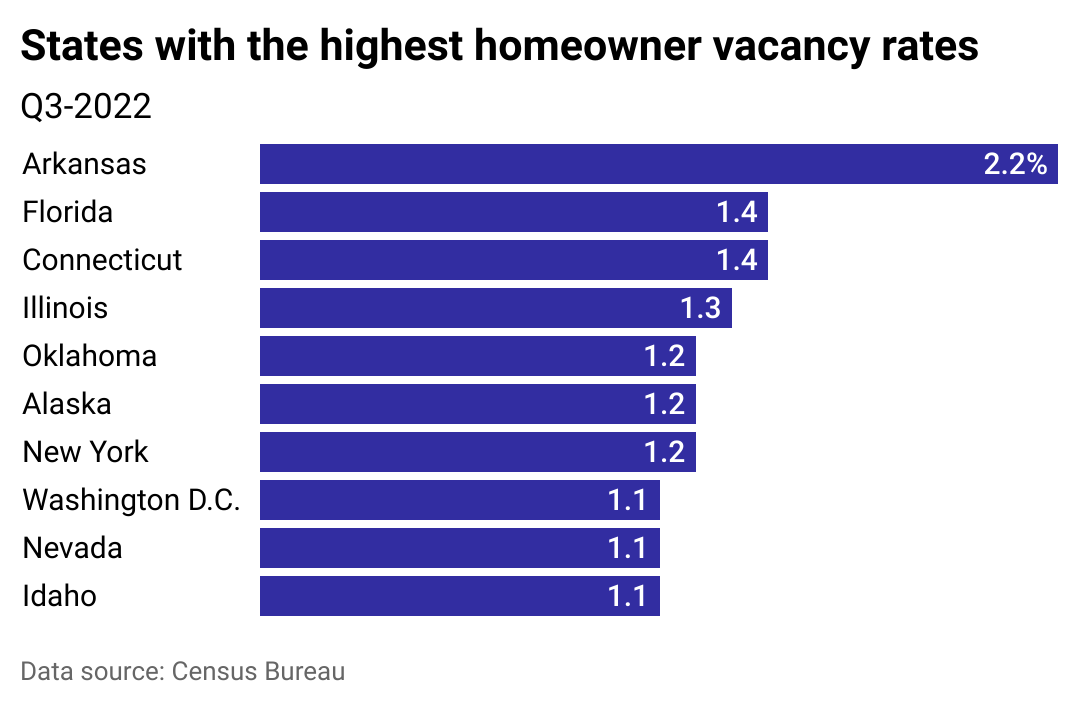
No specific area of the country is particularly prone to high homeowner vacancy rates. In fact, even though these states are ranked "highest," their vacancy rates are still considered to be low compared to the amount of housing that's needed throughout the country.
The is typically at 2%. If the vacancy rate hits above that, that's a sign there's not as much demand to buy homes. If it's below that mark, there's not enough inventory on the market to satisfy homebuyer demand.
Homeowner vacancy in the Northeast
States with the highest homeowner vacancy rates:
- Connecticut: 1.4%
- New York: 1.2%
- Pennsylvania: 0.9% (tie)
- Rhode Island: 0.9% (tie)
In some areas of Connecticut, —though not quite to a normal level.
Real estate agents calculate the estimated time it will take properties to sell by looking at vacancy rates alongside the rates at which listed properties are selling. Earlier this year, the Connecticut market had just weeks of home inventory but is now returning to months of inventory.
Many elements of Pennsylvania's market are , including listings, sales, and inventory. Inventory was down to 3.07 months in October 2022, a 16.4% drop year over year. This represents about half of what experts say is a balanced market, according to the Pennsylvania Association of Realtors.
Many people leaving New York City during the pandemic , providing a real estate boon to many communities that had struggling local economies.
Homeowner vacancy in the Midwest
States with the highest homeowner vacancy rates:
- Illinois: 1.3%
- Minnesota: 0.9%
- Missouri: 0.9%
Illinois' population has dropped annually for the last eight years. From July 2020 to July 2021, it, the second-highest decline in the country. Many people have left the state due to high taxes and cheaper housing elsewhere.
Minnesota is seeing an —2 months in October 2022 compared to 1.6 months a year earlier—even though the number of new listings declined about 19%, which signals properties are spending longer on the market.
In Missouri, the number of listings has steadily increased this year, according to. Meanwhile, the number of homes sold in October 2022 has declined 26% to 6,320 compared to the same time period a year ago.
Homeowner vacancy in the South
States with the highest homeowner vacancy rates:
- Arkansas: 2.2%
- Florida: 1.4%
- Oklahoma: 1.2%
More new construction is happening in the South than any other place in the U.S. This region accounts for 54% of all new housing units that have broken ground in 2022, and 70% of those new units are single family homes,.
Building in the South can be prone to disruption from intense weather like hurricanes, flooding, and tornadoes, but 2022 has been relatively kind to the construction industry. Hurricane Ian, a major category 4 storm, had on new construction in Florida than what was predicted.
In the Oklahoma City area, new construction has picked up: between January and October 2022, an increase of 8% over the same time period the year prior.
Homeowner vacancy in the West
States with the highest homeowner vacancy rates:
- Alaska: 1.2%
- Idaho: 1.1%
- Nevada: 1.1%
The Western region of the U.S. has the lowest vacancy rate in the country, indicating that even states with regionally high vacancy rates still don't have many vacant homes compared to other regions. In Alaska, were both so tight in 2021 that five homes sold for every two listings.
Over the, Idaho's vacancy rate during the third quarter has been typically higher than in other quarters. In 2022 its rate was more in line with pre-pandemic times. Nevada's vacancy rates are also starting to inch toward pre-pandemic levels.
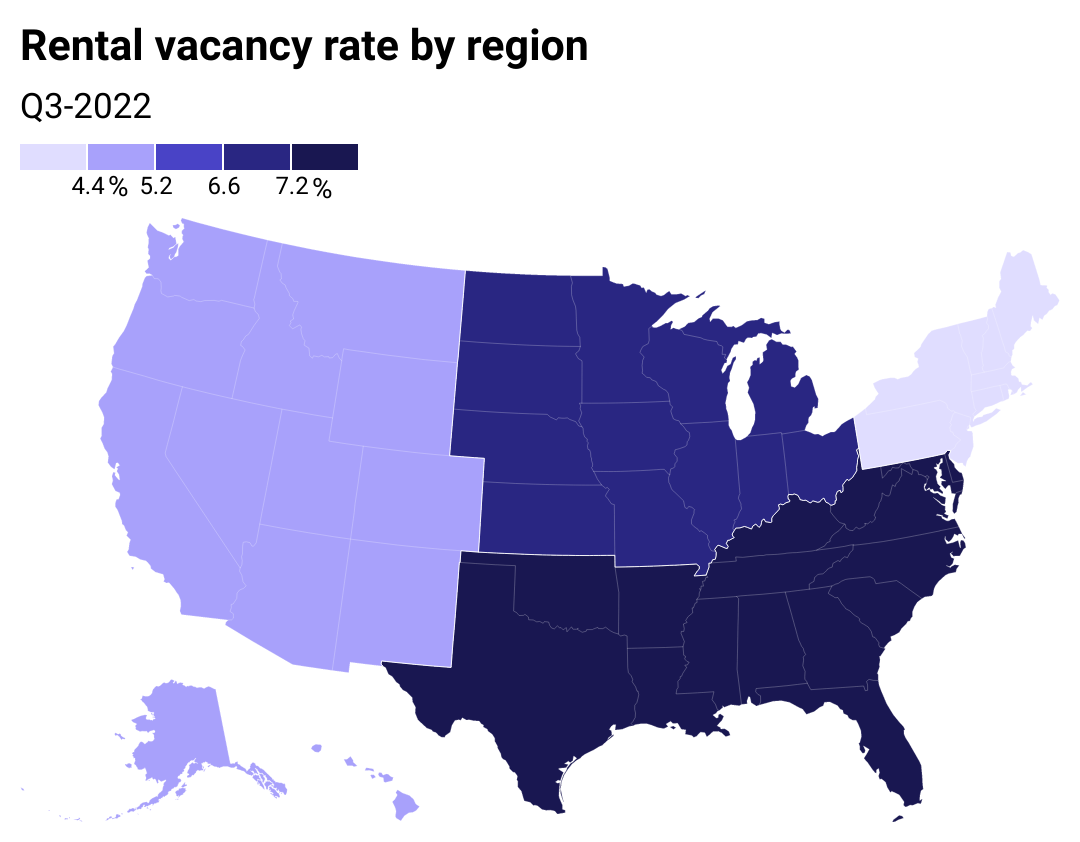
Rental vacancy by region
Unlike in the housing market, the rental market doesn't usually see prices drop when vacancy rates are high. In, vacancy rates affect the speed of increases, rather than actual amounts, according to research by Strong Towns. In years where the vacancy rate is low, the rents tend to go up more quickly. When the vacancy rate is high, rents could go down but are more likely to climb more slowly. Landlords may also throw in perks to maintain a certain rental price, and make price concessions to increase the attractiveness of their property.
Rental vacancy in the Northeast
States with the highest rental vacancy rates:
- Rhode Island: 5.5%
- Pennsylvania: 5.3%
- New York: 4.3%
Rhode Island may have the highest rental vacancy rate in the Northeast, but this entire region suffers from a lack of rental housing. Rhode Island's rate of multifamily construction declined from the last quarter of 2021 through mid-2022. This has put pressure on rental prices, in many cities throughout the state.
In New York, vacancy rates may be high for the region, but the third quarter of 2022 had the state's lowest vacancy rate since the initial pandemic lockdown in 2020.
Central Pennsylvania has become a really competitive market for rentals—in 2022 Harrisburg was named the 2nd most competitive rental market in the country,. Suburban Philadelphia ranked 17th.
Rental vacancy in the Midwest
States with the highest rental vacancy rates:
- North Dakota: 12.4%
- Missouri: 9.6%
- Minnesota: 9.0%
The Midwest saw an uptick in its, from 6.3% in the third quarter of 2021 to 7.1% in the third quarter of 2022. Many states in the Midwest are experiencing population decline, as people move to warmer climates. North Dakota between April 2020 and July 2021, the in the country.
Minnesota's vacancy rate in the third quarter jumped to its highest rate in five years. Missouri's vacancy rate in the third quarter is in line with much of the last five years, but a sharp increase from the 3.7% rate at the beginning of the year.
Rental vacancy in the South
States with the highest rental vacancy rates:
- Arkansas: 12.9%
- Alabama: 9.3%
- Oklahoma: 9.0%
The South's rental vacancy rate is the at 7.3%. That's in part due to more construction of rental units across the region. Arkansas has the in the nation, according to the Census Bureau, and hit double digits for the first time since 2019.
Alabama's vacancy rate ranks 5th in the nation, although the market is still tight, as rents throughout the state from 2021.
In Oklahoma City, rents were low through the pandemic, but now they are on the rise,
Rental vacancy in the West
States with the highest rental vacancy rates:
- Hawaii: 8.6%
- Wyoming: 7.3%
- Alaska: 6.2%
Hawaii's vacancy rate has crept up in 2022 from 6.1% in the first quarter. Rents are on Oahu, due to increased construction costs, which has limited supply.
In Wyoming, vacancy rates are low compared to double-digit rates of five years ago. Rental housing is still needed though, with Cheyenne alone units.
Alaska's vacancy rate is high for the region, but it has actually experienced a sharp decline from a decade high of in 2020. Renters are tending to stay put rather than buying into a higher priced home sales market, and there has been a in multifamily home construction since 2014.