The most popular cities to move to in 2026
Many former sweetheart cities are losing their crowns to these up-and-comers. data shows Austin’s out, while cities like Knoxville, Saint Paul, and Chicago are rising up.
After years of buzz, Florida’s real estate market is “” And Austin’s once red-hot real estate market is now sagging under on the market.
So where will Americans land next?
To determine which way the winds are blowing in 2026, based on data rather than waiting until 2027, when the U.S. Census numbers will confirm where Americans wind up, moveBuddha analyzed moving search data.
MoveBuddha mined its data from 2019 to October 2025 to examine moving search trends and forecast which cities will be most popular in 2026.
The findings?
The Midwest is making a comeback — but it’s still “out” for 2026. Instead, Americans are headed to mid-sized university towns, especially in the South and Southwest.
Key Takeaways
- Knoxville will have the highest in-to-out move ratio in 2026, with 1.61 more newcomers heading in for every person moving away.
- Knoxville hits all three sweet spots that define the top 25: 11 top cities are anchored by a university, 20 are mid-sized cities, and 13 are in the South or Southwest.
- St. Paul is the biggest “comeback city,” with interest soaring 122% over the past five years.
- One of the only large, hub cities that Americans are saying “sweet home” to is Chicago, which has surged 42% since 2019.
- Are the hottest cities getting hotter? Cities that pair high predicted in-moves in 2026 with rare growing interest include Knoxville, Tulsa, Savannah, and Frisco.
What Are The Top Move-To Cities of 2026?
These cities will pull in the most new moves compared to out-moves in 2026. #1 is Knoxville.
#1 Knoxville, TN
In 2026, hikers will find increasingly crowded trails in this city of ~199,000 residents at the base of the Great Smoky Mountains. Along with most U.S. cities, Knoxville has seen its move popularity wane in recent quarters (in the second quarter of 2021, the city welcomed more than three in-moves for every move outbound).
That doesn’t mean its current ratio of 1.56 is a sign that its popularity streak is over. Knoxville’s in-moves were second in the country this quarter. And moveBuddha predicted that, in 2026, the eastern Tennessee city will surpass Savannah to become the nation’s top move-to city.
#2 Tulsa, OK
Back in 2019, Tulsa was losing more residents than it was gaining. But its truly spectacular five-year spike in move interest (27.19%) stands to land it at #2 in the nation in 2026 with an in-to-out ratio of 1.57 new moves for every exit. Though the art deco capital is treading water right now (in fall 2025’s standings), waves of interest have been lapping at Oklahoma’s second city, promising to bring more congestion and a growing downtown scene to the banks of the Arkansas River.
#3 Vancouver, WA
This outsized Portland suburb across the Columbia River isn’t the easiest commute, but “The Couve” was urban enough to see an outflow of residents during the COVID-19 pandemic. Today, Vancouver’s blazing back, with some recent quarters seeing it net almost twice the incoming residents as those saying goodbye. In 2026, expect the city to tie for the #2 position nationally, with a 1.57 in-to-out ratio.
#4 Savannah, GA
Savannah comes with gothic charm, cobblestones, artsy SCAD co-eds — and off-the-charts popularity. The sultry city near the Georgia coast hasn’t seen more residents leave than enter since September 2019. In those six years, it’s also seen surges of extreme in-migration, with one quarter in 2021 bringing more than triple the number of newcomers than exiters, and a second wave in 2024 bringing twice as many newcomers. Expect Savannah to keep its magnetic appeal in 2026.
#5 Tucson, AZ
Once an under-the-radar hotspot, slowed interest hit this southern Arizona university town hard at the start of COVID, when quicker commutes weren’t winning new movers. Though it’s currently sporting a slightly negative in-to-out ratio (0.91 in Q3 2025) and has seen a decline in move interest over five years, it’s predicted that Tucson will bounce back more than ever in 2026, bringing in 1.37 new moves for every exit.
#6 Tempe, AZ
Tempe’s fortunes are poised to reverse middling performance since COVID (averaging an in-to-out 0.92 ratio since 2023), returning to move interest that looks more like 2019 (over 1.40 in pre-COVID quarters). Like Tucson, this university-anchored town offers much that competing move-to destinations can’t match: Campus strolls and game-day celebrations reign supreme here over nearby suburbs. Expect 1.33 newcomers for every resident heading out in 2026.
#7 Frisco, TX
In 2002, Frisco had a . Today, there are nine. And there isn’t a slowdown to this Dallas’ suburb’s “bigger in Texas” growth coming in 2026. In fact, Frisco’s only seen one quarter in the last six years when migration was negative; in fall 2023, Frisco dipped under the 1.00 threshold with an in-to-out ratio of 0.96. It was an anomaly. Frisco bounced back, growing steadily through the COVID years and after (unlike much of the rest of the country, which saw either a stark downturn or upturn in late 2020 and 2021). Will its supersized growth ever stop? Not in the coming year, when moveBuddha predicts an in-to-out ratio of 1.29.
#8 Raleigh, NC
Raleigh’s strong performance over the past six years (without a single quarter when out-migration outpaced inflow) seems unrelenting. In fact, if Raleigh kept up its worst performance (fall 2025, with an in-to-out ratio of 1.23), it would land just out of the top 10 for all cities in 2026. The urban hub of North Carolina’s “Research Triangle,” Raleigh attracts all those newcomers with temperate weather (and tons of ), but also a robust economy, tech scene, and outdoor access. It’s expected to land at #8 in 2026 with an in-to-out ratio of 1.26.
#9 St. Paul, MN
St. Paul is less congested than its twin star, with real estate prices that can undercut the competition. And St. Paul also offers residents a free zoo, a hockey home base, a bluffside nature sanctuary, and a signature winter carnival. We don’t know if that mix of family-friendly and parks prowess is the reason for its popularity, but regardless, St. Paul has exploded in interest over the past five years, up 122% (the most of any city by far). And in 2026, it’s predicted that it’ll see 1.25 in-moves for every exit.
#10 Virginia Beach, VA
More Americans are heading east of the commercial hub of Norfolk, where they’ll stay close to jobs but enjoy boardwalk bikes, flip-flops, and naval neighbors out by the water. While the area wasn’t a top destination a few years ago, a quiet post-COVID rally has steadily transformed it since 2022, and it’s enjoyed mostly positive inflow for those who appreciate its charms ever since. While 2025’s been flat for the beach town at the mouth of Chesapeake Bay, in 2026, expect Virginia Beach to resume its growth, with an in-to-out ratio of 1.24.
Americans Leave the ‘It’ Cities for the ‘Just-Right’ Cities in 2026
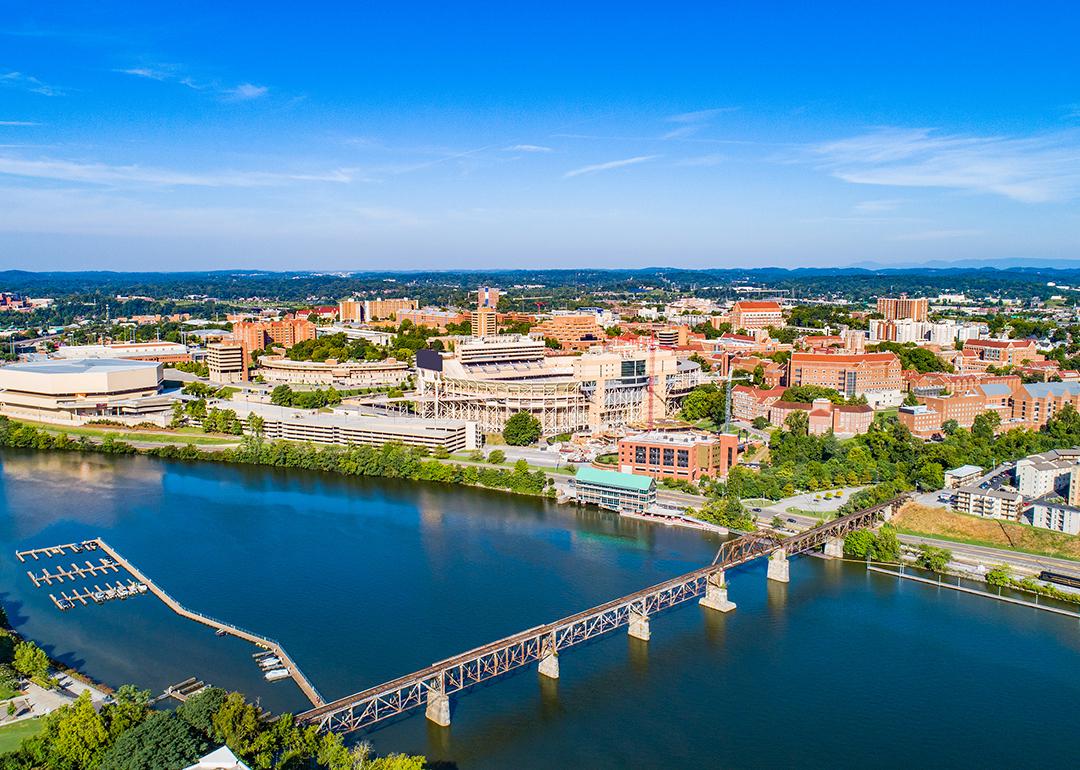
Home of the University of Tennessee Volunteers, Knoxville is a riverfront college town that’s notoriously dog-friendly, with plenty of craft beer and barbecue to go around. But is that the secret of its recent success?
Maybe.
are overrepresented on this list of up-and-coming cities, suggesting that Americans aren’t rejecting all cities; they’re just eyeing university hubs. Popularity in 2026 will center on a young vibe, a stable job market, and a disproportionate number of museums, traveling productions, and ball games.
From Knoxville to Tulsa (TU), Tempe (ASU), Tucson (U of A), Raleigh (NC State and the research triangle), Minneapolis-St. Paul (U of M), Eugene (UO), Spokane (Gonzaga/WSU Spokane), Orlando (UCF), Nashville (Vanderbilt), Washington D.C. (multiple), Charlotte (UNC and the triangle), Savannah (SCAD), and Grand Rapids (GVSU), Americans are searching for moves to cities with degrees.
In the top 25, four cities are primarily “college towns,” and seven more boast a significant university anchor.
Further, there’s a mid-sized majority among top cities, with 20 of the top 25 being mid-sized cities or large suburbs — the sweet spot for access to amenities without the crowds and costs that come with big-city life.
So mid-sized college-anchored cities are poised to win big in 2026.
But which mid-sized college towns see the most action?
Region is also important. Forty-eight percent of the top 25 cities lie in the South and Southwest, showing that the Sunbelt won’t be cooling anytime soon. In 2024, the South saw the of any region, and so far in 2025, it has the highest average in-to-out ratio of any region. However, the Southwest (including Texas and Oklahoma) looks to outperform its southern neighbors in the coming year.
What are 2025’s Biggest Comeback Cities?
St. Paul has seen interest more than double in the past five years, showing that while COVID movers weren’t dazzled by the capital city’s offerings, today’s movers are making up for it. So while today, the city is poised to have the ninth highest in-to-out ratio of 2026, it may continue to rise in 2027.
For all quarters of 2019, St. Paul saw an average in-to-out ratio of 0.64 in-moves for every outgoing resident.
Today’s 1.28 move ratio is roughly 122% higher, a jump that’s more than double that of the closest competitor (fellow upper-Midwesterner, Milwaukee, where interest is up 47.54%).
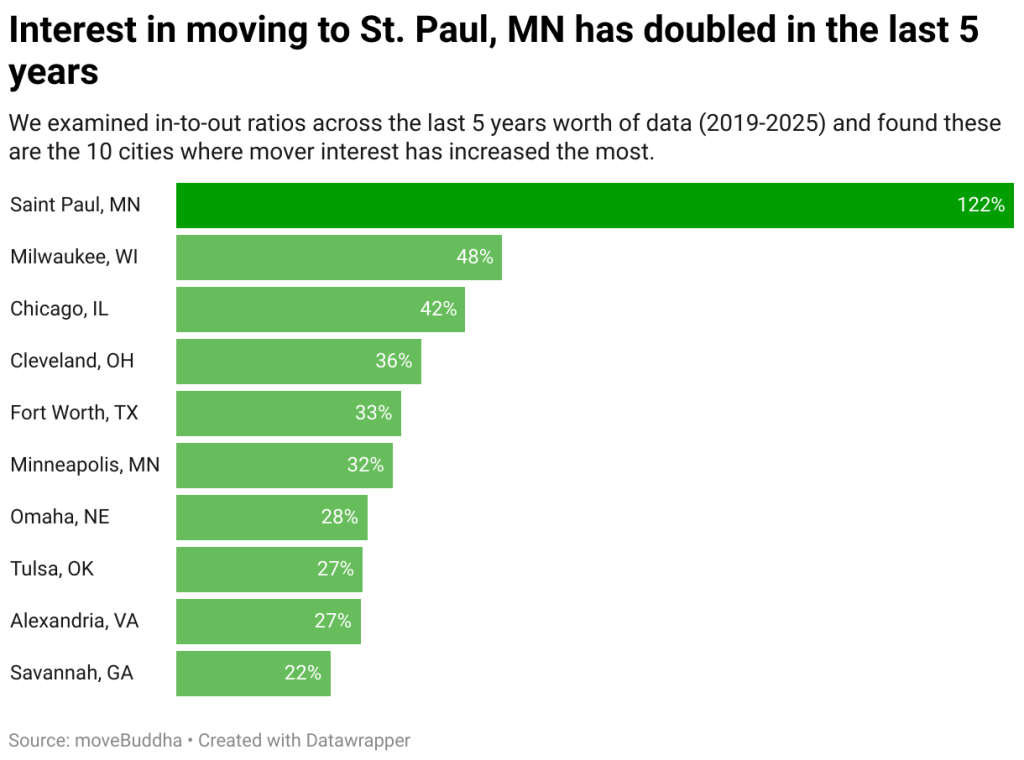
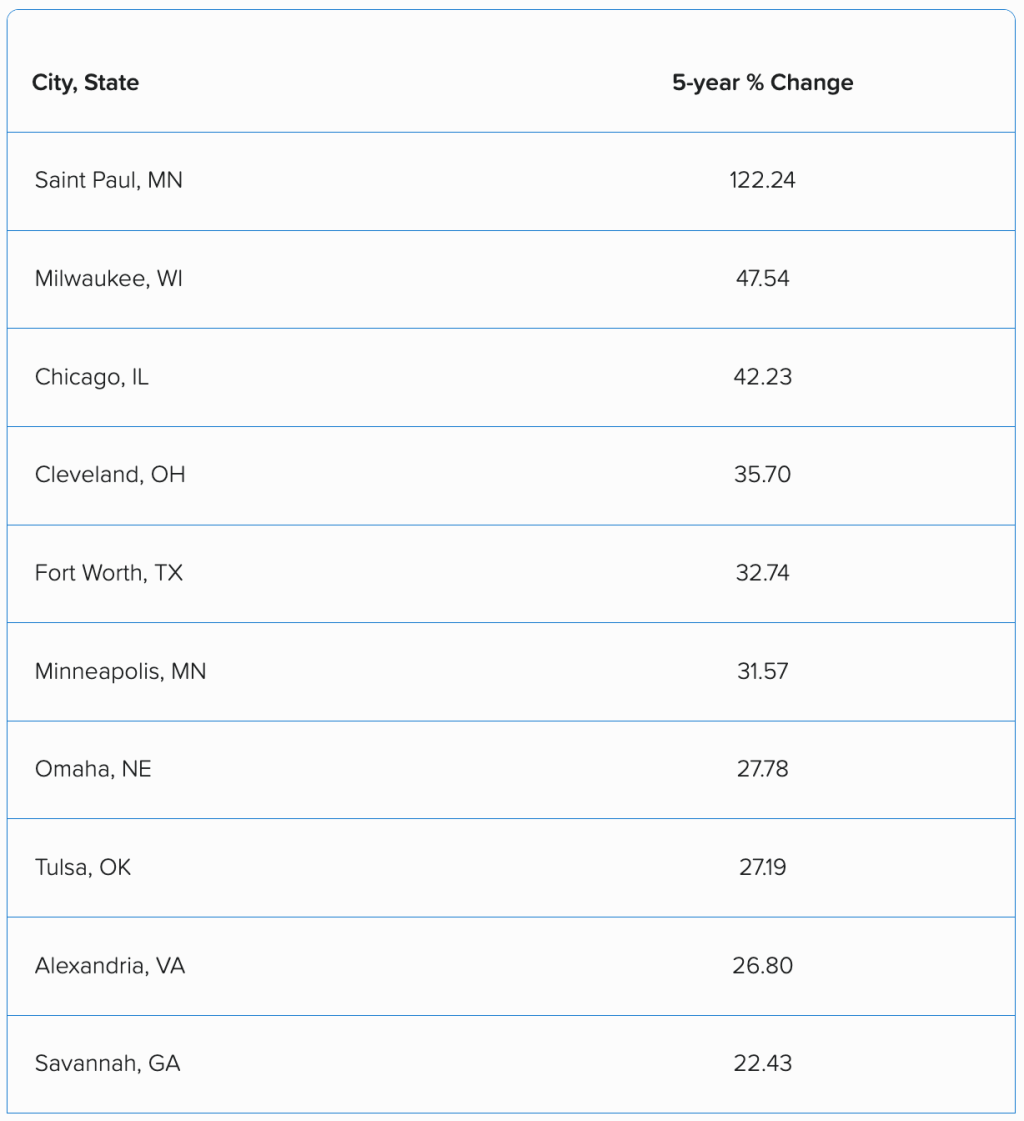
Since 2019, the Upper Midwest and Great Lakes are roaring ahead, with oversized interest compared to what they saw in 2019. Yet many cities in the perennially popular South (Savannah, Atlanta, Knoxville) are also represented.
What do they have in common?
There’s a cost advantage to many of these secondary locales. Take Fort Worth, compared to Dallas, where 100+ miles of trail network meet lower density and a more Western feel. Or Alexandria, compared to Washington D.C., where oak-lined boulevards leave the city’s congestion behind. Movers today may be more interested in keeping the big region and economy, but dropping the less desirable parts of city life.
While these “big comeback” cities differ from the “top” 2026 inflow cities drawing new movers, the story’s the same.
Both seem to tell a story about right-sized urbanity. Residents in cities like Milwaukee and Cleveland don’t spend all day on parking apps, but they can still enjoy a big game (and maybe even afford the ticket).
Chicago is a Notable Upswinger
One glaring exception is the Windy City. Instead of “getting out of the city,” this national hub has reversed its uncool reputation and is drawing more interest than ever, tipping it into the black. Today, Chicago’s not just “recovering” with fewer out-moves than before; it’s actually gaining more newcomers than are leaving. With 42% increased interest compared to 2019, in the fall, 2025, Chicago saw 1.14 in-moves for every outbound relocation. It’s predicted 2026 ratio is just under 1.00, but as one of just 23 out of 79 cities with “growing interest,” maybe 2027 will turn the tide.
Phoenix isn’t Rising from the Ashes This Time
With the biggest overall downswing in popularity from 2019 to 2025, Phoenix shows that it’s not always possible for a big player to make a big comeback. While many of its suburbs are still popular, this urban hub itself is struggling, with 59% less interest than it saw in 2019. Further, its in-to-out move ratio is predicted to be negative in 2016, with 0.75 in-moves for every exit.
These Cities Pair Growing Interest and High Predicted In-Moves
While Chicago is getting popular the fastest, moveBuddha isn’t predicting that it will translate into huge in-move interest in 2026.
So, which cities have both growing interest and are predicted to have high inbound moves? In other words, who is already hot and poised to get hotter?
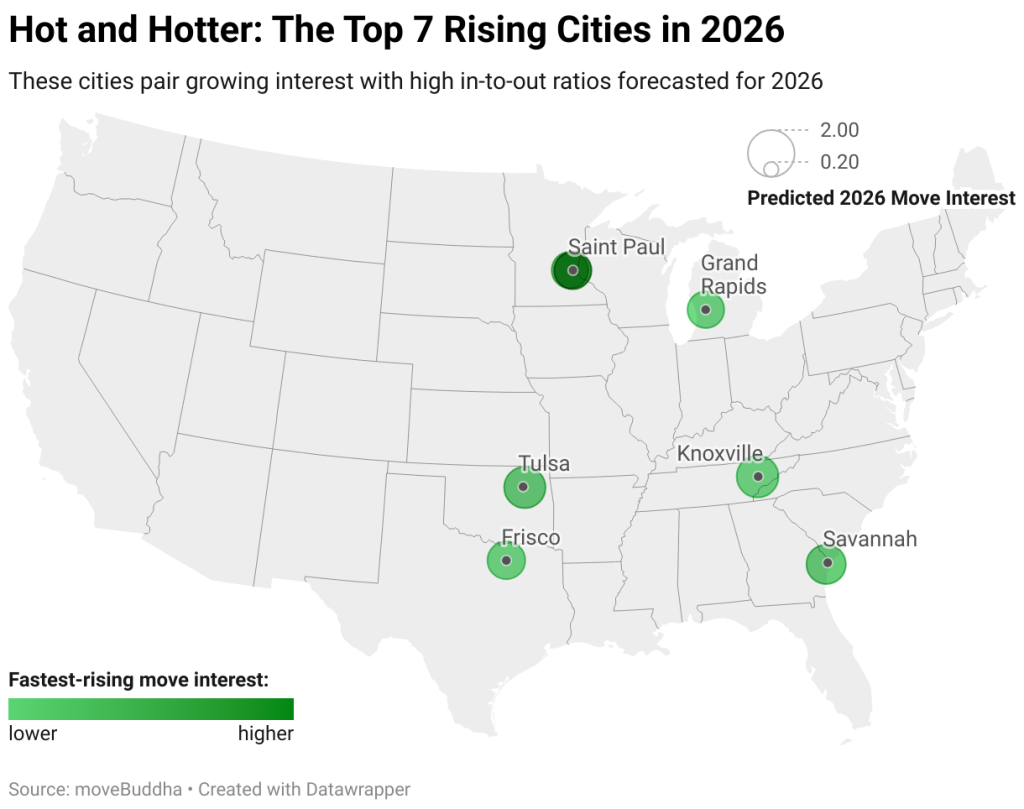
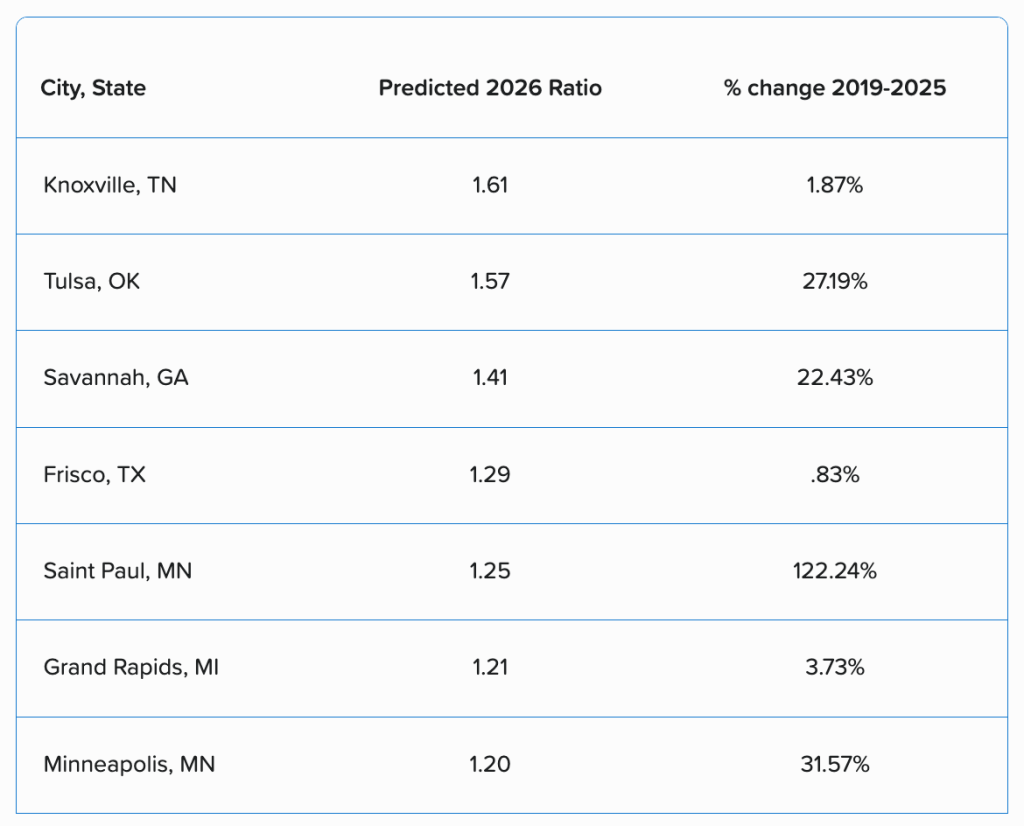
There are only seven cities with 2026 predicted in-ratios over 1.00 that also show growing interest across the last five years. These steady climbers’ popularity isn’t a flash in the pan — it’s built into the fabric of these cities, which are good at welcoming new residents.
But growing interest isn’t all alike.
While Frisco’s long-lived popularity means it can’t explode much more in interest (at least, it appears unlikely to), the desire to move to the northern Dallas city has crept up 83% over the past five years. On the other hand, St. Paul, which saw nearly twice as many move-outs compared to those looking to move in five years ago, has flipped its fortunes from an out-migration city to a hot commodity.
Savannah is an outlier. While interest has been high over the last five years, interest continues to rise by leaps and bounds. It’s 22% higher than it was in 2019, despite the fact that spring 2019 movers were already interested in moving to Savannah at twice the rate of move-outs.
Minneapolis Rivals St. Paul for Popularity Points
Minneapolis’ popularity climb isn’t as profound as its neighbor’s, but it’s the second-largest in the country over the past five years, with its in-to-out ratio soaring from flat interest in 2019 to a predicted 2026 in-to-out ratio of 1.20 (12th in the country). While the city sees quarters where move interest leans outbound, Minneapolis’ popularity shows in-moves aren’t just looking to St. Paul, they’re scouting an entire area that’s strong overall — and getting even stronger.
Is Austin’s Lone Star Falling?
With 40% less interest than in 2019, Austin’s not used to being on the losing end of a popularity contest. Its in-to-out ratio only dipped into outflow territory twice over the past five years, in the last two quarters of 2023. But the city is predicted to average more outflow than in-moves across 2026, with 0.95 in-moves for every resident calling it quits. And with popularity sinking 40% over the past five years, this may be putting its boom days behind it.
Conclusion
Of the top 25 cities for in-to-out ratios in 2026, 18 have “falling interest.” That’s new for many of the cities on moveBuddha’s list that have come to expect moving vans rolling up to their neighborhoods.
But even as move interest falls in general, some cities are bearing more of the weight of disinterest than others. Big cities are losing interest most, while mid-sized cities, especially in the South and West, are still hot when it comes to new moves. Some rising stars like Tulsa and Savannah are trending and poised to win even more moves in 2026, while old favorites like Austin see their popularity waning.
To move the needle in 2026, cities should be compact, university-driven, and offer Sunbelt warmth. And for cities that don’t fit the profile, many are still winning when they’re able to offer big-city amenities minus big-city friction.
Methodology
MoveBuddha included all U.S. cities with at least 20 in-move and 20 out-move searches across the past five years’ worth of data for a total of 79 cities. MoveBuddha then sorted those by trending interest (are they growing or falling in interest?).
How did we forecast 2026’s top cities?
MoveBuddha’s 2026 city forecasts were found using a random forest model. The model was trained on quarterly data from 2019 to 2025 that accounted for the last four quarters for momentum, the quarter of the year for seasonality, the calendar year for longer-term shifts, and a rolling 12-month average to smooth unusual spikes.
Questions
Which cities are predicted to be the most popular to move to in 2026?
Knoxville is projected to rank #1 for inbound move interest in 2026 with a 1.61 in-to-out ratio, followed by Tulsa and Vancouver at 1.57 each, and Savannah at 1.41, according to moveBuddha mover search data and forecasting.
Why are mid-sized, university-anchored cities in the South and Southwest expected to be the most popular places to move to in 2026?
Mid-sized, university-anchored cities lead because they dominate the top 25 (20 are mid-sized, 11 have a university anchor) and nearly half lie in the South/Southwest, where 2026 ratios are forecast around 1.03-1.05.
Which cities are seeing the fastest growth of interest since 2019, and how much has interest grown?
St. Paul is the biggest comeback city, with interest up 122% since 2019, far outpacing Milwaukee (+47.54%) and Chicago (+42.23%).
Of America’s major cities, where is the move-to interest expected to rise or fall in 2026?
Looking only at cities with at least 500K residents:
- Fastest-rising interest: Milwaukee (+47.54%), Chicago (+42.23%), Fort Worth (+32.74%), Louisville (+22%), and Kansas City (+18%).
- Steepest declines in interest: Phoenix (−59%), Denver (-48%), Albuquerque (-47%), Seattle (-46%), Austin (-40%).
Among America’s largest cities, which are predicted to be the most or least popular to move to in 2026?
MoveBuddha looked only at cities with at least 500,000 residents and found:
The Most Popular (highest predicted inbound ratio, >1)
- Tucson, AZ 1.37
- Washington DC 1.18
- Portland, OR 1.18
- Jacksonville, FL 1.17
- Nashville, TN 1.14
- New York, NY 1.12
- Charlotte, NC 1.10
- Dallas, TX 1.04
The Least Popular (lowest predicted inbound ratio, <1)
- Indianapolis, IN 0.75
- Phoenix, AZ 0.75
- San Diego, CA 0.77
- Baltimore, MD 0.78
- Oklahoma City, OK 0.81
- Atlanta, GA 0.81
- San Antonio, TX 0.83
- Memphis, TN 0.83
- Kansas City, MO 0.85
- Houston, TX 0.85
was produced by and reviewed and distributed by Â鶹ԭ´´.