These cities are giving Gen Z vibes: The most 20-something places in the US
Today鈥檚 20-somethings can find it hard to fit in: They鈥檙e notoriously left off the real estate ladder and may struggle to afford housing, get a foot in the door of their careers, and uncover vibrant dating scenes to help them land the partner of their dreams.
Where can they thrive?
We wanted to know which cities 20-somethings are most likely to call home 鈥� the places likely to be friendliest to new grads navigating the rapids of their new adult lives.
So, analyzed U.S. Census data, then calculated the percentage of 20-29-year-olds in every U.S. city with a population over 100K.
Where are America鈥檚 most popular cities for 20-somethings?
Key Takeaways
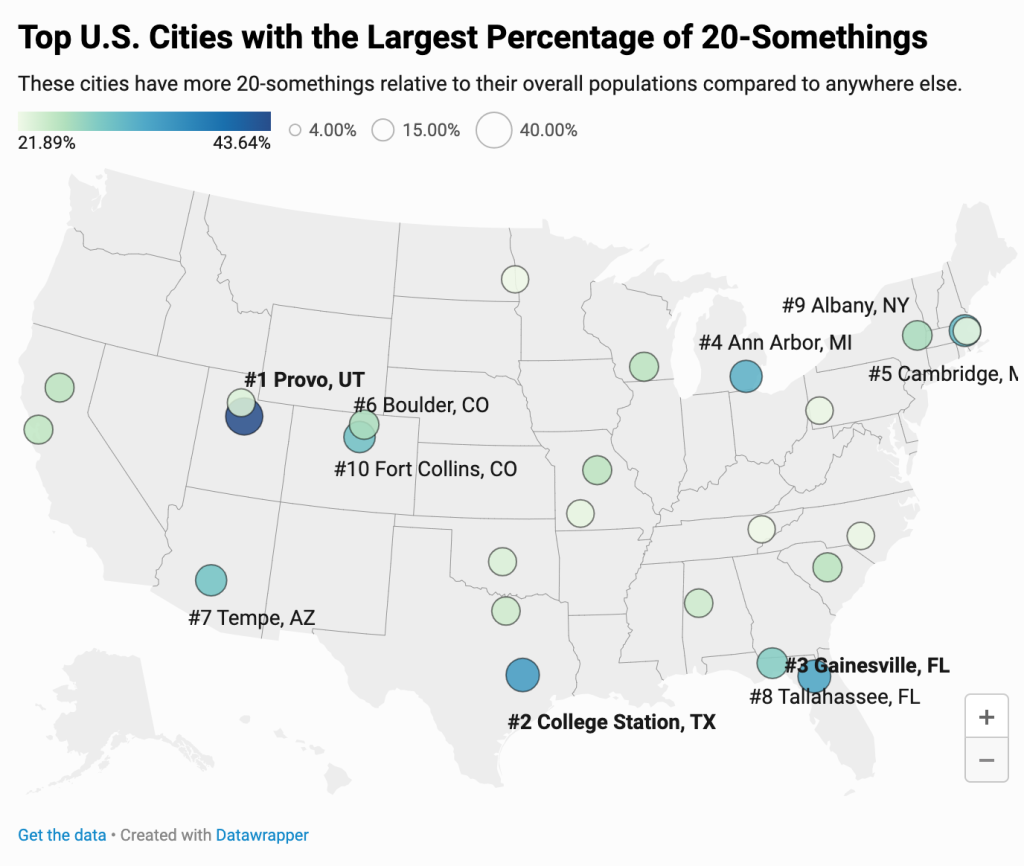
- Provo, Utah, has the highest share of 20-somethings of anywhere in the country. Home to Brigham Young University, Provo edges out College Station, Texas, by 9.2 percentage points, a gap that translates to a roughly 27% larger share of young adults.
- Salt Lake City is the first non-college town on the list with a high 20-something population. It ranks 15th for 20-somethings.
- Brownsville, Texas, is gaining more 20-somethings than any other city. It has grown its proportion of young adults by over 27% from 2013 to 2023.
- New Orleans is losing 20-somethings the fastest. By both proportion and sheer percentage drop, the city is losing young people rapidly.
- Which city has the fewest 20-somethings? That鈥檚 Naperville, Illinois, known for mid-career earners and families. Less than 10% of its population is in its 20s.
What are the 20-Something Meccas Today?
Today鈥檚 20-something Meccas are most often right where the country鈥檚 22-year-olds graduated, did internships, and put down roots: in their college towns. But that鈥檚 not surprising. Which college towns rise to the top and are best at enticing grads to stay well into their 20s is more interesting.
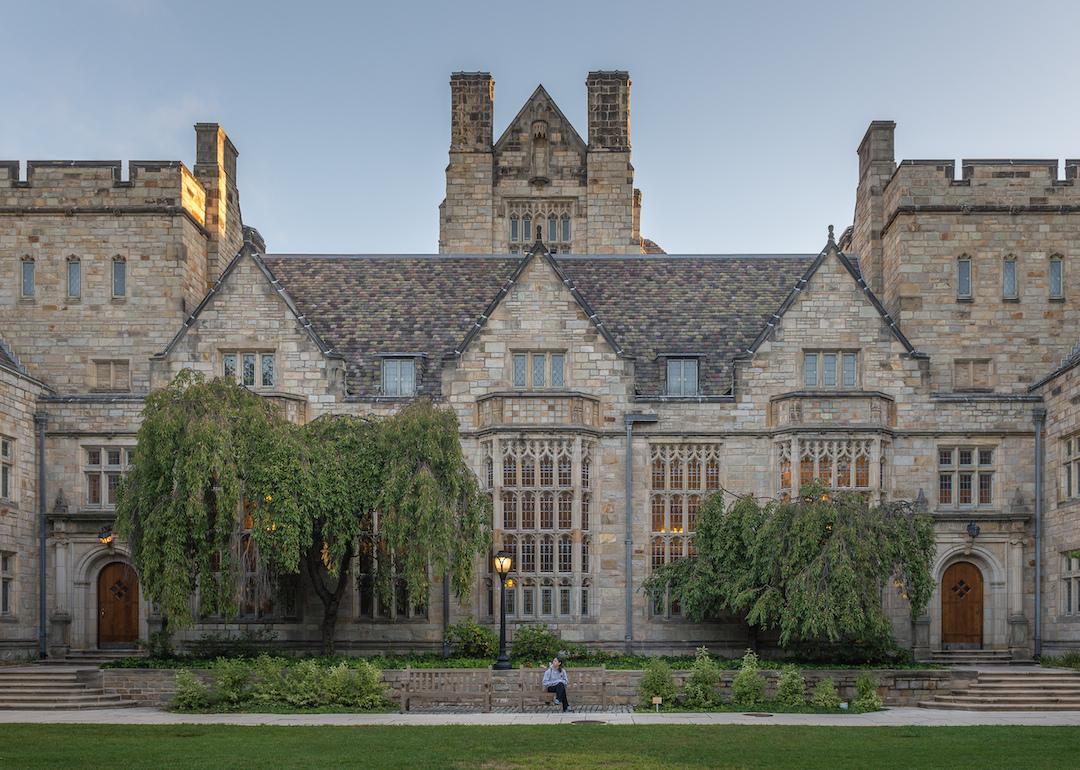
#1 Provo, Utah, caters to 20-somethings. It ought to 鈥� they鈥檙e 44% of the population. However, college enrollment isn鈥檛 the only driver. Though the Census counts juniors and seniors (as well as graduate students) who are likely in their 20s and who reside in dorms or other temporary collegiate digs most of the year as residents, Provo is still notable:
- Its student-aged population is higher than its academic footprint. It鈥檚 the nation鈥檚 top 20-something town, but BYU isn鈥檛 the largest university in the country. both have roughly double . BYU doesn鈥檛 even make the top 25 largest universities in the U.S.
- 叠驰鲍鈥檚 over the past decade, while the number of 20-somethings has risen by 5,350 residents.
- The number of 20-something residents in Provo has grown by the largest percentage of any city since 2013, going from 39.0% to 43.6% of the overall population.
Maybe it鈥檚 not just the student culture of this university town that catapults it to the #1 spot.
Provo does have a large base of students, but it also boasts scads of new graduates who stay put, perhaps drawn to a growing job and . They become magnets for yet more graduates, all reinforcing Provo鈥檚 position as the country鈥檚 capital of the 20-something crowd.
Other college towns take the lion鈥檚 share of young adults well into their 20s. The top 10 are all widely recognized as college towns where higher education shapes the local economy. #2 College Station, Texas, sees ~73K students flood its streets every fall, nearly matching the city鈥檚 128K total residents.
#3 Gainesville, Florida, has ~57.8K students in a city of 144K. It鈥檚 a massive ratio, and the university鈥檚 many large graduate programs, like business, engineering, medicine, and law, keep plenty of 20-somethings near campus.
To get off campus, you鈥檇 have to visit 20-something city #15, Salt Lake City. With 27.65% of its residents in their 20s, it鈥檚 a reflection of Utah鈥檚 Mormon roots: The state sports a due to multiple , and an economy that branches beyond higher education.
Which Cities are Gaining Young People Fastest?
With 14.57% of its population being 20-somethings, Brownsville, Texas, was in 95th place 10 years ago. Today, Brownsville now ranks 20th, with its share of 20-somethings increasing by 27.71% over the decade. The SpaceX outpost was fast amassing 20-somethings even before launches came to town.
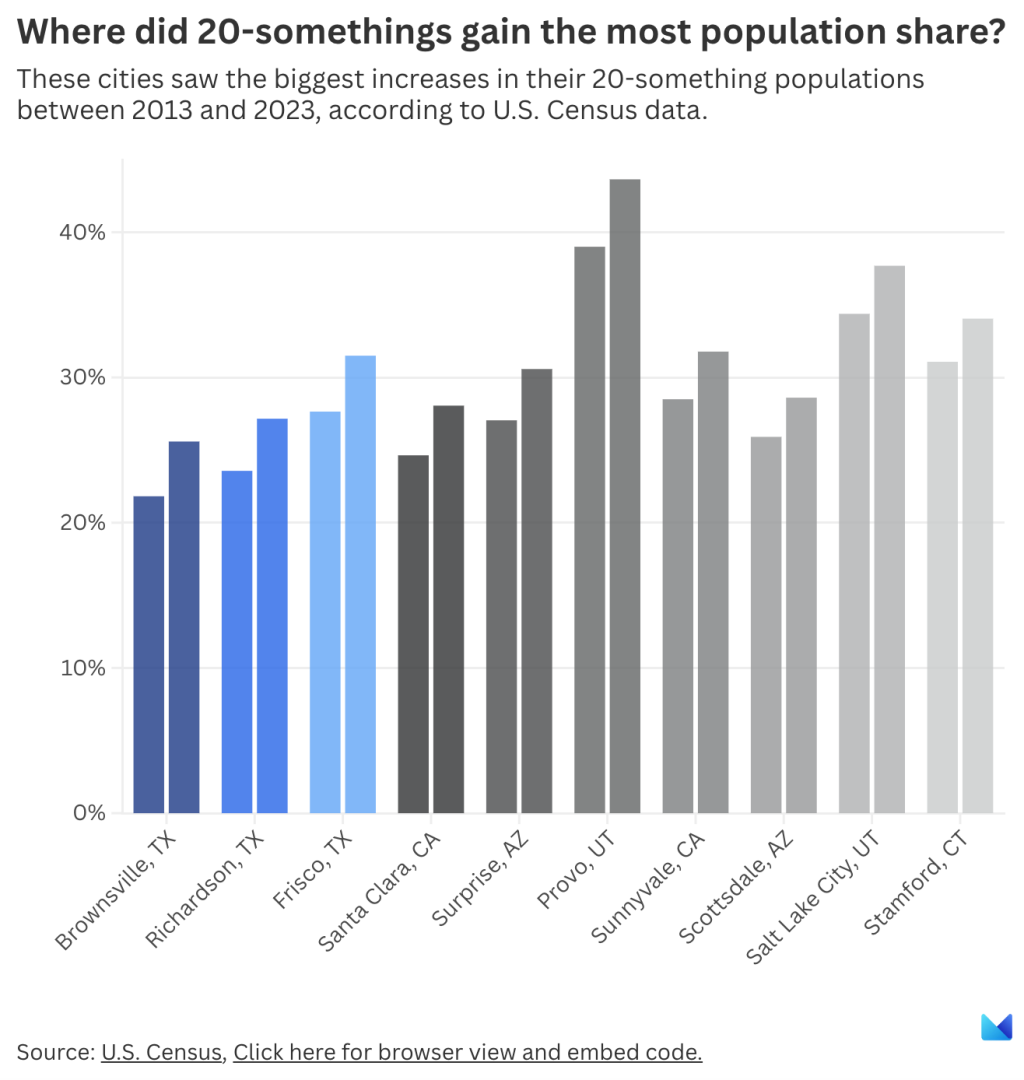
That growth and any new tech opportunities that come to Brownsville may accelerate the trend. As the top 20-something growth cities suggest, high employment growth and high growth among 20-somethings are entwined.
For instance, Richardson, Texas; Santa Clara, California; Sunnyvale, California; Stamford, Connecticut; and Scottsdale, Arizona, are all located in major employment hubs. They encircle places like Dallas, Silicon Valley, Phoenix, and New York City, which helps them pull in young professionals from across the country.
Further, states like and are high-growth in and of themselves, with Texas making headlines as a , and Brownsville trending as a top . These broader growth trends mean that young workers are likely to find compatriots moving to popular cities and begin building networks into the social fabric of these growing cities, spurring further growth.
In other words, where state growth and job development coincide, the 20-something population share takes off. Take Brownsville, dubbed an based on growth from 2018 to 2023, or Scottsdale with its top job market. Both are now on the top 10 list for the highest percentage of 20-something residents.
Which Cities are Losing Young People Fastest?
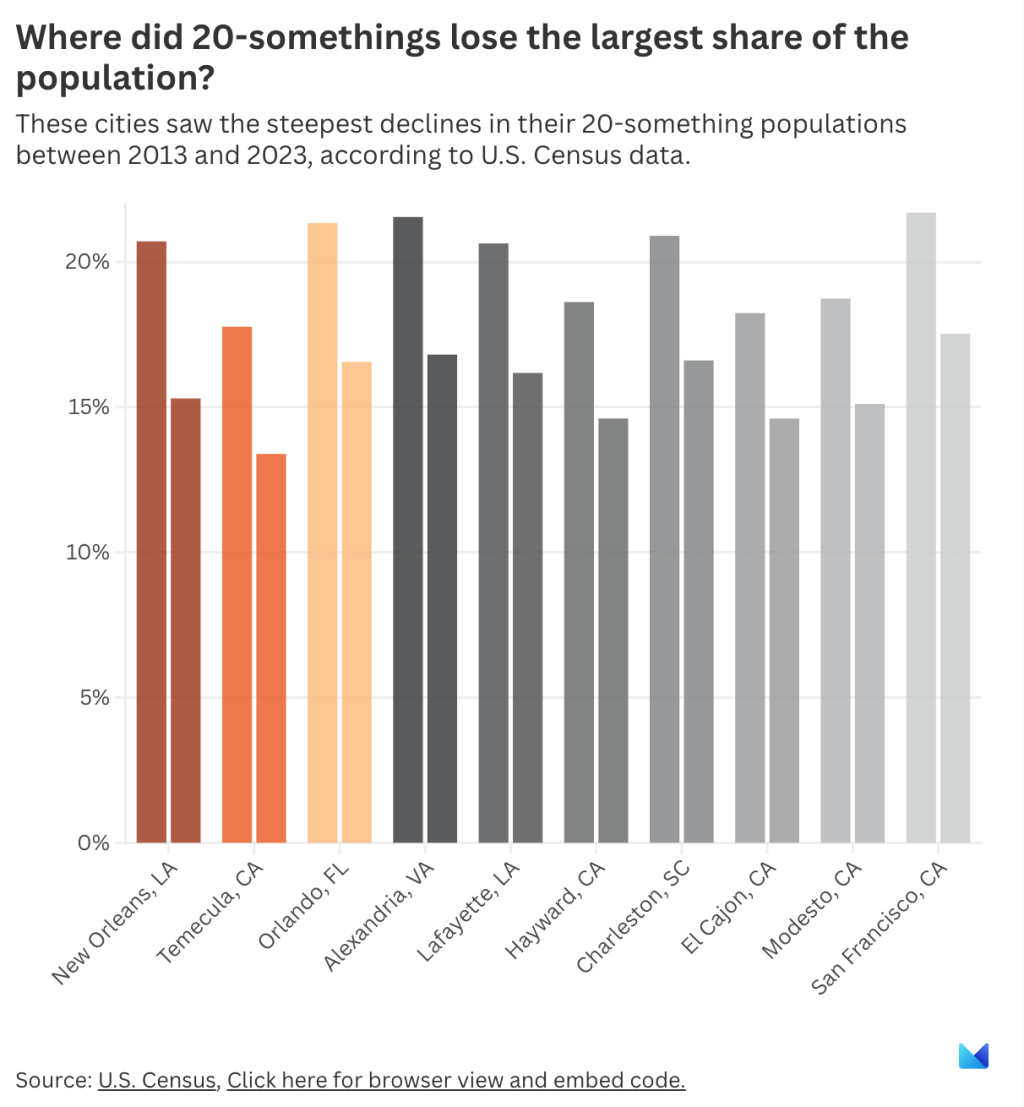
As in the top inbound cities, overall growth trends are tied to 20-somethings saying goodbye to American cities. Between 2018 and 2023, about 7% of its population, but that number skyrocketed to 31% among 25-29-year-olds.
However, strangely, many of these cities are in the U.S. South, an area synonymous with over the past five years.
That means these cities aren鈥檛 losing young people because the region overall is losing ground. Instead, these spots may be finding their young people leaving for suburbs, exurbs, and small metros, all of which are leading Southern growth.
So in Orlando, Florida, outer suburbs like Lake Nona and Clermont, with in recent years, are still winning while the inner city鈥檚 population declines. In Charleston, South Carolina, Mount Pleasant or Summerville may be supplanting the urban core.
Other top 20-something losers are places in popular metros or regions where career-starters can鈥檛 get a foot in the door, like Temecula, California; Alexandria, Virginia; or San Francisco.
Which Cities Have the Fewest 20-Somethings?
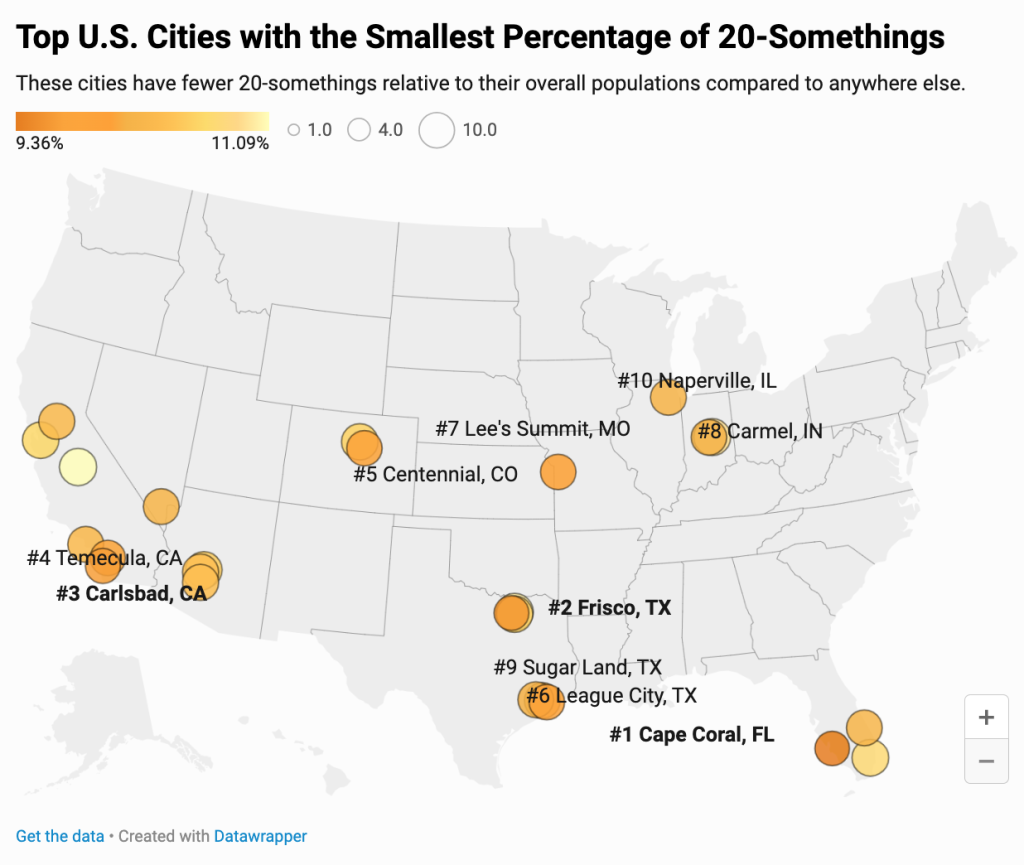
While the college towns that dominate the 20-something landscape are scattered across the map, there鈥檚 less diversity in the cities where 20-somethings fear to tread.
They鈥檙e often either retirement havens or suburbs known for their safe and sleepy reputations and unaffordable price tags, spots that tend to attract mid-career professionals, not young grads.
In fact, every city in the top 10, except for Florida, comes with average home values above the . As a group, they average 64% above the national average, making them less accessible to career starters.
In #2 Carlsbad, California, newcomers can expect to pay over for an average home. And even #10 Naperville, Illinois, is an affluent, family-oriented Chicago suburb where the is more than 10X the average in the Chicagoland area. It鈥檚 a place where 20-somethings won鈥檛 be renting either: The is about 66% the take-home of that marketing salary.
While some cities with low numbers of young adults are in high-growth states, like Texas, their growth is fueled by older adults rather than entry-level job growth and streets teeming with excitement and new grads.
While overall migration growth typically attracts young people, that鈥檚 not true for these cities. They find that popularity alone isn鈥檛 enough to attract young adults.
College Towns Thrive While Well-Heeled Suburbs Flunk Out
Across the country, the most popular cities for 20-somethings are college towns like Ann Arbor, Michigan; and Provo 鈥� university hubs with large grad programs and lots of early-career opportunities nearby.
But they鈥檙e also career super-starters like Richardson, Texas, and Sunnyvale, California, where young adults can take a swing at winning professional and tech jobs.
At the other end of the spectrum, 20-somethings are exiting cities and avoiding suburbs where mid-career earners are pricing them out or where growth is stagnant and jobs are drying up. Some of those cities are thriving, but as young people increasingly ask, 鈥淔or whom?鈥� they鈥檙e looking to find their own fortunes in the familiar university towns that have long had their backs.
20-somethings aren鈥檛 retreating to familiarity in a place with cheap pizza and pints. They鈥檙e simply asking whether their first adult communities can sustain them as they begin building their careers. The winners? The cities that combine growth with jobs and affordable housing. Those places just happen to come with a bumper crop of new teen neighbors every fall, too.
Methodology
moveBuddha mined S0101 U.S. Census tables, which offer age data for all locations in the U.S. We then transformed that data in order to see a percentage of people aged 20-29 in any given place, effectively comparing both large and small populations equally against a single yardstick.
Finally, moveBuddha ranked and tracked data across a 10-year period.
was produced by and reviewed and distributed by 麻豆原创.