25 influential women artists of the 20th century
25 influential women artists of the 20th century
Ask anyone to name a famous artist and you'll probably hear the same names repeated over and over again: Da Vinci, Picasso, Monet, Degas … the list goes on and on. What you're not likely to hear? A woman's name.
This is despite the fact that women make up . Like every other field, there's a gender gap—and certainly a pay gap—in the world of fine arts. Women aren't given the recognition their work commands and often find their work relegated to backrooms and secondary galleries rather than hung alongside the art of their male counterparts. Art museums and galleries have begun to realize the problem, and many are actively working to correct it, but change doesn't happen overnight. Many female artists are still unknown despite creating literal industry-changing masterpieces.
Â鶹ԭ´´ has compiled a list of 25 female artists from the 20th century you should know. Using art encyclopedias and museum websites, it has curated a list of women who have influenced the art world in a number of ways. From creating new styles, like abstract art, to inspiring political movements, like the Black Women's Movement, these powerful ladies are every bit as talented and important as the men with whom they share gallery space.
Agnes Martin
One of the most important painters of her generation, was an abstract artist who created minimalistic paintings driven by her transcendentalist and Buddhist beliefs. Moving to the United States from Canada at a young age, she spent the rest of her life flitting between New Mexico and New York, occasionally before returning with a slightly shifted style. In 2004, she died in New Mexico.
[Pictured: Agnes Martin's ‘Friendship’ is on display during a press preview of MoMA’s first ever Fall Reveal at Museum of Modern Art on Nov. 13, 2020 in New York City.]
Augusta Savage
Through her sculptures, Augusta Savage transformed everyday moments in the lives of Black Americans into high art. A key figure of the Harlem Renaissance, Savage trained in Paris before returning to New York City, where she transformed her studio into a community art center; gave free lessons—other notable artists like Jacob Lawrence were students; and created commissioned projects like “,” which was made for the 1939 New York World’s Fair. . She said that she preferred her legacy to be the artwork of the children she taught rather than anything she made with her own hands.
[Pictured: Augusta Savage viewing two of her sculptures in 1937.]
Barbara Kruger
Collagist got her start working in the design department at Condé Nast’s Mademoiselle magazine. In the mid-1970s, she began producing large-scale pieces that mixed found photographs with pithy sayings written in Futura Bold typeface, like power, identity, gender, and sexuality. The artist splits her time between New York City and Los Angeles, and while she still occasionally produces new work, these days much of her energy is focused on teaching and writing.
[Pictured: A photographic silkscreen print by Barbara Kruger titled ‘I Shop Therefore I Am’ at the Hirshhorn Museum and Sculpture Garden on the National Mall in Washington D.C. in 2018.]
Betye Saar
Political activist Angela Davis once credited Betye Saar’s work with launching . Saar primarily works in assemblage—though she’s an accomplished printmaker as well—challenging the stereotypes that exist around the intersection of race and femininity. Her most famous piece is titled “The Liberation of Aunt Jemima.” She currently lives in Los Angeles, and, despite her advanced age of 95, says she’s not yet done working.
[Pictured: Art work by Betye Saar is displayed at the Take A Stand Center at the Illinois Holocaust Museum & Education Center on Oct. 26, 2017, in Skokie, Illinois.]
Bridget Riley
A figurehead of the Op Art movement, has made some of the best-known optical illusion paintings in existence today. Her work combines clean lines, geometric precision, and color theory to create canvases and murals that attract, soothe, and confuse the viewer's eye. Now in her 90s, , where she enjoys semi-retirement.
[Pictured: Artist Bridget Riley in 1963.]
You may also like: '1984' and 19 other dystopian novels that predicted the future
Dorothea Lange
Documentary photography as we know it today wouldn’t exist without the work and influence of , a Depression-era photojournalist who is best known for her piercing and emotional photographs of migrant workers and families. Her photographs, while incredibly intimate, manage to tell universal stories of struggle and pain, which imbibe them with a timeless quality. , months before a retrospective of her work debuted at the Museum of Modern Art.
[Pictured: Dorothea Lange in 1936 in California.]
Ellen Gallagher
Finding her footing in the art world at the close of the 20th century, comments on issues of race and gender through her multimedia work. In particular, she points out how these two issues have long been suppressed and invalidated by the media, and how this has shaped American history. Only in her mid-50s, Gallagher works and lives in both New York City and Rotterdam, Netherlands.
[Pictured: Works by Ellen Gallagher at the Kunstforum Palais Populaire in Berlin, Germany on Sept. 27, 2018.]
Eva Hesse
Although her career only lasted for a decade, sculptor Eva Hesse certainly made her mark on the art world, ushering in in the ’60s. Her pieces are typically made of found materials like latex, fiberglass, plastic, and string, and often address women’s issues, albeit in an apolitical way. The Jewish artist fled Germany as a child during the rise of Nazism and died in 1970 in of a brain tumor.
[Pictured: Sculptures by German-born artist Eva Hesse at the exhibition "Arrows and Boxes, Repeated" at the Craig F. Starr Gallery in New York in 2018.]
Frida Kahlo
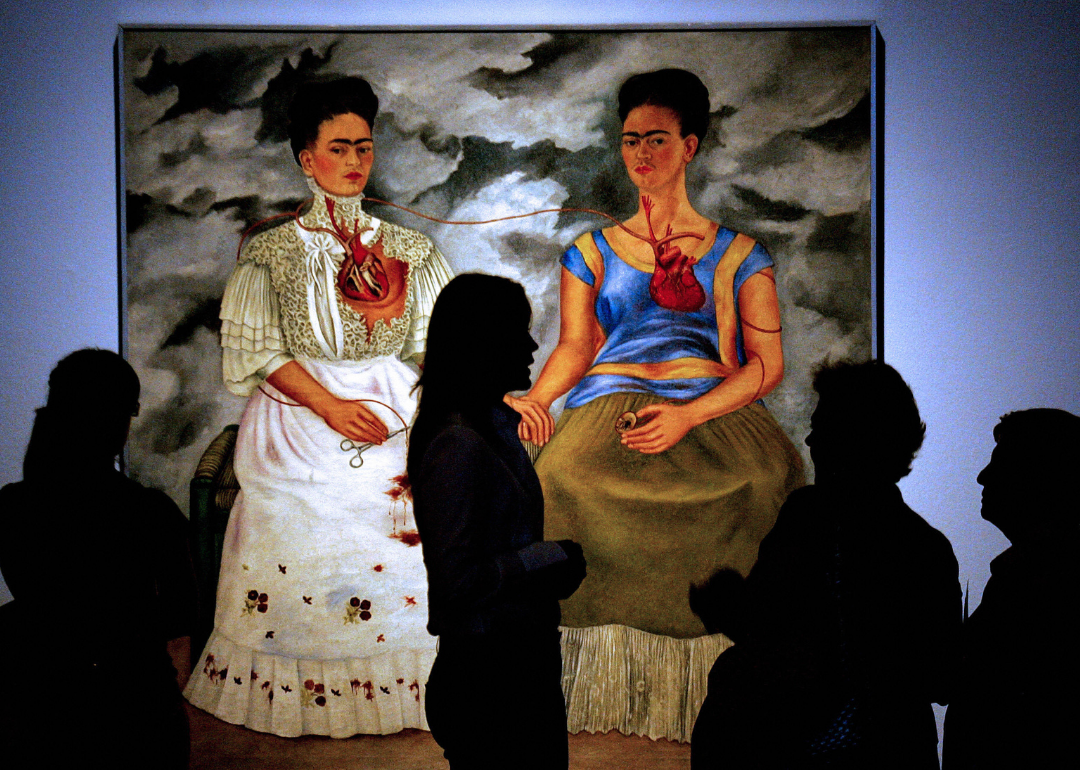
Surrealist painter Frida Kahlo is one of the few female artists to be known worldwide. Of the , many are self-portraits, or are at least autobiographical, and explore questions of gender, identity, class, and race. In 1954—after suffering from ill-health for years following a bus accident in 1925—Kahlo died either from a pulmonary embolism, as was publicly reported, , which has long been believed to be her real cause of death.
[Pictured: Frida Kahlo with self portrait entitled “Me Twice” on Oct. 24, 1939.]
Georgia O'Keeffe
What do flowers, New York City skyscrapers, and New Mexico landscapes all have in common? They're the most common subjects of Georgia O'Keeffe's paintings. Often called "," O'Keeffe literally changed the landscape of American art over the course of her 80-year career. In 1986, at the age of 98, she died in Sante Fe, New Mexico.
[Pictured: Georgia O'Keefe stands at an easel outdoors, adjusting a canvas from her 'Pelvis Series- Red With Yellow,' Albuquerque, New Mexico, 1960.]
Helen Frankenthaler
When she died in 2011, Helen Frankenthaler’s obituary read that . It wasn’t an exaggeration. An abstract expressionist, Frankenthaler produced consistently evolving works for over six decades, though her most notable works are in the color field style, .
[Pictured: Abstract expressionist artist Helen Frankenthaler at work on a large piece, 1969.]
Hilma af Klint
Considered an originator of abstract art, was painting in the nonrepresentative manner years before her male counterparts, like Piet Mondarin and Wassily Kandinsky, made it universally known. Born in Sweden in 1862, af Klint was , and, for at least 10 years, regularly led a group of female artists in seances attempting to contact “the High Masters.” Her work can best be understood through this lens—as a way to explore and represent complex spiritual ideas. In 1944, she died as a result of a traffic accident, having only exhibited her work a handful of times.
[Pictured: Hilma Af Klint Exhibition At Serpentine Gallery on March 2, 2016 in London, England.]
Jenny Holzer
Best categorized as a neo-conceptual artist, makes large text-based works such as posters, electronic signs, and engraved marble benches. A part of the feminist art movement and a member of the artists’ group Collaborative Projects, Holzer has participated in a number of renegade art shows, like , that aim to democratize art. She currently lives and works in New York, though her output has slowed dramatically in recent years.
[Pictured: Artist Jenny Holzer standing in front of her installation at the Guggenheim Museum in New York January 1990.]
Joan Mitchell
In the latter half of the 20th century, the New York School of artists turned out a number of important and influential visual creators. Among them was . An abstract expressionist, that her colorful work, “My paintings repeat a feeling about Lake Michigan, or water, or fields … It’s more like a poem … and that’s what I want to paint.” One of the few famous female artists of her era and in her genre, Mitchell died of lung cancer in Paris in 1992.
[Pictured: The painting 'Edrita Fried 1981' by Joan Mitchell hangs in the exhibition 'Joan Mitchell. Retrospective. Her Life and Paintings.' in the Museum Ludwig in Cologne, Germany, November 2015.]
Judy Chicago
Founder of the first feminist art program in the United States, uses her large installations to and women’s place in society. Her multimedia works are often collaborative—her most famous piece, “The Dinner Party,” was made with the help of 100 volunteers—and are typically images of birth or creation. She currently resides in New Mexico and continues to work alongside her husband Donald Woodman.
[Pictured: Detail of "The Dinner Party" (1979) by American artist Judy Chicago, in 2007, in the Elizabeth A. Sackler Center for Feminist Art at the Brooklyn Museum in New York.]
June Leaf
are the major themes that inspire June Leaf’s drawings, paintings, and sculptures. An abstract artist, her works are often allegorical in nature and feature a recurring cast of characters that have been in development since the 1950s. Leaf was , a group of 1940s Chicago artists. She also spent years working and studying in Paris, before settling in New York City and then Nova Scotia, where she remains today.
[Pictured: Sculptor June Leaf and photographer Robert Frank attend an opening at The Tisch Galleries on Jan. 28, 2016 in New York City.]
Leonora Carrington
Surreal is the best word to describe ’s work. One of the last members of the surrealist movement, and one of the few women ever seriously involved in it, the Mexican-British artist primarily painted narrative landscapes. In 2011, she died of complications from pneumonia in Mexico.
[Pictured: "El gato" by Leonora Carrington is on display during a preview of Christie's Latin American Art auctions, May 24, 2010 in New York. ]
Louise Bourgeois
French-American artist doesn’t fit cleanly into any specific category. Best known for her oversized sculptures and installations—like the 8-meter spider “Maman”—she also produced paintings and prints that encompass the genres of abstract expressionism, surrealism, and feminist art. In 2010, in New York City.
[Pictured: "Maman" pictured in Hamburg, Germany in March 2012.]
Marlene Dumas
When Marlene Dumas sold her painting she broke the record for most expensive work sold by a living artist. Her work, which consists primarily of portraits, is a study in duality—an extension of her own reality of being a South African artist living in the Netherlands—and of . Still active, Dumas lives in Amsterdam.
[Pictured: On display at the Institute Of Contemporary Art in Boston, “One Hundred Models” by Marlene Dumas, 1994. ]
Natalia Goncharova
An integral part of the avant-garde movement, Natalia Goncharova developed a new form of abstract painting called in 1912. The following year, she became the first woman in her native country of Russia to have a full-scale retrospective, in styles ranging from cubism to abstract to folk art. A truly radical artist—her shows were frequently raided by police for so-called pornographic images and anti-religious works— she died in Paris in 1962, suffering from severe arthritis and completely impoverished.
[Pictured: Natalia Goncharova (1881-1962), Russian painter, sculptor and decorator, in her Parisian studio circa 1920.]
Paula Rego
For the past seven decades, , an often underrated British-Portuguese artist, has created a body of work based on fairy tales and folk stories. Despite their seemingly sweet subject matter, the paintings carry some serious weight, relaying timely political messages and . Now in her mid-80s, Rego lives in London, and though she is too frail to paint, she was able to enjoy a retrospective of her work that went up at the Tate Museum in early 2021.
[Pictured: The U.K.'s largest ever retrospective dedicated to Portuguese visual artist Paula Rego at the Tate Britain opens on July 5, 2021 in London, England.]
Tamara de Lempicka
Tamara de Lempicka was a Polish artist who is known for her portraits of the era’s elite. Her pictures, which are done in a blend of cubism and neoclassical styles, ooze with sensuality and are, to this day, incredibly chic. Over the years, many of them have been reproduced in fashion magazines such as Harper’s Bazaar. She fled Europe for the United States just before the start of World War II. In 1980, de Lempicka died in Mexico.
[Pictured: Tamara de Lempicka at her easel.]
Vija Celmins
said it best when it called Vija Celmins’ work “precise, painstakingly wrought illusions of reality.” Her graphite and paper drawings of nature—including the ocean, the night sky, spiderwebs, and rocks—are highly detailed, photorealistic works that are almost overwhelming in scope, forcing the viewer to really slow down and patiently take them in. Born in Latvia, Celmins and remains active.
[Pictured: Artist Vija Celmins with her work in an exhibition at the Hammer Museum in West LA in January 2007.]
Yayoi Kusama
Once the center of New York City’s avant-garde and pop art scenes, is best known for her use of polka dots and her intense, large-scale environments. Born in Japan, Kusama spent her most productive years in the United States, where she used everything from the naked human body to the inside of a room as canvases. In the early ’70s, Kusama returned to her home country, where she has , withdrawing almost completely from society even as her installations and shows have become increasingly popular due to social media apps.
[Pictured: Yayoi Kusama beside her 2016 production titled "Flowers that Bloom Tomorrow" at her exhibition titled "My Eternal Soul" at the National Art Center in Tokyo on Feb. 21, 2017.]
Yoko Ono
Yoko Ono’s art, whether performance or visual, , throwing the viewers’ reactions back at them and revealing some deep inner truths about her audience. Involved in New York’s avant-garde scene, she both collaborated with other artists and created pieces of her own, like her famous hoping to unsettle and inspire those who engaged with it. Now in her late 80s and in failing health, Ono still lives in New York City in the Dakota apartment she once famously shared with her husband John Lennon.
[Pictured: Artist and singer Yoko Ono photographed in London 1967.]