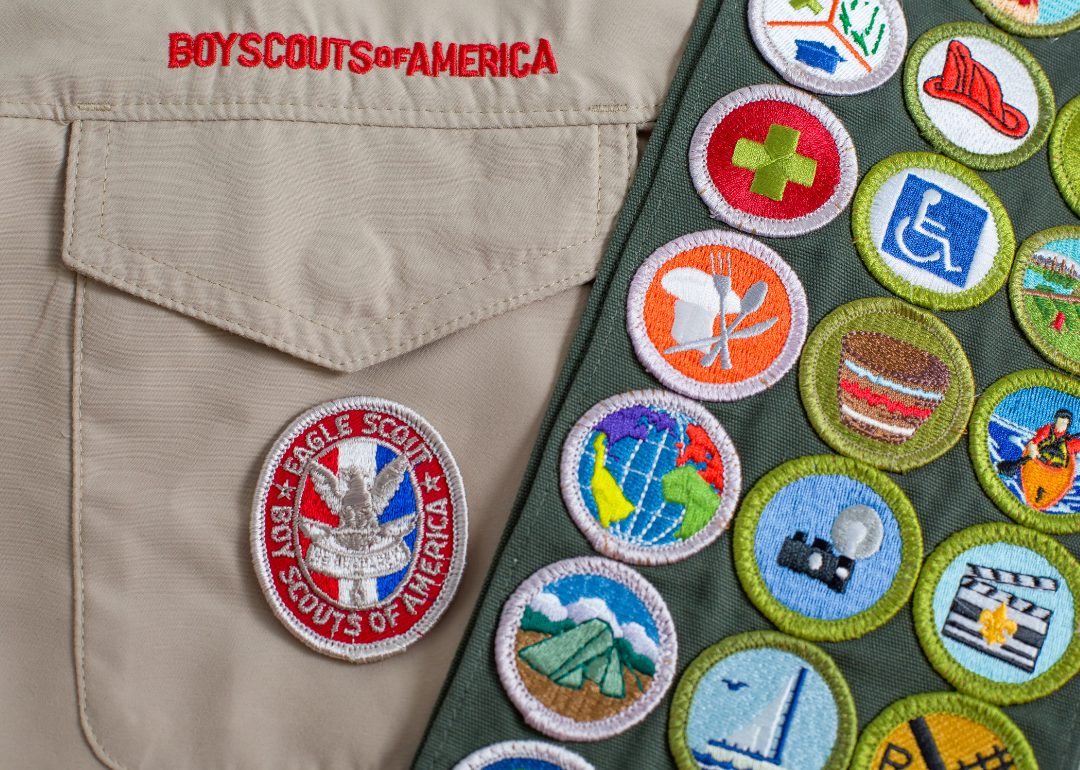
30 major moments in Boy Scouts history
Founded in 1910, the is among the world's most prominent scouting groups and one of the largest and best-known youth organizations in U.S. history. While the Boy Scouts claimed at the height of its popularity, only about 2.5 million members remain today. More than have passed through the ranks of the Boy Scouts over the course of the organization's century-plus history,
Long a symbol of traditional U.S. culture, the Boy Scouts endured two world wars, social upheaval, culture conflicts, lawsuits, and seismic demographic shifts in the U.S. population. Originally conceived to promote self-reliance, outdoor skills, character, and morality among the boys who would grow up to be the nation's men, the group evolved into a unique blend that was at the same time both secular and religious, private, and government sponsored.
As U.S. opinions changed on sensitive issues such as gender, sexuality, and religion, the Boy Scouts鈥攍ike so many traditional organizations鈥攚ere forced to evolve. The last decade has embroiled the Scouts in a whirlwind of controversy and unwanted publicity, from which it has recently emerged as a more inclusive organization. Here's a look at the 30 moments that shaped Boy Scout history.
ALSO:
1908: Robert Baden-Powell publishes 'Scouting For Boys'
At the turn of the 20th century, British military hero, writer, and educator began teaching the principles of military scouting to boys in a non-military setting, so they would be able to live off the land, track, observe, and conceal their movements in case of an invasion or a similar crisis. In 1908, Baden-Powell published "Scouting For Boys," which was based on a military field manual he developed for soldiers during his career in the British service. Modified specifically for boys during times of peace, the book, which also dealt heavily with character and morality, became an instant sensation and triggered the emergence of the youth scouting movement.
Circa 1909: W.D. Boyce meets the 'Unknown Scout'
According to a long-held Boy Scouts legend, a U.S. millionaire businessman and newspaper magnate named when he became disoriented and lost in the city's dense fog. A boy affiliated with the new scouting movement guided Boyce through the fog, showed him his way and鈥攚hen offered鈥攔efused to accept a tip on the notion that he was compelled by honor, not money, to help a stranger in need.
1910: W.D. Boyce founds the Boy Scouts
The legend of the Unknown Scout is murky, but what is certain is that W.D. Boyce returned to the U.S. and on Feb. 8, 1910, he . Boyce's encounters with the burgeoning scouting movement in England convinced him that character development, outdoor recreation, and survival training were critical if boys were going to grow into worthwhile men, particularly those who grew up in cities.
1910: BSA establishes national headquarters in NY
Later in 1910, the BSA made 200 Fifth Ave. in New York City its . Less than a year after its founding, the BSA was already on the radar of the nation鈥檚 most influential leaders. That same year, both John D. Rockefeller and Theodore Roosevelt honored Robert Baden-Powell with a dinner at the Waldorf Astoria.
1911: BSA adds religious declaration to its constitution
Although the BSA's first CEO, James West, claimed that the Boy Scouts would not become an exclusively Christian organization, he established the concept of the from the organization's earliest days. It reads, in part, "The Boy Scouts of America maintains that no member can grow into the best kind of citizen without recognizing an obligation to God and, therefore, recognizes the religious element in the training of the member, but it is absolutely nonsectarian in its attitude toward that religious training." While the organization has historically encouraged diversity among faiths, from both leadership and membership from 1911 through the current day.
1912: Arthur A. Eldred becomes first Eagle Scout
When 17-year-old appeared for his mandatory rank review to become the world's first Eagle Scout, the board that reviewed him consisted of a who's who of scouting. Among those who evaluated him were CEO James West, Red Cross rescue pioneer Wilbert E. Longfellow, and Chief Scout Ernest Thompson Seton. At the time, only 50 Scouts in the U.S. had earned even a single merit badge, and Eldred earned his Eagle rank with 21 merit badges. For his proficiency in鈥攁mong other things鈥攃hemistry, poultry farming, pathfinding, swimming, electricity, cooking, horsemanship, and bicycling, Eldred received the highest honor in scouting in 1912.
1912: Juliette Gordon Low founds the Girl Scouts
In 1912, women were not allowed to vote, but the progressive era and women's rights movement was already starting to take shape. That year, an activist named met Gen. Robert Baden-Powell, who convinced her to start a scouting organization that would instill in girls the same principles of self-reliance, honor, and character that the Boy Scouts sought to instill in Boys. Gordon Low launched the Girl Scouts鈥攚hich is not affiliated with the BSA鈥攁nd in 1965, nearly 100 years after she was born, her home was designated a National Historic Landmark.
1913: Scouts earn first major church endorsement
In 1913, the Church of Jesus Christ of Latter-Day Saints with the BSA, which would become the activity arm of the church's Mutual Improvement Association (MIA) for young men. The church was the first nationally chartered religious institution to make the Boy Scouts its official youth program.
1913: Presidential inauguration tradition begins
In 1913, roughly 1,500 Boy Scouts were invited to assist first responders at the inauguration of President Woodrow Wilson. Boy Scouts have in the more than 100 years that have followed.
1915: Theodore Roosevelt gets involved
In 1915, former President applauding the organization's "unquestioned value to our country" and its focus on "manliness in its most vigorous form." Roosevelt became heavily involved with the BSA, serving as a committeeman for Troop 39 and a commissioner of the Nassau County Council, while also entertaining Scouts, awarding them medals, and participating in their scrap drives during World War I. Roosevelt was honored as the first BSA honorary vice president, and he remains the only person ever to have been honored with the title of Chief Scout Citizen.
1916: BSA gets federal recognition
On June 15, 1916, President Woodrow Wilson signed a unanimously approved Congressional charter that granted federal recognition to the BSA. The charter was part of Title 36, which recognizes "patriotic and national organizations." Wilson stated that he signed the charter because "every nation depends for its future upon the proper training and development of its youth," .
1918: Rotary International adopts the BSA
In 1918, Rotary International became the very . A little more than a century later, the Rotary Club continues to sponsor the Scouts.
1920: First World Jamboree
The was held in London in 1920. BSA boys were among the 8,000 scouts from 34 countries that participated in the inaugural global scouting event.
1923: Scouts with disabilities honored for first time
have participated in BSA activities since the organization's founding in 1910. In 1923, the BSA created a special award for Scouts with disabilities or who were unable to meet certain requirements.
1930: Cub Scouts are born
Robert Baden-Powell had long maintained a scouting program for younger boys called Wolf Cubs in Great Britain. By 1930, the BSA was so big that it was able to spin off an affiliated organization for younger boys while allowing the BSA to focus exclusively on older boys. From that moment on, would be ages 7 to 11 and Boy Scouts would be 12 to 17.
1932: FDR became first Scout leader elected president
Franklin Delano Roosevelt was the , thanks to his role as president of the Greater New York Council of the Boy Scouts of America. In 1934, hundreds of thousands of Boy Scouts heard and heeded President Roosevelt鈥檚 call to help those harmed by the Depression, collecting and other necessities for needy families.
1940: Irving Berlin blesses the Scouts
fled oppression in Russia to come to the United States with his family when he was just 5 years old. Raised in poverty in New York City, the Jewish immigrant would go on to write classics such as "White Christmas" and "God Bless America," the latter of which forever enshrined him in Boy Scout lore. Refusing to accept money earned from the patriotic tune, Berlin donated all earnings for the song鈥攎ore than $10 million to date鈥攖o the Boy Scouts and Girl Scouts, with most going to troops in disadvantaged neighborhoods.
1948: Membership boom
Thanks to the post-World War II baby boom, and the arrival and rapid expansion of the suburbs, the BSA enjoyed a during the 1950s. In 1948, about 2.5 million Boy Scouts claimed membership in the BSA. By 1960, that number had more than doubled to just over 5 million.
1960: A Scout in the Oval Office
The in 1960 was unprecedented on several levels. JFK was the first Catholic president, the youngest president ever elected, and he defeated his opponent, Richard Nixon, in one of the closest elections in American history. To Boy Scouts across the country, however, Kennedy will always be known as the 鈥擩FK was a member of Troop 2 in Bronxville, N.Y. and later served as leader on the Boston Council.
1972: Peak and decline
In 1972, nearly 1 in 3 U.S. boys between the ages of 10 to 19, a full , were involved in scouting鈥攊t was the peak of the organization's popularity and the beginning of a rapid decline. While the BSA's clean-cut, religious, civic-minded, and patriotic image reflected mainstream 1950s ideology, much of the country's youth viewed the organization as the Vietnam era was coming to a close.
1980s: BSA culture changes gears
Although churches had long sponsored the BSA, starting with the Mormons in 1913, the arrival of the 1980s鈥攁nd the so-called culture wars that raged during the Reagan years鈥攚itnessed a . By that time, churches鈥攑articularly the Catholic and Mormon churches鈥攚ere the single biggest sponsors of Boy Scout troops. The BSA was widely viewed less as a secular youth organization and more as an arm of the churches that sponsored it. In the 1980s, just 2% of the country鈥檚 population were members of the Church of Jesus Christ of Latter-Day Saints, but 1 in 5 Boy Scouts were Mormon.
1990s: BSA plays defense
The 1990s saw the Boy Scouts embroiled in pertaining to the so-called "three Gs": God, gays, and girls. The Boy Scouts are a federally chartered organization that enjoys unique access to government resources, and by the 1990s, public sentiment had begun to shift in terms of dogma espoused by the Catholic Church, Mormon Church, and other top BSA religious sponsors. The public began to sour on the BSA's exclusion in both membership and leadership of girls, atheists, and LGBTQ people.
2000: BSA v. Dale
In 2000, in favor of the BSA and against a well-liked and accomplished assistant Scoutmaster named James Dale, who was terminated when the Boy Scouts learned he was gay. The court ruled that as a private organization, the BSA was exempt from state anti-discrimination laws like the kind designed to protect LGBTQ people.
2002: Scouting Museum opens
In 2002, Irving, Texas, became the host of a museum dedicated to the long and storied history of the Boy Scouts. opened that year, and the facility continues to provide both exhibits and hands-on activities that educate visitors and encourage them to explore the Boy Scouts impact on U.S. history.
2013: Scouts end ban on gay members
After enduring a long period of intense external pressure and internal debate, the Boy Scouts in 2013 voted by a margin of 60-40 to end the longstanding ban on welcoming gay boys as members. The action "was widely seen as a milestone for the Boy Scouts, a symbol of traditional America," The at the time. While the Catholic Church, Mormon Church, and Southern Baptist Convention vocally opposed the move, organizations like the National Jewish Committee on Scouting, the Metropolitan Community Church, the Unitarian Universalist Association, the Episcopal Church, and the United Church of Christ had .
2014: Pascal Tessier earns Eagle Scout rank
In 2014, little more than a century after Arthur A. Eldred became the first Eagle Scout in history, a new Eagle Scout made headlines for a different reason. That year, just nine months after the BSA lifted its ban on gay membership, Pascal Tessier became the to earn the organization's highest honor. Since the BSA's two-tiered policy still excluded gay adults, Pascal's older brother, who is also gay, was forbidden from participating in Scout activities.
2015: BSA lifts ban on gay leaders
Just one year after the Scouts began welcoming gay youth members, the organization's two-tiered system collapsed when the BSA again made history, this time by , with some limitations, on openly gay adult men as Scout Leaders. Although the country's opinions on LGBTQ rights had changed dramatically by 2015, the move was still highly controversial. That year, more than 70% of the country's 100,000 Scout units were still sponsored by religious groups.
2017: Boy Scouts admits girls
In 2017, the Boy Scouts became even more inclusive when the BSA announced that for the first time, as Cub Scouts and pursue the coveted rank of Eagle Scout, just as boys had always done. The board of directors voted unanimously to approve the change, which it said reflected the shift in popular American culture and attitudes.
2018: Girl Scouts push back
In 2018, the when the Boy Scouts decided to change its name, which had always served as a differentiator between the two groups. When the Boy Scouts decided to welcome girls, it announced it would from then on be known as Scouts BSA. The Girl Scouts alleged the name change was part of a larger attempt by the Boy Scouts to pilfer members from its ranks.
2019: Mormon Church severs ties
In 2019, the changing nature of the Boy Scouts proved too much for the BSA's first and most significant benefactor: the Church of Jesus Christ of Latter-Day Saints. That year, the Mormon Church announced it was and replacing it with a church-based youth program for the children of its adherents. More than 105 years of history between the Boy Scouts and the LDS Church were exactly that鈥攈istory.