50 ways America is different from 50 years ago
50 ways America is different from 50 years ago
1968 marked one of the in U.S. history. America was locked in a space race to put the first human on the moon, civil rights icon Martin Luther King Jr. was assassinated, the Vietnam War was escalating, and the internet was only in its preliminary stages. Major legislation was also passed that year, including the Gun Control Act and the Fair Housing Act. And what's more, the dawn of the television age allowed Americans to watch current events from the comfort of a living room couch.
To explore how life in America today is different from 50 years ago, Â鶹ԭ´´ explored research from , data from government sources like the and , and news articles. What emerged reveals a world very different 50 years ago from the one we're living in today.
The Vietnam War was escalating
The United States Department of State made a gruesome announcement Feb. 18, 1968. That date of the Vietnam War in a single week, with 543 Americans killed in action and 2,547 wounded. Today, casualties have become greatly reduced in armed conflicts: In 2018, which began in 2003.
There were no ATMs
Fifty years ago, the only way to get cash out of your account was by go to your nearest bank branch and wait in line for a teller. That all changed in 1969, when the at the Chemical Bank in Rockville Center, N.Y. Fast-forward to 2018: There were throughout the country.
A gallon of gas cost less than 50 cents
The was 34 cents (the equivalent of $2.44 in 2017). Today, prices around the country (the equivalent of 41 cents in 1968).
A woman needed a man with her to open a credit card account
Up until 1974, a woman unaccompanied by a man to the bank could be denied credit. It didn't matter if she was married or not, her age, or how much money she made. Rep. Lindy Boggs is in the Equal Credit Opportunity Act of 1974, allowing anyone with decent credit to open an account.
No one had been to the moon
As of 1968, no one had stepped foot on the moon. The following year, on July 20, Apollo 11 . President Richard Nixon—along with about 500 million people around the world—got to watch the whole thing happen on television. Today, NASA has expressed interest in getting people back to the moon; but the space administration has loftier, goals too—of taking people to Mars.
Creditors could impose different terms or conditions based on your race, sexual orientation, or religion
Creditors had the right in 1968 to charge a higher interest rate or bank fee for no other reason than a person's race, religion, or sexual orientation. That wouldn't change until the 1974 passage of the Equal Credit Opportunity Act, which . The act stands to this day.
There were no cell phones
Remote communication in 1968 was limited to the postal service, landline, or pay phone. It wouldn't be until the early 1970s when Motorola and Bell Labs would become locked in a race to bring the first portable phone to the market. In 1973 Motorola for what would in 1983 become the world's first cell phone. Today, cell phones have all but replaced tethered lines.
People got married younger
The median age for first marriages in America was 23 in 1968, . By 2017, that number had jumped: to 27.4 for women and 29.5 for men.
The country was in a lot less debt
The national debt for the United States in June of 1968 was (the equivalent of more than $2 trillion in 2017). In the same month in 2018, the U.S. Department of the Treasury reported that the national debt (the equivalent of $2 trillion in 1968).
There was no Memorial Day
Formally "Decoration Day," the holiday to honor those who served in the military originated shortly after the final days of the Civil War. It was not recognized as an . The holiday continues today, and comes in just behind the Fourth of July for the .
There were no warnings on cigarettes boxes
The public health sector was fighting during the late '60s to make information concerning the hazards of cigarettes available to the public. After the surgeon general of the United States released an official statement connecting cigarettes to low birth weight in 1969, Congress signed the , which required cigarette companies to place warning labels on their packaging. Today, the debate continues over whether the warnings are explicit enough—or whether they ought to include .
Higher education programs could deny participation based on race or gender
In 1968 it wasn't illegal to discriminate on the basis of sex in education programs or activities that receive financial assistance from the federal government, notably in sports and extracurriculars. President Richard Nixon changed that in 1972 with the Higher Education Act, which included groundbreaking legislation called Title IX. charter and for-profit schools, postsecondary institutions, libraries, museums, as well as vocational rehabilitation agencies and education agencies.
The number of obese Americans was 50% lower
Just 13.4% of Americans between the ages of 20 and 74 in 1960. That number rose by about 1% between the years of 1971 and 1974, but made a substantial increase up to 38.2% of the population by 2014. Further, as of 2014.
Lyndon B. Johnson was president
Vice President Lyndon B. Johnson was sworn in as president on Air Force One following the assassination of President John F. Kennedy in 1963. In 1968, there . While escalating military action abroad, Johnson pushed forward several progressive reforms at home that he claimed would form a . Great Society goals included protections for the environment, lowered crime rates, overcoming social inequalities, and eradicating poverty.
Martin Luther King Jr. had just been assassinated
In April of 1968—the day —Martin Luther King Jr. was shot and killed on the balcony outside his hotel room. The assassination sparked national outrage and protests across the country, and a manhunt ending in London with the capture of James Earl Ray. Today, Dr. King's legacy is observed with a national holiday Jan. 21.
Violence against protestors was rampant
Following Dr. King's assassination, the U.S. "" Also at the height of the Vietnam War, had reached a fever pitch. In April of 1968, hundreds of students from Columbia University in New York City were beaten and arrested by police offers after occupying university buildings. Two years later, National Guard troops shot into a group of Kent State students protesting the U.S. invasion of Cambodia, killing four. There were more than .
Soda cans were dangerous
Up until the , soda cans had tabs that pulled completely off the top. These sharp pieces of aluminum littered beaches, parks, and streets and were notorious for cutting into bare feet and even through shoes. The first Sta-Tab was introduced in 1975, and is used to this day to open cans without littering or inflicting physical harm.
Athletes faced suspension for protesting racism
In one of the , U.S. athletes Tommie Smith and John Carlos raised their fists at the 1968 Olympics in Mexico in silent protest against racial discrimination. The gold and bronze medal winners, respectively, were suspended from the U.S. track and field team and faced an enormous public backlash. A similar conflict broke out in 2016 when former San Francisco 49ers player Colin Kaepernick sat and then kneeled during the national anthem to protest systemic racism. Many NFL players followed suit. And while no one to date has been suspended like Smith and Carlos, Kaepernick—who opted out of his 49ers contract—has gone unsigned since.
A U.S. president had never resigned
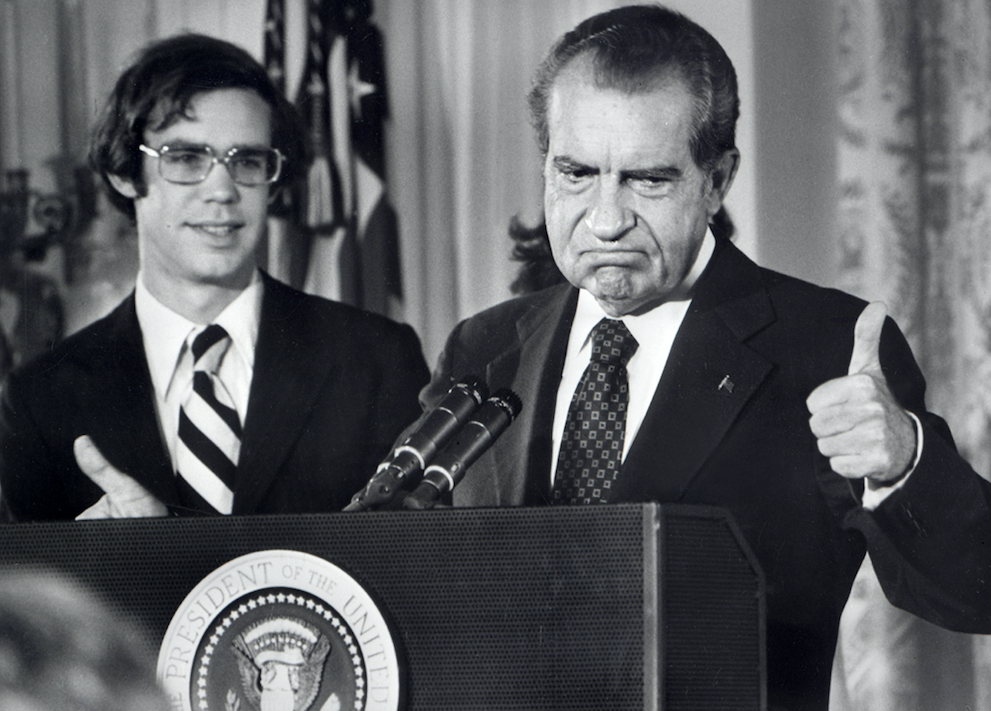
Richard Nixon, who would be elected as the 37th President of the United States, eventually also became the first to resign from the position. On Aug. 8, 1974, after impeachment proceedings had begun in response to Watergate, Nixon . The scandal surrounding Nixon would become a major point of reference throughout two more administrations: and .
The U.S. was in a "space race" with the Soviet Union
Jim Lovell, Bill Anders, and Frank Borman became the first humans to orbit the moon on Christmas Eve 1968. Apollo 8 after breaking free of the Earth's atmosphere at a record 24,200 miles per hour. Today's space race isn't between countries—.
No one had heard of Led Zeppelin
In the final days of 1968, the British band made their fifth performance in the United States as openers for Vanilla Fudge inside a college gym in Washington. The band was so unknown that a Spokane newspaper , "The Vanilla Fudge, with Len Zefflin." The performance famously became the first live recording of the band in history. Today, it is nearly impossible to find a rock band that .
Tensions between the U.S. and North Korea were even higher than today
Even after the end of the Korean War almost 15 years prior, in January of 1968 North Korea and its 83 crew members. There was a discrepancy between the two countries as to whether the ship had been in international waters. After tense negotiations, the crew members were safely returned. There are still tensions between the two countries today; however, the historic North Korea–United States Summit in June of 2018 with each other.
There was no minimum age limit for gun possession
Although the Gun Control Act of 1968 , there was still no minimum age limit for possession. The age limit set in 1968 was 18 for long guns and 21 handguns. Today, spikes in mass shootings have reopened the debate on whether the existing age requirements are too lenient.
21 year olds to purchase handguns from licensed dealers, but 18 year olds are legally able to purchase handguns if purchasing from a an unlicensed seller—such as online or from a friend. Long guns, such as rifles and shotguns, can be purchased by an 18 year old from a licensed dealers, but there is .
TV networks turned off big football games for regularly scheduled programs
In a November game in 1968, NBC switched off a close game between the for their regularly scheduled program (a movie called "Heidi"). Nobody outside of the stadium saw the Raiders score two touchdowns with just nine seconds left, securing a win. NBC was flooded with so many calls from angry fans that the station's switchboard blew. Today, standard practice dictates that games finish before regularly scheduled broadcasting resumes.
The Beatles were still together
Although it was widely speculated that the band had spent the 1960s slowing drifting apart, it didn't become official until the Spring 1970. That was the year Paul McCartney made statements promoting his solo album that the international media chose to accept as the official . It's hard to find popular music today that wasn't .
Country and pop music crossovers were far and few between
Today artists like Taylor Swift and Carrie Underwood create music that blends country and pop, but that was more rare 50 years ago. The first singer to hit the top of Billboard's country and music charts at the same time was 23-year-old Jeannie C. Riley in 1968, with her hit song "Harper Valley P.T.A."
The World Wide Web didn't exist
Although the internet itself was a gradual discovery over a period of time by various collaborating minds, the World Wide Web had a single inventor. In 1991, Tim Berners-Lee, a computer programmer in Switzerland, that anyone with internet could access. Today, it's hard to imagine life without it.
There was no GPS, only paper maps
The first commercially available GPS phone wasn't introduced until 1999. A decade prior, the U.S. Air Force into space on the Delta ii rocket. GPS technology didn't reach its smaller format (like the Garmin and Tom Tom car-navigation devices) until 2001.
It was illegal in most states to pump your own gas
The was rolled out in 1964 in Westminster, Colo. At that time, the practice was entirely revolutionary—and wildly unpopular. By 1968, 23 states still had a law in place banning people from pumping their own gas. Today, the scales have flipped; and all states except New Jersey and Oregon have made it legal to pump your own gas.
Life expectancy was significantly lower
The average life expectancy in the United States in 1970 was 74.7 for women and 67.1 for men, according to the , By 2016, U.S. life expectancy had grown to 81.1 years for women and 76.1 years for men.
"The Brady Bunch" didn't exist
The American television show . The sitcom would go on to become one of the most famous shows on the globe, setting the bar for American popular culture and television programming that is still reached for today.
There was no such thing as Earth Day
The first Earth Day was celebrated in the United States on April 22, 1970, to bring awareness to environmental problems around the globe. Initially created by Senator Gaylord Nelson of Wisconsin, Earth Day continues to be recognized every April 22 with public demonstrations, educational programs, and rallies.
Woodstock was just an idea
Arguably one of the most famous moments in music history, the opened in Upstate New York in August of 1969. Four young promoters managed to book acts like The Who, the Grateful Dead, Janis Joplin, and Jimi Hendrix. When the town of Woodstock and the surrounding areas denied permission to hold the festival, a nearby dairy farmer agreed to open his 600 acres of land in the town of Bethel for the event.
"Sesame Street" hadn't premiered yet
The creator of "Sesame Street," Joan Ganz Cooney, that was entertaining and educational for pre-school children, especially those who were underprivileged. The show first aired in November of 1969, quickly becoming one of the most important and widely viewed children's television shows in history still viewed today. To date, "Sesame Street" has been televised in more than 120 countries.
Fair Housing was brand new
Prior to , discriminatory practices surrounding the sale, rental, or finances of housing based on gender, national origin, or race was legal. Although the bill was fiercely debated in the Senate, it was quickly passed following the assassination of Dr. Martin Luther King Jr. To date the act has been .
You had to be 21 years old to vote
The debate over lowering the voting age in America from 21 to 18 began during World War II and grew stronger through the Vietnam War—especially as more and more 18 year olds were fighting for their country. Congress finally in March of 1971, and then-President Nixon signed it into law four months later. The 18-year-old rule still stands today.
The legal age to purchase alcohol varied from state to state
The country didn't unify under one drinking age until the was passed in 1984. Before then, each state decided individually the legal age when an individual could both buy and publically consume alcohol.
Interracial kissing on television was unheard of
The sci-fi show "Star Trek" broke barriers when it premiered the episode on NBC in 1968. Capt. Kirk and Lt. Uhura share the first scripted interracial kiss ever shown on American television in the episode. That act helped to destigmatize interracial relationships on and off screen.
Seatbelts weren't mandatory
Although all new cars contained some type of seat belt by 1964, it wasn't until 1984 that the state of New York started the trend of enacting seat belt laws. The that only 11% of drivers and front-seat passengers wore seatbelts in 1982. It took another 12 years until every state in the country (except New Hampshire) to follow suit and enact their own seat belt laws for drivers and front-seat passengers.
There was no U.S. agency dedicated to the environment
Four years before he resigned, President Richard Nixon established the . The goal of this organization was to protect both the natural environment and human health by coordinating an attack on harmful pollutants.
There had never been a woman on the U.S. Supreme Court
While the U.S. Supreme Court was implemented in 1789, it did not see a female judge until 1981. In September of that year, after being nominated by President Ronald Reagan. She served on the court until her retirement in 2006. Three other women have served in addition to O'Connor: Ruth Bader Ginsburg, Elena Kagan, and Sonia Sotomayor.
Plants and animals at risk for extinction weren't formally acknowledged
Congress didn't pass the . The goal of the law was to protect the country's plants and animals that were at high risk and dwindling in numbers. Concerned species were officially defined as "threatened" or "endangered" under the ESA, with all animals and plants (besides pest insects) eligible. That act has directly resulted in a number of animal populations rebounding.
Personal computers didn't exist
In 1974, a company called Micro Instrumentation and Telemetry Systems (MITS) first offered an at-home, ." Soon after, the company hired Paul Allen and Bill Gates to make the computer easier to use. It was so successful that the two men were able to break off and form their own company: Microsoft.
The Walkman hadn't been invented yet
Magnetic cassette tapes with pre-recorded music became available in the early 1960s. While they were less popular than vinyl records at the time, the portability and compatibility with car stereos made the tapes much more convenient. In July of 1979, Sony , a sleek, smaller version of the popular TC-D5 cassette recorder after the company's co-founder grew tired of lugging the clunky device around on business trips.
There was a different system of rating movies
Prior to 1968, movies were rated based on a set of "moral guidelines" called the Hays Code. The current rating system was , with a goal of being more parent-focused. The system aimed to inform parents on the content of movies, giving them the ability to make informed decisions for their families.
Medicare was only available to those 65 and older
Regardless of disease or disability, only for Americans aged 65 or older when the program was introduced in 1965. This changed in 1972, when eligibility for the program was extended to those under 65 with certain disabilities or permanent kidney disease. President George W. Bush signed a law in 2003 which included prescription drug benefits in the Medicare program.
"The Ed Sullivan Show" was still the most popular thing on TV
A variety program, "The Ed Sullivan Show" ran for more than two decades on the 8 p.m. Sunday time slot, and featured everything from up-and-coming comedians to rock stars. The show on June 6, 1971.
The draft was active
At the height of the Vietnam War, nearly two-thirds of American soldiers were volunteers. The in order to maintain the desired military presence in Vietnam. When the war broke out, all men of draft-age were ordered to register with the Selective Service System and have their draft status evaluated by a board of representatives. There has not been another draft since.
More people died from lightning strikes
According to the CDC, in males and 70.6% in females from 1968 to 2010. The highest number was recorded in 1969, with 131 deaths caused by lightning, and the lowest in 2010 with 29 deaths.
The U.S. population was significantly lower
The U.S. Census reports that the is more than 328 million, and rising every 17 seconds. Fifty years ago .