Architectural history from the year you were born
Architectural history from the year you were born
Architecture is an art, and like any art form, it changes over the years. Some architectural styles and periods are natural and direct products of the times during which they come to be. and was shaped in part by the then-recent end of World War I and the rise of industrialization. Characterized by a focus on applied arts and the blending of art forms, Bauhaus was about doing things differently and effectively challenged the status quo through art during a period of political unease.
Meanwhile, other waves of art movements may have paved the way for themselves and shaped society as a result. An example here might be the . A multi-day exhibition that aimed to imagine the future of art and architecture, it could be argued that the fair itself influenced what was to come by presenting somewhat realistic possibilities and letting them take hold.
Regardless of what may influence particular periods of architecture, each building, residence, or construction is as much a product of its era as it is a product of unique decisions and stylistic choices that were made specifically for that work. It is this convergence of overarching trends and less predictable project-by-project creative choices that make the exploration of historic architectural milestones so fascinating to explore–particularly in the context of our own lives.
Â鶹ԭ´´ compiled a list of the most noteworthy architectural moments and milestones over the past 100 years. We looked at news articles, art journals, and additional historical resources to identify one significant construction or architectural milestone for each year from 1920 through 2019. Read on to learn more about the evolution of international architecture over the last century.
1920: Arlington Memorial Amphitheater dedicated
Located next to the Tomb of the Unknown Soldiers at Arlington National Cemetery in Virginia, the Memorial Amphitheater is a meeting place for memorial services and ceremonies, including annual Memorial Day and Veterans Day ceremonies. The , and in October of that same year, President Woodrow Wilson laid the cornerstone of the structure, which contained, among other items, a Bible, copies of the Declaration of Independence and the Constitution, a U.S. flag, and an autographed photograph of Wilson. Designed by Thomas Hastings, the colonnaded amphitheater was constructed using marble from the Vermont Danby quarry, which is .
1921: The Einstein Tower is completed
, German architect Erich Mendelsohn was commissioned by astrophysicist Erwin Finlay Freundlich to design a structure that would act as a research facility and laboratory while capturing the breadth of Einsteinian concepts, including the theory of relativity. . Though the structure would become an iconic example of German expressionist architecture, Mendelsohn’s execution of his daring design was not without its complications. While the young architect had planned to construct the Einstein Tower using sculpted reinforced concrete, structural issues combined with shortages of concrete following World War I forced Mendelsohn to reluctantly and hastily substitute his primary material with stucco-covered brick. Unable to tweak his original designs to cater to the material change, Mendelsohn’s famous work would ultimately call for frequent repairs over the years.
1922: Construction of Germany's Böttcherstraße begins
Böttcherstraße, or “Cooper’s Street,” is a 100-meter-long street located in Bremen, Germany, that connects the market square and the Weser River. Böttcherstraße is known for its eclectic architecture, most of which is . Today, the narrow alleyway is home to several cafés, museums, and shops that make it a popular tourist destination, but at the start of the . It was only after coffee trader (and the inventor of decaffeinated coffee) Ludwig Roselius came into the picture that things took a turn for the better. In 1902, Roselius bought his first house on the street, and continued to buy up the rest of the houses along the alleyway until 1922, when he officially began demolishing and rebuilding the street into an artistic and cultural hub.
1923: Église Notre-Dame du Raincy in France completed
Constructed by architect Auguste Perret—who was notably minimalist when it came to décor, instead prioritizing structural considerations—the Église Norte Dame du Raincy was the . Though the material was considered somewhat unconventional and potentially sacrilegious for a place of worship, it was also recognized as a practical option in the years following World War I thanks to its low cost.
1924: Schröder House completed
Truus Schröder was a Dutch pharmacist and socialite who, shortly after losing her husband, decided to collaborate with designer Gerrit Rietveld on the construction of an unconventional home for herself and her three children. , which is characterized by the use of primary colors, an open floor plan, and a blurring of the boundaries between interior and exterior spaces. Today, the house—located in Utrecht—.
1925: 'Art Deco' coined in Paris
When the Exposition Internationale des Arts Décoratifs et Industriels Modernes (or, International Exhibition of Modern and Industrial Decorative Arts) was held in Paris in 1925, it started a new chapter in art and design—both in France and beyond. The ; one that was characterized by simple shapes and lines yet rich and at times extravagant or flashy materials (e.g., chrome or crystal). The new style would come to shape the works of many significant architects, including , and .
[Pictured: The Lalique Fountain at the International Exposition of Modern Industrial and Decorative Arts in Paris 1925.]
1926: Antoni Gaudí, leading figure of the Catalan Modernism movement, dies
Though the Spanish architect was born in Tarragona, Antoni Gaudí’s nonconventional architecture has come to be associated more so with Barcelona. Known for his unique approach to design, Gaudí juxtaposed whimsical, organic lines with geometric shapes and infused color through the use of multi-hued tiles. The architect’s famous works and structures, from Casa Vicens to Park Güell, paved the way for a movement in art and architecture called Catalan Modernism——w³¦³ó . A devout Catholic, Gaudí was nicknamed “God’s architect.” On June 7, 1926, while Gaudí was on his way to confession, , an accident that resulted in his death several days later at the Hospital de la Santa Creu. One of Gaudí’s most celebrated works, the iconic Sagrada Família Roman Catholic basilica, was left unfinished upon the famed architect’s death and remains under construction to this day. The project is estimated to be completed by 2026.
1927: The Ahwahnee Hotel is completed
Formerly known as the Majestic Yosemite Hotel, the Ahwahnee was —a goal that it has most certainly achieved with such visitors as Queen Elizabeth II, Walt Disney, and Barack Obama. The hotel is a clear example of an architectural style called National Park Service rustic, or “Parkitecture,” which is characterized by a building’s goal of blending seamlessly into the natural environment so as not to disrupt its surroundings.
1928: Le Corbusier founds CIAM
Swiss-born French architect Charles-Edouard Jeanneret-Gris, better known by the pseudonym Le Corbusier, was . This particular school of design is characterized by the use of industrial materials—e.g.,the use of steel and concrete—and a general lack of ornamental accents. This modernist movement paved the way for Le Corbusier’s founding of CIAM, or the Congres Internationaux d'Architecture Moderne (the International Congresses of Modern Architecture). The organization of architects by advocating for a more structured approach, such as by proposing things like zoned cities. Though modernist-design philosophies continued to gain popularity, CIAM only remained intact until 1956, when concerns over how the organization’s plans would create fragmentation within society came to a head.
1929: Lovell House, America's first steel frame house, is completed
Known by many as the "Health House'' thanks to its myriad health-conscious features, the Lovell House's true claim to fame is that it was the . The house was designed in 1927 by Austrian-American architect Richard Neutra, who had formerly worked with German architect Erich Mendelsohn on the design of the Einstein Tower in Germany. The three-story, 4,500-square-foot house—w³¦³ó was built for a naturopathic doctor, Dr. Philip Lovell, and his family—sits on the edge of a cliff in Los Angeles' Los Feliz neighborhood. At the time, the residence was considered avant-garde in its incorporation of elements that facilitated indoor-outdoor living, such as having both covered and open-air terraces. As of February 2020, the iconic Lovell House is .
1930: Chrysler Building completed, becomes first man-made structure over 1,000 feet
When industrialist Walter P. Chrysler joined forces with architect William Van Alen to construct the Chrysler Building, there were . First, Chrysler wanted the structure to revitalize the area around 42nd street, which at this point in time had lost its allure from when Grand Central Station was new. Secondly, Chrysler wanted a structure that mimicked a Chrysler car, such as by using gargoyles to mirror hood ornaments. Finally, the building was meant to be the tallest in the world, which it achieved for 11 months until it was outdone by the Empire State Building. Today, the Chrysler Building remains an iconic component of the famous Manhattan skyline.
1931: Empire State Building opens, becomes world's tallest building
While Walter Chrysler was working on his building, . Raskob partnered with several prominent investors and hired a firm called Shreve, Lamb, and Harmon Associates to work on the project, which was remarkably completed in just over a year. When the 102-story skyscraper was completed in 1931, it successfully snatched the title of “tallest building in the world” from the Chrysler Building.
1932: Sydney Harbour Bridge completed
While the Sydney Harbour Bridge was officially completed in 1932, plans to build the bridge had actually been around since early 1815 but hadn’t seen much traction due to various economic and political blockers, including World War I. Australian engineer John Bradfield managed the . The arch design of the bridge offered a sturdy yet cost-effective option, while its six-lane construction was made to accommodate three modes of traffic: vehicle, pedestrian, and train. Today, Sydney Harbour Bridge is as much a tourist attraction as it is a functioning bridge; one of the most popular activities for visitors in the city is to climb to the top and .
1933: Berlin's Bauhaus school shut down by Nazi Germany
Opened in 1919, Staatliches Bauhaus was an art school in Germany that focused on applied arts, and the blending of art, design, architecture, and crafts. Founded by architect Walter Gropius, the school was later led by architect Ludwig Mies van der Rohe, whose simple yet bold angular designs were . In 1933, under Mies’ leadership, pressure from the Nazi regime forced the revolutionary Bauhaus school to close its doors. Though the school was only operational for 14 years, the ideas of Bauhaus lived on well beyond the school’s dissemination as its members spread across the globe, bringing its concepts to other countries, particularly the U.S. For example, Hungarian painter and photographer to further expand on where Berlin’s Bauhaus left off.
1934: Mariscal's Palacio de Bellas Artes completed in Mexico City
When the Palacio de Bellas Artes was completed in 1934, it became the first art museum in history to open its doors in Mexico. The construction was also something of an art form in its own right. Started in 1904 by Italian architect Adamo Boari, the marble exterior of the building plays on the Art Nouveau style that was popular at the time. The outbreak of the Mexican Revolution in 1910 halted construction, however, which didn't pick back up until 1928, when Mexican architect Federico Mariscal took over the project. Because of the large period of time during which construction was at a standstill, the Palacio de Bellas Artes . By the time Mariscal took over, Art Deco had taken the place of Art Nouveau as the style du jour; while the exterior of the building reflects Boari's original plans, the interior presents a stark shift in style thanks to elements like bronze accents and multi-colored marble.
1935: Norman Foster is born
Manchester-born architect Norman Foster , which is known for its sustainable approach to urban planning and architectural design. Foster and his firm are behind countless iconic buildings and constructions worldwide, with works ranging across numerous industries including transportation, office buildings, hotels, residential compounds, and civic buildings. The Hearst Headquarters in New York, the Reichstag in Germany, the Millau Viaduct in France, and the Kuwait International Airport are among some of the firm’s notable projects. A signature component of that incorporates emerging trends while paying homage to those that preceded it. Over the course of his career, Foster has received several accolades and honors, including a Pritzker Architecture Prize in 1999.
[Pictured: Sir Norman Robert Foster at the topping out ceremony for the Berlin Reichstag building in1997.]
1936: Berlin's Olympic Stadium opens
Completed in 1936, Berlin’s Olympic Stadiun, or “Olympiastadion,” was constructed to do more than just host the 1936 summer Olympics—it was meant to act as a piece of Nazi propaganda. In 1933, the Nazis saw the construction of a grand stadium and their expected dominance in the summer games as point of the superiority of West Germany. The Olympiastadion, which upon completion could hold over 100,000 spectators, was . When it came time for the games, Germany succeeded in outperforming its competitors with a grand total of 89 medals. Still, , a Black track and field star from Alabama and the winner of four gold medals, served to challenge and aggravate Hitler’s Nazi theories of racial superiority. In 2004, Berlin’s Olympiastadion underwent a renovation to restore its original architecture, and today, the stadium houses a number of events, including .
1937: Golden Gate Bridge opens
Talks of a bridge that could span the length of the Golden Gate Strait in San Francisco had been around since the 1870s, but it wasn’t until half a century later, in the early 1920s, that . Joseph Strauss, a bridge engineer from Cincinnati who led the construction, drafted the original proposal for a simple suspension bridge in 1921. The design was expanded on by several consulting engineers and architects, including Irving F. Morrow, who infused Strauss’ functional, simple design with Art Deco elements. The signature rich red hue of the bridge was also suggested by Morrow for two reasons: to serve as a natural complement to San Francisco’s brilliant sunsets, and an easy way to resist the effects of unsightly rust damage. The 4,200-foot-long bridge officially opened to pedestrians on May 27, 1937 and to vehicles a day later, on May 28.
1938: Frank Lloyd Wright's Fallingwater house completed
One of the first architects to design structures based on the self-coined approach known as “organic architecture,” Frank Lloyd Wright created buildings meant to work harmoniously with nature and create a blurred sense of boundaries with their environments. This was something that Wright largely pulled from Japanese architecture, which had a profound influence on his works. One of Wright’s most famous designs, the Fallingwater house, was built to sit over a waterfall in the woods of Southwestern Pennsylvania. The house was constructed for businessman Edgar Jonas Kaufmann and his family. In constructing the home, in both subtle and explicit ways, including angular terraces and low ceilings meant to guide the eye outward toward nature rather than upward. .
1939: New York World's Fair features new architectural styles
The New York World's Fair transformed a 1,200-acre plot of land in Queens into an imagined futuristic "city" based on the "World of Tomorrow." Developers and various organizations from around the world came together to design entire pavilions and exhibitions dedicated to the exploration of technological advancements and architectural evolutions. Though much of the display was inspired by fiction—science-fiction art, pulp science, etc.—there were plenty of . The most iconic architectural elements to come out of the New York World's Fair were the signature Trylon and Perisphere structures, . Made with concrete and reinforced steel, the 610-foot-tall Trylon tower and the spherical 200-foot-tall Perisphere were .
1940: Raleigh Hotel in Miami Beach completed
The Raleigh Hotel in Miami Beach was designed by architect L. Murray Dixon, who is credited with largely shaping the (among Dixon’s other designs are, the latter of which was the tallest structure on Ocean Drive from the time of its construction in 1936 to the 1980s). Dixon’s Raleigh Hotel, which featured an asymmetrical facade and an elegant interior pool that Life Magazine declared to be the most beautiful in America in 1947, was yet another example of his strong Art Deco approach to architecture. Severely destroyed by Hurricane Irma in 2017, the once-glamorous hotel has been under construction at the hands of several different owners, including whom Hilfiger sold the property to in 2019.
1941: Hoover Tower completed
The Hoover Tower is an observation platform located at Stanford University commissioned by Herbert Hoover to commemorate the university’s 50th anniversary. The 285-foot tower was designed by several collaborating architects, including Arthur Brown Jr., who was the architect behind Coit Tower. , the Hoover Tower was designed with a Romanesque aesthetic that allowed it to nicely complement the rest of the campus.
1942: WWII Bombing of Cologne destroys over 3,000 buildings
On May 30, 1942, a bomb raid over Cologne, Germany——delivered 2,000 tons of explosives into the city, causing extreme damage throughout. The raid, which was originally intended for Hamburg but diverted due to poor weather conditions, reportedly . The effects of the raid were due in part to the direct hits of the explosives, but also to the fires that spread throughout the city. Remarkably, the raid caused minimal damage to the facade and spires of Cologne’s Gothic cathedral.
1943: Oscar Niemeyer completes his Pampulha project in Brazil
One of the first examples of modernist architecture in Brazil, the with the goal of creating a thriving suburban neighborhood around the man-made Lake Pampulha. The complex, which included a yacht club, ballroom, casino, and church, was one of the first to be completed by Niemeyer, who would later receive a Pritzker Prize for his designs. Taking a lot of inspiration from the work of Le Corbusier, Niemeyer’s designs possessed a number of signature elements, including organic shapes and curved lines that reflected modernist design principles. In 2016, the .
1944: The first prefabs are built in the U.K.
As World War II neared its end, countries were beginning to think about the next steps for postwar reconstruction. In the U.K., one measure that was undertaken was the building of prefabricated houses, better known as prefabs, that could offer an easy rehousing solution for countrymen returning from war. These housing structures, which were , started springing up in 1944, and in March of that year, Winston Churchill in which he called the temporary homes a strong option for servicemen and their families.
1945: Works begins on the Hallgrímskirkja, kicking off 41 years of construction
A main landmark in Reykjavík that can be seen from almost anywhere in the city, Hallgrímskirkja is the largest (standing at 74.5 meters) Luther parish church in Iceland. Designed by Guðjón Samúelsson, the church was as much a display of modernism as it was a reflection of nature and the landscape of the country. The construction of the building took over four decades from start to finish, with the tower being the first piece of the structure to be completed and the nave being the last.
1946: Hudson's department store is completed in Detroit
Macy’s may be the first department store to come to mind when thinking of the most significant retailers in U.S. history, but Hudson’s in Detroit was easily a close second. —after final additions stretched its span over an entire city block—the ongoing project was originally started over five decades prior in 1891. Today, the original Hudson’s no longer stands where it once did, but plans are in motion to build a new structure in its place. For the new project—set to combine retail, office, and residential space—.
1947: 75 Rockefeller Plaza in New York City completed
The was built to house the offices of J.D. Rockefeller’s Standard Oil Company. A New York landmark, 75 Rockefeller Plaza was constructed in a modernist style that utilized materials like steel and favored sleek, straightforward aesthetics over decorative designs. Among its noteworthy distinctions at the time, the tower held the title of tallest air-conditioned building in the city and housed the largest restaurant in the world, Schrafft's Restaurant. Over the course of its history, the building has changed hands several times, with its most for $420 million.
1948: Mile High Stadium in Denver completed
Originally known as Bears Stadium, the Mile High Stadium in Denver was built in 1948 to replace the city’s Merchants Park as the main ballpark for the Denver Bears. The construction of the stadium was financed by private funds from the Howsam family, . The first game at Bears Stadium against the Sioux City Soos had an estimated 11,000 spectators on August 14, 1948. Twenty years later, in 1968, the City of Denver acquired ownership of the stadium and proceeded to .
[Pictured: Bears Manager Bob Howsham shows the stadium to Yankee Manager George Weiss in 1957.]
1949: Canaan Glass House completed in Connecticut
Completed in 1949, the Glass House was the first of 14 structures—including an art gallery and a sculpture pavilion—that architect Philip Johnson would construct on a . The single-story house was simple in design, featuring an open floor plan, red brick flooring, and glass paneling supported by steel rods and H-beams. The design of the house was largely inspired by the work of Bauhaus architect Ludwig Mies van der Rohe—specifically his Farnsworth House in Illinois, which also featured a glass construction that blurred the boundaries between the structure's interior and the surrounding natural landscape. Though , the Glass House earned its status as a National Trust Historic Site in 1997.
1950: Neutra Office Building is built in Los Angeles
Modernist architect Richard Neutra’s greatest claim to fame was his construction of the Lovell House in 1929. The Vienna-born architect’s work remained prolific over the years as he became a key figure in the expansion of modernism throughout Southern California and beyond. included the construction of a Palm Springs winter getaway for socialite Grace Lewis Miller in the mid-’30s and his work on a winter residence for the same Kauffman family for whom Frank Lloyd Wright had designed Fallingwater. In 1950, Neutra designed and completed in Silverlake, Los Angeles, that would serve as his architectural office over the next two decades.
[Pictured: A California house designed by Richard Neutra.]
1951: Modernist Lina Bo Bardi designed glass house in Brazil
While the Morumbi suburb of São Paulo, Brazil, is today recognized as a wealthy neighborhood, architect in the area when it was constructed in 1951. Bo Bardi’s goal in creating the house was not to pave the way for further development, however; the architect designed the house in what was left of the Mata Atlantica rainforest to live with her husband outside of the city. Modernist in style, the house aims to exist harmoniously with the surrounding forest, such as by using stilted columns as a foundation to allow the natural landscape to flow underneath. Like Philip Johnson’s Glass House, the glass paneling allows for a blending of the indoor space and nature.
1952: United Nations Secretariat Building completed in New York City
In 1948, construction began on a permanent United Nations headquarters in New York. The land for the project was , after which they donated the plot to the city. The team of architects on the project consisted of individuals from around the world, all of whom were led by American architect Wallace K. Harrison, Brazilian architect Oscar Niemeyer, and Swiss-French architect Le Corbusier. The design for the headquarters features , while the north and south facades are simply composed of Vermont marble.
1953: Erich Mendelsohn, leading figure of the Art Deco movement, dies
Though one of Mendelsohn’s most renowned works was the Einstein Tower, the architect worked on a number of projects during his lifetime that made him a key figure in the rise and spread of Art Deco and exemplified his insistence on pushing the boundaries of conventional design. When Mendelsohn was tasked with office building in Berlin, for example, the architect totally pivoted away from the original neo-baroque design of the building in favor of working with new materials like ceramic. Other signature works included the De La Warr Pavilion in England and The Weizmann Residence in Israel, which is credited with .
[Pictured: Staircase detail of the De La Warr Pavilion.]
1954: Norma Merrick Sklarek becomes one of the first African American women to be a licensed architect
The daughter and only child of immigrants from Trinidad, Harlem-born-and-raised Norma Merrick Sklarek was . With a bachelor of architecture degree from the School of Architecture at Columbia University under her belt, Sklarek spent the early part of the 1950s struggling to find work—due to her gender and race—before deciding to take her licensing exam in 1954. Unfortunately, Sklarek's status as an African American female architect forced her to play the role of a project manager more often than a lead architect despite her capabilities. Nevertheless, she achieved a number of milestones throughout her long career, including becoming the first African American woman member of the American Institute of Architects in 1958 and co-founding Siegel-Sklarek-Diamond in 1985, which, at the time, was the country's largest woman-owned architectural firm.
1955: Architectural critic Reyner Banham identifies 'New Brutalism' as an architectural style
Brutalism is a design movement that is characterized by a raw, almost bland-looking aesthetic and a use of harsh, rough materials like concrete. Though architectural critic Reyner Banham is credited with coining the term in his the movement could actually be said to have its roots in the post-World War II designs of Le Corbusier over a decade earlier, which were
[Pictured: Brutalist block of flats in London 1968.]
1956: Price Tower opens in Oklahoma
When he commissioned architect Frank Lloyd Wright to design a new corporate headquarters for his construction company in Bartlesville, Okla., Harold C. Price did so with the intention of building a low-rise, rectangular structure. Wright, having previously worked on the design for a New York skyscraper that never came to fruition, . The architect was ultimately able to use his 1929 skyscraper designs to guide the direction of the tower, which was constructed using a mix of copper, concrete, and aluminum. In 1960, just four years after Price Tower’s official opening, the American Institute of Architects declared the structure to be among Wright’s most significant works, and in 2007, the tower earned the status of National Historic Landmark. Price Tower was the only skyscraper to ever be designed by Wright.
1957: Wuhan Yangtze River Bridge is completed in China
The Wuhan Yangtze River Bridge was the first to traverse the Yangtze River in China, which is the largest in the country and acts as a north-south boundary. The construction of the bridge marked an important point in history as it allowed for through travel and communication between previously divided regions. The , was one of the over 150 construction projects in China that the Soviet Union consulted on.
1958: UNESCO headquarters completed in Paris
Plans for the UNESCO headquarters began taking shape in 1951, at which point the organization was temporarily being “headquartered” in Paris’ Hotel Majestic. Early considerations around who to have lead the design project included Le Corbusier, though the famous architect was ultimately , which was largely financing the new construction. Instead, an international team of three architects—Marcel Breuer, Bernard Zehrfuss, and Pier Luigi Nervi––were selected to lead the project. The finished headquarters, which has a signature Y-shaped design and uses a mix of concrete and glass, presents a .
1959: Solomon R. Guggenheim Museum opens in New York City, last major work of Frank Lloyd Wright
Though Price Tower has been deemed one of Frank Lloyd Wright's most iconic works, the Solomon R. Guggenheim Museum in New York has often been considered his crowning achievement. The circular shell of the museum is constructed using a combination of gunite—a (not poured) onto plywood forms that give the structure its curved lines—and structural steel. The interior of the museum features a spiral ramp and a domed glass skylight above the inner court. The Guggenheim is .
1960: Brasilia established as Brazil's capital city with Oscar Niemeyer designing several public buildings
Up until 1960, the capital of Brazil had been the coastal city of Rio de Janeiro. However, the overcrowding of the city became a hindrance as far as the efficiency of government operations, which prompted the nation to instead create a new capital: Brasilia. The planned city was the product of a four-year project aimed at creating a well-designed, structured city that could have delineated sections dedicated to different government and political activities. Of the various architects and planners involved in the development of Brasilia, one of the most famous is Oscar Niemeyer, who had previously worked on the Pampulha project. —e.g., the Cathedral of Brasilia, the National Congress building in Brasilia’s Monumental Axis, etc.—shaped the city’s signature modernist aesthetic, which earned it the distinction of a UNESCO World Heritage Site.
1961: Marion Mahony Griffin, one of the first licensed female architects, dies
The first woman to become a licensed architect in Illinois, Marion Mahony Griffin is best known for her role in . Prominent in the American Midwest, the no-frills design approach is one characterized by sparse use of ornamentation and a focus on creating a sense of unity between a structure and its environment. It also in its emphasis on strong craftsmanship. During the course of her career, Griffin collaborated with various well-known architects whose works aligned with the Prairie School, including Frank Lloyd Wright and Walter Burley Griffin, whom she would later marry.
[Pictured: Watercolor and ink by Marion Griffin 1894.]
1962: Seattle’s Space Needle debuts at the World’s Fair
Standing at 605-feet tall, that dates back to the 1962 World’s Fair. Hotelier and chief fair organizer Edward E. Carlson first came up with the idea of the Space Needle in 1959, after being inspired by a broadcast tower that housed a restaurant in Germany. Determined to make the structure the focal point of the World’s Fair, Carlson teamed up with architect John “Jack” Graham, Jr. and former NASA engineer John Minasian to bring the vision to life over the course of the next several years. On April 21, 1962, the completed Space Needle, which had a futuristic design and a signature saucer-like top, officially opened.
1963: Historic Penn Station is torn down amid protests
From the point of its initial opening in 1910, Penn Station was considered a signature New York landmark, thanks in large part to its Beaux-Arts-style construction and Roman influences. By the 1950s, however, new modes of transportation were causing a serious dip in passenger traffic, and the train station was facing dwindling financial security. As a result, the station was torn down in October 1963 in what many New Yorkers referred to at the time as .
[Pictured: American writer Jane Jacobs (L) and architect Philip Johnson (R) stand with picketing crowds outside Penn Station.]
1964: BT Tower completed in London
Completed over the course of three years, the BT Tower in Fitzrovia, London, was . The tower, which was constructed using around 13,000 tons of concrete, stands at 627 feet, which made it the tallest building in London at the time it was built in 1964. Though the circular design of the tower is largely a result of the microwave aerials that cover its midsection, it was also a strategic architectural play: Eric Bedford and G.R. Yeats, who were behind the tower’s design, opted for a rounded design because this could help the building withstand a nuclear blast, which was top of mind amid the Cold War.
1965: Gateway Arch completed in St. Louis
The Gateway Arch in St. Louis was a commemorative construction meant to . The arch was designed by Finnish architect Eero Saarinen, who took on the project after winning a nationwide competition. While Saarinen drafted the plans for the stainless steel Gateway Arch, the architect never got to see his design come to life, as he died of a brain tumor two years before construction began in 1963.
[Pictured: Placing the keystone in the Gateway Arch on November 1, 1965.]
1966: Construction begins on the Twin Towers designed by Minoru Yamasaki
New York City’s iconic World Trade Center was originally constructed with the intention of promoting economic advancement, such as by stimulating global trade. , who is known for his mastery of New Formalism, a design style that combines a classical, clean aesthetic with rich materials. While Yamasaki originally planned to construct the towers out of steel, he ultimately used a cheaper aluminum silver alloy that was made specifically for the project. The Twin Towers officially opened in 1973 and remained an iconic part of the New York skyline until they were destroyed in the Sept. 11, 2001 terrorist attacks.
[Pictured: The Twin Towers under construction in 1971.]
1967: St. Pancras railway station designated a Victorian landmark in London
The St. Pancras railway station first opened in 1868, and was built by the Midland Railroad Company in an effort to connect London with other major cities throughout England. Designed by civil engineer William Henry Barlow, played largely in its favor as the railway station fell into a rapid state of decline in the early 20th century and was at risk of demolition. The station was ultimately saved thanks to the efforts of English poet John Betjeman, who
[Pictured: A statue of poet Sir John Betjeman stands at St Pancras Station.]
1968: Mies van der Rohe's New National Gallery opens in Berlin
In signature Mies style, the New National Gallery in Berlin offered a novel museum construction that consisted of a single open space surrounded by floor-to-ceiling glass panels as walls. The design of the museum is reminiscent of the Bauhaus architect’s earlier works, including his Farnsworth House in Illinois. Oddly, the New National Gallery’s main collection, rather than being housed in the museum’s main area, is , suggesting that it is meant to be less of a focus than Mies’ structure itself.
1969: Iconic Fernsehturm opens in East Berlin
Designed by Hermann Henselmann along with architects Fritz Dieter and Günter Franke, the Fernsehturm—also known as the Berlin TV Tower—is the tallest structure in Berlin. It is crafted with unfinished concrete and contains a metal dome about two-thirds of the way to the top which houses two separate viewing floors that provide a panoramic view of the city. At the time of its construction, .
1970: Construction begins on Sears Tower in Chicago
The Sears Tower—known now as the Willis Tower—was designed by the architectural firm Skidmore, Owings and Merrill to provide a new office space for Sears, Roebuck and Company. The construction of the steel-framed tower would take around .
1971: Hillbrow Tower is completed in Johannesburg
The Hillbrow Tower, , was built over the course of three years, between 1968 and 1971. In order to serve its function, the tower needed to stand higher than all of the buildings surrounding it, which was a literal tall order in during the 1960s, when skyscrapers were all the rage and building . The tower, though constructed first and foremost for functional purposes, is considered such a significant part of the Johannesburg skyline that it has even earned a spot in the city’s official logo.
1972: Yale University designates the Yale School of Architecture as a separate professional school
Throughout the course of the 1800–1900s, the role of architecture as a discipline was evolving at the university level. At Yale University, architecture had been a part of the arts curriculum since the late 19th century, and as early as 1916, there was a specific architecture department within the university’s School of the Fine Arts. It wasn’t until 1972, however, that the .
[Pictured: Perspective drawings of the Yale Art and Architecture Building designed by Paul Rudolph.]
1973: Sydney Opera House completed
The construction of the Sydney Opera House technically started in 1955, when sought to locate a designer who could create a plan for the venue. Danish architect Jørn Utzon was ultimately given the project, which he approached with an Expressionist aesthetic. Financial complications over the next several years ended up , after which the architect was replaced by an architect named Peter Hall. By the time of its completion, which was nearly 10 years later than the projected finish date, the construction of the Sydney Opera House had not only been led by two different architects, but it had also come to cost about 1,457% more than its projected budget.
1974: Sears Tower opens in Chicago
Four years after construction started on the project and one year after it wrapped up, the Sears Tower—now the Willis Tower—officially opened to the public. Upon its completion, the tower was the tallest in the world, which remained true until 1998 when it was dethroned by the Petronas Towers in Malaysia. When the tower opened, attractions like its signature Skydeck were a huge draw, and to this day the .
1975: First Canadian Place opens in Toronto
First Canadian Place in Toronto was originally constructed to house the Bank of Montreal’s Ontario headquarters, and sits in the heart of the city’s financial district. The building is with a steel-and-framed-tube structural system and glass exterior that replaced the original marble facade in 2012. Today, First Canadian Place features a number of signature design and functional elements, including a state-of-the-art environmental system with no less than 20 controlled zones per floor. The building has also earned countless distinctions over the years, including a 2005 Building of the Year award from BOMA, which recognizes environmentally sound or conscious building practices. Once one of the tallest buildings in the world, First Canadian Place remains the tallest building in Canada.
1976: Eileen Gray, leading figure in the Modern Movement, dies
Eileen Gray was an Irish designer and modernist architect known primarily for her unique and eccentric furniture designs. One of Gray’s designs——is famous for having belonged to fashion designer Yves Saint Laurent and for later being sold at auction in 2009 for a record-breaking $28 million. After Gray’s death in Paris in 1976, the National Museum of Ireland declared the architect and designer to be one of the most influential designers of the 20th century. The Central Bank of Ireland also , making the designer the first woman to ever appear on an Irish coin.
1977: Centre Georges Pompidou opens in Paris
The idea for Centre Georges Pompidou (or simply Centre Pompidou) came about in 1969, when France’s then-new president, President Georges Pompidou, called for the construction of a first-of-its-kind cultural center for contemporary arts. As in the case of the Sydney Opera House and the St. Louis Gateway Arch, efforts to find the right designer for this project took the form of an architectural competition, which was won by a team of three architects: Richard Rogers, Renzo Piano, and Gianfranco Franchini, the former two of whom would go on to receive Pritzkers in later years. The resulting construction possessed an unconventional industrial aesthetic in which functional elements like . Likened to an oil refinery in the time following its construction, Centre Pompidou eventually came to be recognized as an iconic structure.
1978: Sunshine 60 opens in Tokyo
Once the tallest building in Japan, Sunshine 60 is a 60-story skyscraper that houses office spaces and a shopping complex. Constructed in Ikebukuro in Tokyo, the building is considered haunted because it’s built on the ground where the Sugamo Prison—w³¦³ó held political prisoners and war criminals—once stood. This dark history is ultimately what inspired the name of the building, which attempts to .
1979: Metropolitan Cathedral of Rio de Janeiro completed
Construction of the Metropolitan Cathedral of Rio de Janeiro began in 1964 and was led by architect Edgar Fonseca. A truly unique structure that draws , the cathedral has also been likened to a beehive because of its honeycombed stained class that moves its way to the top of a cylindrical dome at the top of the building.
1980: Tallinn TV tower built to serve the 1980 Olympics in Moscow
Standing at 1,000 feet, Estonia’s Tallinn TV tower is the tallest structure in the country, when it was constructed in 1980, however, the goal wasn’t to create a structure that towered over everything else in the country—it was to improve telecommunications ahead of the 1980 Moscow Olympics. Though it took , the project was successfully completed with just enough time to broadcast the games.
1981: I.M. Pei's Texas Commerce Tower completed in Houston
Before and the Four Seasons Hotel in Midtown Manhattan, the Chinese-born, America-trained architect led the construction of the Texas Commerce Tower (now the JPMorgan Chase Tower). Pei began the Texas Commerce Tower project in 1978, ultimately creating a .
1982: Maya Lin's Vietnam Veterans Memorial completed in Washington D.C.
The Vietnam Veterans Memorial is unquestionably one of America's most popular monuments, with over 100 million people having visited the site since its construction, as of 2017. What few of the countless annual visitors know, however, is that the design behind the Vietnam Veterans Memorial was completed by an architectural student at the time. Maya Lin was in her senior year studying architecture at Yale when she submitted the design, which had been part of a class project, to a competition being held in Washington choosing the design for a memorial structure. Lin’s winning design featured the names of the then-estimated 58,000 Americans who lost their lives in service, which would be .
1983: Trump Tower completed in New York City
The construction of , and the project was led by Der Scutt, the modernist architect who was also behind the construction of One Astor Plaza overlooking Times Square. The 68-story skyscraper was constructed to serve as the headquarters of the Trump Corporation, as well as the occasional residence of the tower’s namesake, now-President Donald Trump. The jagged facade of the mixed-use skyscraper along with the structure’s bronzed-glass curtain wall made it a . In addition to housing a host of high-end retailers and dining destinations inside its walls, the building’s lobby also features a 60-foot waterfall.
[Pictured: Interior of Trump Tower.]
1984: Lloyd's 'Inside-Out' building completed in London
Following the strong positive (even if not immediately so) reception of the Centre Pompidou in Paris, Richard Rogers’ was asked to design a new building for the insurance firm Lloyd’s in London. The design that was drafted by that focused on flipping a building “inside out,” so to speak. This way, elements that may traditionally remain out of sight or relatively concealed become decorative tools, in a sense.
1985: Inman Report is released, changing how government buildings are made secure
Following the bombing of the , American leaders were focused on identifying measures that would need to be taken in order to allow the U.S. to continue carrying out its diplomatic affairs without putting the nation’s citizens, visitors, and foreign residents at risk. The Inman Report, or Report of the Secretary of State's Advisory Panel on Overseas Security, was published in 1985 with a list of measures that could be taken to ensure higher levels of security. Among the recommendations were several that would call for changes in the architecture of government buildings. Specifically, the a minimum of 100 feet away from uncontrolled areas, on sites of at least 15 acres, and with a window-to-wall ratio of 15% to minimize the amount of glass used in buildings.
[Pictured: Enhanced security features the U.S. Embassy in London.]
1986: Robot Building completed in Thailand
In the late 1970s, Thai architect Sumet Jumsai was tasked with creating a new headquarters for the Bank of Asia in Bangkok that could somehow . Jumsai’s response to the challenge was a building inspired by one of his son’s toy robots, where tiered levels would create the appearance of a robot’s body, and circular windows at the top of the structure would serve to mimic a robot’s eyes. Though certainly unconventional in its construction, the building’s innovative design earned it recognition from the Los Angeles Museum of Contemporary Art as one of the century's 50 seminal buildings.
1987: Construction begins on the Ryugyong Hotel in North Korea
Though a single glance at the Ryugyong Hotel in North Korea might garner appreciation of the structure’s unique architecture, the perpetually unfinished project leaves much to be desired. Originally started in 1987, the hotel, which is nicknamed the “Hotel of Doom,” has in North Korea. As it stands today, Ryugyong holds the ranking as the tallest unoccupied building in the world and has been used for things other than its intended use in hospitality, such as the display of propaganda-infused light shows.
[Pictured: Pyongyang skyline with Ryugyong Hotel (left) in 2009.]
1988: Sultan Salahuddin Abdul Aziz Mosque completed in Malaysia
The Sultan Salahuddin Abdul Aziz Mosque is an iconic structure in Malaysia constructed using a blend of traditional Malay style and a Modernist approach. The mosque features blue stained windows to create a sense of serenity as well as decorative accents like calligraphic inscriptions and intricately layered aluminum panels along doors and walls. Beyond acting as a grand example of religious architecture compared to other mosques in Asia and around the world, the Sultan Salahuddin Abdul Aziz Mosque .
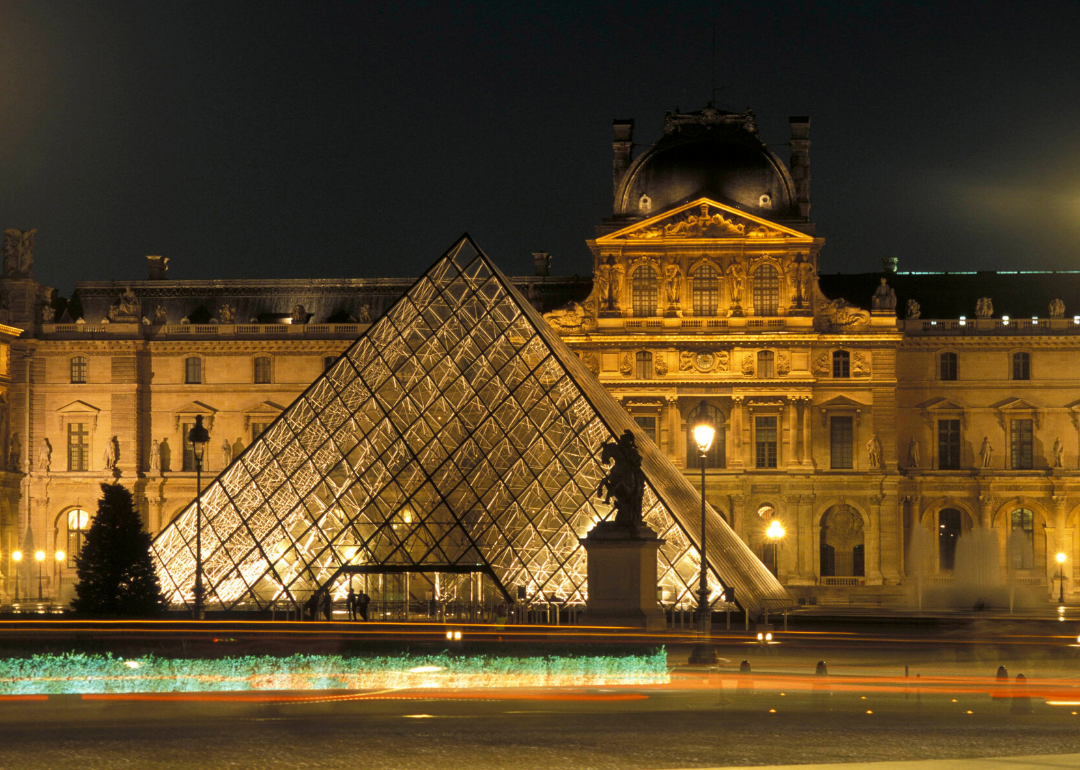
1989: I.M. Pei's Pyramid opens at the Louvre in Paris
In 1983, the president of France, François Mitterrand, approached Pritzker Prize-winning architect I.M. Pei about modernizing the Louvre and helping to create a more intuitive way of navigating the galleries. Upon studying the Louvre, Pei decided that the best solution would be to create an alternative entrance in the center of the courtyard in front of the Louvre that could then funnel people into a more thoughtful underground infrastructure. Pei’s alternative entrance—a pyramid constructed of glass and metal—. The Louvre Pyramid is considered as iconic a symbol of Paris as the Eiffel Tower, which was also met with its fair share of backlash upon its construction.
1990: Bank of China Tower opens in Hong Kong
The same year that I.M. Pei completed the Louvre Pyramid, he and his firm were simultaneously wrapping up construction on the Bank of China Tower in Hong Kong. The asymmetrical tower, which was built to house the headquarters of Bank of China, posed the difficult challenge of creating a skyscraper in a typhoon-prone region where wind-load requirement was a key focus. Pei’s design , which allowed for a stronger resistance to intense winds. The bold design of the building, which uses reflexive mirrors and strong angles makes the building a standout structure in Hong Kong, but has also caused a fair share of controversy. For example,
1991: One Canada Square completed in London
César Pelli, the Argentine architect who would later lead the design of the Petronas Towers in Malaysia, was commissioned to help that would house primarily offices, as well as a select few residential rentals. The design of the building takes influences from iconic British monuments, such as Big Ben, as well as former works of Pelli, like the American Express Tower in New York.
1992: Bank of America Corporate Center completed in Charlotte
Another building designed by César Pelli, the Bank of America Corporate Center project in Charlotte was also shaped in large part by structural engineer Walter P. Moore. To build the structure, as it was the best and most cost-effective option to achieve structural stability while adhering to Pelli’s design, which included the architect’s signature sharp angles and geometric shapes. The 60-story building, which serves as the headquarters for Bank of America, is adorned with a “crown” for metal rods around the top of the building to symbolize the city of Charlotte’s nickname: “The Queen City.”
1993: Umeda Sky Building completed in Japan
A structure that looks somewhat like a futuristic, sci-fi version of the Arc de Triomphe, the Umeda Sky Building in Osaka, Japan, consists of two 40-story skyscrapers bridged together by a “floating” observatory at the top which offers 360-degree views of the city. Designed by Hiroshi Hara, the Umeda Sky Building was the , by which the floating observation garden was constructed on the ground before being lifted by wire atop the towers.
1994: Oriental Pearl Tower completed in Shanghai
Construction of the Oriental Pearl TV Tower in Shanghai began in 1991. The design, which blends traditional styles with an overarching modern construction, is said to have been that compared the droplet-like melody of a pipa instrument with the sound of pearls dropping onto a jade plate. The finished tower, which opened in 1994, includes a museum, a “space capsule,” a glass-bottomed sightseeing deck, and a revolving restaurant.
1995: Barcelona Museum of Contemporary Art is completed
Led by Richard Meier & Partners, took place over the course of eight years, from 1987 to 1995. The design of the building was significantly influenced by Modernism, which is evident from the structure’s lack of ornamentation and focus on clean lines. Though the museum will occasionally display the work of artists from around the world, the
1996: Jane Drew, leading figure of the Modern Movement, dies
A member of Le Corbusier’s CIAM, British architect Jane Drew was a major proponent of not just the modernist movement, but more specifically . This twist on traditional modern design served as a way to bring the modernist trends of Europe into warmer climates like those of West Africa, Ghana, India, and Sri Lanka, where Drew worked on designing schools and housing developments. In 1946, Drew and her husband, British architect Maxwell Fry, actually started their own firm—Fry, Drew, and Partners—with the primary goal of taking on large-scale projects and design planning for tropical countries.
[Pictured: Architect Jane Drew in 1948.]
1997: The start of Neo-Modernism and Parametricism
Neo-Modernism is similar to Modernism in that its approach to architecture is . Parametricism, on the other hand, is a radically new concept that started emerging towards the end of the 1990s with the rise of personal computers and advances in technology. Parametricism utilized the emerging trend of computer- and algorithm-generated building design made possible by programs and workflows like .
[Pictured: The Guangzhou Opera House designed by Zaha Hadid.]
1998: Petronas Twin Towers are completed in Kuala Lumpur, Malaysia
Designed by Argentine American architect Cesar Pelli, the Twin Towers in Kuala Lumpur were built to house the headquarters of Malaysia’s largest petroleum manufacturer, Petronas. Constructed using steel-reinforced concrete foundation and frame with a glass-and-stainless-steel exterior, the towers were at once Modernist in their sleek, metallic aesthetic, yet infused with influences from traditional Islamic art. For example, By the time the towers were completed in 1998, they stood at, which made them the tallest structures in the world, replacing the Sears Tower.
1999: London Eye opens on New Year's Eve
The London Eye——was designed by architects David Marks and Julia Barfield as a submission to a newspaper competition in London sourcing ideas for a new landmark to commemorate the turn of the century. The project was , and the 400-foot ferris wheel, once completed, stood taller than Big Ben. The London Eye remained the largest ferris wheel in the world until the construction of China’s Star of Nanchang.
2000: Experience Music Project opens in Seattle
Experience Music Project—now called —is dedicated to music, science fiction, and popular culture. Designed by Frank Gehry, the goal with the aesthetic of the building was to create something that somehow captured the experience of listening to music. Gehry ultimately covered the exterior of the museum with 21,000 hand-cut shingles made of either stainless steel or painted aluminum that would produce dynamic reflections of light and thus create a shifting experience akin to listening to music.
2001: Twin Towers fall on 9/11
On Sept. 11, 2001—35 years after construction began on the World Trade Center—the Twin Towers were destroyed in a series of terrorist attacks that also targeted the Pentagon in Washington D.C. In New York, two planes that had been hijacked by Islamic extremist group al Qaeda flew directly into the towers, and the second striking the south tower around 9:03 a.m. Both towers completely collapsed by 10:30 that morning, and over 2,600 individuals lost their lives as a result of the World Trade Center attacks.
[Pictured: An aerial view of the World Trade Center rescue site on September 14, 2001.]
2002: Kingdom Centre becomes the tallest tower in Saudi Arabia
The construction of Kingdom Centre was a joint architectural effort between U.S.-based firm Ellerbe Becket and Riyadh-based firm Omrania and Associates. The project was who wanted to see the development of a structure that could represent the country’s role in the global economy. The resulting structure—a 992-foot tall mixed-use complex constructed out of a combination of glass, granite, and brushed aluminum—became (and also housed the tallest mosque in the world on the 77th floor).
2003: Walt Disney Concert Hall opens in Los Angeles
2Designed by Frank Gehry, the architect behind Seattle’s Museum of Pop Culture, the Walt Disney Concert Hall has a . The interior was designed to feel open and bright, but Gehry’s real pièce de résistance was the hall’s seating structure; rather than creating a layout that resembled the typical concert hall—complete with balconies and tiered seating—the architect chose to opt for something that felt more equalizing than dividing.
2004: Taipei 101 begins six-year reign as tallest building in the world
At the time that the construction of , the tallest structure in the world was César Pelli’s Petronas Towers. The 101-story Taiwanese skyscraper, which stood at 1,667 feet with its spire, managed to bump Pelli’s towers in Malaysia out of the top spot. The steel-and-concrete structure, which houses offices in addition to a large shopping center on the lower levels, has , which resembles a tall, layered pagoda.
2005: The last Xanadu House is demolished
The Xanadu Houses were starting in 1979. To construct one of the Xanadu Houses, Masters would inflate a balloon, spray it with polyurethane foam, and then remove the balloon once the foam had dried. Masters would then customize the dried structures to convert them into “houses,” such as by cutting out areas for windows or doors. Masters created two of the houses (one in Tennessee and one in Wisconsin), while Roy Mason designed the Florida home, and they incorporated elements of a “smart house” where tasks like controlling the lights or seeing who was at the door could be computerized. While the experiment ultimately went nowhere—the houses were all demolished, with the Florida home the last to be destroyed in 2005—Masters’ ideas around the evolution of a smart house were not too far off from where things were headed.
2006: High Line groundbreaking in New York City
In 2006, plans to turn the defunct High Line elevated railroad into a 1.5-mile-long park officially went into motion. Ahead of the groundbreaking, , and though many submissions may have earned points for thinking big—e.g., turning the railroad into a roller coaster—the winning submission was that of Field Operations and Diller Scofidio + Renfro. Their design for an elevated park was easy enough to implement while also creating a totally one-of-a-kind serene and natural space in the heart of New York.
2007: Wembley Stadium opens, becoming the biggest football stadium in England
Prior to the , the original Wembley Stadium, which was called Empire Stadium and opened in 1923, had already had a long history in London. Besides hosting the first ever FA Cup final (and every subsequent FA Cup final from 1923–2000), the stadium also hosted the 1948 Olympics. In 2000, however, the old Wembley Stadium was demolished and plans went into place to rebuild a larger version in its place. The project, which was , resulted in a stadium with a 90,000-person capacity and the addition of a retractable roof.
2008: Beijing Summer Olympics showcase a range of architecture
When Beijing hosted the Summer Olympics in 2008, there was as much buzz about the athletic showmanship of the games as there was about. The most famous of the buildings was the Beijing National Stadium, which was referred to as the “Bird’s Nest.” The stadium, which was the site of the Opening Ceremony, was designed by Herzog & De Meuron in collaboration with Chinese artist and activist Ai Weiwei. Other notable architectural masterpieces from the 2008 Olympic Games in Beijing included the National Indoor Stadium, which was called “The Fan,” as well as the Beijing National Aquatics Center.
2009: Largest U.S. embassy opens in Baghdad
When the Americans and Iraqis dedicated the , the idea was that the milestone would mark a turn in American-Iraqi relations. The embassy, which is the largest U.S. embassy in the world, cost $600 million just to build. Designs for the embassy ahead of its construction were completed by a Kansas City architectural firm called Berger Devine Yaeger.
2010: Burj Khalifa, the world's tallest building, opens
Led by architect Adrian Smith, architects Skidmore, Owings & Merrill LLP and Emaar Properties developers, the construction of the neo-Futuristic Burj Khalifa began in 2004, just one year after Taipei 101 earned the title of tallest building in the world, which the Dubai building would soon snatch. As the project progressed, special considerations had to be taken into account to accommodate a structure of that size. For example, the unique Y-shape of the tower is as much functional as it is aesthetic; the shape helps reduce the damaging effects of wind, which become more detrimental the taller the building gets. By the time the construction of the multi-use tower was complete in 2010, it had already broken a number of world records, only the least of which was the tallest building in the world. Beyond that, Burj Khalifa has set records including hosting the highest BASE jump from a building, the highest fireworks on a building, and the most floors in a building.
2011: Seville’s Metropol Parasol becomes the world’s largest wooden structure
In the early 2000s, the City of Seville was focused on trying to revitalize the once-bustling Plaza de la Encarnación. In doing so, the city held a competition to collect bids for architectural projects that could potentially return the region of the city to its former splendor. The structure that came to be chosen for the space was one designed by a German firm called J. MAYER H., led by architect Jürgen Mayer H. that incorporated flowing parasols and a waffle-like composition. By the time the project was completed in 2011, in addition to being the world’s largest wooden structure, the Metropol Parasol was also the largest construction to be held together using polyurethane, or foam seal.
2012: The Shard is completed in London
Designed by architect Renzo Piano, The Shard is a multi-use building that houses everything from restaurants to corporate offices. At the time of the building’s development, a number of hurdles held up the project that were only overcome when . Despite having an incredibly aggressive aesthetic as far as blending-in goes, the final Shard tower still achieves a sense of harmony with the city thanks to its reflective glass exterior that quite literally transforms with its surroundings.
2013: Amsterdam's Rijksmuseum reopens after a 10-year renovation project
When , the Rijksmuseum, closed for renovations in 2003, the plan was to have everything back up and running three years later. However, a slew of setbacks, including asbestos problems and the departure of the museum’s director, caused the museum to instead remain closed for a decade. In 2013, the museum finally opened its doors again and debuted—among other long-anticipated improvements—a completely redesigned atrium. Amidst all of the changes, the only thing that remained in its former position was Rembrandt’s “The Night Watch.”
2014: One World Trade Center completed in New York City
Nearly five years after the 9/11 terrorist attacks on the World Trade Center, work started on a project to build a new tower. One World Trade Center—also called the “Freedom Tower”—was designed by David Childs and was built with a hybrid . The exterior of the 1,776-foot tower is comprised of a special glass that is at once highly reflective to create a unique kaleidoscope effect when hit by light and also incredibly transparent. One World Trade Center officially , and in addition to leasing corporate offices, the tower is also home to the “One World Observatory” observation deck.
2015: Original Sardar Patel Stadium demolished and new construction begins
In 2015, the was torn down with plans to build a larger, better-designed stadium that would be completed in two years. Though the project wasn’t completed in the original timeline, updated projects estimate the new Sardar Patel Stadium will be completed in 2020. In addition to increased audience capacity, additional improvements to the stadium will include a 55-room clubhouse that will house an Olympic-sized swimming pool, an indoor cricket academy, and a fabric roof system designed by Walter P. Moore, whose previous work includes the Bank of America Tower. Once complete, the new Sardar Patel Stadium is positioned to become the world’s largest cricket stadium.
[Pictured: U.S. President Donald Trump speaks at Sardar Patel Stadium on February 24, 2020.]
2016: Chilean architect Alejandro Aravena awarded the Pritzker Architecture Prize
Among Alejandro Aravena’s greatest architectural . The Chilean architect’s firm, Elemental, has been working for over a decade to rehouse families who have been left homeless and squatting because of economic hardship. Aravena’s innovative approach to the problem is to provide basic concrete-terraced houses that act as a blank slate for families who can start with the frame and make the space feel like their home from there. This work in socially aware and conscious architecture earned Aravena the 2016 Pritzker Prize in Architecture.
[Pictured: Chilean architect Alejandro Aravena, Director of the Biennale di Venezia, speaks in Santiago, Chile in 2016.]
2017: Apple Park completed in California
When ., the plan was to construct a space that felt more like a campus than it did a traditional office space or company base. and continued through 2018, though the 175-acre campus was opened to employees in 2017, before all construction had wrapped up. Architectural designs for the project—including those for a central Ring Building, the Steve Jobs Theater, a 100,000-square-foot fitness and wellness center, etc.—were , while the campus’ natural landscape was
2018: Amazon Spheres open in Seattle
Located at the base of Amazon’s campus in downtown Seattle, where employees can work amidst the foliage in the enclosed gardens. , the structures were meant to push the boundary of a traditional workspace by giving the e-retailer’s employees a chance to step away from traditional offices and desks in favor of working and collaborating in the presence of nature. Construction on the Spheres—w³¦³ó are made of a combination of glass, concrete, and steel—began in 2015, and over the next three years, the structures were completed and slowly filled with plants to allow the ecosystems to thrive.
2019: Notre-Dame de Paris catches fire
A UNESCO World Heritage Site, Notre-Dame de Paris is one of the most iconic landmarks in the French capital. The medieval Gothic cathedral, which dates back to the 12th century, is from around the world each year, which is actually double the amount of people who visit the Eiffel Tower. In April 2019, the historic church was engulfed in flames due to a structural fire, which ultimately destroyed the cathedral’s spire and ceiling—dubbed “the forest” because of the ceiling frame’s strong use of (very flammable) oak wood—before it was extinguished. Reconstruction plans for the church are underway, led largely by French architect Philippe Villeneuve, but about how to approach the restoration continue to pose difficulties in moving forward.