Do you know your American history?
U.S. history books are filled with tales of brave heroes who fought and died to stay true to the ideals of a wild, new world order focused on equality and freedom. Those iconic characters you read about—from Harriet Tubman and Crazy Horse to Abraham Lincoln and Martin Luther King Jr.—represent revolutionaries with progressive ideals who fought relentlessly for what they hoped to make a more perfect union bolstered by a government that would support each of its people in their individual quests for happiness.
Some of our country's greatest civil advancements have come at a terrible price; paid for with bloody battles, imperfect leadership, and the scars left behind from racism, sexism, and even genocide. Our history includes the mass killing of Native Americans and the scourge of American slavery as much as it includes the Declaration of Independence and the .
America's greatness comes in even measure with her complex past, with countless demonstrations of unchecked power and the foolish notion of boundless growth; but it is also borne of great showings of empathy and what is possible when, as a nation, we defer to our "."
To take a look at the rich history of the United States—from battles won in favor of righteousness and equality to periods of extreme darkness—Â鶹ԭ´´ used a variety of historical sources and photographs to put together a quiz highlighting key events in American history. On each slide, you'll find part of a historic photo that matches a clue about American history from that year. On each subsequent slide will be the answer, along with some background on the significance of that event.
Keep reading to test your knowledge of American history, from the Roaring '20s and Mickey Mouse's debut film to the civil rights movement and Watergate.
You may also like:
Clue: 1920
What landmark legislation was signed in 1920—after first being proposed in 1878?
1920 Answer: The 19th Amendment
The , passed June 4, 1919, and ratified Aug. 18, 1920, secured all American women’s right to vote. The legislation came on the heels of decades of organizing, protesting, appealing to government officials, and working to push through suffrage acts in individual states—which resulted in nine western states passing suffrage laws by 1912.
[Pictured: Three women suffragists cast votes.]
Clue: 1922
Two years after the legislation was passed, what national law actually saw increased use of the very thing it banned?
1922 Answer: Prohibition
Reporting from the suggests alcohol consumption began to rise in 1922 after a period of decline. Prohibition was in effect from 1920 to 1933, during which time the black market and mob activity spiked—not to mention tax dollars toward enforcing the law.
Federal agents were tasked with enforcement, which meant regular Prohibition raids at speakeasies, restaurants, coffee houses, saloons, vehicles, and private property. alone saw thousands of raids throughout Prohibition.
[Pictured: New York City Deputy Police Commissioner John A. Leach, right, watching agents pour liquor into sewer following a raid during the height of prohibition.]
Clue: 1923
Which U.S. president died in 1923 from a heart attack?
1923 answer: Warren Harding dies
President Warren Harding served from 1921 until 1923 when he died from a heart attack while on a tour out west. Calvin Coolidge was sworn in as the 30th president of the United States on Aug. 2, 1923, the same day Harding died. Harding’s funeral was held at the Capitol on Aug. 8.
[Pictured: People in a long line waiting to pay respects to President Warren Harding in August 1923. He laid in state at the Capitol before his funeral there Aug. 8.]
Clue: 1924
What milestone did Ford Motor Company reach in 1924?
1924 answer: The production of its 10 millionth vehicle
The 10 millionth automobile produced by Ford Motor Company was a Model T. Company founder Henry Ford sent the vehicle on a publicity tour along the Lincoln Highway.
[Pictured: A view inside the Ford Motor Company factory.]
Clue: 1925
Tens of thousands of members from what group marched brazenly in Washington in 1925?
1925 answer: The Ku Klux Klan
The —it was mainstream. The hate group, which even then did not hide its anti-Semitism, anti-Catholic, and anti-Black stances, had its own baseball team, sponsored father-son outings and beautiful baby contests, and even hosted road rallies and festivals. The relative public acceptance of the KKK was perhaps most grossly apparent at a in August 1925 when 40,000 unmasked KKK members marched along Pennsylvania Avenue.
[Pictured: Unmasked Klansman parade on the nation's capital.]
Clue: 1926
Which system, established in 1926, simplified road navigation for U.S. motorists traveling throughout the country?
1926 answer: The U.S. Numbered Highway System
The U.S. Numbered Highway System was a dramatic upgrade to an existing that, with routes such as Victory and Lincoln Highways, didn’t imply which direction the road went. Numbered routes follow a basic framework: Highways traveling east to west are generally even-numbered, while north-south highways get odd numbers.
[Pictured: Americans take to the roads in great numbers.]
Clue: 1927
Charles Lindbergh completed what historic trip on May 21, 1927?
1927 answer: First solo flight across the Atlantic
was trained as a pilot while serving in the U.S. Army, and was working as a pilot for U.S. Mail when he heard about a $25,000 prize for flying nonstop between New York and Paris. Lindbergh was 25 years old when he successfully made the historic trip, touching down at Le Bourget Airfield just north of Paris where he was greeted by 100,000 people who’d come to celebrate his achievement.
[Pictured: American aviator Charles Lindbergh arrives at Croydon Airport in the U.K. after his historic flight across the Atlantic, May 1927.]
Clue: 1931
Which iconic New York City building had its design updated 15 times between its ground-breaking in 1930 and completion in 1931, ensuring it would be the world's tallest building when it opened?
1931 answer: Empire State Building
The Empire State Building was completed after 13 months of work that included five confirmed deaths. The building’s official open was May 1, 1931; President Herbert Hoover had the privilege of pushing a button in Washington D.C. on that day to turn on the Manhattan building’s lights.
[Pictured: Workman on the framework of the Empire State Building.]
Clue: 1933
The 21st Amendment was ratified Dec. 5, 1933, to signify what?
1933 Answer: Prohibition repeal
Prohibition grew increasingly unpopular over its 13-year span. Over that time, it is estimated that for the federal government and the deaths of 10,000 people from drinking bathtub gin.
[Pictured: Customers celebrate Prohibition’s end at a Philadelphia bar in December 1933.]
Clue: 1934
Which man-made disaster affected American and Canadian prairies from 1930 to 1936?
1934 Answer: The Dust Bowl
The represents a cautionary tale in American history that demonstrates what happens when unsustainable farming practices are followed. Wind erosion, resulting from deep tilling and other dryland farming, turned lush fields to the desert and sent hazardous dust into the air.
[Pictured: A dust storm approaches Springfield, Baca County, in May of 1937.]
Clue: 1935
On Aug. 14, 1935, FDR signed what act into law that (among other things) was set up to provide income after retirement to those 65 years and older?
1935 answer: Social Security Act
The Social Security Act created the Social Security Board (later the Social Security Administration), which sought to provide insurance for the unemployed and elderly, assistance for the handicapped, and workers’ benefits. Its impetus drew from the Great Depression, still in full swing in 1935, which exposed a need for caring for the country’s most vulnerable.
[Pictured: President Roosevelt signs Social Security Act on Aug. 14, 1935.]
Clue: 1936
One of the most significant elements of FDR’s New Deal was this legislation, which stipulated that the federal government provide low-cost loans to farmers that would bring what to rural parts of the United States?
1936 answer: Electricity
Prior to 1936’s Rural Electrification Act, were without power. Along with the legislation came the need to train people how to use electricity, so an “electric circus” was scheduled that would demonstrate to farmers and other people living in remote locations the value of electrifying their homes.
[Pictured: Workers extend power lines.]
Clue: 1940
German troops entered and conquered which city on June 14, 1940?
1940 answer: Paris
Approximately 2 million Parisians had already fled the city when German tanks rolled in for occupation in 1940. A large swastika was hung under the Arc de Triomphe as German Gestapo set about with arrests and questioning throughout Paris.
Clue: 1941
What major Dec. 7, 1941, event caused the United States to officially enter World War II?
1941 answer: The bombing of Pearl Harbor
Japan’s onslaught of Hawaii’s lasted roughly two hours and involved attacks by air and sea. In the water, launched five Midget subs while two waves of aerial attacks from all directions came from bombers and fighters raining enemy fire down over Oahu. The first shot fired that day was actually from the U.S. when the USS Ward sank a Ko-hyoteki-class sub.
Clue: 1943
The 1941 bombing of Pearl Harbor and the official entrance of the U.S. into World War II led to panic among the American West Coast over national security and the issuance of Executive Order 9066, which relocated all people of Japanese descent (whether citizens or not, and people of all ages) out of the Pacific military zone and into what?
1943 answer: Internment camps
The Pacific military zone stretched along the entire West Coast and as far east as the Cascade Mountains rim in Oregon and Washington. Two-thirds of the were born in the United States. In addition to being blatantly racist, internment camps also posed safety issues for the Japanese held there. Overcrowding meant diseases spread easily, with over deaths recorded from 1942 to 1946 due to tuberculosis. FDR suspended the order in 1944, with the last internment camp () closing in March 1946.
[Pictured: Members of the Mochida family await evacuation by War Relocation Authority in Hayward, Calif.]
Clue: 1944
This iconic photo shows part of the largest seaborne invasion in military history. Also known as “Operation Neptune,” the Allied liberation effort of France during World War II began on what is now commonly known as this “day.”
1944 answer: D-Day
D-Day, or Operation Neptune, refers to the Normandy Landings by the U.S. and its allies to initiate the France liberation effort from German control during WWII. This particular photo shows the U.S. Army 1s Infantry arriving at Omaha Beach in Normandy by amphibious vehicle.
[Pictured: American soldiers arriving at Omaha Beach, June 6, 1944.]
Clue: 1945
Crowds celebrated this momentous occasion in New York City’s Times Square in the summer of 1945. Also known as V-J Day, the date of this gathering is one of the most iconic in American history as this news was delivered.
1945 answer: Victory over Japan announced
The Japanese surrender effectively brought World War II to end. Following years of global conflict and massive death tolls since fighting began in 1939, there was an obvious cause for celebration when the news hit America, and the nation realized they had entered mid-century peacetime.
[Pictured: Americans celebrate V-J day in New York’s Times Square on Aug. 14, 1945.]
Clue: 1946
Four female programmers and mathematicians proudly pose for a moment marking this technological completion. They hold parts of a much larger machine—the most powerful at the time—which was commissioned during WWII and intended for military purposes.
1946 answer: ENIAC Computer debuts
Patsy Simmers, Gail Taylor, Milly Beck, and Norma Stec all programmed and debuted ENIAC: the Electronic Numerical Integrator and Computer. The first programmable electronic digital computer, it debuted in 1946 after the army commissioned its construction for calculating artillery range.
[Pictured: Patsy Simmers (mathematician/programmer), holding ENIAC board, Gail Taylor, holding EDVAC board, Mrs. Milly Beck, holding ORDVAC board, Norma Stec (mathematician/programmer), holding BRLESC-I board.]
Clue: 1947
This historic moment in American sports was made in 1947 in New York by a four-sport star athlete and graduate of UCLA.
1947 answer: Jackie Robinson breaks the color barrier in Major League Baseball
Jackie Robinson broke baseball’s color barrier at Ebbets Field in Brooklyn on April 15, 1947, for the Dodgers. He drew a walk, scored a run, and Brooklyn won 5-3.
[Pictured: Jackie Robinson of the Brooklyn Dodgers warming up before a game on Ebbets Field.]
Clue: 1950
Where did President Harry S. Truman order U.S. forces to on June 27, 1950?
1950 answer: South Korea
The United States defended the democratic nation of South Korea in the , which lasted from 1950 to 1953. The war had more civilian casualties than World War II and the Vietnam War. Roughly 5 million people died in total, almost 40,000 of whom were Americans.
[Pictured: Soldiers in South Korea.]
Clue: 1951
The Twenty-Second Amendment set what limitations on the presidency?
1951 answer: Term limits
President Franklin D. Roosevelt handily won a third time in 1940 in a race against Wendell Willkie that was marred by drama over whether it was appropriate for a president to serve three terms. In 1944 he won reelection to his fourth term, cementing opposition to such long presidencies and leading to the while President Harry Truman was in his second term in office. The amendment's language allowed the incumbent president to run for a third term; however, after losing the New Hampshire primary.
[Pictured: President Truman waving from the steps as he prepares to board his airplane in Washington for a vacation trip to Florida in March 1952.]
Clue: 1953
Julius and Ethel Rosenberg were put to death for what in 1953?
1953 answer: Espionage
During World War II, a group of researchers and developers created the Manhattan Project to figure out how to produce nuclear weapons. Throughout that project, —or spying to share government secrets with other countries—was of grave concern. U.S. citizens Julius Rosenberg, an electrical engineer, and his wife, Ethel, were found guilty of conspiring to share U.S. atomic secrets with the Soviets. The case was exceedingly controversial for taking place at the height of McCarthyism and the Red Scare, and the Rosenbergs were the only Americans to receive the death penalty during the Cold War for espionage.
[Pictured: Julius and Ethel Rosenberg, separated by heavy wire screen as they leave U.S. Court House after being found guilty by the jury.]
Clue: 1954
Debuting in 1954 was what consumer item that changed at-home entertainment forever?
1954 answer: Color television
Admiral and Westinghouse were the first to sell color TVs, but it was , released in March 1954, that made color television mainstream. The secret? Compatibility built into one screen that added a layer of color to black and white screens thanks to two sets of circuits operating within one console. The price tag on the CT-100 in 1954 was $895—more than $7,000 today.
[Pictured: An American family watching television in 1958.]
Clue: 1955
Ray Kroc opened the first franchise of what business on April 15, 1955?
1955 answer: McDonald's
The mega-corporation McDonald’s began in 1948 as a small restaurant by brothers Richard and Maurice “Mac” McDonald in San Bernardino, California. Their small operation bought appliances from Ray Kroc, a salesman who visited the shop in 1954 out of curiosity over their order of eight malt and shake mixers to meet demand. Kroc discovered that the McDonald brothers had revolutionized ways to efficiently produce and sell high volumes of inexpensive food and offered to help the business franchise. Today, McDonald’s serves food out of 36,000 restaurants in more than 100 countries around the world.
[Pictured: The exterior of a McDonald's fast-food restaurant in August 1970.]
Clue: 1956
What 41,000-mile national network was enacted on June 29, 1956, by President Eisenhower to the tune of $26 billion?
1956 answer: Interstate Highway System
The push for a in the United States began in the late ‘30s and received attention from President Franklin D. Roosevelt, who was attracted to the potential jobs such a project would create. President Eisenhower signed the , which at the time was the biggest public works project in American history. In addition to serving civilian needs, interstates were seen as potential assets in emergency evacuation situations and offered emergency landing space for planes (although the highways were not designed for that express purpose).
[Pictured: A busy motorway linking the Hollywood and Ventura freeways in Los Angeles.]
Clue: 1957
The first black students to attend a desegregated high school in Arkansas in September 1957 came to be called what?
You may also like:
1957 answer: The Little Rock Nine
On May 17, 1954, the U.S. Supreme Court found state-sanctioned segregation of public schools to be unconstitutional. Three years later, nine black students known as the ” arrived at Central High School in Little Rock, Arkansas, in order to integrate the school. The students comprising the Little Rock Nine were Minnijean Brown, Elizabeth Eckford, Ernest Green, Thelma Mothershed, Melba Pattillo Beals, Gloria Ray Karlmark, Terrence Roberts, Jefferson Thomas, and Carlotta Walls LaNier.
The students were scheduled to attend the school on Sept. 3, 1957; however, then-Arkansas Gov. Orval Faubus ordered the National Guard to block the school’s entrance. The students tried again on Sept. 4, only to be blocked by large protesting crowds, and again Sept. 23—on which date they were in class for three hours only to be sent home when protesters attempted to break into the high school.
On Sept. 25, President Eisenhower sent U.S. Army troops along with the federalized National Guard, who chaperoned the students to Central High and made sure they could attend class.
[Pictured: African American students arrive at Central High School in Army vehicles, escorted by soldiers from the 101st Airborne Division.]
Clue: 1960
The first televised presidential debates in U.S. history helped contribute to which candidate’s narrow success in 1960?
1960 answer: John F. Kennedy
The 1960 presidential election results represent one of the closest margins in U.S. history. Contributing to Kennedy’s victory may have been the first televised debate. Those who listened to the broadcast via radio overwhelmingly found Richard M. Nixon to be the winner, while the (a full one-third of the population at the time) determined the young and energetic John F. Kennedy to be the victor.
and director of the televised debate, later said Kennedy benefitted by looking “tan and fit” while Nixon looked “like death warmed over.”
[Pictured: Sen. John F. Kennedy (1917–1963) is given a rousing ovation during his presidential campaign.]
Clue: 1961
What was the name given to civil rights activists who traveled by bus to segregated southern states in 1961 to protest a lack of enforcement of a 1960 Supreme Court decision that found segregated interstate facilities unconstitutional?
1961 answer: Freedom Riders
The represent the first wave of 400-plus people who volunteered to ride interstate buses such as Greyhound and Trailways throughout the South over the course of seven months in 1961 in order to fight racial segregation. The activists were met with violence and arrest, including angry mobs blocking buses, slashed tires, physical attacks, and even fire.
[Pictured: A group of black Americans get off the 'Freedom Bus' at Jackson, Mississippi, to protest against the segregation of passengers on the nation's buses.]
Clue: 1963
What president was buried in 1963 at Arlington Cemetery just two weeks after laying a Veterans Day wreath there at the Tomb of the Unknown Soldier?
1963 answer: John F. Kennedy
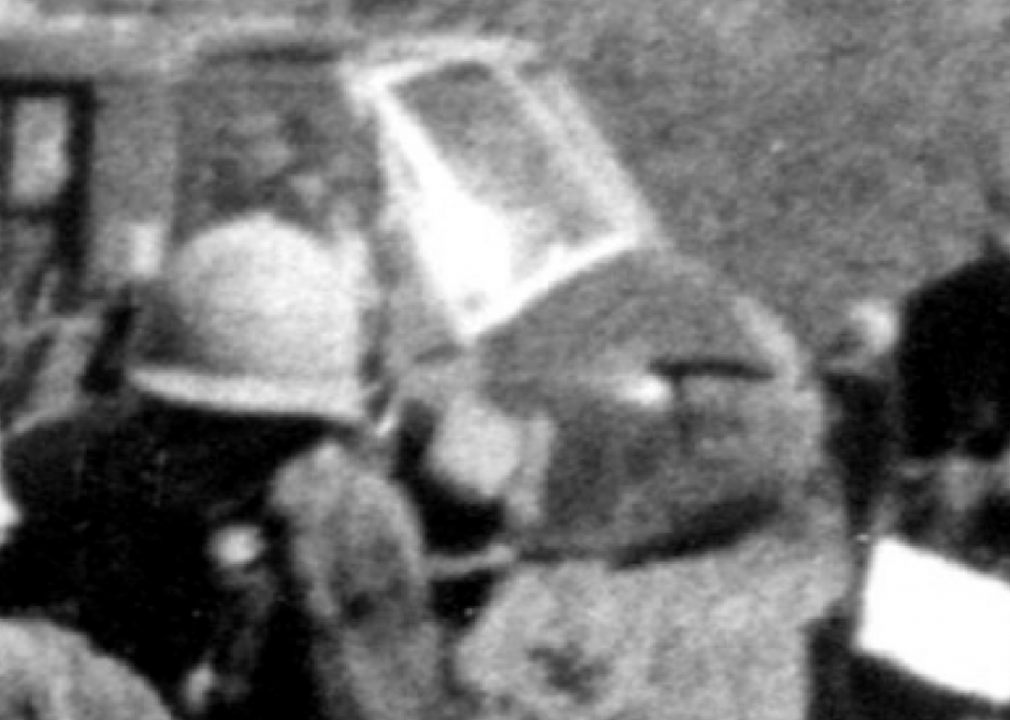
JFK’s murder marked the fourth in U.S. history. The shooting—which remains unsolved today—might have never happened had the morning rain not stopped. The convertible he would be traveling in on Nov. 22, 1963, in Dallas had been outfitted with a plexiglass, bulletproof bubble top, which JFK preferred to go without. The bubble top was removed when the sun came out, leaving the president vulnerable to the gunfire that would kill him at 12:30 p.m. that day.
[Pictured: Jacqueline Kennedy, Edward Kennedy, and Robert Kennedy stand as the coffin of President John Fitzgerald Kennedy passes them.]
Clue: 1964
What band, formed in Liverpool, England, arrived in the United States on Feb. 7, 1964?
1964 answer: The Beatles
Beatlemania hit the United States in 1964 with the band’s first appearance on the “.” Viewership records were made as —73 million people—tuned in for the broadcast.
[Pictured: Press photographers scramble for the best pictures as British pop group The Beatles depart from London Airport, bound for America.]
Clue: 1965
Citing the “outrage of Selma,” President Lyndon B. Johnson signed into law what landmark voting legislation on Aug. 6, 1965?
1965 answer: Voting Rights Act
Historic strides in civil rights throughout the 1950s and 1960s were in direct relation to highly organized actions throughout those decades. Looking back at landmark legislation passed as the result of the civil rights movement, that “Montgomery led to the Civil Rights Act of 1957 and 1960; Birmingham inspired the Civil Rights Act of 1964, and Selma produced the voting rights legislation of 1965.”
[Pictured: Marchers with signs at the March on Washington in August 1963.]
Clue: 1966
Which United States agency drafted 382,010 men into military service in 1966?
1966 answer: Selective Service System
The Selective Service System of the United States tracks information on all individuals who may potentially be drafted into the military. 1966 represents the
[Pictured: American soldiers get off helicopters during the operation "Double Eagle" against a Vietcong position at Bon Son, South Vietnam, March 7, 1966.]
Clue: 1967
One of the bloodiest race riots of the 20th century occurred in the summer of 1967 to protest police action in what American city?
You may also like:
1967 answer: Detroit
in 1967 represent a breaking point over ongoing issues related to black unemployment and segregated communities. The tipping point to this unrest came on July 23, 1967, when police busted an unlicensed bar where a party was underway to welcome home two black servicemen from fighting overseas in Vietnam.
As revelers were arrested and hauled out of the bar, a crowd gathered. The scene erupted when a bottle was tossed through a police car window, with demonstrations and violent face-offs lasting five days. Forty-three people died in the riots, 7,200 were arrested, and 1,189 were injured.
[Pictured: A policeman stands guard in a Detroit street on July 25, 1967, as buildings are burning during riots that erupted in Detroit following a police operation.]
Clue: 1970
Which environmental agency was formed in 1970 to offer protections for human and environmental health?
1970 Answer: The EPA
President Richard Nixon used an Executive Order to establish the (EPA) in 1970. The move came in the wake of public outcry over environmental pollutants seen to be harming humans and the environment. In November 2019, a draft of the ,” sought to reduce which scientific and medical research would be adopted by the EPA for establishing regulations related to public health.
[Pictured: A West Los Angeles freeway photographed by an EPA photographer documenting subjects of environmental concern.]
Clue: 1971
What civilian movement gained strength throughout the 1960s and led to the end of the Vietnam War?
1971 answer: Anti-war protests
The anti-war protests of the 1960s and ‘70s demonstrated waning public support for the Vietnam War. After the were held in 1969, the gained significant momentum and eventually put sufficient pressure on the United States government to bring troops home beginning in 1973.
[Pictured: Democratic Party Rep. Parren Mitchell addresses an anti-war demonstration on the steps of the U.S. Capitol building in Washington D.C. on May 5, 1971.]
Clue: 1972
Which Constitutional amendment in 1972 was made possible due to the tireless work of New York Rep. Bella Abzug, Gloria Steinem, and Betty Friedan?
1972 answer: Equal Rights Amendment
The is a law passed in 1972 proposing an end to gender-based discrimination. But while the legislation went through almost 50 years ago with a two-thirds vote, to ratify it required the approval of at least 38 states. At the time, a deadline of seven years was given for that state-by-state ratification. But by 1979 just 35 states were on board, causing Congress to push the deadline to 1982—another year that came and went without ratification.
Change has come in pieces, with Nevada ratifying the ERA in 2017 and Illinois in 2018. With Democrats in November 2019 taking control of Virginia’s Senate and House of Delegates, it’s probable that state will become the 38th to necessary to finally ratify the ERA.
[Pictured: Women’s Equal Rights march in Washington D.C., Aug. 26, 1977.]
Clue: 1973
A national crisis in 1973 was a result of a shortage of what resource?
1973 answer: Gasoline
In the midst of the Arab-Israeli War in 1973, the United States sought to leverage its own interests in peace negotiations and gave support to the Israeli military. In retaliation, members from the Organization of Petroleum Exporting Countries (OPEC) embargoed oil being sent to the United States. That ban on trade sent . The led to an odd- and even-numbered system by which consumers could purchase gas, which was in short supply throughout the U.S. Effects of the crisis—including layoffs, limited access to energy, and inflation—lasted throughout the ‘70s.
[Pictured: The state of Oregon was the first to go to a system of odd and even numbers during the gasoline crisis in the fall and winter of 1973–1974.]
Clue: 1974
In 1974, Richard Nixon became the first (and only) president to do what?
1974 answer: Resign
in 1974 was the result of the Watergate scandal, which involved bugging phones at the Democratic National Committee headquarters (located in the Watergate complex) and stealing documents in order to help Nixon win reelection. That case broke open when five men were arrested for breaking into the headquarters in order to fix the wiretaps that had been improperly installed on the phones there.
Nixon denied involvement and indeed won reelection by a landslide in 1972; but a whistleblower exposed the president’s close coordination with the illegal activity, leading journalists Carl Bernstein and Bob Woodward broke the story in the Washington Post. Facing removal from office, Nixon resigned.
[Pictured: The 37th president of the United States, Richard Nixon, bids farewell to the White House staff on August 9. Family members are (L-R): First Lady Pat Nixon, hidden behind the president, daughter Tricia Nixon Cox, and her husband Edward Cox.]
Clue: 1975
The capture of which city in South Vietnam brought about the end of the Vietnam War?
1975 answer: Saigon
Anti-communist allies Australia, the Philippines, South Korea, the U.S., and others supported South Vietnam throughout the . After years of conflict, North Vietnam took control over in South Vietnam, leading to surrender and removal of U.S. troops from the city, which was renamed in honor of the nationalist leader and president of North Vietnam who died in 1969.
[Pictured: North Vietnamese Army (NVA) forces take over the South Vietnamese presidential palace in Saigon April 30, 1975.]
Clue: 1976
Which series of celebrations in the 1970s marked the creation of the United States?
1976 answer: America's Bicentennial
came in honor of the adoption of the Declaration of Independence in 1776. One element of the celebrations—which lasted more than a year—was the posthumous naming of George Washington as General of the Armies of the United States.
[Pictured: The New Hope Singers International marching band wears 18th-century costumes while playing flute, guitar, and drums during the “Spirit of '76” American Bicentennial celebrations in Central Park, New York City.]
Clue: 1977
Which 1977 movie release broke significant barriers in tech, the sci-fi genre in general, and set cultural milestones still felt today?
1977 answer: ‘Star Wars’
From a computer-programmed camera system called the Dykstraflex and the speed of the film’s special effects to never-seen-before merchandising and revolutionary sound, of film. The film also borrowed a from ancient myth and put it square into a Western movie trope while examining issues of diversity, war, and a distinctly American sentiment of rooting for the underdog who is, while complicated and imperfect, ultimately beyond reproach.
[Pictured: A cinema marquee in 1977 showing "Star Wars."]
Clue: 1980
For what reason were international representatives bearing their flags in the snowy terrain of upstate New York?
1980 answer: XIII Winter Olympics in Lake Placid, NY
On February 14, 1980, athletes and spectators representing countries all over the world came together for the torch-lighting ceremony to kick off the Winter Olympics in Lake Placid.
[Pictured: Spectators and athletes from all over the world watch the opening ceremony of the XIII Winter Olympic Games on Feb. 14, 1980, in Lake Placid.]
Clue: 1981
Who is pictured here in February 1981, and why is he showcasing this economic chart?
1981 answer: President Reagan takes office, outlines economic policy
A month after first taking office, President Ronald Reagan outlined his new economic plan—Reaganomics, or “trickle-down”—which would take a laissez-faire market approach, reduce government spending, and cut taxes to stimulate growth.
[Pictured: President Ronald Reagan holding a chart as he tells the American people about his new budget, Washington D.C., Feb. 5, 1981.]
Clue: 1982
Which non-human entity in 1982 became Time magazine’s Man of the Year?
1982 answer: The personal computer
Neither a human nor a man, the personal computer won the 1982 honors. Time’s editors had never before chosen a non-human recipient.
[Pictured: A 4-year-old girl receives a computer that used to belong to her father as a birthday present.]
Clue: 1983
Which anti-United States deadly attack transpired in 1983 in the Middle East?
1983 answer: U.S. Embassy in Beirut bombed
On April 18, 1983, the United States Embassy in Beirut, Lebanon, was attacked via suicide bomb as a response to American intervention in the Lebanese Civil War. Although a pro-Iranian group claimed responsibility at the time, it was later determined that Hezbollah had carried out the attack.
[Pictured: Aerial view of the United States embassy in Beirut, April 18, 1983, after a bomb destroyed part of the building.]
Clue: 1984
Who is addressing his supporter base in the fall of 1984 ahead of an election?
1984 answer: President Reagan
Incumbent President Ronald Reagan addressed his supporters just a few days prior to the 1984 election. , whereby Reagan carried all but one state and took 58.8% of the popular vote. At the time, he was 73 years old—making him the .
[Pictured: President and Republican presidential candidate Ronald Reagan address supporters at an electoral meeting in November 1984, a few days before the American presidential election.]
Clue: 1985
Jean-Claude Chermann, a French professor, is seen here working on infectious research relating to what 1980s epidemic?
1985 answer: AIDS epidemic
This photo was taken two years after Chermann and a research team discovered the AIDS virus, which had become an American epidemic by the mid-80s. Between 1983 and 1986 they had discovered HIV 1 and 2, and shown how the former progressively attaches to and destroys certain white blood cells that combat infections.
[Pictured: Professor Jean-Claude Chermann works on April 25, 1984, in the laboratory of research on the AIDS virus of the Institut Pasteur in Paris.]
Clue: 1986
What infamous NASA orbiter is shown here during liftoff for its 10th flight?
1986 answer: Space Shuttle Challenger
The Space Shuttle Challenger broke apart after liftoff just over a minute into its 10th mission, killing all seven aboard. The disaster was televised and thus witnessed by many live.
[Pictured: Space Shuttle Challenger launches from launchpad 39B at the start of STS-51-L at the Kennedy Space Center in Florida, Jan. 28, 1986.]
Clue: 1987
What financial event caused some to hang their head, and many to panic?
1987 answer: Stock market crash
This Wall Street trader’s dismay came at the hands of Black Monday—the start of the unprecedented stock market crash of October 1987, when the Dow Jones Industrial Average plummeted over 22%.
[Pictured: A trader (c) on the New York Stock Exchange reacts on Oct. 19, 1987, as stocks are devastated during one of the most frantic days in the exchange's history.]
Clue: 1990
What landmark 1990 legislation prohibited discrimination against individuals experiencing physical or mental limitations?
1990 answer: Americans with Disabilities Act
The (ADA) fundamentally prohibited discriminatory practices based on an individual’s disability in cases related to public and private enterprises or services, from employment and transportation to schools and retailers. The act was signed into law by July 26, 1990, by President George H.W. Bush.
[Pictured: President Bush signs the Americans With Disabilities Act on July 26, 1990.]
Clue: 1991
Which major U.S. military conflict overseas was the first of its kind following the Cold War?
1991 answer: Operation Desert Storm
Military action for the Gulf War, with lead-up beginning in 1990, was officially authorized by President George H.W. Bush in January of 1991 in response to Iraq crossing the border into Kuwait in August 1990. The U.S. mandate called for any necessary means to force Iraq’s withdrawal from Kuwait. Operation Desert Storm lasted just 43 days.
[Pictured: F-15C Eagles fly over Kuwait during the Gulf War in 1991.]
Clue: 1992
What court decision in 1992 sparked the Los Angeles Riots?
1992 answer: The Rodney King verdict
Following the acquittal of four Los Angeles police officers for the documented, violent beating of , Los Angeles erupted in five days of riots in 1992. Similarly to the Detroit riots in 1967, L.A.’s riots were the result of years of racial tension and inequality brought to a head by the March 1991 beating of King, who led police on a high-speed chase before he was captured. The resulting attack—observed by more than a dozen officers—left King with permanent brain damage, multiple broken bones and teeth, as well as skull fractures.
[Pictured: Flames roar from a Thrifty Drug store in the Crenshaw neighborhood of Los Angeles as riots brake out on April 29, 1992.]
Clue: 1993
Who won a three-way race for president in 1992 and was sworn in at an inauguration ceremony in January 1993 with 800,000 people present?
1993 answer: President Bill Clinton
In a three-way race between , Clinton unseated Bush with 370 electoral votes and 44,908,254 popular votes. The public excitement over Clinton’s win led to a of 800,000 people—more than twice the amount of people at the prior president’s inauguration and more than three times the number of people who would be at Clinton’s second inauguration four years later.
[Pictured: A member of the U.S. Marine Corps Marching Band tunes up prior to the start of the inauguration of William Clinton in Washington D.C. on Jan. 20, 1993.]
Clue: 1994
Which 1994 legislation was designed to tighten criminal justice and improve community responses to domestic and dating violence, stalking, and sexual assault?
1994 answer: Violence Against Women Act
The (VAWA) was reauthorized three times—in 2000, 2005, and 2013—in order to adopt additional provisions and further specify protections the act offers, from legal assistance for victims (2000) and housing protections (2005) to better protection and justice for LGBTQ+ and Native American survivors (2013).
The was stalled after objections from the National Rifle Association and Republicans that updates to the by keeping individuals convicted of stalking or abuse from purchasing firearms.
[Pictured: Members of The National Organization for Women (NOW) hold a rally in support of the reauthorization of the Violence Against Women Act (VAWA) on June 26, 2012.}
Clue: 1995
What 1995 domestic terrorism incident involved a truck explosion so powerful it obliterated a full one-third of the Alfred P. Murrah Federal Building?
1995 answer: Oklahoma City bombing
Timothy McVeigh, a security guard who had served in the U.S. Army, rented a Ryder truck to carry out his . The bombing killed 168 people, injured over 500 others, and damaged more than 300 buildings.
[Pictured: Fire personnel gather at the base of the nine-story Alfred P. Murrah Federal building on April 20, 1995.]
Clue: 1997
What historic 1997 environmental treaty was signed by President Clinton but failed to pass in the Senate?
1997 answer: The Kyoto Treaty
Representatives from more than 150 countries gathered in Kyoto, Japan, in 1997 to figure out solutions for a global reduction in greenhouse gas emissions. The treaty drawn up from those talks and signed by President Clinton was never ratified. The , which officially took effect in 2005, represents the first international agreement by a number of industrialized nations to curb greenhouse gas emissions based on a clear measure and timetable. Those involved pledged by 2012 to reduce yearly hydrocarbon emissions by, on average, 5.2%.
[Pictured: Smoke billows from a large steel plant in Inner Mongolia, China, in November 2016.]
Clue: 2000
The closeness of the presidential election results in Florida between George W. Bush and Al Gore led to what in 2000?
2000 answer: Election recount
In the , Vice President Al Gore was ahead by about 500,000 popular votes. But with the Electoral College votes neck-and-neck, the Florida victor would win the presidency. mandates a statewide machine recount if the margin of victory in an election is 0.5% or less than all votes for a particular office, which sent that state into a highly contested recount ultimately ended by the Supreme Court. Gore conceded the presidency, and Bush went on to serve two terms.
[Pictured: Judge Robert Rosenberg of Broward County Canvassing Board uses a magnifying glass to view a dimpled chad on a punch-hole ballot Nov. 24, 2000, during a recount of votes in Fort Lauderdale, Fla.]
Clue: 2001
What attacks in 2001 represent the largest terrorist violence on U.S. soil?
2001 answer: Sept. 11 attacks
Nineteen extremist members of al-Qaida on , hijacked four planes in the U.S. Two were flown into the World Trade Center Towers in Manhattan, one hit the Pentagon in Washington D.C., and passengers on the fourth plane overwhelmed the hijackers, causing a crash landing in a Pennsylvania field. There were nearly 3,000 deaths—including all 19 hijackers.
[Pictured: Firefighters make their way through the rubble of the World Trade Center on Sept. 11, 2001, in New York City.]
Clue: 2002
In what public-facing speech before the United States in 2002 did President Bush present a case for war with Iraq?
2002 answer: State of the Union Address
President Bush used his to convince Americans of his cause for overthrowing the regime of Saddam Hussein. He cited the phrase “weapons of mass destruction” four times in the speech’s transcript and hovered over more than any State of the Union speeches in recent years.
[Pictured: President George W. Bush delivers his State of the Union address on Capitol Hill in Washington D.C., Jan. 29, 2002.]
Clue: 2003
In March 2003, President Bush ordered U.S. forces to instigate what military conflict?
2003 answer: Iraq War
In a conflict centered around the assumption that Iraq was gathering materials like yellowcake uranium to build weapons of mass destruction, President Bush ordered the start of the . Since then, Saddam Hussein’s regime was toppled and the dictator tried and hanged, democratic elections were held, and more than 4,700 U.S. and allied troops—and —were killed.
[Pictured: A U.S. Army tank rolls deeper into Iraqi territory on March 23, 2003, south of the city of An Najaf, Iraq, as part of the ongoing Operation Iraq Freedom.]
Clue: 2004
What social network release in 2004 began in a dorm room at Harvard University?
2004 answer: Facebook
Nineteen-year-old Mark Zuckerberg created Facebook (then called “”) in 2004 at Harvard University in his dorm room. The year prior, he’d tried out an earlier iteration called “,” a website inviting users to judge two side-by-side photos of Harvard students to determine who was better looking.
[Pictured: A woman browses the social networking site Facebook in 2007.]
Clue: 2005
What 2005 natural disaster came with storm surges of up to 28 feet and overwhelmed New Orleans’ levees, causing mass flooding?
2005 answer: Hurricane Katrina
A full by in 2005, while Gulfport and Biloxi, Mississippi, were overwhelmed by water and damage. The storm represents the first $200 billion disaster in U.S. history.
[Pictured: A military truck drives down a flooded Canal Street in New Orleans, La., on Aug. 31, 2005.]
Clue: 2006
What 2006 film is credited with bringing the climate change discussion into the mainstream?
2006 answer: ‘An Inconvenient Truth’
“” won two Oscars, more than a dozen critics choice awards, and stands as the 11th top-grossing U.S. documentary film. But more importantly, it framed climate change in a way that demanded attention and action around the world. The in energy efficiency and waste reduction, while holding corporations accountable and helping bolster momentum for official legislation proposed by politicians in 2019 for a Green New Deal.
[Pictured: Researchers place a GPS system into the ice on July 17, 2018, on the Glacial Ice Sheet in Greenland to monitor glacier activity.]
Clue: 2007
What tech breakthrough from Apple in 2007 revolutionized communication?
2007 answer: The iPhone
Apple introduced the iPhone on Jan. 9, 2007, forever changing the landscape of handheld devices and communication. The multifaceted cell phone featured touch controls, internet capabilities and email access, maps, and music players.
[Pictured: Apple chief executive Steve Jobs unveils a new mobile phone that can also be used as a digital music player and a camera, a long-anticipated device dubbed an "iPhone" on Jan. 9, 2007, at the Macworld Conference in San Francisco, Calif.]
Clue: 2010
The largest marine oil spill in history happened in what body of water?
2010 answer: The Gulf of Mexico
The began April 20, 2010, when the (owned by Transocean and leased by BP) caught on fire and sank, rupturing a riser and causing a free-flow of oil into the Gulf. The leak lasted for 87 days and peaked at an estimated 60,000 barrels of oil a day.
[Pictured: A boat makes its way through crude oil that has leaked from the Deepwater Horizon wellhead in the Gulf of Mexico on April 28, 2010, near New Orleans, La.]
Clue: 2011
The repeal of what military policy allowed for up to 24 new benefits for veterans and active-duty members of the military with same-sex partners?
2011 answer: Don’t Ask, Don’t Tell
“” (DATA) was a policy introduced by Bill Clinton in 1993 and which became official military policy in February 1994. At the time, DATA seemed to many like a move toward inclusion in the U.S. Armed Forces and away from discriminatory practices that barred members of the LGBTQ+ community from serving. Others, however, saw the policy as forcing LGBTQ+ members of the military into hiding and secrecy.
Obama overturned DATA in 2011; however, brings back elements of Clinton’s initial proposal.
[Pictured: Joseph Martinez, an active-duty sailor in the Navy, prepares to march during the San Diego gay pride parade July 16, 2011, in San Diego, Calif.]
Clue: 2012
What storm in 2012 caused $65 billion in damages to the entire eastern seaboard?
2012 answer: Hurricane Sandy
for around 8.5 million customers and killed 149 people. What started out as a tropical wave became a devastating “” that made landfall close to Atlantic City, New Jersey. Daily life came to a screeching halt as flights were grounded, subway tunnels flooded, and homes and businesses were destroyed.
[Pictured: Waves break in front of a destroyed amusement park wrecked by Hurricane Sandy on Oct. 31, 2012, in Seaside Heights, N.J.]
Clue: 2013
On April 15, 2013, brothers Tamerlan and Dzhokhar Tsarnaev set off two bombs at the finish line of what public event in the U.S.?
2013 answer: The Boston Marathon
Three people were killed and hundreds injured by the bombs set to go off as people crossed the finish line of the . An ensuing manhunt for the suspects led to a shootout and the capture of Dzhokhar, who ran over and killed his brother with an SUV as he fled the gunfire. Dzhokhar was convicted on 30 separate charges and sentenced to death. His lawyers appealed the death sentence.
In November 2019, it was reported that a in a 2011 triple homicide.
[Pictured: Boston police officer Roy Broussard observes a moment of silence commemorating the two-year anniversary of the Boston Marathon bombings, on April 15, 2015.]
Clue: 2014
What movement, begun in 2013, exploded the following year as demonstrators organized a national protest and held demonstrations to oppose the deaths of black civilians by police officers throughout the United States?
2014 answer: Black Lives Matter
Patrisse Cullors, Alicia Garza, and Opal Tometi in 2013 launched a political movement called in protest of George Zimmerman being acquitted for the murder of . Today, Black Lives Matter is an international movement that has become integral to conversations about police brutality and racism in today’s culture.
[Pictured: Protesters march through the streets in support of Maryland State Attorney Marilyn Mosby's announcement that charges would be filed against Baltimore police officers in the death of Freddie Gray on May 1, 2015.]
Clue: 2015
In this photo, crowds are celebrating what landmark ruling by the Supreme Court?
2015 answer: The legality of same-sex marriage
The United States welcomed a new civil right for its residents in 2015 with the Supreme Court’s historic decision to recognize as legally binding. The ruling made the United States the 21st country in the world to adopt such legalization.
[Pictured: Same-sex marriage supporters rejoice after the U.S. Supreme Court hands down a ruling regarding same-sex marriage June 26, 2015.]
Clue: 2016
What stunning historic political victory in 2016 was made possible by a precedent established in 1804?
2016 answer: Donald Trump elected president
Reality TV star and real estate developer Donald Trump was elected to the presidency in 2016 with 304 electoral votes to Hillary Clinton’s 227 in spite of losing the popular vote. The political novice won on a platform promising to “Make American Great Again” by building a border wall, cutting taxes, and improving trade deals with foreign governments.
[Pictured: Republican presidential candidate Donald Trump speaks at a rally Oct. 18, 2016, in Grand Junction, Colo.]
Clue: 2017
What civic demonstration in January 2017 was estimated to have as many as 5.6 million participants?
2017 answer: The Women's March
The Jan. 21, 2017, Women’s March was held the day after President Trump’s inauguration in international protest of his statements about and behavior toward women. The march has grown into a movement seeking to “.”
[Pictured: Protesters walk during the Women’s March on Washington on Jan. 21, 2017.]
Clue: 2018
What controversial U.S. immigration policy at the border with Mexico created a national outcry that led to an executive order in June 2018 to end the practice?
2018 answer: Separating children from their families
When President Trump signed an executive order on June 20, 2018, ending , 2,814 separated children were confirmed to be in government custody. One of the key elements of President Trump’s presidency has been to enforce a zero-tolerance policy in regard to immigration.
In July 2019, the Texas Tribune reported, based on federal data, that as many as . The Associated Press reported in October 2019 that more than 5,400 children have been separated from their families at the border since July 2017.
[Pictured: A Honduran child and her mother, fleeing poverty and violence in their home country, waits along the border bridge after being denied entry from Mexico into the U.S. on June 25, 2018, in Brownsville, Texas.]
Clue: 2019
What is President Trump the fourth president in U.S. history to face?
2019 answer: Impeachment
In U.S. history, Andrew Johnson and Bill Clinton were the only two to be formally impeached; however, neither was removed from office. Richard Nixon resigned in the face of a , and it remains to be seen what will come of the impeachment hearings for . The House voted to move forward with formal impeachment hearings Oct. 31, 2019.
[Pictured: Speaker of the House Nancy Pelosi (D-CA) gavels the close of a vote by the U.S. House of Representatives on a resolution formalizing the impeachment inquiry centered on U.S. President Donald Trump Oct. 31, 2019, in Washington D.C.]
You may also like: