
We feel guilty about our digital habits. So why won't we change?
We know our digital lives have an environmental cost. We've seen the headlines about data centers guzzling energy and artificial intelligence models burning through computing power. Many of us even feel guilty about it. Yet we keep streaming, scrolling, and prompting AI chatbots as if nothing has changed.
A new survey of 1,000 U.S. adults reveals just how wide this gap has become. Conducted by Pollfish in August 2025 for , a data center cooling company, the measures the tension between environmental concern and actual behavior鈥攁nd the results suggest we're stuck between knowing and doing.
Americans scored just 36 out of 100 on the Digital Guilt Index, a new benchmark designed to quantify how conflicted people feel about the environmental impact of their online activities. That low score tells a story: Guilt exists, but it's weak. It lingers in the background without ever becoming decisive.
The survey results bear this out. 78% of respondents say they care about the environment, yet 70% admit they feel guilty about their digital habits while continuing them unchanged. 69% report their guilt hasn't shifted at all in the past year. Meanwhile, 75% actively try not to think about the hidden impacts of streaming, gaming, and AI use. Guilt, it turns out, is easy to acknowledge and equally easy to ignore.
The Hidden Weight of Invisible Infrastructure
Part of the problem is that most people can't picture what their digital life actually "weighs." The infrastructure powering our feeds and cloud services is deliberately invisible, and the units of environmental impact鈥攇rams of CO鈧�, kilowatt-hours鈥攔emain abstract for most users.
58% of survey respondents rated a one-hour streaming session as having 鈥渟ome鈥� or 鈥渢iny鈥� environmental impact. Half said they'd never really considered their own digital footprint at all. When people do think about where responsibility lies, 62% place most of the burden on data centers rather than personal devices鈥攁n externalization that keeps the issue at arm's length.
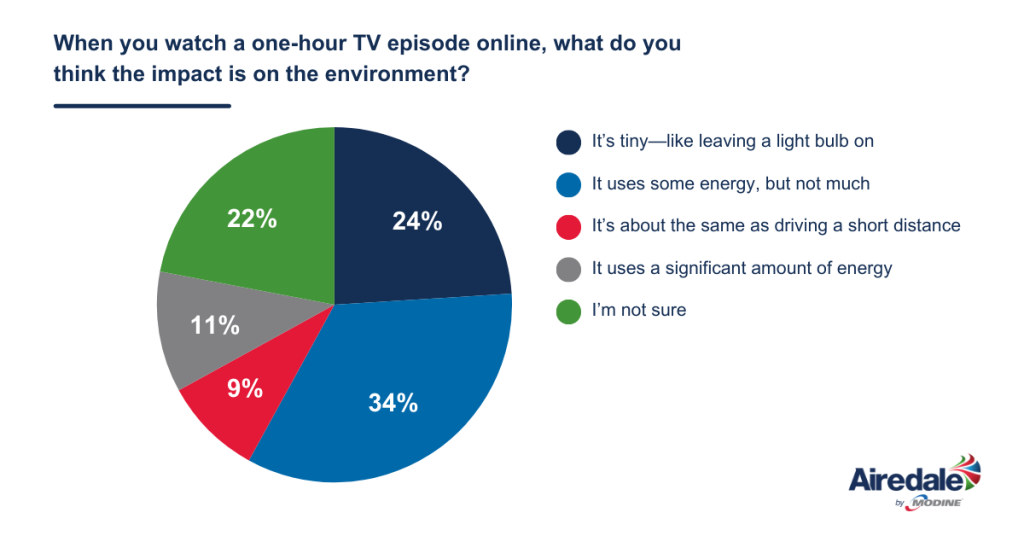
In reality, of streaming鈥檚 footprint have swung from exaggerated headlines to newer analyses showing a smaller but still measurable cost 鈥� roughly 36 g CO鈧� per hour, according to the IEA. That uncertainty reinforces complacency. And across a year, internet use to about 229 kg CO鈧�, roughly the same as driving 500 miles in a typical vehicle.
The picture gets murkier with ; the computational demands required to sustain AI advancements double approximately every 100 days. For innovative AI companies to achieve a tenfold increase in AI model efficiency, they鈥檒l need up to 10,000 times the processing power of current models. The scale is hard to grasp, which makes it even easier to ignore.
Why Willpower Fails and Design Wins
67% say they would close or use less if shown a clear red carbon warning, and 59% say light friction鈥攕uch as pop-ups, slower loads or price nudges鈥攚ould curb bingeing. By contrast, manual trade-offs are uncommon: 56% say they have never lowered streaming quality to save energy.
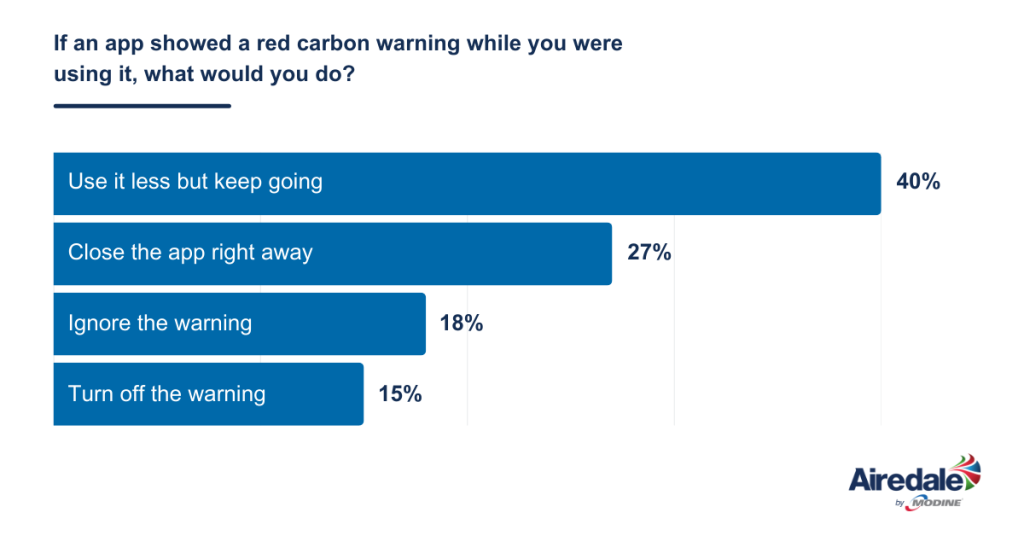
The implication is clear: Design nudges embedded in the user experience are far more effective than relying on people to remember their values in the moment. If platforms want users to make lower-impact choices, they need to make those choices visible, immediate, and easy.
Trust Is Fragile, and Broad Claims Don't Cut It
The survey also reveals growing skepticism toward sustainability messaging. In a landscape where the environmental cost of digital services is invisible and abstract, people have learned to discount vague promises.
35% doubt 鈥渃arbon-neutral鈥� claims. At the same time, 63% want companies to advertise how eco-friendly their data centers are, and 53% say they would use or feel more positive about an app if its infrastructure ran on cleaner power.
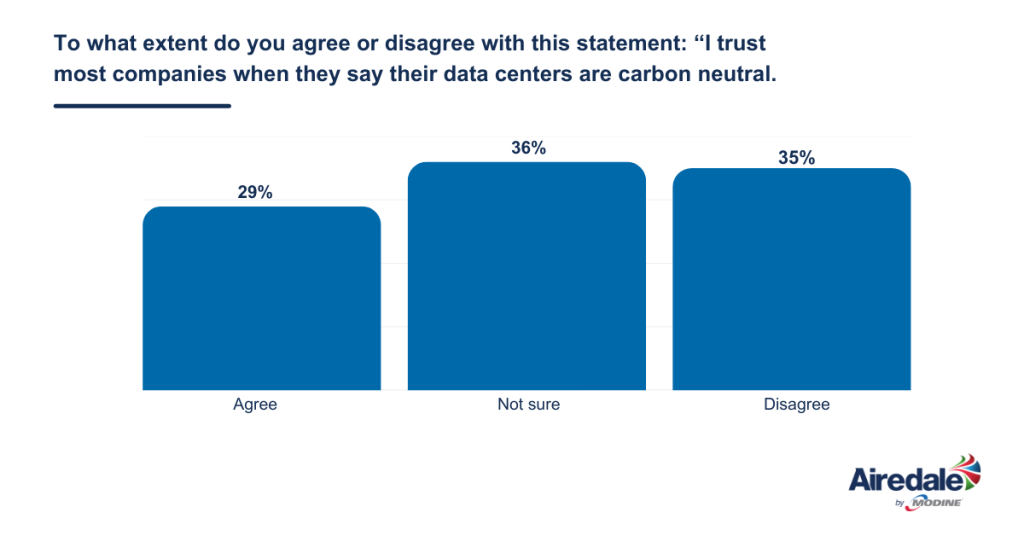
The pattern is clear: Statements about overall neutrality carry less weight than clear signals about the underlying technology, its sourcing, and operational choices that reduce impact.
Who's Responsible?
When asked who should lead efforts to reduce emissions from digital services, 68% of respondents pointed to tech companies or said "all equally"鈥攁 diffusion of responsibility that keeps individuals off the hook.
68% say tech companies鈥攐r 鈥渁ll equally鈥濃�攕hould lead emissions reductions. At the same time, social cues have little pull: 63% would brush off criticism or haven鈥檛 thought about it, and 75% report either never having considered avoiding content (50%) or not having felt that discomfort themselves (25%). Interest in what providers do upstream remains high, reflected elsewhere in calls for visible information about data center practices.
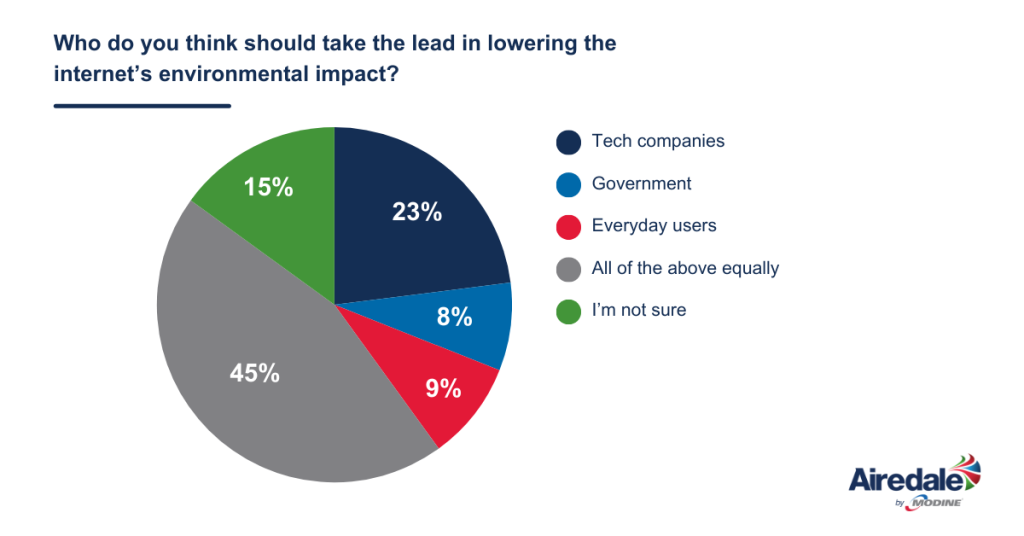
Taken together, the center of gravity for action sits with platforms and providers rather than one-to-one social dynamics. Guilt tends to be private, norms are scattered, and pressure among users is limited鈥攍eaving institutional choices more prevalent than interpersonal ones.
Data Centers Hold the Key
The survey paints a picture of a society caught between awareness and inertia. We know our digital habits have consequences. We feel bad about it. But the infrastructure is invisible, the trade-offs are unclear, and the friction required to change is just high enough to keep us scrolling.
The path forward isn鈥檛 about asking individuals to try harder. It鈥檚 about making infrastructure improvements both real and visible. For data center operators facing surging compute demand, climate-conscious cooling is a decisive lever: higher-efficiency air and , heat-reuse readiness, free-cooling strategies, low-GWP refrigerants and advanced controls can while protecting uptime and rack density. These gains help data centers meet rising load without compromising sustainability, and they create credible metrics that product teams can communicate simply.
Digital life isn't slowing down, and guilt alone won't change it. But infrastructure can. Providers that pursue efficiency investments, especially in cooling, will be positioned to handle growth sustainably. More importantly, they鈥檒l turn that nagging background guilt into something users can actually believe in: proof that the systems behind their screens are getting better, not worse.
was produced by and reviewed and distributed by 麻豆原创.