What grocery shopping was like the year you were born
What grocery shopping was like the year you were born
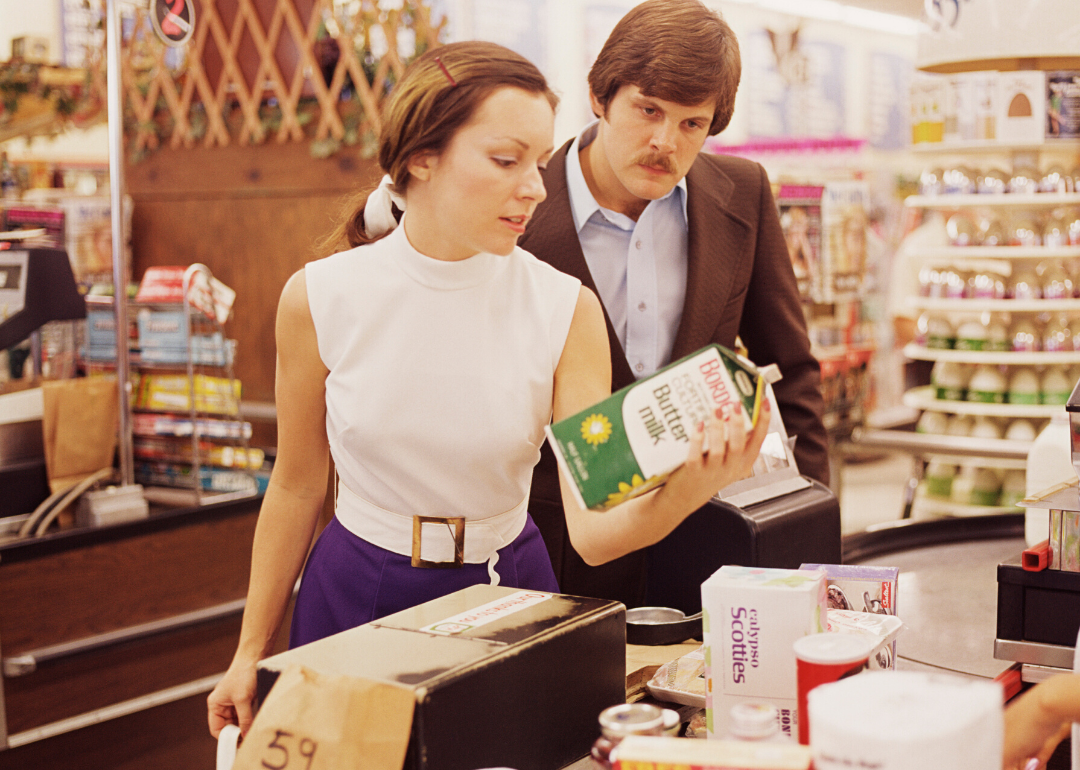
During the COVID-19 pandemic, many have gotten wary of what they're touching in high-traffic areas like the grocery store. It's now normal to spray down carts with disinfectant or use hand sanitizer before and after shopping. But 100 years ago, grocery stores weren't set up in a way that allowed customers to handle the products; they'd go into a small shop—likely one that specialized in a specific type of groceries such as produce or dry goods and give the clerk a shopping list. The staff would then gather the items, tally up the bill, and send them on their way.
Things changed when Clarence Saunders cut the ribbon on the on Sept. 11, 1916. Unlike the competition, this "modern supermarket" was built on self-service. Shoppers could pick up packages of food and take the time to read the label while shopping. They could choose the biggest, greenest bell pepper from the produce display, and (much to grocers' dismay) squeeze every last peach to find the perfect ones for their cobblers.
While self-service grocery shopping is now the norm, it was revolutionary for the time. Customers loved it, and Piggly Wiggly would go on to open at least 530 more supermarkets by 2020. More importantly, the self-service concept would pave the way for the big-box supermarkets we shop at today.
Grocery stores have undergone a lot of changes over the last century and often looked quite different from one decade to the next. To find out what grocery shopping was like every year since 1920, Â鶹ԭ´´ took a look at news articles, industry reports, government research, historical documents, and vintage photographs. The research shows how supermarkets progressed over the years, from and to stocking their freezers with and filling their produce displays with .
Wondering what grocery shopping was like the year you were born? Read on to see how supermarkets have changed every year from 1920 to 2020.
1920: Chain grocery stores take off
took off in the U.S. in the 1920s. These large businesses commanded economies of scale that allowed them to buy food in bulk, delivering lower prices and a wider selection of products to customers.
1921: Mechanical refrigerators keep food fresh at home
Manufacturers in the U.S. produced in 1921, according to History-Magazine.com, via The Packer. Throughout the decade, household refrigerators became an essential kitchen appliance, allowing families to store more food and changing how they approached grocery shopping.
1922: Progressive Grocer magazine hits newsstands
Progressive Grocer, a trade magazine focused on the retail food industry,. The publication would go on to provide information on best practices to independent grocers and supermarkets, as well as chronicle the history of supermarkets.
1923: Coca-Cola introduces six-bottle cartons
Soda was gaining in popularity in the 1920s. In 1923, Coca-Cola introduced, making it easier for American shoppers to pick up a few days’ worth of soda on a grocery run.
1924: Drive-in market opens in California
In 1924, C.L. Peckham opened, Ye Market Place, on the side of a commuter highway in Glendale, California, in an effort to serve daily commuters, according to Ryan Reft of KCET. The U-shaped complex of 23 stores flanked a 15,000-square-foot parking lot, allowing customers to make purchases at each store and stash their shopping bags in their cars.
1925: Terminal markets gain popularity
Amid increasing urbanization in the 1920s, new terminal markets in major cities allowed fruit and vegetable, rather than direct to consumer. Chicago’s South Water Market opened in 1925, and within 30 years it would start moving at least 500 billion pounds of produce every year, according to Janice M. Kresin of The Packer.
1926: Safeway Inc. is founded
stores with more than 300 Safeway stores in 1926. The merger would allow the retail entrepreneur to form Safeway Inc. that year, which would eventually become one of the largest grocers in the country.
1927: Clarence Birdseye perfects fast-freezing foods
Inventor Clarence Birdseye perfected a technique for and maintaining freshness in 1927, according to Tevere Macfadyen of American Heritage. preserved by the flash-freezing method would hit the shelves of 18 stores three years later, notes Mary Bellis of Thought Co.
1928: Safeway introduces by-the-pound pricing
Customers could, rather than the piece, at Safeway starting in 1928. The move would provide more equitable pricing of the same products, despite variations in size and weight.
1929: Entrepreneurs sell groceries from their homes
Desperate to make ends meet during the Great Depression, "survivalist entrepreneurs" stocked up on nonperishable foods and or vacant storefronts in urban areas, according to Robert Boyd, a Mississippi State University sociology professor. They knew that they could feed their families with anything that didn't sell.
1930: America’s first supermarket opens in Queens
America got its first supermarket when opened on Jamaica Avenue in Queens, New York, in 1930. It met five key criteria that defined it as a modern supermarket: “Separate departments; self-service; discount pricing; chain marketing; and volume dealing,” per The Smithsonian Institute.
1931: Gas station convenience stores challenge supermarkets
In the 1930s, small ice manufacturers that had already started selling some foods began co-locating their establishments at gas stations to encourage impulse grocery purchases. The new convenience stores would, according to Wessels Living History Farm.
1932: King Kullen expands
The low prices at King Kullen helped the first supermarket gain immense popularity among customers, giving it the opportunity to expand rapidly. By 1932, the company had eight locations and a, according to The Packer.
1933: Grocery pioneer predicts supermarkets’ domination of the industry
In 1933, entrepreneur Roy Dawson predicted that supermarkets would soon do most of the nation’s grocery business. He touted as cheaper, better for car owners, and appealing to people who were taking a growing interest in shopping, according to Macfadyen.
1934: Campell's introduces chicken noodle soup
Campell's debuted its canned chicken noodle soup in 1934, creating an instant grocery store classic. The product would help the company become according to Micah Maidenberg of the Wall Street Journal.
1935: Groceries eat up 25% of household budgets
Around a quarter of the average American family’s budget, according to Supermarket Business. Increasing efficiencies at farms and grocery stores reduced the cost of food in subsequent decades, and by 2018, Americans spent less than.
1936: Sawall Health Foods is born
In effort to offer an alternative to the ultra-processed foods lining supermarket shelves,, a healthy grocery store, in Detroit in 1936. The store, which has since moved to Kalamazoo, is now considered the country’s
1937: Self-checkout is born
Clarence Saunders launched the first in 1937. The store, called Keedoozle, allowed customers to push a device into product displays, which would punch coded data into an attached roll of ticker tape. Clerks would then tally the purchases and send the tape to the backroom, where workers would pack up the order and send the bags to the shoppers on a conveyor belt, according to Laura Bliss of CityLab.
1938: Food trucks get portable air-conditioning
Inventor Frederick Jones created a design for portable air-cooling for trucks in 1938. It would help around the country all year long.
1939: Government creates food stamp program
The federal government made it easier for low-income families to buy groceries when it introduced the in 1939. The initiative would also help reduce product surpluses at grocery stores.
1940: Shopping carts influence grocery store design
Shopping carts picked up in popularity after they were first dreamed up by supermarket entrepreneur Sylvan Goldman in 1936. Just four years later, the interiors of to better accommodate them. Aisles were widened and the size of check-out counters was increased to hold the growing volume of products people were purchasing, according to Rob Lammle of Mental Floss.
1941: Shaw’s converts into self-service store
Shaw’s Supermarkets advanced the grocery industry by converting to a. Customers could hand-pick the products they wanted to buy, rather than asking a clerk for assistance.
1942: Government sets price limits to discourage hoarding
The Office of Price Administration gained the authority to put limits on the price of commodities and ration food through the. The act would be used to discourage hoarding and make sure that food and other scarce resources would be equitably distributed during World War II.
1943: World War II rationing creates lines at supermarkets
During World War II, families had to obtain ration books and stamps to exchange for common foods like sugar and meat. Grocery stores saw a on days when they got deliveries of good meat in 1943, according to Steve Cichon of Buffalo Stories.
1944: Supermarkets experiment with produce packaging
In 1944, supermarket chain A&P decided to try packaging fresh fruits and vegetables in a refrigerated environment, wrapping the produce in transparent film, machine-labeling the products, and storing them in chilled warehouses. The with customers and helped grocery stores cut food waste, according to Janice M. Kresin of The Packer.
1945: Publix becomes a chain
Publix Super Market founder George W. Jenkins turned his business into a chain when he from the Lakeland Grocery Company in 1945. He would convert these smaller grocery stores into big supermarkets with high standards of cleanliness and quality merchandise.
1946: Strawberries become a grocery-store staple
Harold Thomas and Earl Goldsmith of Driscoll Strawberry Associates crossed two university varieties of strawberries in 1946. Z5A, the new cultivar which would become commercially available in 1958, could hold up to shipping and continue to fruit in early fall, helping the, according to Dana Goodyear of the New Yorker.
1947: Vacuum-packaged food becomes available
American shoppers no longer had to go to the butcher to get bacon in the late 1940s. Bacon was the to become available at supermarkets in 1947.
1948: Grocery stores offer self-service meat and produce
An ambitious new Vons supermarket in Los Angeles became home to some of the country’s, deli, and produce departments in 1948. The advancement was spurred by the wider availability of pre-packaged perishables at the time.
1949: Modern shopping cart gets patented
The patent for the use in most grocery stores today was granted to inventor Orla E. Watson in 1949. The carts had hinged baskets that could telescope out and were designed to nest inside one another for compact storage.
1950: Supermarkets enhance stock with thousands of products
Supermarkets started spoiling customers for choice in the 1950s, when they offered an according to Tevere Macfadyen of American Heritage. The stock was six times larger than what was on offer when the first supermarkets opened two decades earlier.
1951: Albertsons opens large supermarket with drugstore
The Albertsons grocery store chain opened its in 1951. The property was 60,000 square feet and included groceries and an in-house drugstore.
1952: Barcode technology receives patent
In an effort to speed up check-out at grocery stores, inventor N. Joseph Woodland came up with a technology that could code prices and other information within a series of black bars. He received a patent for the design in 1952, but since there was no scanner that could read it, the sat unused for more than 20 years, according to IBM.
1953: Inventors create material for plastic grocery bags
The plastics industry figured out how to—the material used in many grocery store bags—in 1953, according to Sarah Laskow of The Atlantic. A little more than three decades later, plastic bags became an option for customers at 75% of supermarkets in the U.S.
1954: TV dinners explode in popularity
In 1954, just one year after Swanson & Sons introduced its first TV dinner, Americans would purchase more than 10 million of the ready-made meals. The product was an effort to offer customers an alternative to home-cooked meals.
1955: European-style cookies hit grocery store shelves
Pepperidge Farm released its collection of. Their presence on grocery store shelves made it more convenient for American shoppers to keep their pantries stocked with baked goods without making a separate trip to a bakery.
1956: Supermarkets get bigger
In the mid-20th century, supermarkets were well on their way to becoming the big-box stores shoppers would see in the 1990s and 2000s. By 1956, the average supermarket clocked in at, according to Laura Byrne Paquet, author of “The Urge to Splurge.”
1957: Grocery stores remain open on Sundays
Sunday had traditionally remained a day for religious observation and at-home activities in the U.S., but that changed in the mid-1950s. Around 1957, grocery stores started to, according to Tom Reidy, author of “Certifiably Insane.” Blue Laws in certain states still restricted what grocers could sell on Sundays, though, and often banned the sale of alcohol that day.
1958: Kroger enhances a Detroit supermarket
Kroger put a new spin on grocery stores at its Detroit supermarket, in 1958. In addition to buying everything on their grocery list, customers could also shop at the service deli, treat themselves to sweets from the in-store bakery, and get smoked meats from the on-premises barbecue shop, according to Supermarket News.
1959: Alaska gets first major food store
In the same year it became a state, Alaska saw the opening of its, Safeway, in 1959. Over the next few years, Safeway would open three locations in Anchorage and a single store in Fairbanks, giving Alaskans greater access to groceries.
1960: Little Debbie becomes instant hit at stores
O.D. McKee, founder of McKee Foods, produced and sold it in stores for 49 cents per carton. The brand was an instant hit with grocery shoppers, who snapped up more than 14 million cakes within the first 10 months. Little Debbie products are now sold in all 50 states and “represent a third of the snack cake market.”
1961: First National Supermarkets acquires 164 Safeway stores
First National Supermarkets acquired Safeway’s New York division in 1961. The would be the supermarket industry’s largest single acquisition ever up to that point, according to Supermarket News.
1962: ‘The Silent Spring’ causes concern about pesticides
Author and environmentalist Rachel Carson published “The Silent Spring” in 1962, bringing awareness of the potential dangers of pesticides to the American public. People called on the government, farmers, and supermarkets to end the use of.
1963: Instant coffee becomes available at supermarkets
Kraft brought Maxwell House instant coffee to supermarkets in 1963. The product sparked a new trend in the coffee industry, and all major manufacturers created their own version just a few years later, according to Kenneth Moore of Chemical & Engineering News.
1964: Food Stamp Program becomes permanent
President Lyndon B. Johnson signed the Food Stamp Program into law on Aug. 31, 1964 after a two-year pilot program proved successful. It would make and improve nutrition levels.
1965: Unseasonable weather leads to higher prices on groceries
Production of fruits and veggies took a nosedive after a spout of unseasonable weather during the 1965 growing season. The reduced supply contributed to a at supermarkets, which drew the wrath of housewives in 1966.
1966: Discount supermarkets are born
After running a Randalls Super Valu Store, Robert Onstead teamed up with Norman Frewin and R.C. Barclay to develop in 1966. It would have innovations like hot delis, special promotions splashed across large front windows, in-store bakeries, and electronic check cashing. The concept, called Randalls, would go on to become one of the biggest food and drug retailers in the nation.
1967: First Trader Joe’s opens in California
Entrepreneur Joe Coulombe in Pasadena, California, in 1967. The grocery store allowed customers to shop for staples and novel foods and wines at affordable prices. The company would go on to open more than 500 stores across the country by 2020.
1968: Grocery store trading stamps fuel loyalty
Trading stamps, a loyalty program offered by grocery stores that allowed customers to earn stamps for every dollar spent and redeem them for products,, according to Steve Markenson of the Food Marketing Institute. In 1968, the value of trading stamps in the U.S., making it the peak of the trading stamp boom, according to the Democrat & Chronicle.
1969: Americans reduce consumption of fresh vegetables
Fresh produce fell out of fashion during the rise of frozen fruits and vegetables in the mid-20th century. In 1969, per-capita fresh vegetable consumption fell to just nine years earlier, according to The Packer.
1970: Supermarkets put expiration dates on food
After noticing increased customer concern about food freshness, supermarkets began on food in the 1970s. Throughout the decade and the years following, many states would make food dating mandatory.
1971: Grocery stores reduce real estate for produce
With more frozen and processed foods available for purchase, grocery stores reduced the amount of space they devoted to produce. Fresh fruits and veggies comprised just in smaller retail stores in the 1970s, according to The Packer.
1972: Supermarkets introduce 24-hour service
Late-night grocery runs became more feasible in the early 1970s, when a handful of stores started to remain open 24 hours a day. became available at 4% of supermarkets that had revenues of at least $500,000 per year by 1972, according to Jeff Wells of Grocery Dive.
1973: FDA standardizes nutrition labels
In 1973, the Food and Drug Administration brought after getting pressured by consumer groups. The new labels would include calorie counts and information on protein, carbs, and fat.
1974: Marsh’s scans barcode for the first time
Marsh’s grocery store in Troy, Ohio, conducted the at its checkout counter on June 26, 1974, according to IBM. It was on a pack of Wrigley’s Juicy Fruit gum, which is now displayed at the National Museum of American History in D.C. Barcode scanners would go on to speed checkout times by 40%.
1975: Supermarkets lead to decline of home milk delivery
Getting a from the local milkman was the norm for many American households in the 1950s and ‘60s, according to Eve Tahmincioglu of The New York Times. But after supermarkets made the purchase of milk easier and cheaper, home milk delivery started to decline. It comprised less than 7% of total milk sales by 1975, according to the Department of Agriculture.
1976: First membership-based superstore opens
An airplane hanger in San Diego was converted into a membership-based warehouse club called Price Club in 1976. While it only served businesses at first, it soon opened membership to customers in the general public who wanted to pay wholesale prices for groceries. Price Club would go on to merge with Costco in 1993.
1977: Low-fat foods flood grocery stores
“The Dietary Goals for the United States” was first published in 1977. It recommended that Americans switch to a low-fat diet. Grocery stores responded by stocking their shelves with processed foods containing fat-replacers that may have contributed to, according to a 2016 report by Julia Reedy, a researcher at the University of Connecticut.
1978: Generic private-label products enter grocery stores
Supermarkets started offering in 1978, according to Frozen Food Age and Supermarket News. One of the earliest manufacturers of these goods, Star Market, kick-started the trend with generic frozen french fries.
1979: Flowers hit grocery stores
In 1970, holidays like Mother’s Day and Easter were the only times of the year that customers could find fresh flowers at their local grocery store—if the store offered them at all. That changed in the coming years, and by the end of the decade, all year round, according to The Packer.
1980: Whole Foods launches first store
On Sept. 20, 1980, health food stores SaferWay and Clarksville Natural Grocery merged into a new store in Austin, Texas, called. The company would go on to acquire several other natural food stores around the country over the subsequent decades.
1981: Lean Cuisine creates a frenzy
In 1981, Nestle released as a healthier alternative to Stouffer’s frozen meals. It tripled sales projections in the first year after its launch, and Nestle was forced to ration Lean Cuisine meals to supermarkets because demand was so high, according to Suzanne Raga of Mental Floss.
1982: Would you like paper or plastic?
Supermarket chains Safeway and Kroger began offering customers starting in 1982, according to the UN Environment Programme. They would become widely used in retail stores soon after. Less than 30 years later, the world would consume a million plastic bags every minute.
1983: Shopping carts get seatbelts
The Safe-Strap Company debuted the first in 1983. The idea for the product came after the company’s founder, Paul Giampavolo, from nearly falling from a shopping cart seat.
1984: Supermarkets bolster their produce selection
Customers began to see more diversity in the produce department of grocery stores in the mid-1980s. In 1984, supermarkets stocked an average of—more than double what they carried in 1980, according to The Packer.
1985: Supermarkets bump up beauty product sales
Health and beauty products were becoming big business at grocery stores in the mid-1980s. In 1985, supermarkets were responsible for, according to Supermarket Business.
1986: Baby carrots are born
Frustrated by grocery stores’ unwillingness to stock less-than-perfect carrots, produce farmer Mike Yurosek used a potato peeler to round irregular carrots into smooth in 1986, according to Rosie Cima of Priceonomics. The snack-size carrots were a hit with customers, as well as with supermarkets, who could sell them at a 100% mark-up.
1987: Safeway goes private to avoid a hostile takeover
Amid a series of mergers and leveraged buyouts in the grocery industry, supermarket giant to prevent a hostile takeover, according to Groceteria. The move would cost Safeway about half its geographical reach, reducing customers’ access to the brand.
1988: Walmart launches first supercenter store
After initially offering general merchandise in smaller stores, Walmart cut the ribbon on in 1988. It would be Walmart’s first foray into groceries, and with the expanded real estate, customers could shop for general goods, food, and pharmacy products under one roof.
1989: Online grocery delivery service becomes available
Brothers Andrew and Thomas Parkinson founded Peapod, an, in 1989. To place an order, customers needed to use software from CD-ROMs installed on their computers. The company would then prepare the order at Jewel and deliver the groceries to the customer’s door, according to Jim Dallke of Chicago Inno.
1990: Produce self-checkout is patented
Inventor David R. Humble received a patent for an invention for for produce in 1990. It formalized the Humble’s company, CheckRobot, had been developing since 1984, according to Kaitlyn Tiffany of Vox.
1991: Kmart becomes a grocery store
The grocery business got more competitive in 1991, when Kmart cut the ribbon on its first. The full-service store, which was open 24/7, included Kmart’s general merchandise selection, along with groceries and fresh foods, according to The New York Times.
1992: First ozone-friendly grocery store opens
Amid growing concerns about pollution, Hannaford Brothers Company opened the first “ozone-friendly” supermarket in the U.S. in 1992. The store used a, which, unlike other conventional refrigerants, did not destroy ozone in the stratosphere, according to Matthew L. Wald of The New York Times.
1993: FDA establishes serving sizes
The Food and Drug Administration that would be listed on the nutrition facts labels of foods in 1993, based on data collected from the Nationwide Food Consumption Surveys of the late 1970s and 1980s. The information would help grocery shoppers understand what’s in a.
1994: FDA approves genetically modified tomato
After getting the FDA’s for commercial sale in 1994, manufacturer Calgene brought the to market. The tomato was engineered to be more resistant to shipping and to stay ripe for weeks, allowing grocery stores to keep them on the shelves longer, according to E. Vinje of Planet Natural Research Center.
1995: Credit cards become widely accepted at grocery stores
While, they didn’t become widely used in grocery stores until the mid-1990s. began accepting credit cards in 1995, according to Dee Segel of the Hartford Courant.
1996: Supermarkets expand their services
Supermarkets historically focused their offerings on fresh produce, preserved foods, flowers, and household supplies. That when grocery stores began offering in-store cafes, cooking classes, childcare facilities, and even massage therapy, according to Louise Kiernan of the Chicago Tribune. It was part of an industry-wide effort to make grocery stores more appealing to customers.
1997: Online grocery service expands
The dot-com bubble of the late 1990s gave customers more options for ordering groceries online. By 1997, there were more than to choose from, according to Keith Ervin of the Seattle Times. Despite consumer excitement for their business model, none of the experimental start-ups were profitable at the time.
1998: FDA approves meat irradiation
The Food and Drug Administration in 1998. The process, which, would help increase the safety of the meat supply at grocery stores.
1999: Kroger merges with Fred Meyer
Supermarket chain Kroger had its biggest merger in history when it bought Fred Meyer, Inc. for $13 billion in 1999. The deal allowed the company to “generate huge economies of scale in purchase, manufacturing, information systems, and logistics,” according to the company website. It would also allow Kroger to overtake its competitor, Albertsons, as the in the U.S., according to Dana Canedy of The New York Times.
2000: Grocers form electronic buying alliances
In effort to compete against Walmart, formed an electronic buying alliance called the WorldWide Retail Exchange, according to Jenny McTaggart of Progressive Grocer. The helped simplify trading and allowed retailers to reduce their costs.
2001: Grocery cooperatives flourish
Some American shoppers took an increased interest in alternatives to big-box supermarkets for their groceries in the early 2000s. Revenues at the top member-owned and -controlled grocery stores known as cooperatives in 2001, according to a report from the National Cooperative Bank.
2002: Federal government regulates organic food
The Department of Agriculture implemented the to define organic food and introduced the USDA Organic seal in 2002, according to Supermarket News. By that time, organic food sales had skyrocketed to $8.6 billion and would eventually grow to a nearly $50 billion market in 2017.
2003: 70,000 grocery store workers go on strike
Faced with pay cuts and slashed benefits, around in southern California went on strike in October 2003, according to CNN. The strike impacted 850 locations of three grocery chains and would become according to James F. Peltz and Hailey Mensik of The San Diego Union-Tribune. Shoppers who dared to cross the picket line often found near-barren shelves.
2004: 'Dirty Dozen' list reveals groceries with pesticides
The Environmental Working Group released its first in 2004 to help concerned consumers avoid pesticides in their foods, according to Rachel Koning Beals of MarketWatch. The annual lists provide a grocery shopping guide to the 12 fruits and vegetables with the most pesticide residue and the 15 kinds of produce with the least.
2005: Smart tags increase efficiencies
Food retailers saw increased efficiencies in their warehouses and inventory management systems through the growth of RFID tags, sometimes referred to as smart tags. A Forrester report predicted that RFID tags would make their way onto, crates, and boxes by 2005.
2006: Nutrition facts label includes trans fat
The Nutrition Facts Panels added information on trans fat in 2006. Seven years later, the FDA issued a notice that it would no longer consider partially hydrogenated oils, which were the top contributor of trans fats in the average American diet, as safe. Trans fats are now recognized as for your health.
2007: Amazon enters the grocery industry
Amazon Prime subscribers in certain cities could order their groceries online after in 2007. By adding the service to Amazon, the tech giant would offer added value and convenience over other online grocery delivery services at the time.
2008: Food prices spike across the world
Changes in the economy, agriculture, and climate caused the world food price index to, according to the United Nations’ Food and Agriculture Organization. Customers would see the price of eggs increase by more than 30%, dairy 12%, and baked goods 9% when, according to John Yaukey of Gannett News Service.
2009: Industry consolidation limits customers’ choices
The late 1990s and early 2000s were a period of consolidation in the grocery industry. Nearly 100 mergers occurred every year between 1996 and 1999, according to Food & Water Watch. Walmart, Kroger, Costco, and SuperValu—the four top-performing food retailers—would be responsible for by 2009. The consolidations resulted in and reduced variety of shopping experiences for customers.
2010: Target debuts scannable smartphone coupons
In 2010, Target introduced—the first foray into digital coupon technology, according to Kevin Farrell of USA Today. It was a move that would allow customers to get discounts on groceries without spending hours clipping coupons from their local newspaper.
2011: Federal government maps food deserts
Decades of grocery store mergers left some Americans living in locations known as “food deserts” with little to no options for places to buy healthy food in the 2000s. The Economic Research Service of the USDA created a in 2011. The map would help government efforts to eliminate food deserts and ensure that all Americans could buy healthy, affordable foods.
2012: Instacart starts offering grocery delivery service
Instacart was founded by Apoorva Mehta in 2012, giving customers the ability to get groceries delivered to their door in just an hour. By 2015 the start-up was named “America’s Most Promising Company,” according to CrunchBase.
2013: Childhood obesity gains more awareness
The was the most important food topic of 2013, according to a Food News Study from that year. Customers began paying more attention to food labels and ingredient lists as they did their grocery shopping. They also cut out some processed foods from their diets.
2014: California proposes plastic bag ban at grocery stores
After the nonprofit group Californians Against Waste found near waterways in 2010, California lawmakers began brainstorming ways to reduce the amount of plastic in the environment, according to Isabelle Phillippe of ABC News. They introduced Proposition 67, which would ban plastic bags at grocery stores and other retail businesses, in 2014 and passed it two years later.
2015: Albertsons and Safeway merge
Mergers in the grocery industry continued in the second decade of the 21st century. On Jan. 30, 2015, into one company. The new company would operate 2,200 grocery stores across the country.
2016: Families can order groceries from their fridge
Samsung introduced the Family Hub Refrigerator in early 2016, piloting a new category of kitchen appliances. The fridge included an innovative Wi-Fi-powered screen that allowed families to with just a few taps.
2017: Amazon buys Whole Foods
In June 2017, Amazon agreed to for $13.4 billion. The deal would allow Amazon to further infiltrate the grocery market and offer online ordering and delivery through the upscale supermarket chain.
2018: Stores struggle to meet demand for local food
Local food became one of the hottest trends at grocery stores in the 2000s. The local food market, a nearly 2.5-fold increase from 2008, according to Packaged Facts. By 2018, grocery stores would be struggling to keep up with the still-growing demand (approaching $20 billion) for food grown close to home, according to AgFunderNews.
2019: Pop Up Grocer curates food shopping
The retail pop-up concept made its way to grocery shopping through the. It would bring a curated selection of groceries to focused on design to cities across the U.S.
2020: Online grocery sales surge during COVID-19 pandemic
had bought groceries online by 2020, according to the results of the Coresight Research U.S. Online Grocery Survey, which polled 1,152 people on March 17–18. The survey also predicted a 40% surge in online grocery sales for the year. Online grocery shopping had already been on the rise, but the lockdowns during the COVID-19 pandemic gave them an even bigger lift.