What life was like in New York City 100 years ago
What life was like in New York City 100 years ago
New York City is the in the United States, coming in at more than double the population of the second-largest city, Los Angeles. With this size comes an outsize influx of tourism and larger-than-life fame that compels people to visit New York from all over the world, either for a quick visit or to relocate. From Frank Sinatra to , countless songs have been written about the city, and from "Annie Hall" to "Breakfast at Tiffany's," dozens of famous movies have memorialized the Big Apple.
It comes as no surprise, then, that a city as rich in culture as New York City has changed significantly in the last century. From politics and sports to fashion and transportation, some elements of life are virtually unrecognizable from the way they were 100 years ago. Case in point: While policewomen in the New York City police force today dress in uniforms very similar to their male counterparts, their 1920s uniforms featured skirts and pillbox hats. And while the New York Yankees are today considered one of the most impressive teams in baseball, they had only recently moved to the city 100 years ago and had yet to win a World Series. Neighborhood demographics are drastically different, as is the layout鈥攎ost notably due to throughout the 20th century.
New York politics is no stranger today to scandals in its political life (just Google the names Eliot Spitzer or Anthony Weiner), but politics in the early 20th century was a decidedly more corrupt affair, with political machines like Tammany Hall still holding outsize sway in the city, to say nothing of mob families and bosses.
Using a combination of archival photographs and reports and news articles, curated a gallery of 30 ways in which life was very different in New York City 100 years ago than it is today. Click through for a look at just how much has changed in the city that never sleeps.
Policewomen wore skirts
Policewomen weren't as common 100 years ago as they are now, but those that walked the police beat had an . Policewomen wore , along with tiny .
Horses and cars shared the road
While cars had become a fixture in New York City by the 1920s, there were still horse and buggies on the street, as well. Sharing the road was decidedly different from the carriages you see today parked alongside cars near Central Park: In 1920, this meant that there was a lot of horse manure鈥攁nd even sometimes .
Harlem experienced a renaissance
The famous Harlem Renaissance was flowering in this northern Manhattan neighborhood around a century ago. many African American writers, activists, and artists concentrating in the neighborhood in a tremendously productive era.
Speakeasies replaced bars
Prohibition went into effect in 1920, driving legitimate New York City bars underground. After five years, there were estimated to be as throughout the city.
The Mafia ruled the city
The "Five Families"鈥擨talian mob crime houses鈥攃ontrolled much of the city's activity in the 1920s. The primary neighborhoods they were located in included the .
The Yankees came to town
The Yankees franchise moved to New York in 1903 as the Highlanders. In 1913, the team exclusively and moved into the Polo Grounds, which they shared with the New York Giants. Although the team is widely known as one of the best in baseball today, 100 years ago they had yet to win one World Series, which would happen for the first time in 1923.
Thanksgiving streets were quiet
Unlike today, the streets of New York were quiet on Thanksgiving Day. The famous Macy's parade, which today takes over huge swathes of the city, .
Fewer skyscrapers marked the skyline
Although some early skyscrapers dotted the city landscape, the true skyscraper boom had not happened yet a century ago and the New York City skyline was notably shorter than it is today. The most famous buildings today, including the Chrysler Building, wouldn't be .
Passenger liners left for California
Today, transcontinental flights are common. But 100 years ago, travelers to California took to the seas instead of the air, going .
Immigrants arrived at Ellis Island
One of the peak immigration periods at Ellis Island took place , with 5,000 to 10,000 people passing through each day. During World War I, suspected enemies and . The receiving center was reopened for normal inspections in 1920; that year, 225,206 immigrants came through. Today, Ellis Island survives as a museum.
Tenements built on the Lower East Side
The Lower East Side is home to luxury condos today, but 100 years ago the near-opposite was true. Millions鈥攎ainly immigrants鈥攍ived in slums called tenements, which often .
The first tabloids rolled off the press
Tabloids are common all over America today, but in 1919, the first tabloid was coming out of New York City. The covered the scandals of politicians, celebrities, and socialites alike.
The Charleston swept the stage
The famous dance the Charleston was sweeping New York a century ago. The exuberant dance move was shown on , before making its way to Broadway and beyond.
Georgia O'Keefe made New York home
Although she is commonly associated with New Mexico, Georgia O'Keefe actually lived in New York 100 years ago. Fittingly, a would come to dominate both her attire and her work from the time.
Organ grinders plied the streets
New York City 鈥攚ho raised money cranking a small hand organ on the street鈥攚ere fixtures a century ago. Roughly 5% of Italian men living in the Five Points section of Manhattan were organ grinders in 1880, and often had live monkeys tethered to them to draw crowds. Organ grinders were outlawed in 1936 by Mayor Fiorello La Guardia.
Few traffic lights existed
New York City is covered in traffic lights today, but this wasn't always the case. The . Their intent was to replace police officers at every corner telling motorists when they could and could not go.
Nathan's Hot Dogs were new
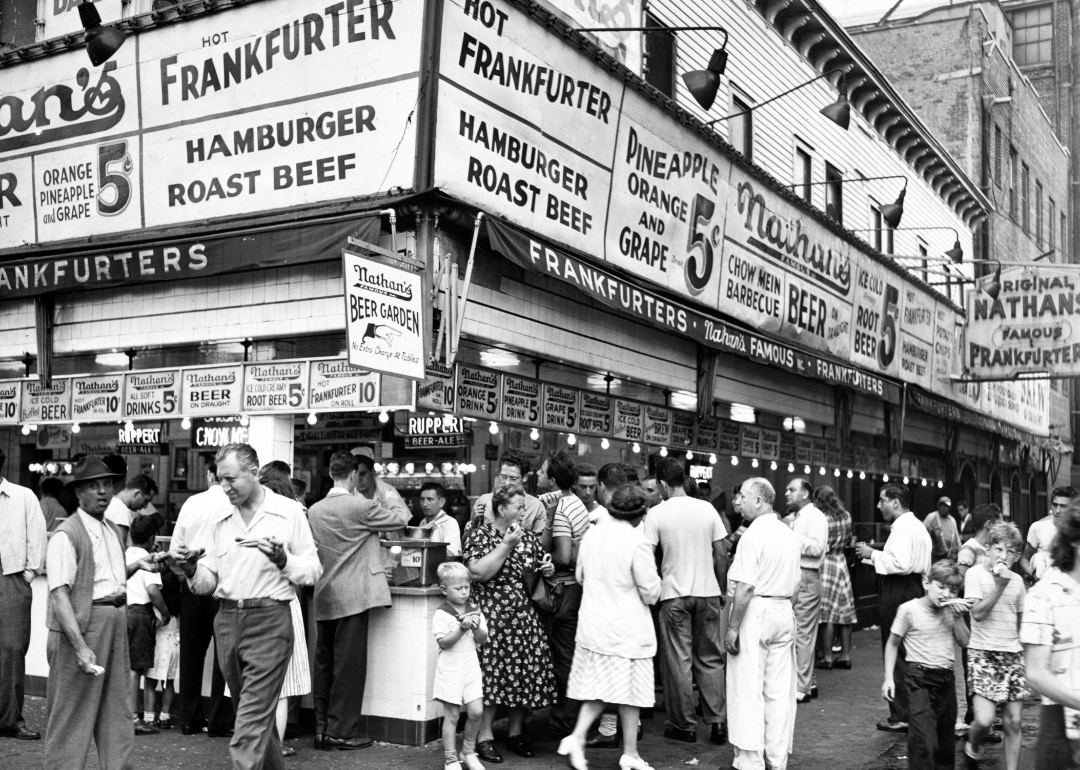
Nathan's Hot Dogs may be ubiquitous and famous now, but 100 years ago, the brand was just starting out. The founder opened on Coney Island in 1916.
The 'Sleepy Sickness' takes the city
On the heels of the devastating influenza pandemic of 1918 came a new, if less deadly, ailment that killed millions around the world. The so-called "Sleepy Sickness"鈥攕cientific name Encephalitis lethargica, meaning "inflammation of the brain that makes you tired," hit young women particularly hard and manifested as .
Legs鈥攁nd everything else鈥攚ere for sale
Although there are certainly no shortage of questionable goods on the New York marketplace today, one item from around a century years ago takes the cake. One man who had lost his leg in an accident put out an ad for a replacement leg and was . Other seemingly odd items for sale at the time? An (actually maps folded into a watch), "" items being mass produced for the first time like radios and cars, and .
Ragamuffin Day debuted
New Yorkers put their own spin on Halloween, and on Thanksgiving, nonetheless. City children and asked strangers for candy.
Penn Station was beautiful
Today's Penn Station leaves much to be desired aesthetically. But this was not the case 100 years ago, when the original station鈥攄emolished beginning in 1963鈥攚as made of pink marble in a .
No neon in Times Square
Today's travelers to Times Square know that the area is alit with neon and billboards. But 100 years ago, the technology didn't exist to keep Times Square lit the same way all night, so it was a affair than it is today.
A very different Greenwich Village
Today, it is home to some of the priciest real estate in the city. But a century years ago, was home to many , some of whose shopfronts still exist today among the multimillion dollar townhomes and condos.
Tammany Hall in power
The corrupt New York City political machine was still in power 100 years ago. Although its influence had waned from its height several decades before, it wasn't until Mayor Fiorello LaGuardia's term began in 1934 that the organization really lost the majority of its power.
Indoor sanitation still not a given
Although a city law enacted in 1910 theoretically said that new construction had to have indoor bathrooms, in 1937, it was found that well over 100,000 New York families still did not have .
Wall Street bombed
In 1920, a wagon parked outside of a Wall Street building in the exploded. Anarchists were blamed for the more than 30 resulting deaths, but the anyone specific to arrest for the crime.
Brooklyn caught up to Manhattan
For the first time, Brooklyn began catching up to Manhattan in a significant metric. The census in 1920 showed an increase in population that continued trending: By 1930, .
A champagne porch at the Plaza
The Plaza Hotel is commonly associated with the Jazz Age writer F. Scott Fitzgerald. And it's no wonder: His characters would have felt right at home drinking champagne on the "champagne porch" , which is featured in Fitzgerald's most famous novel, "The Great Gatsby."
No New Yorker
in 1920 was five years away from being published. New Yorker's founder, Harold Ross, first published the iconic weekly in 1925.
A high period for Broadway
Today, Broadway鈥攁 beloved tourist institution and destination鈥攈as been shuttered due to the coronavirus pandemic and will remain that way . Back in 1920, the future was looking bright for all things Broadway. With films (centered around plot) gaining popularity, some of the biggest Broadway acts of the day were music revues featuring big-name actors performing song and dance. Theater hit a snag by 1927鈥攚hen film met sound and talkies became all the rage鈥攂ut managed to rebound with its own identity decidedly separate from motion pictures.